Window Tint Meter: How It Reads VLT, 6 Meters Compared
Senior Automotive Glass Diagnostic Specialist & Master Technician at CarGlassFix · AGSC Master Certified Auto Glass Technician, NGA Certified Installer, I-CAR Automotive Safety Specialist · 12+ Years in Automotive Glazing, Windshield Structural Bonding, ADAS Camera Calibration & Precision Chip Restoration
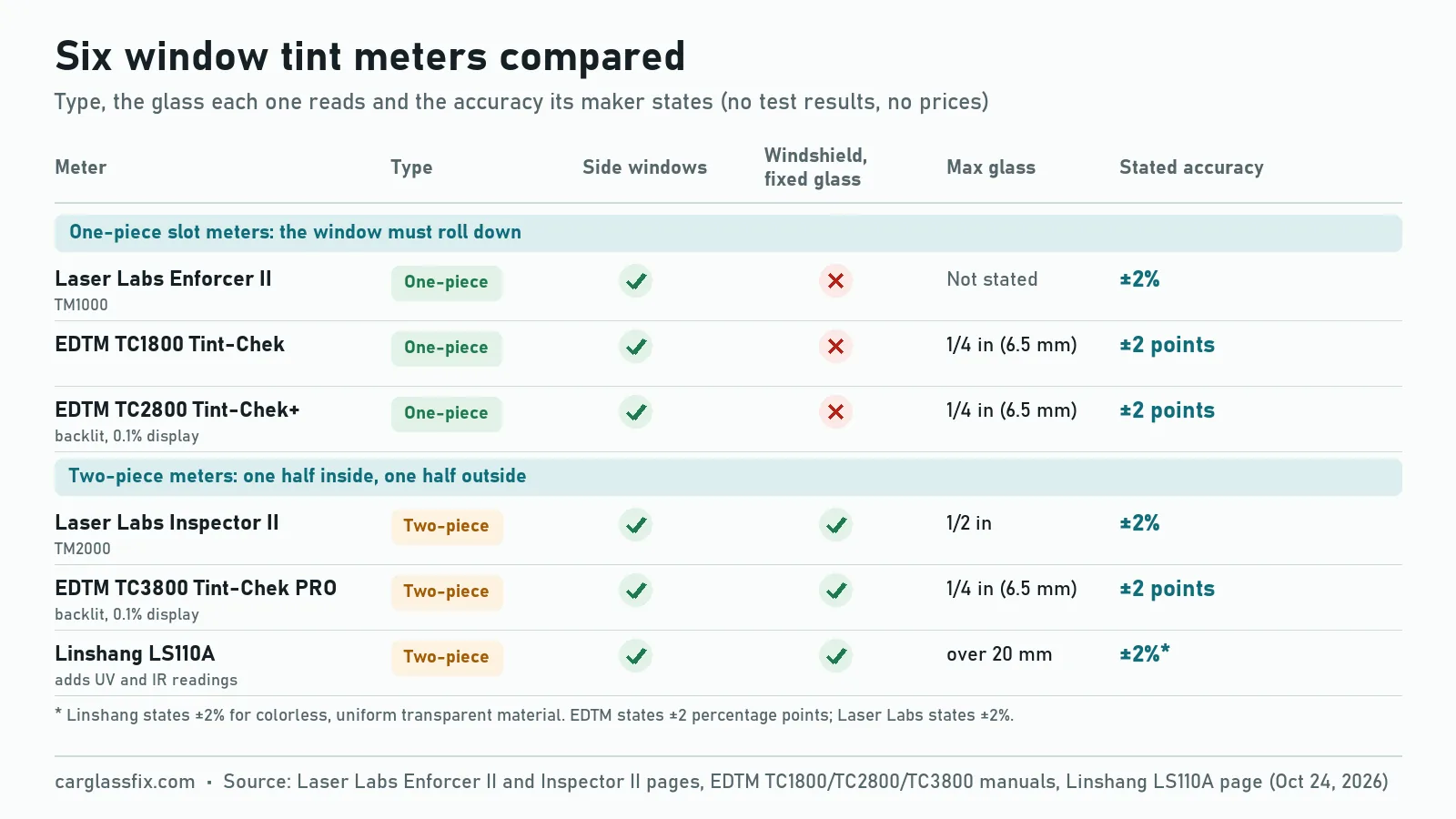
A window tint meter shines light through the glass and any film on it and shows the percentage that reaches its sensor, the visible light transmission (VLT). Laser Labs and EDTM state accuracy of plus or minus 2 percentage points. A one-piece slot meter suits most drivers checking roll-down side windows. Windshields and fixed glass need a two-piece meter.
As an Amazon Associate, CarGlassFix earns from qualifying purchases. The picks below come from the makers’ published specifications, not from our own testing.
How a window tint meter measures VLT
A window tint meter measures visible light transmission, the share of visible light that passes through a window. It has a light source on one side of the glass and a sensor on the other. Laser Labs and EDTM meters calibrate themselves at start-up, so the display reads 100% with nothing in the way. With glass in place, the meter shows how much of that light still arrives. Laser Labs defines the ends of the scale: 0% is an opaque material such as cardboard, and 100% is pure air. What each percentage looks like is shown in the window tint percentage chart.
Laser Labs and EDTM both use an LED at 550 nanometers. Linshang’s LS110A reads the whole 380 to 760 nm band instead, weighted to the CIE photopic curve for daylight vision.
The reading covers everything between the light and the sensor, including the factory tint in the glass and any film on it. The International Window Film Association (IWFA) says most state laws therefore set a “net” VLT, because installed film is almost impossible to measure on its own.
One-piece vs two-piece tint meters
A one-piece meter has a slot that slides over the top edge of a lowered window, while a two-piece meter holds the glass between two separate halves.
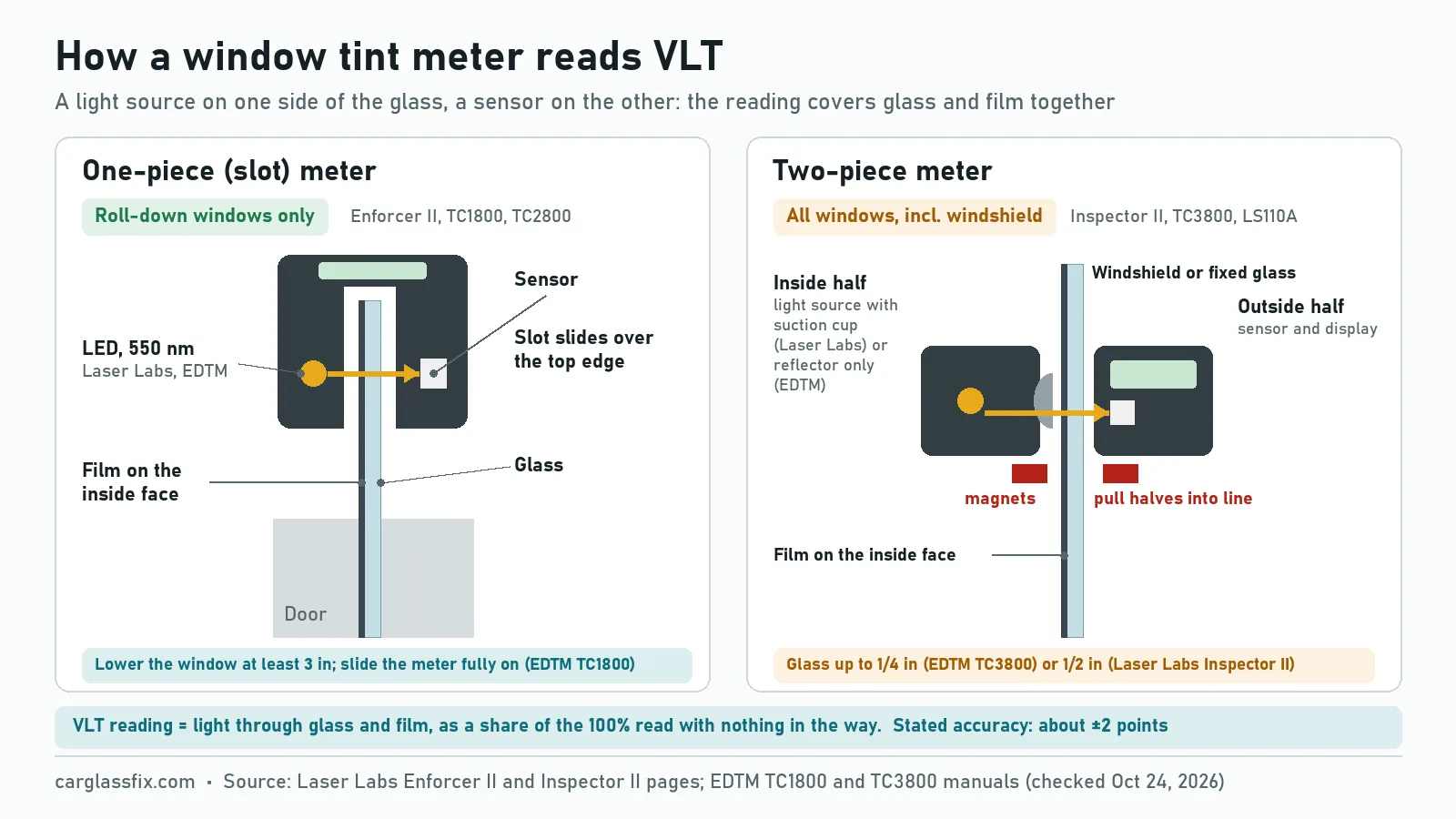
The one-piece design works with one hand. The limit is the slot. EDTM’s TC1800 manual says to roll the window down at least 3 inches and to slide the meter fully onto the glass, so the edge of the film does not sit over the sensor.
A two-piece meter puts one half inside the car and one outside, and magnets pull them into line through the glass. The Laser Labs Inspector II holds its light source on the inside with a suction cup. The inside half of the EDTM TC3800 has no electronics, only a reflector and magnets. Because nothing has to roll down, a two-piece meter can read a windshield, a rear window or fixed quarter glass, including the strip above the AS-1 line on a windshield. Laser Labs does not recommend its two-piece meter for police officers, because one half has to go inside the vehicle.
How we chose and the specifications that matter
We chose meters only from makers that publish a manual or a specification sheet, and only models for sale on Amazon US on October 24, 2026. We did not test or handle any meter.
Stated accuracy. Laser Labs, EDTM and Linshang all state plus or minus 2 percentage points. Linshang limits its figure to colorless, uniform materials. EDTM adds a repeatability of 1 point.
Display resolution. Resolution is how finely the screen shows a number. It says nothing about accuracy. EDTM’s TC2800 and TC3800 show 0.1% so that 39.5% is not rounded to 40%. Laser Labs removed tenths from its meters and calls them “junk science” on a 2-point meter.
Reference samples. Laser Labs and EDTM ship two NIST-traceable samples with each meter. A meter in good order reads each sample within 2 points of its label.
Glass limits. EDTM meters take glass up to 1/4 inch (6.5 mm), and the Laser Labs Inspector II up to 1/2 inch. Laser Labs rates its meters for 0 to 100°F, and EDTM for 0 to 122°F.
One-piece tint meters for roll-down windows
A one-piece meter is the simpler choice when every window you want to check rolls down.
Laser Labs Enforcer II (TM1000)
The Enforcer II is a pocket slot meter that Laser Labs designed for police. It has no buttons: it reads when slid over the glass and shuts off when lifted. Laser Labs states plus or minus 2% and a CR2032 battery good for 5,000 uses. It cannot read a windshield. It suits anyone who checks side windows often. Check Laser Labs Enforcer II on Amazon
EDTM TC1800 Tint-Chek
The TC1800 has no lever switch, so glass can enter the slot from any direction. EDTM states plus or minus 2 percentage points and 1% resolution. It runs on a 9-volt battery and switches off after about 2 minutes. It does not read windshields. It suits a driver checking film after a shop visit. Check EDTM TC1800 Tint-Chek on Amazon
EDTM TC2800 Tint-Chek+
The TC2800 has the TC1800’s slot and accuracy, plus a backlit display and 0.1% resolution. EDTM says the backlight is for use indoors and at night, which suits installers in dim bays. Check EDTM TC2800 Tint-Chek+ on Amazon
Two-piece tint meters for windshields and fixed glass
Buy a two-piece meter if you need to read a windshield, a rear window or glass that does not open.
Laser Labs Inspector II (TM2000)
The Inspector II reads any car window up to 1/2 inch thick. Magnets align the halves, and Laser Labs states plus or minus 2% and includes a Certificate of Accuracy. Laser Labs designed it for inspection stations. Check Laser Labs Inspector II on Amazon
EDTM TC3800 Tint-Chek PRO
The TC3800 pairs an outside instrument unit with an inside reflector held by suction cups. EDTM states plus or minus 2 points, 0.1% resolution and a backlit display, for glass up to 1/4 inch. Check EDTM TC3800 Tint-Chek PRO on Amazon
Linshang LS110A
The LS110A is a split meter with magnets and laser alignment that adds UV rejection at 365 nm and IR rejection at 940 nm. Linshang states plus or minus 2% for colorless, uniform materials on glass larger than 40 by 40 mm. Its packing list has no reference samples. Check Linshang LS110A on Amazon
| Meter | Type | Reads | Max glass | Accuracy | Amazon |
|---|---|---|---|---|---|
| Laser Labs Enforcer II | One-piece | Roll-down windows | Not stated | ±2% | Check Laser Labs Enforcer II on Amazon |
| EDTM TC1800 | One-piece | Roll-down windows | 1/4 in | ±2 points | Check EDTM TC1800 Tint-Chek on Amazon |
| EDTM TC2800 | One-piece, backlit | Roll-down windows | 1/4 in | ±2 points | Check EDTM TC2800 Tint-Chek+ on Amazon |
| Laser Labs Inspector II | Two-piece | All windows | 1/2 in | ±2% | Check Laser Labs Inspector II on Amazon |
| EDTM TC3800 | Two-piece, backlit | All windows | 1/4 in | ±2 points | Check EDTM TC3800 Tint-Chek PRO on Amazon |
| Linshang LS110A | Two-piece, UV and IR | Installed glass | Over 20 mm | ±2% | Check Linshang LS110A on Amazon |
Check the current price on Amazon.
How to use a tint meter correctly
A tint meter gives a reliable number only after a reference-sample check and only on clean glass. These steps combine the written instructions from Laser Labs and EDTM.
How to measure window tint with a tint meter
Start the meter clear
Turn an EDTM slot meter on with nothing in the slot, or a two-piece meter with both halves together, and wait for 100%.
Check a reference sample
The reading should be within 2 points of the value printed on the sample.
Clean the test spot
Wipe off heavy dirt. Laser Labs says normal water spots do not change a reading; EDTM says dirty glass can.
Place the meter
Slide a one-piece meter fully onto a lowered window. For a two-piece meter, fix the inside half first, then line up the outside half.
Avoid heater lines and film edges
Keep the sensor off rear-window defroster lines and away from the edge of the film.
Read and repeat
Remove the meter and test again. EDTM recommends a second test to confirm the first.
Laser Labs notes that some aftermarket films fade in sunlight, which raises the reading over time. EDTM advises against leaving a meter in a car overnight in extreme weather. If you fit film yourself, measure the result after following how to install car window tint. EDTM’s official YouTube channel shows the two-piece TC3800 being aligned by its magnets and read on glass.
Tint meter readings and the law
State tint laws set a minimum VLT for the glass and film together, and some also set a tolerance for meter readings. The IWFA says the best laws include one, averaging about 5% within a range of 3% to 7%, and that some states allow none. In Virginia, the Division of Purchases and Supply sets the standard for measuring devices, officers may use only devices that meet it, and readings get a tolerance of minus 7 percentage points.
| State | Limit (glass and film together) | Meter tolerance | Source |
|---|---|---|---|
| Virginia | Front side 50%; rear side and rear 35% | Minus 7 points | Va. Code § 46.2-1052 (D), (E) |
| Ohio | Windshield 70%; front side 50% | Plus or minus 3% | Ohio Adm. Code 4501-41-03 |
| Minnesota | Side and rear 50%, with exceptions | Plus or minus 3% | Minn. Stat. § 169.71, subd. 4 |
| California | Front side: clear film of 88% or more, 70% with the glass | None stated | Cal. Veh. Code § 26708 (d) |
Your own meter does not decide a ticket or an inspection. It shows how close a window is to the limit before someone else measures it. For limits in every state, see what car window tint is legal, and for California, is car window tint legal in California. Rules change, so confirm the current statute with your state DMV or state police.
What a tint meter cannot tell you
A tint meter gives one number for visible light, and several questions fall outside it. It cannot split the film from the factory tint. The IWFA says a film’s rated VLT is measured on clear glass, so the same film usually reads darker on a car’s tinted glass. Keep that in mind when you compare a reading with what 30% car window tint looks like. The layer math, with worked examples, is in how to measure window tint.
The meters above do not measure reflectance, although Virginia and Minnesota both set a 20% reflectance limit. The UV and IR figures on a 3-in-1 meter come from single wavelengths, and Linshang says absorbing films reject 940 nm better while metallic films reject 1,400 nm better.
Two of the top “window tint meter” listings on Amazon on October 24, 2026 claim plus or minus 2% accuracy. Neither listing links a user manual or a maker specification sheet, so we left them out. Phone apps are another shortcut: the Tint Meter app on Google Play says it uses the phone’s light sensor.
Frequently asked questions
How accurate are window tint meters?
Laser Labs, EDTM and Linshang each state about plus or minus 2 percentage points. A meter in good order reads each supplied reference sample within 2 points of its label.
What tint meter do police use?
Laser Labs says its one-piece Enforcer II is designed for daily police use because it works with one hand. Virginia officers may use only meters that meet the standard set by the state’s Division of Purchases and Supply.
Can a tint meter measure a windshield?
Yes, if it is a two-piece meter, because a windshield cannot roll down into a slot. Windshield limits are covered in is it illegal to have tint on your windshield.
Is there an app that can measure window tint?
Yes, apps such as Tint Meter on Google Play estimate VLT with the phone’s light sensor. A dedicated meter has its own light source and reference samples, so it is the better check near a legal limit.
Does a tint meter include the factory tint?
Yes. It reads the light that passes through the glass and the film together, the net VLT most states regulate. See what car window tint is legal for state limits.
Sources
- Laser Labs: Enforcer II product information and technical specifications (checked 24 October 2026)
- Laser Labs: Enforcer II TM1000 store page (checked 24 October 2026)
- Laser Labs: Inspector II product information and technical specifications (checked 24 October 2026)
- Laser Labs: Inspector II TM2000 store page (checked 24 October 2026)
- Laser Labs: How to use the Enforcer II and Inspector II
- Laser Labs: FAQ and History of Laser Labs
- Laser Labs: Reference samples
- EDTM: TC1800 Tint-Chek user manual (PDF)
- EDTM: TC2800 Tint-Chek+ user manual (PDF)
- EDTM: TC3800 Tint-Chek PRO user guide (PDF)
- EDTM: TC3800 Tint-Chek PRO product page (checked 24 October 2026)
- Linshang: LS110A split transmission meter (checked 24 October 2026)
- Linshang: LS162 transmission meter (940 nm and 1,400 nm IR models)
- International Window Film Association: Automotive Education Guide 2026, page 41
- Code of Virginia § 46.2-1052 (checked 24 October 2026)
- Ohio Administrative Code 4501-41-03 (checked 24 October 2026)
- Minnesota Statutes § 169.71 (checked 24 October 2026)
- California Vehicle Code § 26708 (checked 24 October 2026)
- Tint Meter: Window Tint, Google Play listing

Similar Posts