Window Tint Percentage Chart: 5% to 90% VLT Explained
Senior Automotive Glass Diagnostic Specialist & Master Technician at CarGlassFix · AGSC Master Certified Auto Glass Technician, NGA Certified Installer, I-CAR Automotive Safety Specialist · 12+ Years in Automotive Glazing, Windshield Structural Bonding, ADAS Camera Calibration & Precision Chip Restoration
Tint percentage is the visible light transmission (VLT) of a window: the share of visible light that passes through the glass and film. A lower number means a darker window. A 5% tint, often called limo tint, passes 5% of the light, and a 70% tint passes 70%. Heat rejection is a separate rating.
As an Amazon Associate, CarGlassFix earns from qualifying purchases. The picks below come from the makers’ published specifications, not from our own testing.
What tint percentage means
Tint percentage is the visible light transmission (VLT) of a window, the percent of visible light that passes through it, as the International Window Film Association (IWFA) defines it. A 35% tint passes 35% of visible light and stops the other 65%. A 20% tint is darker than a 35% tint, and a 5% tint is darker than both. To preview any shade on your own car, try the window tint simulator.
The IWFA says most state laws use a “net” VLT, the reading of the film and the glass together. Film makers rate each film on clear glass in a lab. LLumar and SunTek, both Eastman brands, use a single 1/4-inch (6 mm) pane of clear glass. XPEL uses 1/8-inch (3 mm) glass. VLT covers visible light only. Heat and ultraviolet (UV) protection are separate numbers on the same spec sheets.
SunTek Films, the film maker’s official YouTube channel, explains tint percent in this 54-second clip.
Tint percentage chart: 5% to 90%
Common film shades run from 5%, the darkest, to about 90%, which looks nearly clear. Each step changes how much light reaches the driver and how much an outside viewer can see. The chart shows the usual shades, their common names and one sourced fact for each.
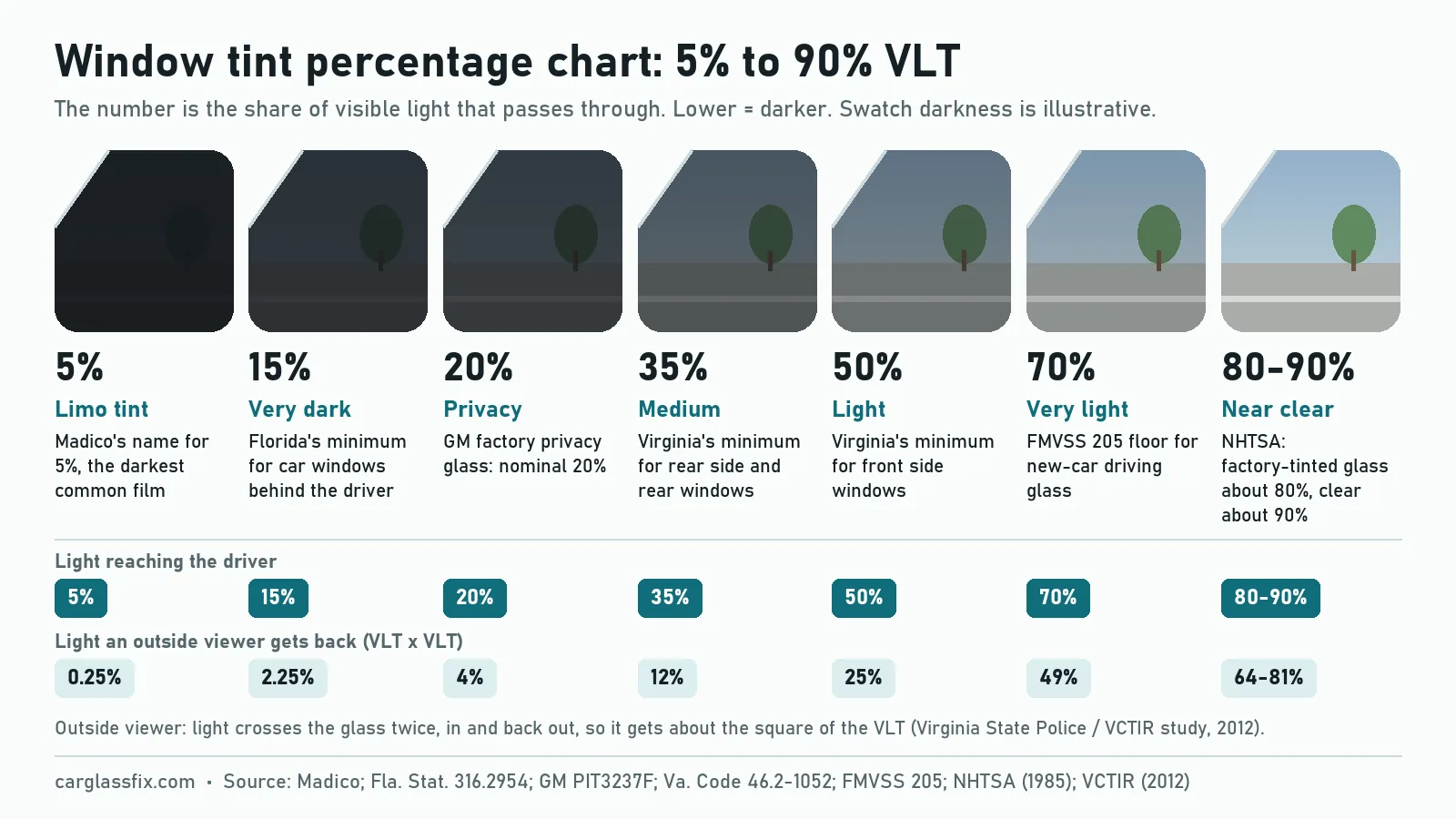
A tinted window looks much darker from outside than from the driver’s seat. A 2012 University of Virginia study for the Virginia State Police explains why. Light crosses the tinted glass twice, into the car and back out, so an outside viewer gets about the square of the VLT. A 35% window returns about 12% of the cabin’s light, and a 70% window about 49%.
| Shade (VLT) | Common name | Light an outside viewer gets back | What studies found near this shade | Where it shows up |
|---|---|---|---|---|
| 5% | Limo tint (Madico) | 0.25% | Darker than any shade tested below | Rear glass, where state law allows it |
| 15% | Very dark | 2.25% | Darker than any shade tested below | Florida’s minimum for car windows behind the driver |
| 20% | Privacy | 4% | All drivers did worse (Burns, 1999) | GM factory privacy glass (nominal 20%) |
| 35% | Medium | 12.25% | Older drivers did worse (Burns; LaMotte, 2000) | Virginia’s minimum for rear side and rear windows |
| 50% | Light | 25% | Older drivers already did worse at 63% (Burns) | Virginia’s minimum for front side windows |
| 70% | Very light | 49% | NHTSA: below 70% could pose a safety hazard | Federal minimum for new-car glass needed for driving (FMVSS 205) |
| 80% to 90% | Near clear | 64% to 81% | NHTSA: factory-tinted glass about 80%, clear about 90% | Factory glass and clear heat films; California front side film must be 88% or more |
Two shades have their own guides. For the middle of the range, see what 30% car window tint looks like. For the near-clear end, read about the lightest tint for car windows.
Why the film number is not the reading on the car
A meter on the car reads darker than the number on the film box because the factory glass blocks some light first. Net VLT is close to the glass VLT multiplied by the film VLT. Madico, a film maker, gives an example: a 50% film on 70% factory tint gives 35%.
NHTSA wrote in 1985 that clear windows pass about 90% of light and factory-tinted windows in new cars about 80%. On 80% glass, a 35% film reads about 28% and a 20% film about 16%. GM lists its privacy glass at a nominal 20%. A 20% film on that glass reads about 4%.
The shade name can also differ from the rated number. On LLumar’s 2026 sheet, the film named ATC 50 is rated at 60% VLT, ATC 20 at 25% and ATC 15 at 18%. Those ratings come from clear lab glass. Florida’s statute tests film on the glass of the specific vehicle. Our guide on how to measure window tint works through the layer math for clear, factory-tinted and privacy glass.
Tint percentage does not show heat or UV protection
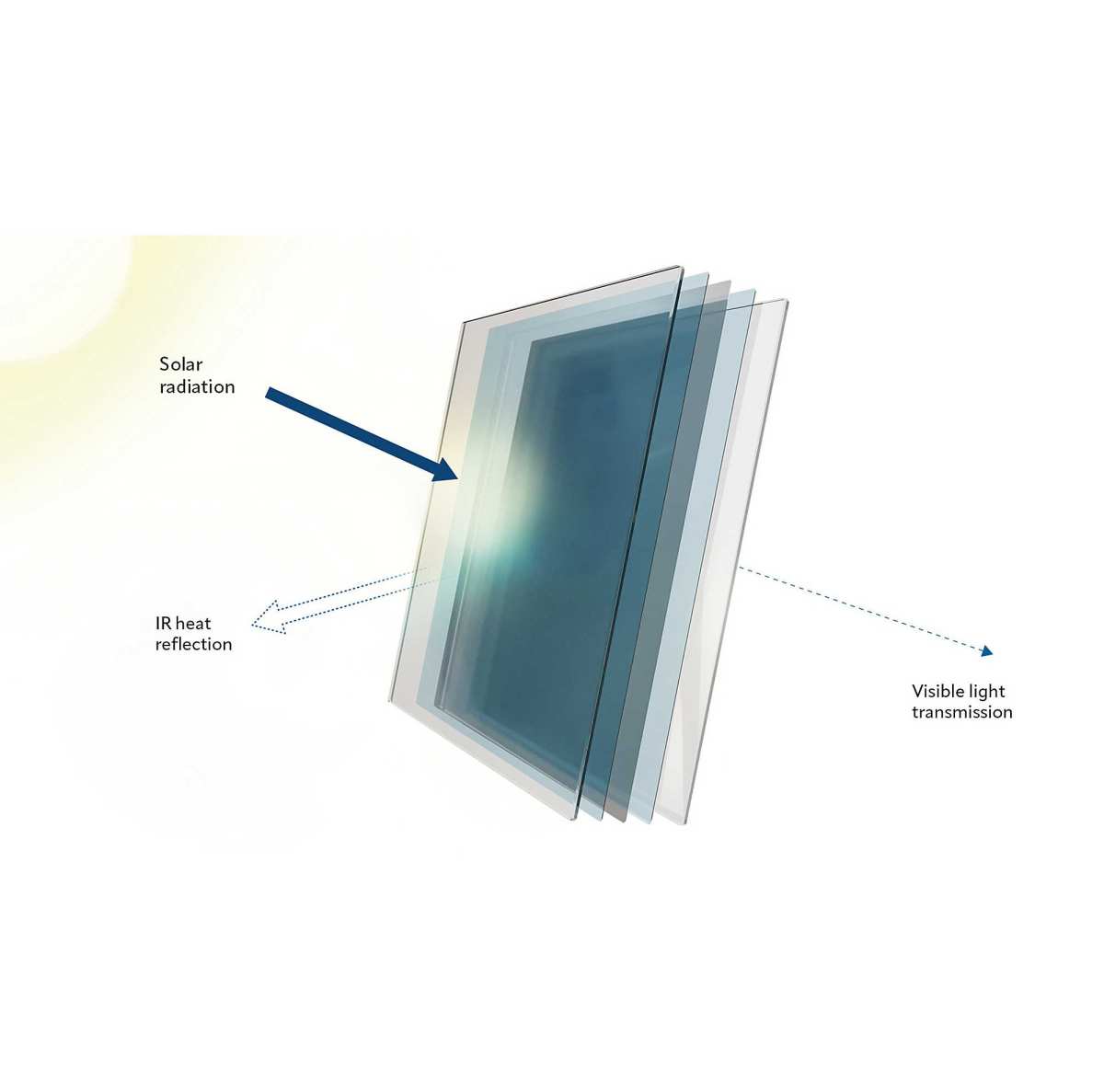
VLT measures visible light only, so two films with the same tint percentage can block very different amounts of heat. Heat is rated as total solar energy rejection (TSER), the share of the sun’s total energy kept out. The IWFA says occupant comfort is mostly driven by heat control, best described by TSER or the solar heat gain coefficient. The table pairs films of about the same shade from three makers’ published sheets.
| Maker and sheet | Film | VLT | TSER |
|---|---|---|---|
| LLumar (03/26) | ATC 35, color-stable dyed | 38% | 35% |
| LLumar (03/26) | IRX 35, infrared-rejecting ceramic | 39% | 54% |
| SunTek (04/24) | Carbon 35 Black | 36% | 38% |
| SunTek (04/24) | Evolve 35 | 38% | 57% |
| XPEL (R0523) | PRIME CS Black 35 | 34% | 36% |
| XPEL (R0523) | PRIME XR PLUS 35 | 38% | 59% |
| LLumar (03/26) | AIR 80, clear | 77% | 43% |
| LLumar (03/26) | ATC 05, color-stable dyed | 5% | 44% |
The last two rows show the gap at its widest. LLumar’s clear AIR 80 passes 77% of visible light and rejects 43% of solar energy. Its dyed ATC 05 passes 5% and rejects 44%. UV protection does not track darkness either. Every LLumar automotive film on the sheet, from the 87% AU 85 to the 5% ATC 05, lists more than 99% UV protection. XPEL lists 99% for every PRIME film.
Compare TSER within one maker’s sheet, because LLumar and SunTek test on 6 mm glass and XPEL on 3 mm glass. Installation costs for ceramic film are covered in how much ceramic car window tint costs.
How tint percentage changes what a driver sees at night
Darker tint makes dim, low-contrast objects harder for a driver to see at dusk and at night, while bright daylight shows little effect. A 1996 review by the Virginia Transportation Research Council (VTRC) found no evidence that tint affects driver performance “during well-illuminated daytime conditions”. The same review found the harm grows as transmittance drops below 70%, especially for people who wear glasses.
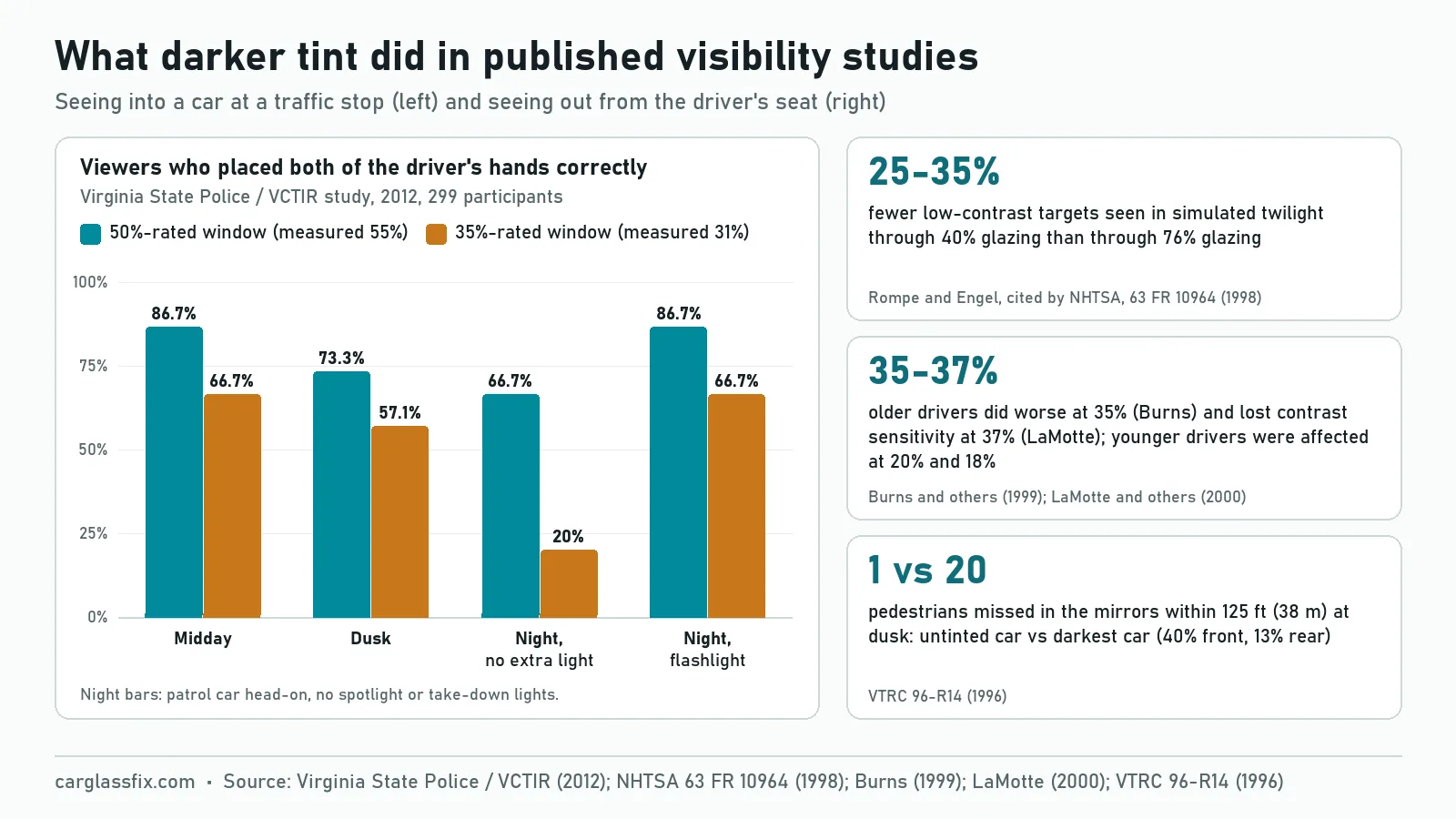
NHTSA described one twilight study in a 1998 Federal Register notice. Glazing that passed 40% of light cut drivers’ detection of low-contrast targets by 25 to 35 percent, compared with 76% glazing. NHTSA added that drivers need clear side windows in darkness to use the outside mirrors and to see sideways at intersections. Age matters too, as the table shows.
| Study | Shades compared | Finding |
|---|---|---|
| Rompe and Engel, cited by NHTSA (1998) | 40% vs 76% windshield glazing, simulated twilight driving | 25 to 35 percent fewer low-contrast targets detected |
| Burns and others, Ergonomics (1999) | 100% down to 20% VLT | Older drivers did worse at 63% and 35%; all drivers at 20% |
| LaMotte and others, Human Factors (2000) | Stock window, 37% and 18% film | 37% cut contrast sensitivity for drivers aged 60 to 69; 18% cut it at fine detail for drivers aged 20 to 29 |
| VTRC mirror test (1996), at dusk | Side windows from 88% (untinted) to 40% front and 13% rear (measured) | Missed pedestrians within 125 feet (38 m): 1 in the untinted car, 20 in the darkest |
In the VTRC test, 24 drivers looked for a pedestrian in their mirrors. Results varied widely, and darker tint hurt some drivers far more than others. For film choices aimed at night use, see the best car window tint for night driving. For the wider question, read whether car window tinting reduces visibility.
How tint percentage changes what others can see inside
Tint hides the inside of a car far more than it dims the view out, because outside light crosses the glass twice before it reaches a viewer. The 2012 Virginia report, written by University of Virginia researchers for the Virginia State Police, tested this at a simulated traffic stop. Its 299 participants played officers walking up to a stopped car.
One test car’s front side windows measured 55%, near Virginia’s 50% limit. The other measured 31%, near a proposed 35% limit. Viewers saw the driver’s hands 98.7% of the time through the lighter windows and 84.4% through the darker ones. They placed both hands correctly 70.5% and 48.3% of the time. At night, with the patrol car head-on and no extra lighting, correct answers fell to 66.7% and 20%.
For objects, lighting mattered more than tint. The study found no overall effect of tint level on naming objects, and a flashlight at night gave results comparable to midday. Without a flashlight at night, only 6 of 118 participants identified any object in the car. The two cars were different models, and the darker one had the lighter interior.
How states set tint limits by window
States set a separate tint percentage limit for each window position, and the windows beside the driver get the strictest number in the laws checked for this guide. Florida requires at least 28% on front side windows and 15% on windows behind the driver. Multipurpose passenger vehicles in Florida may go to 6% behind the driver. Virginia requires at least 50% on front side windows and 35% on rear side and rear windows. California allows only film of 88% or more on front side windows, and the window with film must still pass 70%.
Federal standard FMVSS 205 sets a 70% minimum for new-car glass needed for driving visibility. Most state limits apply to the film and glass together, measured on the car. The IWFA says state meter tolerances average about 5%, range from 3% to 7%, and some states allow none. Laws change, so check the current rule. Our guide to what car window tint is legal lists the limits, and windshield rules are in is it illegal to have tint on your windshield.
How to check a car’s tint percentage
A tint meter reads a window’s tint percentage by passing light through the glass. Meter maker Laser Labs says all its meters are accurate within plus or minus 2% and use light at 550 nm. A one-piece meter slides over a lowered side window. A two-piece meter sits on both faces of glass that does not roll down, such as a windshield or rear window. Our window tint meter guide compares six meters.
We chose the two picks below from Laser Labs’ published specifications and current availability on Amazon. We have not tested them. Check the current price on Amazon.
- Laser Labs Enforcer II: a one-piece meter for roll-down side windows. Laser Labs includes two NIST-traceable reference samples to check it. It cannot read a windshield or fixed glass. Check Laser Labs Enforcer II on Amazon
- Laser Labs Inspector II TM2000: a two-piece meter that Laser Labs says works on all windows up to half an inch thick. It suits windshields, rear glass and fixed side windows. Check Laser Labs Inspector II on Amazon
Frequently asked questions
Is 35% or 20% tint darker?
20% tint is darker. It passes 20% of visible light, while 35% tint passes 35%.
What is the darkest tint percentage?
5%, often called limo tint, is the darkest common car film. SunTek’s sheet lists a darker HP 5 Charcoal film at 3% VLT. Madico’s 1% Black Out film is made for building glass, not vehicles.
How does tint percentage work with factory tint?
Multiply the two numbers. A 35% film on glass that passes 80% gives about 28%, darker than the film’s own number.
Does a lower tint percentage block more heat?
Not by itself. LLumar lists its 77% clear AIR 80 film at 43% total solar energy rejection and its 5% ATC 05 film at 44%. For heat, compare the TSER figure on the maker’s sheet.
Is 20% tint legal in the US?
It depends on the state and the window. In Florida, a 20% reading meets the 15% minimum behind the driver but fails the 28% minimum for front side windows. In Virginia, 20% is below both the 50% front side limit and the 35% rear limit, with exceptions for some vehicles.
Sources
- Proffitt and others, Safety and Visibility Issues Associated with Motor Vehicle Window Transmittance and Aftermarket Window Tinting (VCTIR, 2012), Virginia State Police report RD375 (checked 24 October 2026)
- Proffitt, Bertamini, Bhalla and Joseph, The Effect of Reduced Transmittance Window Tinting on Drivers’ Ability to Detect Targets in Their Rear-view Mirrors (VTRC 96-R14, 1996)
- NHTSA, Fleetwood Enterprises; Action on Application for Decision of Inconsequential Noncompliance, 63 FR 10964 (5 March 1998)
- LaMotte, Ridder, Yeung and De Land, Effect of aftermarket automobile window tinting films on driver vision, Human Factors 42(2), 2000
- Burns, Nettelbeck, White and Willson, Effects of car window tinting on visual performance: a comparison of elderly and young drivers, Ergonomics 42(3), 1999
- NHTSA interpretation 1985-03.16 on FMVSS 205 light transmittance (checked 24 October 2026)
- FMVSS 205, Glazing materials, 49 CFR 571.205
- International Window Film Association: Automotive Education Guide 2026, pages 14, 34, 37 and 41
- LLumar Window Film Performance Data, LL0116NAEN (03/26)
- SunTek Automotive Window Film Specifications (04/24)
- XPEL PRIME USA Specification Sheet (R0523)
- Madico: Mastering Tint Percentage Guide
- GM Preliminary Information PIT3237F: Glass UV Protection and Tint Percentage (October 2012)
- Florida Statutes 316.2953 and 316.2954 (2025 statutes, checked 24 October 2026)
- Code of Virginia 46.2-1052 (checked 24 October 2026)
- California Vehicle Code 26708 (checked 24 October 2026)
- Laser Labs: Enforcer II and Inspector II product information (checked 24 October 2026)
Similar Posts