How to Stop a Windshield Crack From Spreading
Senior Automotive Glass Diagnostic Specialist & Master Technician at CarGlassFix · AGSC Master Certified Auto Glass Technician, NGA Certified Installer, I-CAR Automotive Safety Specialist · 12+ Years in Automotive Glazing, Windshield Structural Bonding, ADAS Camera Calibration & Precision Chip Restoration
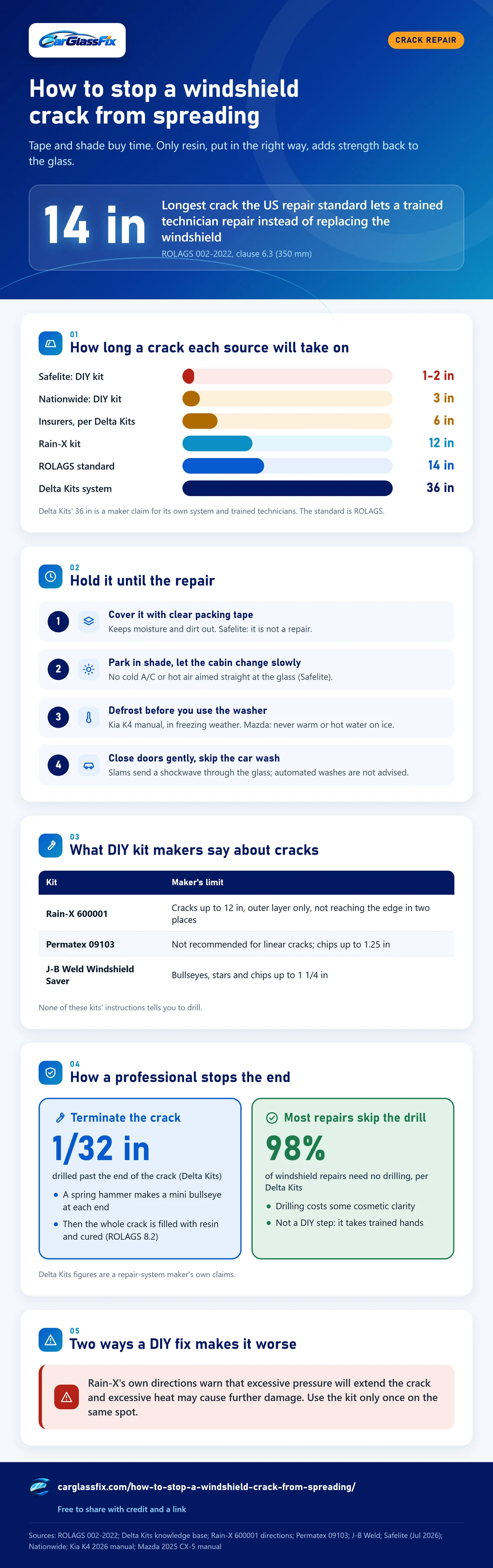
Only a resin repair stops a windshield crack from spreading. The ROLAGS repair standard says a professional repair stops damage from spreading by adding strength to the damaged area. Until the repair, clear tape over the crack, shade, gentle defrosting and no hot water slow the crack down. Stress cracks and cracks reaching two edges need a new windshield.
How do you stop a windshield crack from spreading?
You stop a windshield crack from spreading by having it filled with repair resin, and everything else only slows it down. The ROLAGS standard, the American National Standard for repairing laminated auto glass, lists what a repair by a trained professional usually achieves. One item is to stop the damage from spreading by adding strength to the damaged area. The resin fills the air gap in the outer glass layer and bonds the two faces of the crack. Infiniti’s dealer bulletin on windshield cracking explains why the gap matters. Cracks spread from the strike point through temperature changes, hand pressure, wind force and vibration from potholes. Tape, shade and careful driving reduce those loads for a few days. They do not close the crack. The plan therefore has three parts: protect the crack today, get it repaired while it is still small and clean, and replace the glass when the crack is past the repair limits. Why some cracks grow and others stay put is covered in will a windshield crack spread.
What to do right after the windshield cracks
Right after a crack appears, keep water, dirt and sudden temperature changes away from it and book a repair. Safelite’s guide on stopping cracks, dated July 1, 2026, recommends a piece of clear packing tape over the crack to keep moisture and debris out.
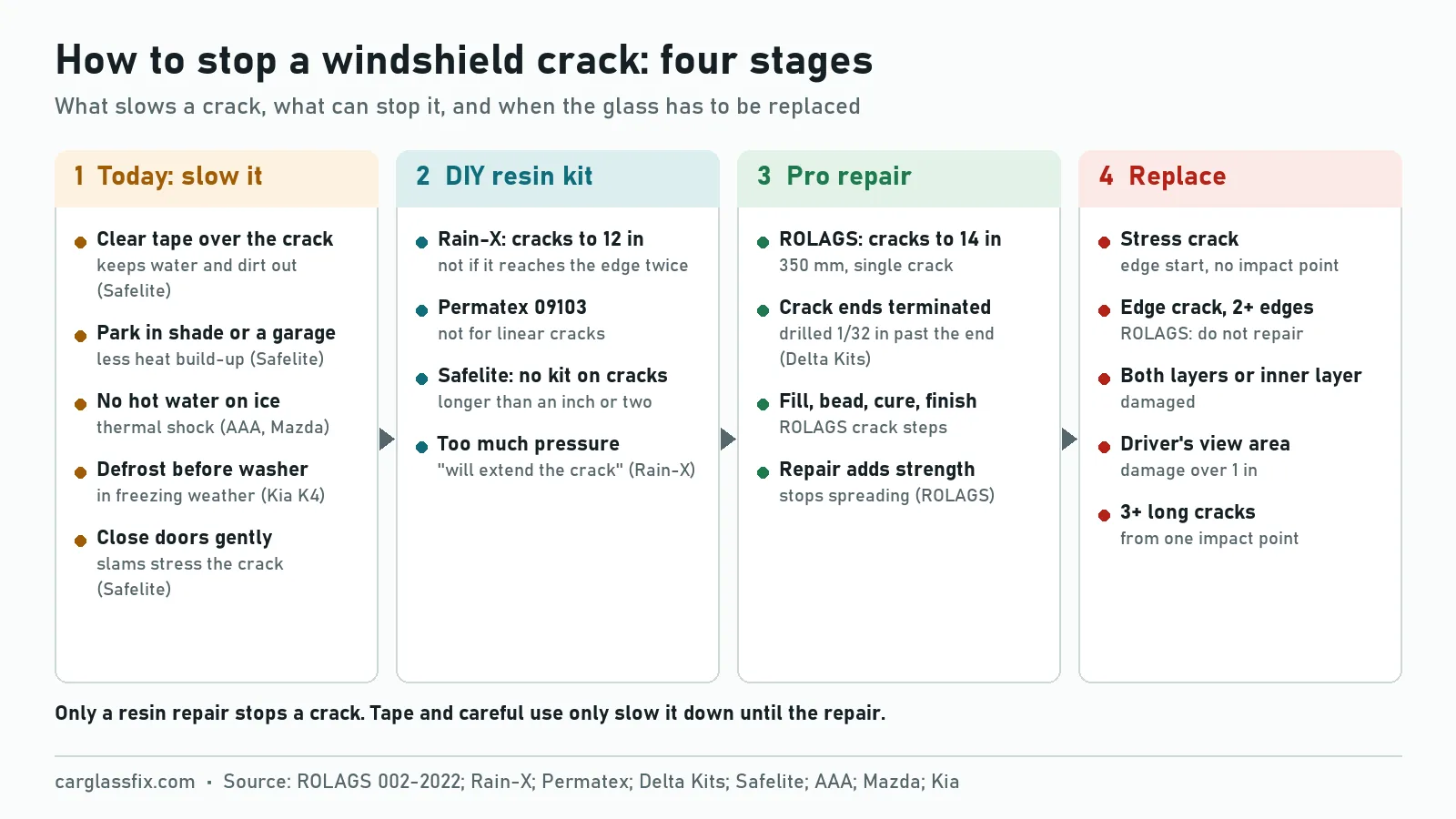
Safelite also says plainly that tape is not a repair. The steps below come from Safelite, AAA and two owner’s manuals. Water matters most in winter, because water trapped in a crack can freeze and push the glass apart. Rain-X tells kit users to repair damage before dirt or water contaminates it, so the tape also keeps the repair option open.
How to protect a cracked windshield until the repair
Tape the crack
Clean and dry the glass around the crack, then lay clear packing tape over it on the outside to keep out water and grit.
Park out of the sun
Park in shade or a garage so the glass does not heat unevenly around the crack.
Warm the glass slowly
Start the defroster on low and raise it gradually, and do not aim hot or cold air straight at a cold or sun-baked windshield.
Skip hot water
Never pour warm or hot water on ice or frost; AAA and Mazda both warn that it can crack glass.
Defrost before washing
In freezing weather, warm the windshield with the defroster before you use the washer, as Kia’s K4 manual instructs.
Drive and close doors gently
Avoid potholes where you can and close doors and the trunk softly, since the shock travels into the glass.
Avoid automated car washes
Hand wash with a gentle hose and water at outside temperature until the crack is repaired.
More on defrosting in winter is on can cold weather cause a windshield to crack.
How to stop a windshield chip from spreading
A chip is easiest to stop, because a chip repair is quick and stays inside the repair limits. Subaru’s service bulletin on its windshield warranty extension describes a crack type “caused by continuous stress starting from a small chip.” The bulletin blames small external damage combined with body twist and shock while the car is driven. A chip should therefore be taped the same day and repaired soon after. DIY chip kits have published limits. Rain-X rates its kit for round damage of not more than 1 inch across. Permatex rates its 09103 kit for bullseye and star damage up to 1.25 inches. J-B Weld lists the same 1 1/4 inch limit for its Windshield Saver. ROLAGS allows professional bullseye repairs up to 1 inch and star breaks up to 3 inches. Rain-X advises against using its kit more than once on the same damage, so a failed DIY attempt can limit later options. Home remedies are a different matter. Clear nail polish and super glue are not repair resins, as explained in how to repair a windshield with clear nail polish and will super glue fix a chip in a windshield.
Can a DIY resin kit stop a crack from spreading?
A DIY kit can stop a short, clean crack in the outer glass layer, but the makers and shops disagree on how long that crack may be. Rain-X is the only major kit maker found that rates its kit for cracks. Its directions say a crack repair may not succeed if the crack is longer than 12 inches, reaches the edge in two places, or is not in the outer layer. The same directions warn that “excessive pressure will extend the crack.” Permatex says its 09103 kit is not recommended for linear cracks. Safelite advises against any DIY kit on a crack longer than an inch or two. It says kits rarely bond properly on larger cracks and can make professional repair harder or impossible. The table puts the published limits side by side.
| Source | Crack limit stated | Other condition |
|---|---|---|
| Rain-X 600001 kit | 12 in | Not reaching the edge in two places; outer layer only |
| Permatex 09103 kit | Not recommended for linear cracks | Chips up to 1.25 in |
| Safelite (shop advice) | No DIY kit past an inch or two | Shop repairs cracks under 6 in |
| Nationwide (insurer) | DIY kits for cracks under 3 in | Rule of thumb |
| ROLAGS 002-2022 (professional) | 14 in (350 mm) | No stress cracks; no edge cracks reaching more than one edge |
The full kit procedure is on how to repair a windshield crack or chip yourself.
How professionals stop a crack: drilling the ends and filling with resin
A trained technician stops a long crack by anchoring its ends and then filling the whole crack with resin. ROLAGS clause 8.1 lets the technician reach the damage “through probing or drilling.” Clause 8.2 sets the crack steps: fill the crack completely with resin, place a bead of resin on top, cure it, finish it flush and inspect it. Delta Kits, a maker of professional repair systems, describes the termination step. A technician drills 1/32 inch past the end of the crack with a carbide bur, then uses a spring hammer to make a small bullseye there. Delta Kits says the drill depth may need adjusting for the glass thickness and that long cracks take considerably more practice than chips. It recommends an extra day of long-crack training. The online videos that show a home drill at the crack tip skip these controls. Tesla’s chip-repair procedure warns technicians not to penetrate the interlayer. None of the Rain-X, Permatex or J-B Weld kit instructions reviewed tells the user to drill. A crack that is still running usually belongs with a professional. ROLAGS also requires written and practical exams for repair technicians.
Laminated glass: why the outer layer cracks while the windshield holds
A windshield crack usually stays in the outer glass layer because the windshield is laminated. ROLAGS defines laminated glass as two or more layers of glass with a non-glass inner layer. It names that inner layer the plastic interlayer, or PVB (polyvinyl butyral). A PPG Industries patent describes a typical windshield as two 1/8 inch (3.2 mm) glass plies with a 0.030 inch (0.76 mm) PVB interlayer. Pilkington, a glass maker, says the plastic layer holds the glass splinters in place and resists penetration. A stone therefore usually cracks the outer ply while the PVB and the inner ply stay intact. Repair resin can only reach damage in that outer ply. ROLAGS rules out repair for damage on the inside layer, damage through both layers and damage or discoloration of the plastic interlayer. US windshields must meet the ANSI/SAE Z26.1 glazing standard under FMVSS 205. Side and rear windows are often tempered and break differently, as explained in laminated glass vs tempered glass.
When a crack cannot be stopped and the windshield needs replacing
A crack cannot be stopped by repair once it falls into one of the ROLAGS “do not repair” cases, and then the windshield has to be replaced. Clause 7 of the standard lists the cases. Location matters as much as size. The driver’s primary viewing area is a strip 12 inches wide, centered on the driver, from the top to the bottom of the wiper sweep. Areas with features such as rain sensors or head-up displays also count, and ROLAGS tells technicians to follow the vehicle maker’s guidance there.
| Condition (ROLAGS clause 7) | Why repair is ruled out |
|---|---|
| Stress crack | Starts at an edge with no impact point |
| Edge crack reaching more than one edge | Runs across the glass from edge to edge |
| Three or more long cracks from one impact point | Each of the cracks is longer than 6 in |
| Damage through both layers or on the inside layer | Resin cannot reach or restore it |
| Dirt that cannot be cleaned out | Contamination blocks the resin |
| Damage over 1 in inside the driver’s viewing area | A repair would affect the driver’s view |
A single crack longer than 14 inches is also beyond the standard’s repair limit. Many shops stop at a lower length, as shown on what size windshield crack is repairable. If the crack blocks your view, read how long can I drive with a cracked windshield before driving further.
Frequently asked questions
Does clear tape stop a windshield crack from spreading?
No. Clear tape keeps water and dirt out of the crack, which protects it for a repair, but Safelite says tape is not a repair and the crack can still grow.
Will clear nail polish stop a windshield crack?
No. Nail polish is not a repair resin, and ROLAGS lists contamination that cannot be cleaned out as a reason not to repair, so filling the crack with polish can rule out a later resin repair. Details are on how to repair a windshield with clear nail polish.
Can Safelite stop a crack from spreading?
Safelite’s help center says it repairs cracks smaller than 6 inches, and longer cracks usually mean replacement there. The ROLAGS standard allows professional repair of a single crack up to 14 inches, so another shop may repair a longer crack.
Should I drill a hole at the end of a windshield crack myself?
Drilling the crack ends is a professional step done with a carbide bur, a depth gauge and training, according to repair-system maker Delta Kits. No DIY kit instruction reviewed tells the user to drill, and a hole that goes too deep can damage the interlayer.
Can the defroster make a windshield crack spread?
Yes, a blast of hot air on a cold windshield can make a crack grow, Safelite warns. Start the defroster on low and raise it slowly, and never use hot water on the ice.
Sources
- ANSI/AGSC/NWRD/ROLAGS 002-2022, Repair of Laminated Automotive Glass Standard (clauses 4 to 10, checked 29 October 2026)
- Delta Kits: How do I prevent a crack from running past the drill hole?, tools for drilling and terminating long cracks and how long of a crack can be repaired (checked 29 October 2026)
- Safelite: How to Stop a Windshield Crack from Spreading (1 July 2026)
- Safelite: Does Cold Weather Make Windshield Cracks Worse? (2 April 2026) and Safelite: Can You Go Through a Car Wash with a Cracked Windshield? (23 July 2026)
- Safelite Help Center: glass damage and service
- Rain-X Windshield Repair Kit directions (600001), product page and FAQs (checked 24 and 28 October 2026)
- Permatex Windshield Repair Kit (09103) and technical data sheet (checked 24 October 2026)
- J-B Weld Windshield Saver (checked 28 October 2026)
- Nationwide: Can a cracked windshield be repaired?
- Infiniti Technical Bulletin ITB09-039K, Windshield Cracking (29 April 2024) and Subaru Service Bulletin 12-257-25R (13 February 2025), via NHTSA
- AAA: How to Deice Your Car’s Windshield
- Mazda 2025 CX-5 owner’s manual, Winter Driving and Kia K4 2026 owner’s manual, windshield washer
- Pilkington Technology Datasheet 6, Shaping and strengthening
- Tesla Model 3 Service Manual: windshield chip repair
- PPG Industries, US Patent 6,582,799 B1
- 49 CFR 571.205, FMVSS 205 Glazing materials (checked 28 October 2026)

Similar Posts