Colorado Window Tint Laws: The 27% Rule by Window
Senior Automotive Glass Diagnostic Specialist & Master Technician at CarGlassFix · AGSC Master Certified Auto Glass Technician, NGA Certified Installer, I-CAR Automotive Safety Specialist · 12+ Years in Automotive Glazing, Windshield Structural Bonding, ADAS Camera Calibration & Precision Chip Restoration
Colorado window tint laws require every window except the windshield to let through at least 27% of light on a vehicle registered in Colorado. The windshield must pass 70%, with film allowed only in the top 4 inches. Side and rear windows behind the driver may go darker only if the front side windows also pass 70%.
Colorado window tint limits by window
Colorado sets one 27% minimum for every window except the windshield, and the same number applies to every body style. The rule is Colorado Revised Statutes 42-4-227, titled “Windows unobstructed.” The statute does not split cars from SUVs, vans or pickups, so a sedan and a full-size SUV follow the same limits. The number describes the window as a whole. The text bans any material that leaves the window allowing “less than twenty-seven percent light transmittance,” so the reading is of film and glass together. The statute states no measuring tolerance. The table sets out each window, with the one condition that changes the rear limit.
| Window | Sedan | SUV, van, pickup |
|---|---|---|
| Windshield | 70% light or more for the whole glass; tint strip only in the top 4 in, not red or amber | Same |
| Front side windows | 27% light or more | Same |
| Side windows behind the driver | 27% or more; darker allowed if the front sides and windshield pass 70% | Same |
| Rear window | 27% or more; darker allowed if the front sides and windshield pass 70% | Same |
| Reflective film | No metallic or mirrored appearance on any window | Same |
| Measured as | The light the window allows, film and glass together; no tolerance stated | Same |
How the 27% and 70% rules work together
The 27% and 70% figures form a trade: a Colorado driver can tint every window to 27%, or leave the front side windows at 70% and tint the rear windows as dark as wanted. Subsection (1)(a)(II) says the windows to the rear of the driver, “including the rear window,” may fall below 27% only “if the front side windows and the windshield” allow at least 70%.
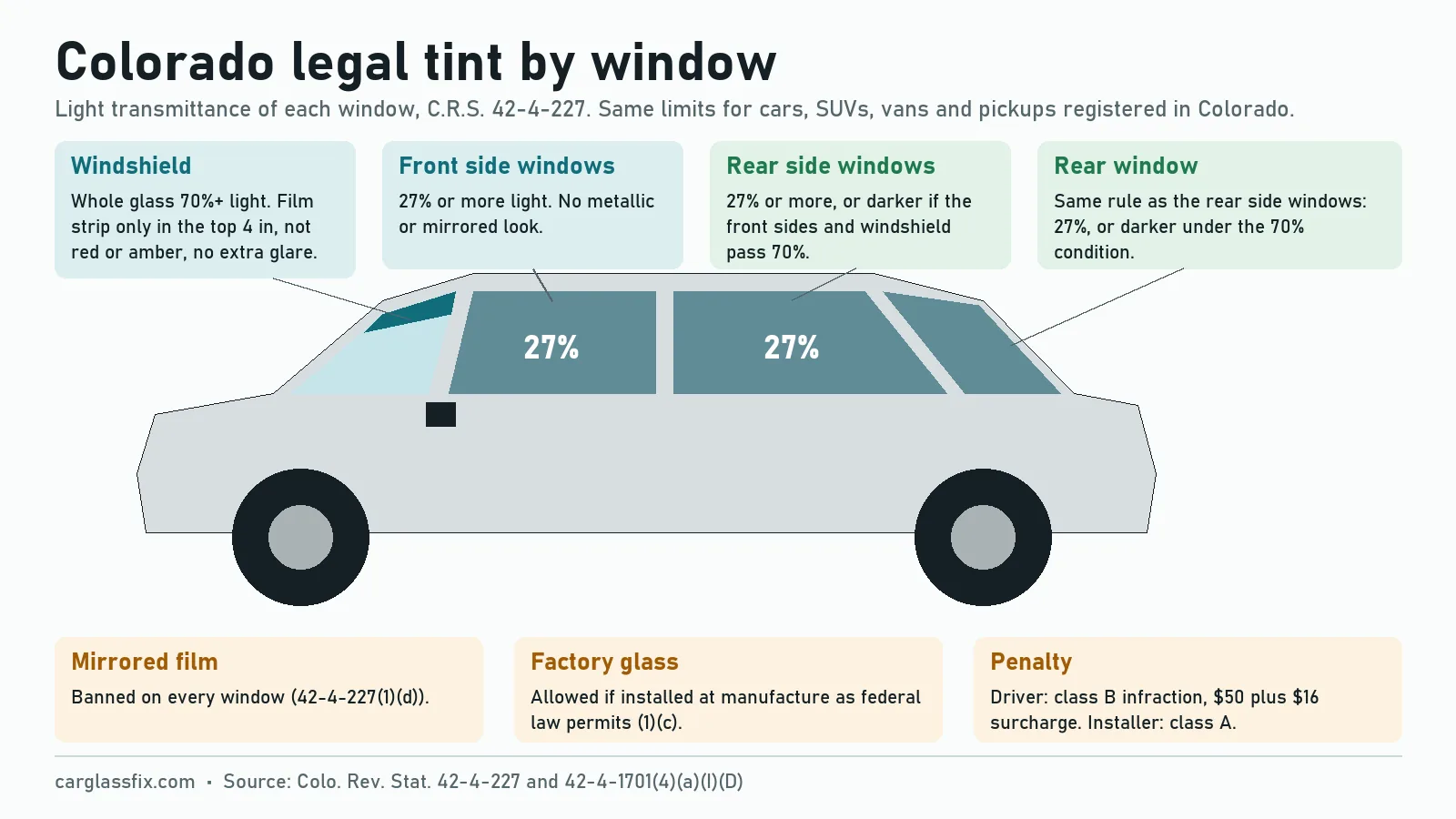
Most factory side glass already blocks part of the light, so a front window held to 70% can take little or no film. In practice, dark rear glass usually means clear or nearly clear front doors. Many tint pages say Colorado rear windows may be “any darkness” without stating this condition. A car with 27% film on the front doors must keep 27% on the rear windows too. Film rated 27% on the box reads darker once it sits on glass. Our how to measure window tint guide shows the math, and the window tint percentage chart shows how dark each shade looks.
Windshield tint in Colorado: the top 4 inches
A Colorado windshield may carry tint only in a strip whose bottom edge sits no more than 4 inches down from the top of the glass. Subsection (1)(b) allows “nontransparent material” in that band under three conditions. The strip may not be red or amber. It may not affect perception of primary colors, distort vision, or carry lettering that obstructs vision. It may not reflect sunlight or headlight glare into other drivers’ eyes more than the bare windshield would.
Below the strip, the whole windshield must still allow at least 70% light under (1)(a)(I). Colorado measures the strip in inches and does not refer to the AS-1 line that many other states use. Subsection (1)(e) keeps room for certificates and papers that the law requires and that do not block the driver’s view. For how other states handle the glass in front of the driver, read is it illegal to have tint on a windshield. Clear film that keeps the windshield above 70% falls inside the light rule, though the statute does not name clear film directly.
Mirrored film, colors and factory glass
Colorado bans mirrored and metallic film on every window, limits colors only on the windshield strip, and leaves factory glass alone. Subsection (1)(d) reads: “No material shall be used on any window in the motor vehicle that presents a metallic or mirrored appearance.” That sentence carries no percentage and no registration condition. A mirror film that passes 27% of light is still illegal. Our page on whether you can put mirror tint on a car covers the film types.
The red and amber ban sits in the windshield rule, (1)(b)(II), and the statute names no banned colors for side or rear glass. Subsection (1)(c) protects windows treated “in a manner approved by federal statute or regulation” when the glass came with the vehicle from the factory. The same subsection covers a replacement window that meets those federal guidelines. That is why factory privacy glass on the rear of many SUVs is legal in Colorado. Law enforcement vehicles get their own exception in (1)(a)(III), but they may not be used for traffic enforcement with that darker glass.
Out-of-state cars and the 20% figure
The 27% rule in 42-4-227(1)(a) applies to a motor vehicle “registered in Colorado,” and the statute sets no separate percentage for cars registered elsewhere. Several tint pages state that out-of-state vehicles must pass 20% in Colorado. That figure comes from HB19-1067, “Motor Vehicle Window Tint.”
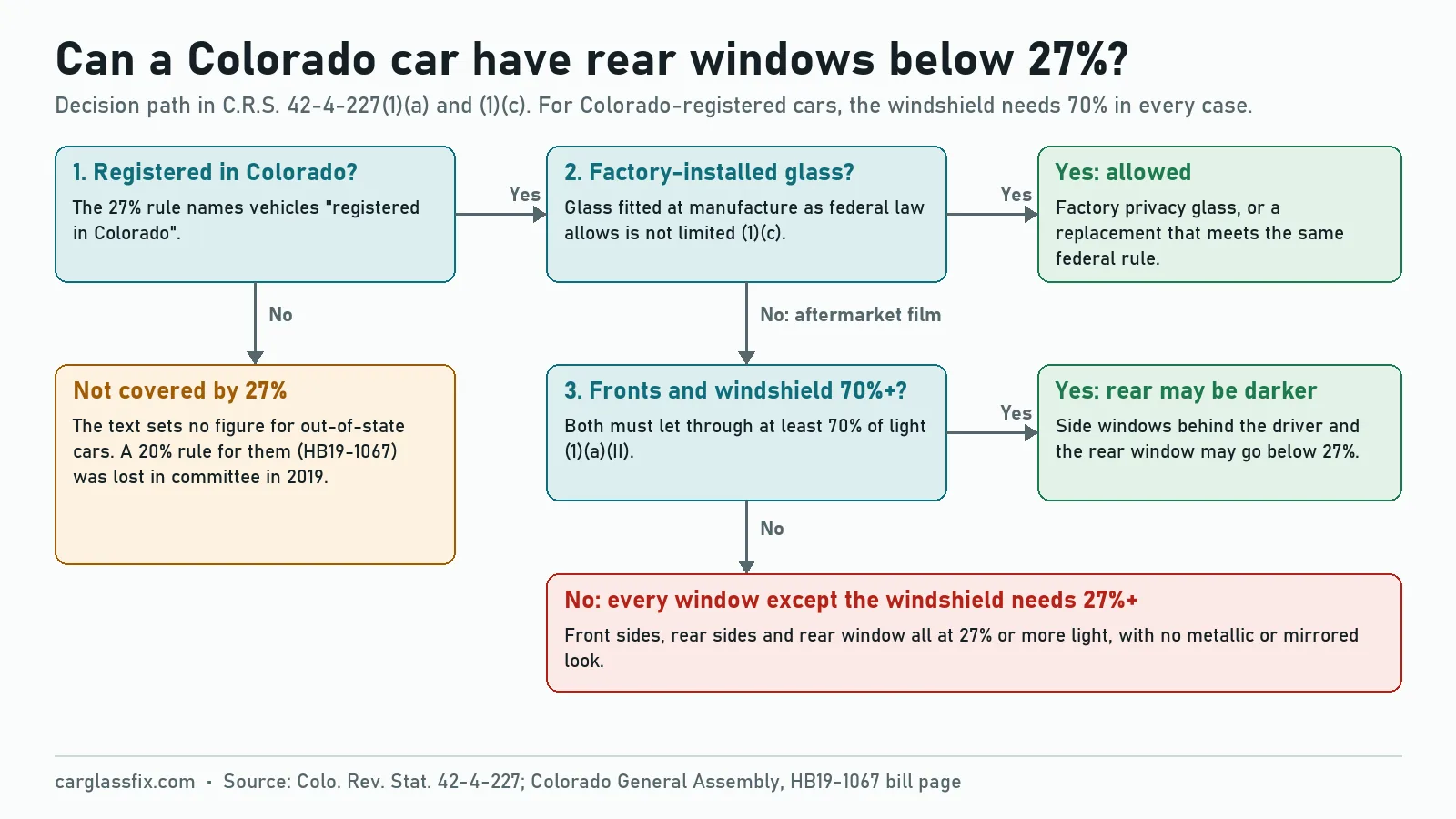
The Colorado General Assembly lists HB19-1067 as “Lost.” The House Transportation and Local Government Committee voted 7-0 on March 5, 2019, to postpone it indefinitely. The 20% rule therefore never became law. Two parts of 42-4-227 are worded more broadly than (1)(a). The mirrored-film ban in (1)(d) and the windshield strip rule in (1)(b) do not repeat the registration phrase, and subsection (4) says the section “shall apply to all motor vehicles.” The text does not limit those two rules to Colorado-registered cars. Compare home-state rules in what car window tint is legal.
Is there a medical exemption for tint in Colorado?
No, Colorado’s tint statute contains no medical exemption, physician statement or permit for darker windows. Section 42-4-227 lists exceptions for factory glass, law enforcement vehicles, required certificates and the windshield strip, and none of them mentions a medical condition. Some states let a driver carry a doctor’s signed statement in the vehicle. Colorado’s text has no such provision, so a page that describes a Colorado medical tint form or physician statement is not describing this statute. No other Colorado law granting a tint waiver was found for this page.
A driver who needs protection from sunlight still has options inside the 27% and 70% limits. Clear or light films are legal on any window as long as the finished window stays above the legal reading. Dark film behind the driver is also legal if the front side windows and windshield stay at 70%. A driver whose condition calls for darker front glass should ask the Colorado State Patrol or a lawyer before tinting. Before choosing a film, preview shades in the window tint simulator.
Colorado tint ticket: fine, surcharge and installer liability
A Colorado tint ticket is a class B traffic infraction for the driver, and the statute’s penalty schedule lists it at $50 plus a $16 surcharge. Section 42-4-227(3)(a) sets the class. The equipment violation schedule in 42-4-1701(4)(a)(I)(D) lists “42-4-227” with a penalty of $50.00 and a surcharge of $16.00. That schedule covers the whole section in one line. The general range for class A and class B infractions is $15 to $100 under 42-4-1701(3)(a)(I). A traffic infraction “constitutes a civil matter” under 42-4-1701(1). Under 42-4-1701(3)(c), the Department of Revenue’s motor vehicle division has no authority to assess license points for a class B traffic infraction.
Installers carry their own liability. Under (3)(b), any person who installs, covers or treats a window so that it fails the 27% or 70% rule commits a class A traffic infraction. The driver and the shop can both be cited for the same window. Enforcement happens at traffic stops. The Colorado Sun reported in June 2026 that the Colorado State Patrol had issued 210 tint tickets that year, against 480 in 2025, and that troopers use a tint meter. A window tint meter reads the same net figure.
Colorado’s tint rules can change in any legislative session. Check the current Colorado Revised Statutes 42-4-227 before you tint. This article is general information, not legal advice.
Frequently asked questions
How much is a ticket for illegal tint in Colorado?
The penalty schedule in Colo. Rev. Stat. 42-4-1701(4)(a)(I)(D) lists a tint violation under 42-4-227 at $50 plus a $16 surcharge. It is a class B traffic infraction, and class B infractions carry no license points.
Is 20% tint legal in Colorado?
A 20% reading is illegal on the front side windows of a Colorado-registered car, which must pass 27%. It is legal on the windows behind the driver only if the front side windows and the windshield pass 70%.
Is 27 percent tint dark?
A 27% window lets through 27% of visible light, a little over a quarter, so it blocks most of it. The window tint percentage chart compares it with lighter and darker shades.
Is 15% or 30% tint darker?
A 15% tint is darker because it lets through 15% of visible light, against 30% for the lighter film. In Colorado, 30% meets the 27% minimum and 15% does not, unless the front sides and windshield pass 70%.
Do out-of-state cars have to follow Colorado’s 27% rule?
The 27% rule in 42-4-227(1)(a) names vehicles registered in Colorado and sets no figure for others. The 20% rule for out-of-state cars in HB19-1067 was lost in committee in 2019, but the mirrored-film ban in (1)(d) is not limited to Colorado registration.
Sources
- Colorado Revised Statutes 42-4-227, Windows unobstructed (copy of the official CRS 2024 Title 42; checked 29 October 2026)
- Colorado Revised Statutes 42-4-1701, Traffic offenses and infractions classified, penalty and surcharge schedule (checked 29 October 2026)
- Colorado General Assembly: HB19-1067, Motor Vehicle Window Tint (checked 29 October 2026)
- The Colorado Sun via Gigafact: Can you be pulled over for having tinted windows in Colorado? (15 June 2026)

Similar Posts