Indiana Window Tint Laws: 30% Limit by Window
Senior Automotive Glass Diagnostic Specialist & Master Technician at CarGlassFix · AGSC Master Certified Auto Glass Technician, NGA Certified Installer, I-CAR Automotive Safety Specialist · 12+ Years in Automotive Glazing, Windshield Structural Bonding, ADAS Camera Calibration & Precision Chip Restoration
Indiana window tint law allows film that lets through at least 30% of light and reflects no more than 25% on the windshield, side wings, front door windows and rear back window. Windshield film may sit only on the uppermost part, no lower than the AS-1 line. Rear door side windows are not listed, so no percentage applies to them.
Indiana window tint limits by window
Indiana allows 30% light transmittance or more, with 25% reflectance or less, on the windshield, the side wings, the side windows in the front doors and the rear back window. The rule is Indiana Code 9-19-19-4(c), last amended by P.L.164-2018. The statute names four window positions and then applies one pair of limits to all of them. It does not mention sedans, SUVs, vans or pickups, so the same limits apply to every passenger vehicle. The rear door side windows are not on the list. The table below uses the statute’s own window names. Many state tables show a separate SUV column with a looser rear limit, but Indiana’s statute has no such column, and the pages that print one have no source for it.
| Window | Sedan | SUV, van, pickup |
|---|---|---|
| Windshield | Film only on the uppermost part, no further down than the AS-1 line; 30% light or more, 25% reflectance or less | Same |
| Side wings (vent windows beside the windshield) | 30% light or more, 25% reflectance or less | Same |
| Front door side windows | 30% light or more, 25% reflectance or less | Same |
| Rear door side windows | Not listed in 9-19-19-4; must not obstruct the driver’s clear view (9-19-19-3) | Same |
| Rear back window | 30% light or more, 25% reflectance or less | Same |
| Tolerance | None in the statute | Same |
How the Indiana statute words the 30% and 25% tests
The statute bans material with “a total solar reflectance of visible light of more than twenty-five percent (25%) as measured on the nonfilm side and light transmittance of less than thirty percent (30%) in the visible light range.” Both numbers sit in one sentence, joined by “and”. Read word for word, the sentence describes film that fails both tests at once. We found no Indiana court decision or agency rule on whether film that fails only one test is legal, so the safe reading for a driver is to meet both: 30% or more light, 25% or less reflectance.
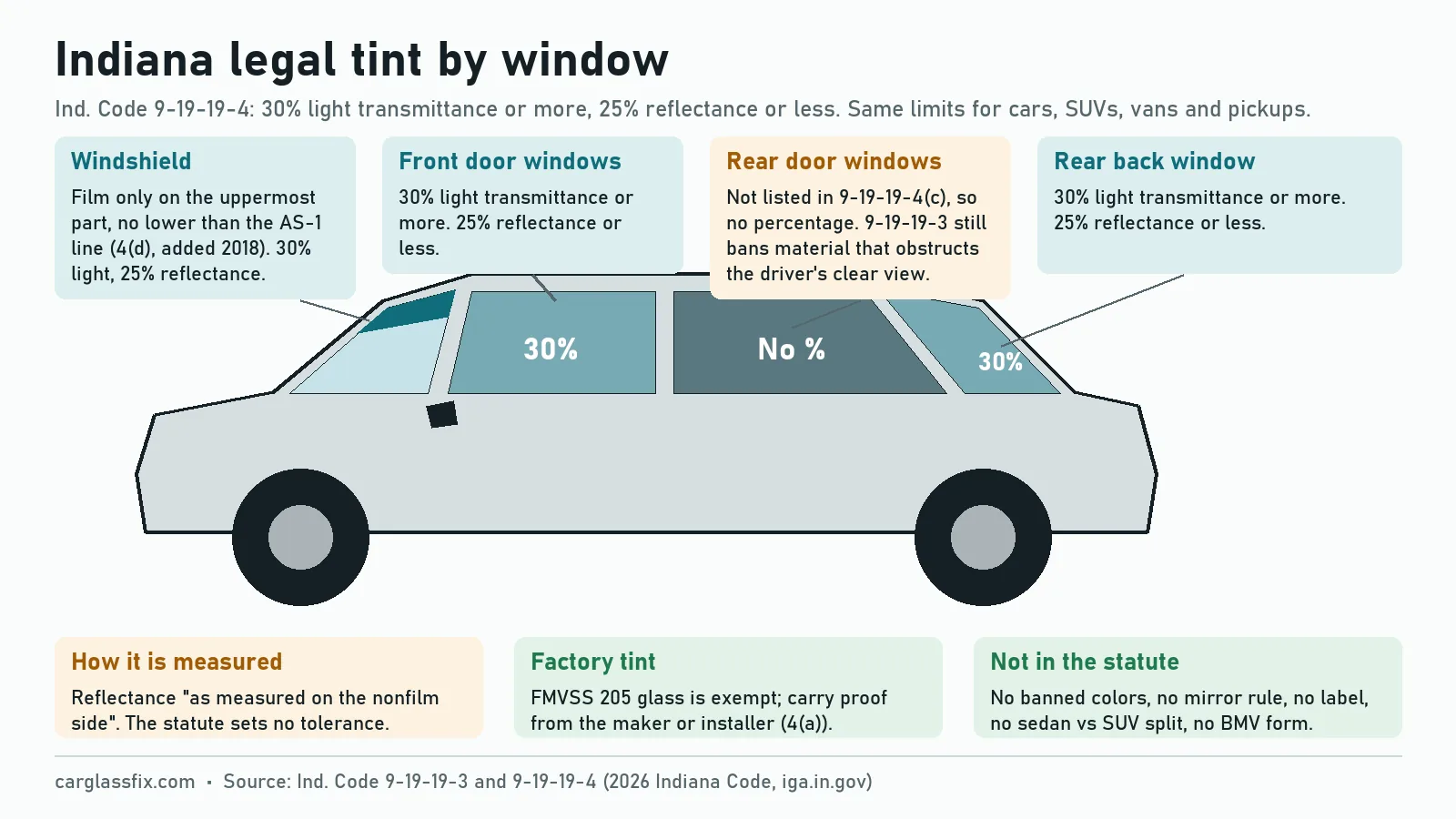
The statute says reflectance is “measured on the nonfilm side”, which points to a reading taken on the window with the film in place. It does not say whether the 30% figure means the film alone or the film and glass together, and it gives no tolerance. The how to measure window tint guide shows the film-times-glass math, and a window tint meter gives the net reading an officer would see. Subsection (a) exempts a manufacturer’s tint that complies with FMVSS 205, but “proof from the manufacturer, supplier, or installer” of that compliance “must be carried in the vehicle”.
Windshield tint in Indiana: above the AS-1 line only
Indiana allows windshield film only on the uppermost part of the glass, and it may “extend no further than the AS-1 line”. That is subsection 9-19-19-4(d). The strip must also meet the 30% light and 25% reflectance limits, because subsection (d) covers “any treatment allowed under subsection (c)”. The statute gives no inch measurement as a fallback, so the etched AS-1 mark near the top corners of the glass is the only boundary. See what is the AS-1 line on a windshield to find it on your car.
The AS-1 rule is newer than most Indiana tint pages suggest. The 2017 Indiana Code has no windshield subsection at all; the windshield simply sat in the list of windows held to the 30% and 25% limits. P.L.164-2018 added subsection (d), renumbered the installer and stop clauses as (e) and (f), and updated section 8 to cite 4(e). A clear film with no visible tint is not addressed by the Indiana statute, and we found no Indiana State Police guidance on it. For other states, read is it illegal to have tint on a windshield.
Rear door windows: the glass Indiana’s statute does not name
Indiana sets no tint percentage for the side windows in the rear doors, because 9-19-19-4(c) lists only the “windshield”, “side wing”, “side window that is part of a front door” and “rear back window”. A rear door window is none of those. The omission has been in the text since at least the 2002 edition of the Code, and the 2003, 2014 and 2018 amendments left the list unchanged. Most tint sites print 30% for the back side windows anyway, and the Bing AI answer checked for this page repeated that figure. The statute does not say it.
Two limits still apply there. Section 9-19-19-3(b) bans “sunscreening material, or other nontransparent material” on the “side or rear windows” that “obstructs the driver’s clear view of the highway or an intersecting highway”. That is a judgment call for the officer and the court, not a percentage. The second limit is practical: the rear back window behind those doors must still read 30%, so a car tinted 5% on the rear doors and 30% on the back glass is the legal combination. The window tint percentage chart shows how each shade looks from outside. Indiana has no dual-mirror condition for dark rear glass, unlike several neighboring states.
How the Indiana tint law changed: 1995, 2003, 2014 and 2018
The 30% and 25% figures have been in Indiana’s statute since before 2003, but the way the statute uses them has changed three times. The history line of 9-19-19-4 reads “As added by P.L.2-1991, SEC.7. Amended by P.L.128-1995, SEC.1; P.L.12-2003, SEC.1; P.L.217-2014, SEC.42; P.L.164-2018, SEC.9.”
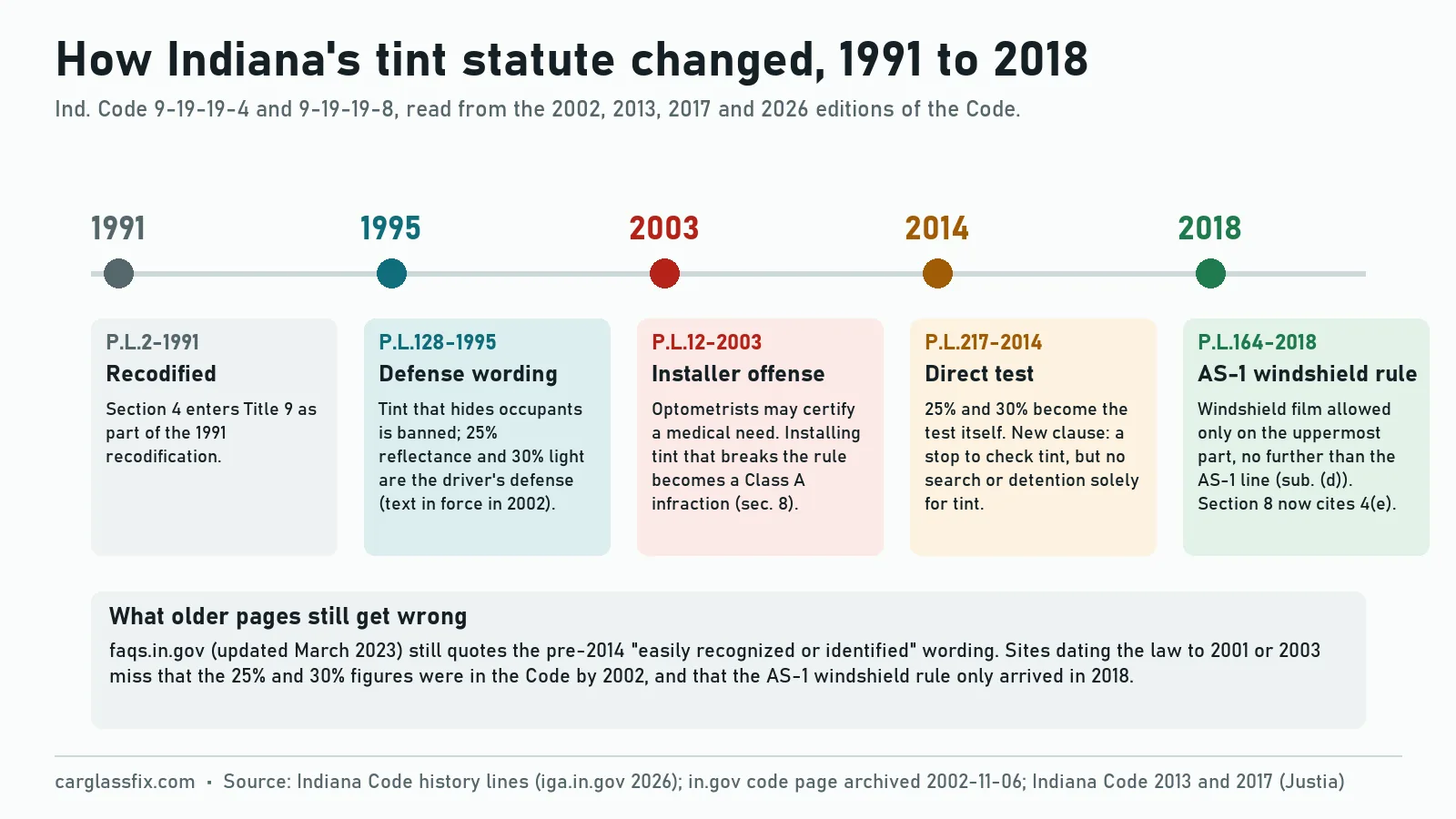
In the 2002 text, the offense was tint that kept occupants from being “easily identified or recognized” from outside, and 25% reflectance with 30% light was “a defense” the driver could raise. Only a physician could certify a medical need. P.L.12-2003 added optometrists, created the installer offense, and added section 8, which makes that offense a Class A infraction. A long-running tint-law archive page reports the installer clause took effect July 1, 2003. P.L.217-2014 rewrote subsection (c) so that 25% and 30% became the test itself, and added the clause that a vehicle may be stopped to check tint but not searched or detained solely for it. P.L.164-2018 added the AS-1 windshield rule. The state’s own FAQ page, faqs.in.gov, updated March 2, 2023, still quotes the pre-2014 “easily recognized or identified” wording.
Indiana medical exemption for window tint
Indiana’s medical exemption is a certificate from “a physician or optometrist licensed to practice in Indiana”, carried in the vehicle and renewed every year. It comes from 9-19-19-4(b), which lifts the whole section for the driver of a vehicle owned by a person who must be “shielded from the direct rays of the sun” for medical reasons, or in which such a person “is a habitual passenger”. The statute names no form, no BMV filing and no list of conditions. Pages and videos that tell Indiana drivers to “submit it to the DMV” describe a step the law does not contain, and we found no BMV page on tint exemptions.
How to use the Indiana medical tint exemption
See a physician or optometrist licensed in Indiana
Only these two professions can attest to the medical need under 9-19-19-4(b).
Get a written certification of the condition
The statute calls it the “physician’s or optometrist’s certification of that condition”.
Give a copy to the tint shop
Subsection (e) protects an installer who receives the statement before doing the work.
Keep it in the vehicle
The certification “must be carried in the vehicle” whenever the exempt person owns the car or rides in it as a habitual passenger.
Renew it every year
The certificate “must be renewed annually”.
The exemption follows the person, not the car alone: it covers a vehicle the person owns, or any vehicle in which the person is a habitual passenger.
Indiana tint tickets: Class C for drivers, Class A for installers
A driver who breaks the Indiana tint law commits a Class C infraction, and a court may enter a judgment of up to $500. Section 9-19-19-7(b) sets the class, and Indiana Code 34-28-5-4(c) sets the amount: “a judgment of up to five hundred dollars ($500)”. Court costs are separate. The fixed dollar amounts on tint and legal-question sites have no statutory source, and we do not repeat them.
The installer faces more. Section 9-19-19-8 makes tinting a vehicle so that driving it breaks subsection (c) or (d) a Class A infraction, and 34-28-5-4(a) allows a judgment of up to $10,000. Subsection 4(f) also matters at the roadside: “A vehicle may be stopped to determine compliance with this section”, but the vehicle, its contents, the driver and any passenger “may not be inspected, searched, or detained solely because of a violation of this section.” Before choosing a shade, try the window tint simulator, compare neighboring rules in Illinois window tint laws, and see every state in what car window tint is legal.
Indiana’s tint statute can change in any legislative session. Check the current Indiana Code 9-19-19-4 on iga.in.gov or ask an Indiana State Police post before you tint. This article is general information, not legal advice.
Frequently asked questions
Is 20% tint illegal in Indiana?
A 20% reading is illegal on the front door windows, the side wings, the windshield strip and the rear back window, which all need at least 30% light transmittance under 9-19-19-4(c). The statute sets no percentage for the rear door side windows, so 20% there breaks no numeric limit.
Can a cop pull you over for tint in Indiana?
Yes. Section 9-19-19-4(f) says a vehicle “may be stopped to determine compliance” with the tint section. The same subsection bars inspecting, searching or detaining the vehicle, driver or passengers solely because of a tint violation.
How do you get a tint waiver in Indiana?
Get a written certification of the medical condition from a physician or optometrist licensed in Indiana, keep it in the vehicle and renew it every year. Indiana has no BMV form or state-issued tint waiver; the certificate itself is the exemption under 9-19-19-4(b).
Is 35 or 20 tint darker?
A 20% tint is darker because it lets through 20% of visible light, against 35% for the lighter film. In Indiana, 35% passes the 30% limit on the front door windows and rear back window, and 20% does not; the window tint percentage chart shows both shades side by side.
Can an SUV have 5% tint on the back windows in Indiana?
On the rear door side windows, yes, because the statute lists no percentage for them on any vehicle. On the rear back window, no: Indiana Code 9-19-19-4 applies the same 30% limit to sedans and SUVs alike and has no separate rule for SUVs, vans or pickups.
Sources
- Indiana Code 9-19-19-4, Tinting, glazing, or sunscreening vehicle windows (2026 Indiana Code) (checked 29 October 2026)
- Indiana Code 9-19-19-3, Decals, signs, posters, sunscreens, or other nontransparent material, 9-19-19-7 and 9-19-19-8, classification of violations (checked 29 October 2026)
- Indiana Code 34-28-5-4, judgments for infractions (checked 29 October 2026)
- IN.gov FAQ: What is the Indiana law concerning tinted windows? (updated 2 March 2023; checked 29 October 2026)
- Indiana Code 9-19-19 as published by the Office of Code Revision, archived 6 November 2002 (checked 29 October 2026)
- Indiana Code 2013, chapter 9-19-19 (Justia PDF) and Indiana Code 2017, chapter 9-19-19 (Justia PDF) (checked 29 October 2026)
- Indiana Window Tint Law archive page (pcisys.net), for the reported 1 July 2003 effective date only (checked 29 October 2026)
- 49 CFR 571.205, FMVSS 205 Glazing materials (checked 29 October 2026)

Similar Posts