Arizona Window Tint Laws: 33% Front, Any Darkness Behind
Senior Automotive Glass Diagnostic Specialist & Master Technician at CarGlassFix · AGSC Master Certified Auto Glass Technician, NGA Certified Installer, I-CAR Automotive Safety Specialist · 12+ Years in Automotive Glazing, Windshield Structural Bonding, ADAS Camera Calibration & Precision Chip Restoration
Arizona window tint law sets front side windows at 33% light transmission, plus or minus 3%, measured with the glass. Windows behind the driver have no darkness limit, only a reflectance cap, and the rear window is fully exempt with two outside mirrors. Windshield film may sit only in a top strip set by a 29-inch seat measurement.
Arizona window tint limits by window
Arizona limits only the front side windows and the windshield; every window behind the driver may be as dark as the owner wants. The rule is Arizona Revised Statutes 28-959.01. It works as a ban with exceptions: subsection (C) forbids any transparent material that “alters the color or reduces the light transmittance” of a window, and subsection (A) lists the windows and films that escape the ban. The front side exception covers “front side wing vents and windows”, so a small vent pane counts as a front window. Arizona draws no line between sedans and SUVs, vans or pickups. One statute, one set of numbers, every passenger vehicle. The table below uses the statute’s own figures. Many states need a separate column for multipurpose vehicles. Arizona does not, because the windows behind the driver are already free of any transmission limit on every vehicle.
| Window | Sedan | SUV, van, pickup |
|---|---|---|
| Windshield | Strip at the top only; bottom edge at least 29 in above the undepressed driver’s seat; not red or amber | Same |
| Front side windows and wing vents | Light transmission 33% plus or minus 3%; reflectance 35% plus or minus 3% | Same |
| Side windows behind the driver | Any darkness; reflectance 35% plus or minus 3% or less | Same |
| Rear window | Any darkness; reflectance 35% plus or minus 3% or less, or fully exempt with an outside mirror on each side showing 200 ft behind | Same |
| Measured as | Film and glass together (“including the glazing”) | Same |
| Label or sticker | None required by the statute | Same |
How Arizona measures the 33% limit
Arizona measures the film and the glass as one unit, so the legal number is the reading on the finished window, not the figure on the film box. Subsection (H)(1) defines light transmission as the light that passes “through the product or material including the glazing” divided by the light falling on it. Factory glass already blocks a few percent, so a film sold as 35% can read near or below 33% once it is on the door.
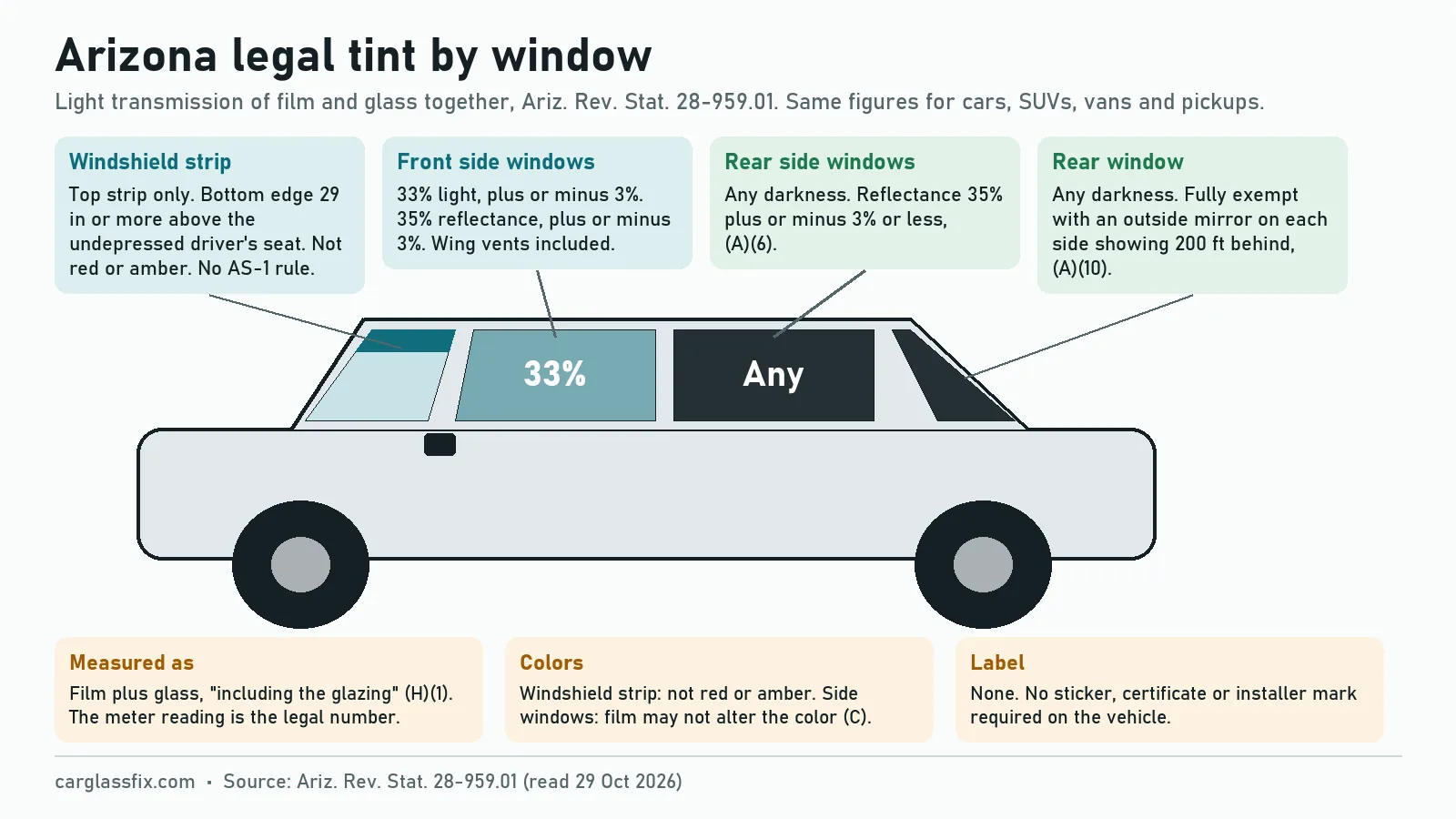
The front limit is written as a band, not a floor. The statute says “thirty-three percent plus or minus three percent”, which spans 30% to 36%. It does not say whether a 30% reading passes or fails, and no Arizona agency page we found settles that, so treat 33% as the target and 30% as the edge. The same band applies to reflectance: 35% plus or minus 3% on the front side windows, and “or less” on the windows behind the driver. Our how to measure window tint guide explains the glass-times-film math, and the window tint percentage chart shows what 33% looks like next to 20% and 5%. Officers read the window with a window tint meter, and the reading they get is the one that counts.
Windshield tint in Arizona: the 29-inch rule, not the AS-1 line
Arizona allows windshield film only in a strip across the top, and the statute measures that strip from the driver’s seat, not from an AS-1 mark. Subsection (A)(11) permits “transparent material” on “the topmost portion of the windshield” when its bottom edge is “at least twenty-nine inches above the undepressed driver’s seat”. The measurement starts “five inches in front of the bottom of the backrest”, with the seat “in its rearmost and lowermost position”. The strip may not be red or amber. The statute gives no light-transmission figure for the strip and no inch limit from the top of the glass.
Shop pages that say “above the AS-1 line” or “top 5 inches” are importing another state’s rule. California uses the same 29-inch wording, so is car window tint legal in California covers the same measurement. The ADOT exemption form mentions “the top of the manufacturer’s AS-1 line”, but the statute’s test is the 29-inch one. Below the strip, subsection (C) bans any film that cuts light transmittance, so a full windshield tint is illegal, and the exemption form says the exemption does not cover the windshield. Stickers get a 7-inch square in the lower corner farthest from the driver and a 5-inch square in the nearest corner (A)(5).
Reflective film, colors, mirrors and the installer notice
Arizona caps reflectance on every side and rear window, bans two colors on the windshield strip, and requires no label on the car. Luminous reflectance is the share of light a film bounces outward (H)(2). The cap is 35% plus or minus 3% on the front side windows and 35% plus or minus 3% “or less” behind the driver, which rules out mirror-finish films. The red and amber ban appears only in the windshield subsection. The side window rules name no colors, though subsection (C) forbids film that “alters the color” of a window outside the exceptions. The window tint simulator previews the shades that fit each window.
The rear window has a second route to legality. Under (A)(10), it is exempt from the whole section when the vehicle has outside mirrors on both sides that show the highway “for a distance of at least two hundred feet to the rear”. With both mirrors, even the reflectance cap drops away. Two duties fall on the trade. Each film maker “shall certify to the director” that its product meets the rules (D). Anyone who sells or installs film must state “in a conspicuous manner” that front side tint “may be illegal in some states” (F). Arizona asks for no certificate sticker, no door-jamb label and no installer mark on the glass.
Arizona medical exemption for window tint
ADOT’s Motor Vehicle Division may exempt a vehicle from the tint limits when a physician attests that the applicant must be shielded from direct sun. Subsection (G) names “a physician licensed pursuant to title 32, chapter 13, 14 or 17”, the chapters for medical doctors, naturopathic doctors and osteopathic doctors. The ADOT Medical Review page lists the signers as an MD, DO, NMD or ophthalmologist. The exemption attaches to a vehicle the person owns “or in which the person is a habitual passenger”, and ADOT says a certificate must be in each vehicle covered.
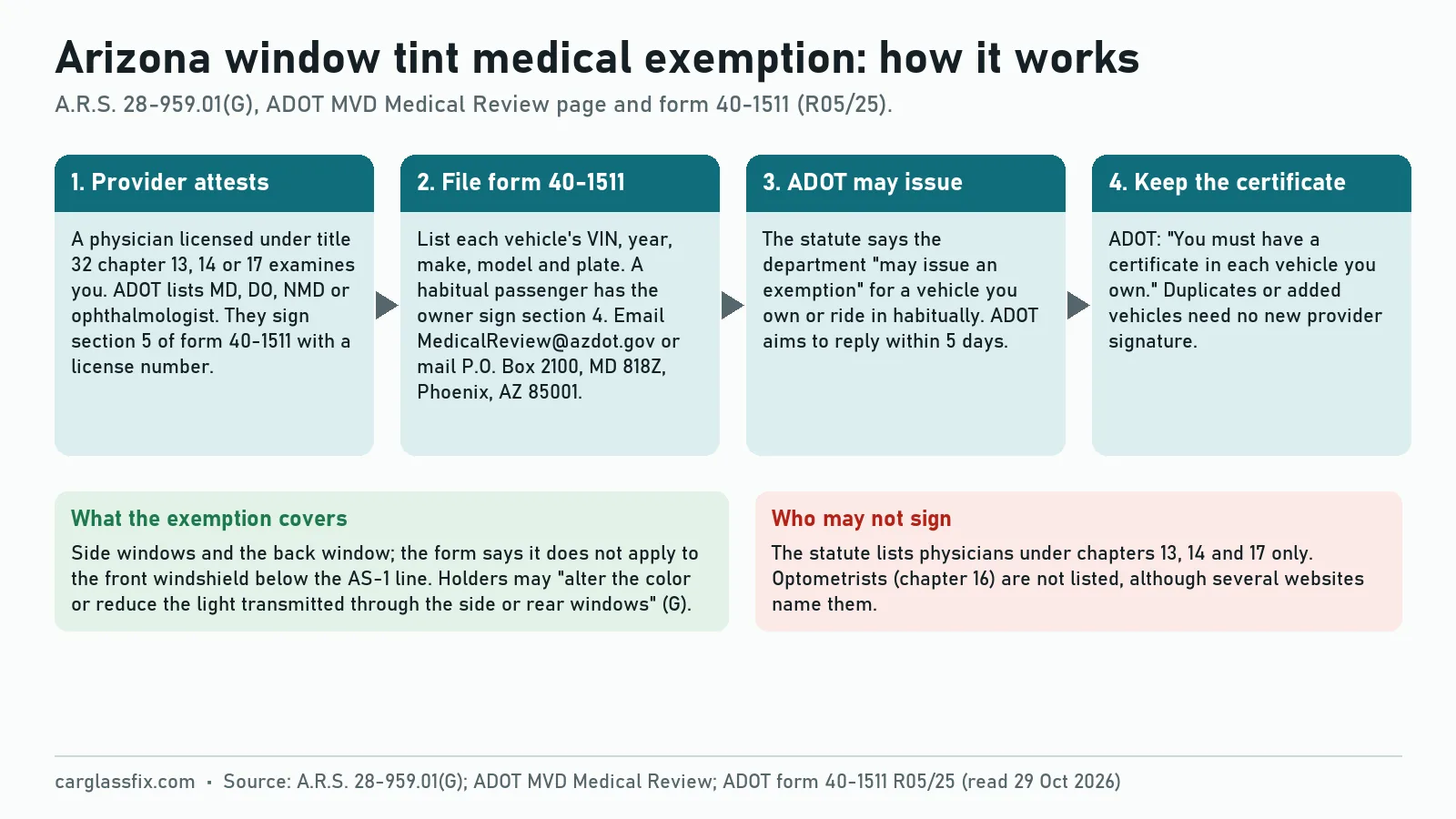
The form is 40-1511, Application for Window Tint Medical Exemption, revision 05/25. The provider must give a state license number and attest that “eye protective devices will not provide adequate protection”. The form limits the exemption to the side windows, the back window and the area above the AS-1 line, and adds that tinting “does not apply to the front windshield”.
How to apply for an Arizona window tint medical exemption
See a qualifying provider
An MD, DO, NMD or ophthalmologist examines the applicant and signs section 5 of form 40-1511 with a license number.
Complete the vehicle sections
List the VIN, year, make, model and plate of each vehicle; a habitual passenger has the registered owner sign section 4.
Send the form to ADOT Medical Review
Email it to MedicalReview@azdot.gov or mail it to Motor Vehicle Division, P.O. Box 2100, Mail Drop 818Z, Phoenix, AZ 85001. ADOT aims to reply within 5 days.
Keep the certificate in every vehicle
ADOT requires a certificate in each vehicle you own that carries the darker tint.
Add or replace later without a new signature
The form’s duplicate and add-or-remove-vehicle option does not need the provider to sign again.
Tint tickets in Arizona: what the statute does and does not say
An Arizona tint ticket is a civil traffic violation with a penalty capped at $250 before surcharges. Section 28-959.01 itself sets no fine, even though its title includes the word “violation”. The classification comes from 28-121(B), which makes a breach of chapter 3 of the transportation title “a civil traffic violation unless the statute defining the violation provides for a different classification”. The ceiling comes from 28-1598: a civil penalty “shall not exceed two hundred fifty dollars”, and the court must add the surcharges in 12-116.01 and 12-116.02. Each court sets its own schedule inside that cap, so the figure on a citation varies by city and county.
The statute contains no inspection step, no fix-it procedure and no removal order, so enforcement rests on traffic stops, where an officer meters the window. Whether a court dismisses a citation after the film comes off is up to that court. The statute carries no out-of-state exemption, so a visitor’s car is subject to subsections (B) and (C) on Arizona roads. For the general picture across states, see what car window tint is legal.
Arizona heat, tint, and what older pages get wrong
Arizona drivers tint for heat first, and the law decides where heat-blocking film can go. NHTSA reports that the temperature inside a car “can reach over 115 degrees when the outside temperature is just 70 degrees”. Any darkness is legal behind the driver, so the rear seats and cargo area can carry the darkest film. The front side windows must stay inside the 33% band, so a heat-rejecting film there has to work through infrared rejection, not darkness. How much film cuts cabin heat is covered in does car window tint help with heat.
Several claims in the Arizona search results do not match the statute. Pages that put the windshield limit at the AS-1 line or the top 5 inches are quoting other states. A Bing AI answer checked for this page said the strip must pass 70% of light and named an optometrist as a signer; the statute has no strip figure and lists only physicians. One aggregator says film makers “don’t need to certify” their film; subsection (D) says the opposite. A shop chart says a sticker is required; the statute asks for none. We found no 2025 or 2026 bill amending 28-959.01. Rules change, so check the current statute or ADOT MVD before you tint. This article is general information, not legal advice.
Frequently asked questions
How dark can tint be in Arizona?
Front side windows must read 33% light transmission, plus or minus 3%, with the glass. Side windows behind the driver and the rear window may be any darkness as long as reflectance stays at 35% plus or minus 3% or less, and the rear window is fully exempt with an outside mirror on each side.
Is 20% tint legal in Arizona?
A 20% reading is illegal on the front side windows, which must fall in the 33% plus or minus 3% band. It is legal on every window behind the driver. The window tint percentage chart shows how 20% compares with 33%.
Can you tint a windshield in Arizona?
Only a strip across the top whose bottom edge is at least 29 inches above the undepressed driver’s seat, and it may not be red or amber. Film below that line reduces light transmittance and is barred by A.R.S. 28-959.01(C), and the ADOT exemption form says the medical exemption does not cover the windshield.
Do you need a tint sticker or certificate in Arizona?
No. A.R.S. 28-959.01 requires no label, sticker or installer certificate on the vehicle. The only document is the ADOT medical exemption certificate, which must be kept in each exempt vehicle.
Is 20% window tint darker than 35%?
Yes. The percentage is the share of visible light that passes through, so a 20% film lets through less light than a 35% film. In Arizona, 35% sits inside the legal front side band and 20% does not.
Sources
- Arizona Revised Statutes 28-959.01, Materials on windows or windshield; exceptions; requirements; violation; definitions (checked 29 October 2026)
- Arizona Revised Statutes 28-121, Violation; classification; civil traffic violation; surcharge (checked 29 October 2026)
- Arizona Revised Statutes 28-1598, Maximum civil penalty (checked 29 October 2026)
- ADOT MVD: Medical Review, window tinting exemption (archived copy of 21 May 2026 read; the live site uses a bot check)
- ADOT form 40-1511, Application for Window Tint Medical Exemption (R05/25) (archived copy of 14 July 2025 read)
- NHTSA: Help Prevent Hot Car Deaths (archived 2026 copy read)

Similar Posts