New York Window Tint Laws: The 70% Rule by Window
Senior Automotive Glass Diagnostic Specialist & Master Technician at CarGlassFix · AGSC Master Certified Auto Glass Technician, NGA Certified Installer, I-CAR Automotive Safety Specialist · 12+ Years in Automotive Glazing, Windshield Structural Bonding, ADAS Camera Calibration & Precision Chip Restoration
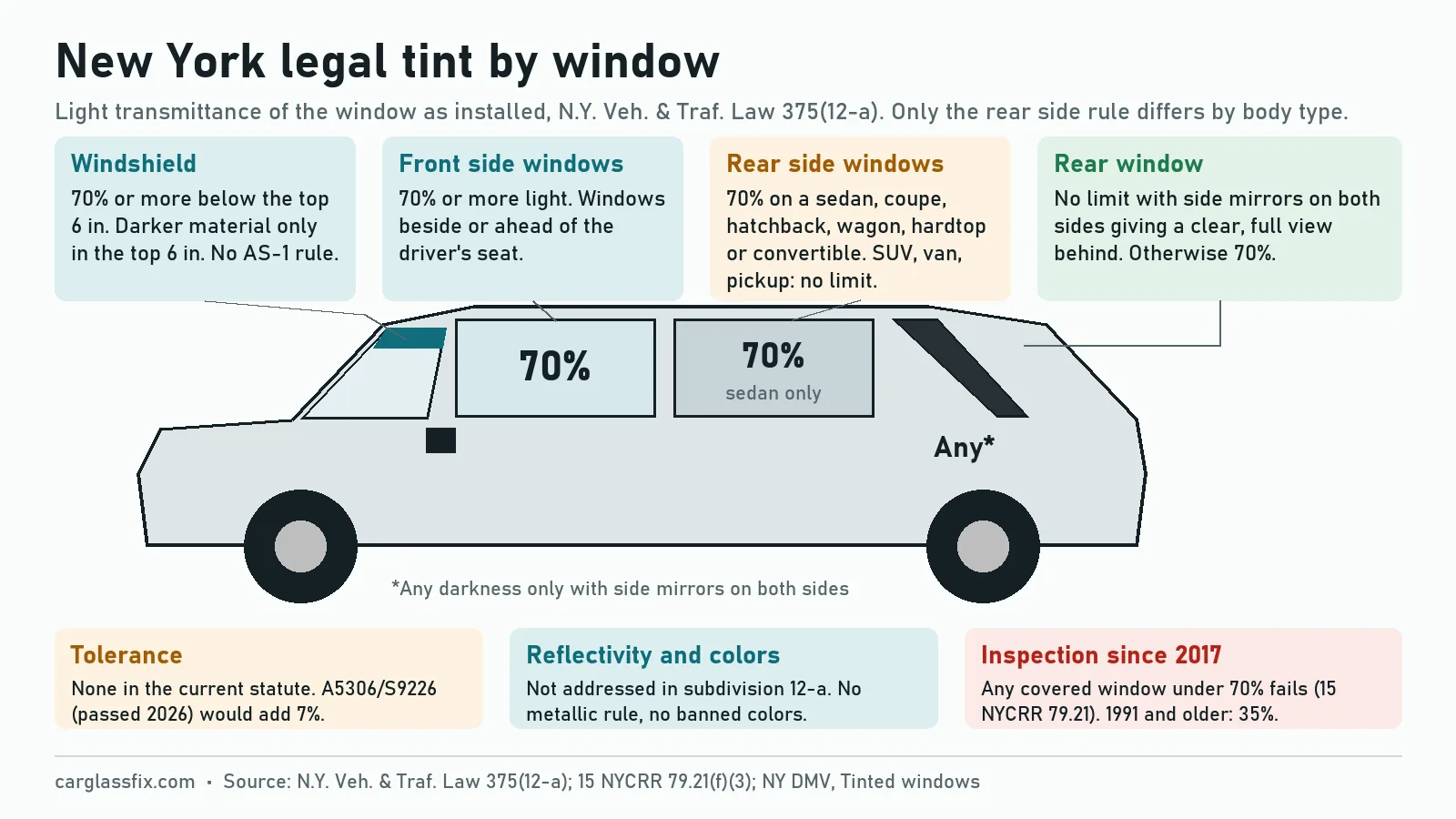
New York window tint laws require the windshield and the front side windows to pass at least 70% of light. Rear side windows must also pass 70% on a sedan, coupe, hatchback, convertible, hardtop or station wagon, but not on an SUV, van or pickup. The rear window may be darker if the vehicle has side mirrors on both sides.
New York window tint limits by window
New York sets one number, 70% light transmittance, and applies it to a different set of windows depending on the body type. The rule is Vehicle and Traffic Law 375(12-a)(b). Paragraph (b)(1) covers the windshield, (b)(2) the “sidewings or side windows” that are “forward of or adjacent to the operator’s seat”, (b)(3) the rear side windows, and (b)(4) the rear window. The rear side limit applies only if the vehicle “is classified as a station wagon, sedan, hardtop, coupe, hatchback or convertible”. The DMV says that means a vehicle labelled “Passenger Car” on the federal ID label on the left front door. An SUV, van or pickup carries a different class on that label, so its rear side windows have no limit. The rear window on any vehicle may go below 70% if it “is equipped with side mirrors” on both sides that give the driver a clear and full view behind. Without both mirrors, the rear window must pass 70% too.
| Window | Sedan (Passenger Car label) | SUV, van, pickup |
|---|---|---|
| Windshield | 70% or more below the top 6 inches; darker material only in the top 6 inches | Same |
| Front side windows (beside or ahead of the driver’s seat) | 70% or more | Same |
| Rear side windows | 70% or more | Any darkness |
| Rear window | Any darkness with side mirrors on both sides; otherwise 70% or more | Same |
| Reflectivity and colors | Not addressed in the statute | Same |
| Tolerance | None in the current statute | Same |
How New York measures the 70% rule
New York measures the window as it is, so the 70% figure is the reading of film and glass together. The statute bars a window “composed of, covered by or treated with any material which has a light transmittance of less than seventy percent”, and the inspection regulation tells the inspector to reject a window if “any part” of it reads below the threshold. Nothing in subdivision 12-a allows a tolerance. Factory glass already blocks a few percent of light, so a film sold as 70% usually reads below 70% once installed.
The glass-times-film math is in our guide on how to measure window tint, and the window tint percentage chart shows what 70% looks like next to darker shades. Inspectors do not meter every car. The regulation says that if a window “through observation, clearly meets the required visible light transmittance standard”, the tint meter is not needed. A borderline window gets a reading. A window tint meter shows the same net figure before an inspection or a stop. Subdivision 12-a names no reflectance limit and no banned colors. Tint shop pages that list a “no metallic or mirrored appearance” rule for New York are not quoting the statute.
Windshield tint in New York: the top 6 inches
A New York windshield may carry tint under 70% only in the “uppermost six inches of the windshield”. Below that strip, the glass must pass 70% of light. The statute does not mention the AS-1 line, which many other states use as the limit; New York measures 6 inches from the top. The inspection regulation repeats the rule as “any part of the windshield below the top 6 inches” under 70% is a reject. A clear film is not addressed by name, so a film that keeps the whole windshield at or above 70% is within the wording, while a darker ceramic film is not.
Paragraph (a) of subdivision 12-a adds a second rule for the same glass. No sign, poster or other nontransparent material may sit on the windshield or the front side windows, except papers the law requires to be displayed, such as the inspection and registration stickers. The medical exemption, covered below, can lift the 70% rule for the windshield, but it does not lift the ban on nontransparent material. For how other states treat windshield film, see is it illegal to have tint on a windshield.
The annual inspection tint check since 2017
Since January 1, 2017, a New York safety inspection has failed any vehicle with a covered window under the legal transmittance. Vehicle and Traffic Law 301(c)(1)(a) lists among the inspected items “any window which is composed of, covered by or treated with any material which has a light transmittance of less than seventy percent pursuant to section three hundred seventy-five”. The DMV describes the change as “an examination of tinted or shaded windows”. The procedure is in the inspection regulation, 15 NYCRR 79.21(f)(3), amended effective March 15, 2017.
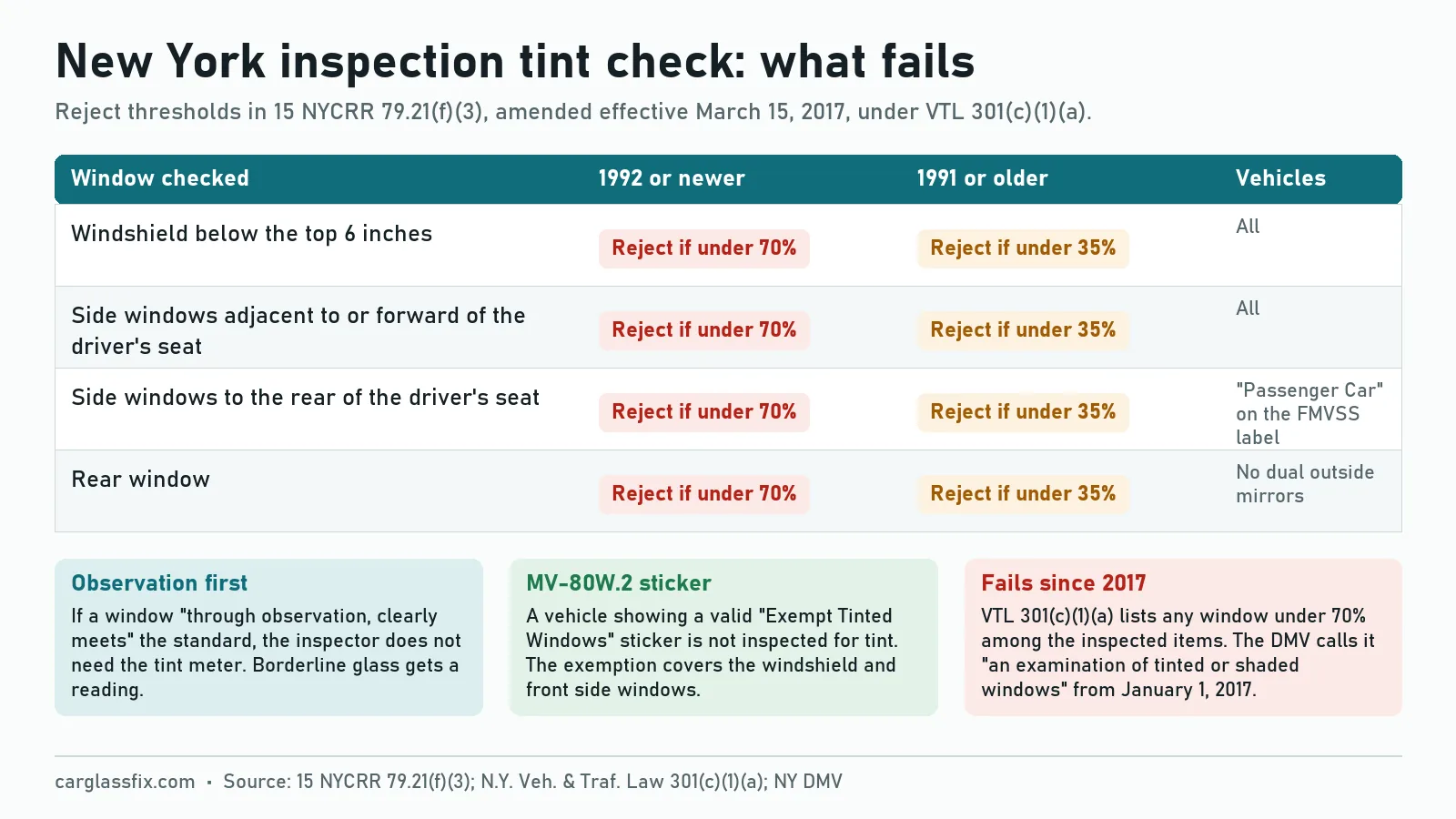
The inspector checks the windshield, every side window “adjacent to or forward of the driver’s seating position”, the rear side windows on a vehicle classified “Passenger Car” on the FMVSS certification label, and the rear window on a vehicle “not equipped with dual outside rearview mirrors”. For a 1992 or newer vehicle the reject point is 70%. For a 1991 or older vehicle the regulation sets 35%, which carries over the grandfather clause in 375(12-a)(e) for cars whose windows met the old law on December 31, 1991. A vehicle showing a valid MV-80W.2 “Exempt Tinted Windows” sticker is not inspected for tint. The NYS DMV channel published a short video, “New Window Tinting Law”, when the check began.
New York medical exemption: form MV-80W
New York grants a tinted window exemption through the DMV on form MV-80W, and the exemption lifts only the windshield and front side window limits. Subdivision 12-a(c) covers “any person required for medical reasons to be shielded from the direct rays of the sun”, as driver or as a regular passenger, and exempts that person’s vehicle from paragraphs (b)(1) and (b)(2). The rear side and rear window rules stay in force. The statute asks for a physician’s or nurse practitioner’s statement; the current form, MV-80W (6/24), also accepts a physician assistant. The condition must be on the Health Department list: albinism, chronic actinic dermatitis, dermatomyositis, lupus erythematosus, porphyria, xeroderma pigmentosum, prolonged severe drug photosensitivity, photophobia from an eye or neurological disorder, or another condition causing severe photosensitivity.
How to apply for a New York tinted window exemption
Fill in page 1
The registrant completes page 1 of MV-80W. If the exemption is for a regular passenger, add that person’s details and how often they ride.
Get page 2 signed
A New York licensed physician, physician assistant or nurse practitioner completes page 2 within 60 days of the exam, naming the condition, the minimum light transmission required and why sunscreen, clothing or clear UV film is not enough.
Enclose two copies
Add a copy of the provider’s New York professional license and a photocopy of the vehicle registration.
Mail it to Albany
Send everything to the DMV Driver Regulation Bureau, Medical Review Unit, 6 Empire State Plaza, Room 337, Albany NY 12228.
Fit the sticker
The DMV issues a “sufficiently noticeable sticker” for the window; the inspection regulation calls it the MV-80W.2 Exempt Tinted Windows sticker.
The form warns that a false statement is a class A misdemeanor under Penal Law 210.45. Paid online services that promise a New York exemption are not part of the DMV process.
Tint tickets in New York: fines and what a stop needs
A New York tint ticket is a traffic infraction, and Vehicle and Traffic Law 1800 sets the fine at “not more than one hundred fifty dollars” for a first conviction. Subdivision 12-a itself names no fine, so the general penalty applies. Section 1800(a) makes it a traffic infraction “to violate any of the provisions of this chapter” unless the chapter declares the act a misdemeanor or felony. A second conviction within 18 months allows a fine of up to $300, and a third within 18 months up to $450, each with possible jail time. Pages that quote a flat “$150 to $300” figure are citing the first two caps without their conditions.
After a charge, 375(12-a)(d) lets the commissioner test the window and affix a label if it conforms. Police must also have a basis for the stop. In People v Nektalov (May 16, 2024), the Court of Appeals threw out a stop where the detective said only that the windows were “excessively tinted”. The court listed what would have sufficed: testimony that the officer could not see into the car, training and experience in tint stops, or a meter reading taken after the stop.
The 2026 bill to drop the limit to 50%, and what older pages get wrong
New York’s 70% limit is still the law on October 29, 2026, but a bill to cut it to 50% has passed both houses. Assembly bill A5306, with Senate companion S9226, passed the Assembly on February 24, 2026 and the Senate on June 2, 2026 by 50 votes to 11. The bill pages show no delivery to the Governor, signature or veto, and the statute text revised on August 28, 2026 still says “seventy percent”. The bill would set 50% for the front side, rear side and rear windows, keep 70% for the windshield, give commissioner measurements “a tolerance of plus or minus seven percent”, remove the rear window mirror exception, and take effect 60 days after becoming law.
Older pages carry three errors. The rear window is not simply “any darkness”; the mirror condition applies. There is no general tint sticker or installer label; the law’s only stickers are the exemption sticker and the post-charge conformity label. Points and reflectivity rules appear on shop pages without a source. Our window tint simulator previews 70% against darker shades, and what car window tint is legal compares New York with the other states. Rules change; check the current Vehicle and Traffic Law 375 or the New York DMV before you tint. This article is general information, not legal advice.
Frequently asked questions
Is 35% tint legal in New York?
No on the windshield, front side windows, or a sedan’s rear side windows, where 70% is the minimum. It is legal on the rear side windows of an SUV, van or pickup, and on any rear window if the vehicle has side mirrors on both sides.
Is 5% tint legal in New York?
Only on windows the 70% rule does not reach: the rear side windows of an SUV, van or pickup, the rear window of a vehicle with two side mirrors, and the top 6 inches of the windshield. Everywhere else it fails the statute and the inspection.
Can you tint the windshield in New York?
Only the top 6 inches may go below 70% light transmittance. The rest of the windshield must stay at 70% or above, and the statute does not use the AS-1 line as the boundary.
Will tinted windows fail inspection in New York?
Yes, since January 1, 2017. Under 15 NYCRR 79.21 the inspector rejects a 1992 or newer vehicle if any covered window reads under 70%, unless the car shows a valid MV-80W.2 exemption sticker. The window tint percentage chart shows how 70% compares with common shades.
How do I get a tint exemption in New York?
Send form MV-80W, with page 2 signed by a New York licensed physician, physician assistant or nurse practitioner, plus a copy of the provider’s license and your registration, to the DMV Medical Review Unit in Albany. The exemption covers only the windshield and front side windows.
Sources
- N.Y. Vehicle and Traffic Law 375, subdivision 12-a (tinted windows) (revision of 28 August 2026, checked 29 October 2026)
- N.Y. Vehicle and Traffic Law 301, inspection of motor vehicles (checked 29 October 2026)
- N.Y. Vehicle and Traffic Law 1800, penalties for traffic infractions (checked 29 October 2026)
- 15 NYCRR 79.21, Inspection of motor vehicles, subdivision (f)(3) window tint (amended effective 15 March 2017; checked 29 October 2026)
- New York DMV: Tinted windows (checked 29 October 2026)
- New York DMV form MV-80W, Application for Tinted Window Exemption (6/24) (checked 29 October 2026)
- New York Assembly bill A5306 (2025-2026) and Senate bill S9226 (checked 29 October 2026)
- People v Nektalov, 2024 NY Slip Op 02725, New York Court of Appeals (16 May 2024)
- NYS DMV: New Window Tinting Law (video)

Similar Posts