Wiper Blade Size Finder: What Size Do You Need?
Senior Automotive Glass Diagnostic Specialist & Master Technician at CarGlassFix · AGSC Master Certified Auto Glass Technician, NGA Certified Installer, I-CAR Automotive Safety Specialist · 12+ Years in Automotive Glazing, Windshield Structural Bonding, ADAS Camera Calibration & Precision Chip Restoration
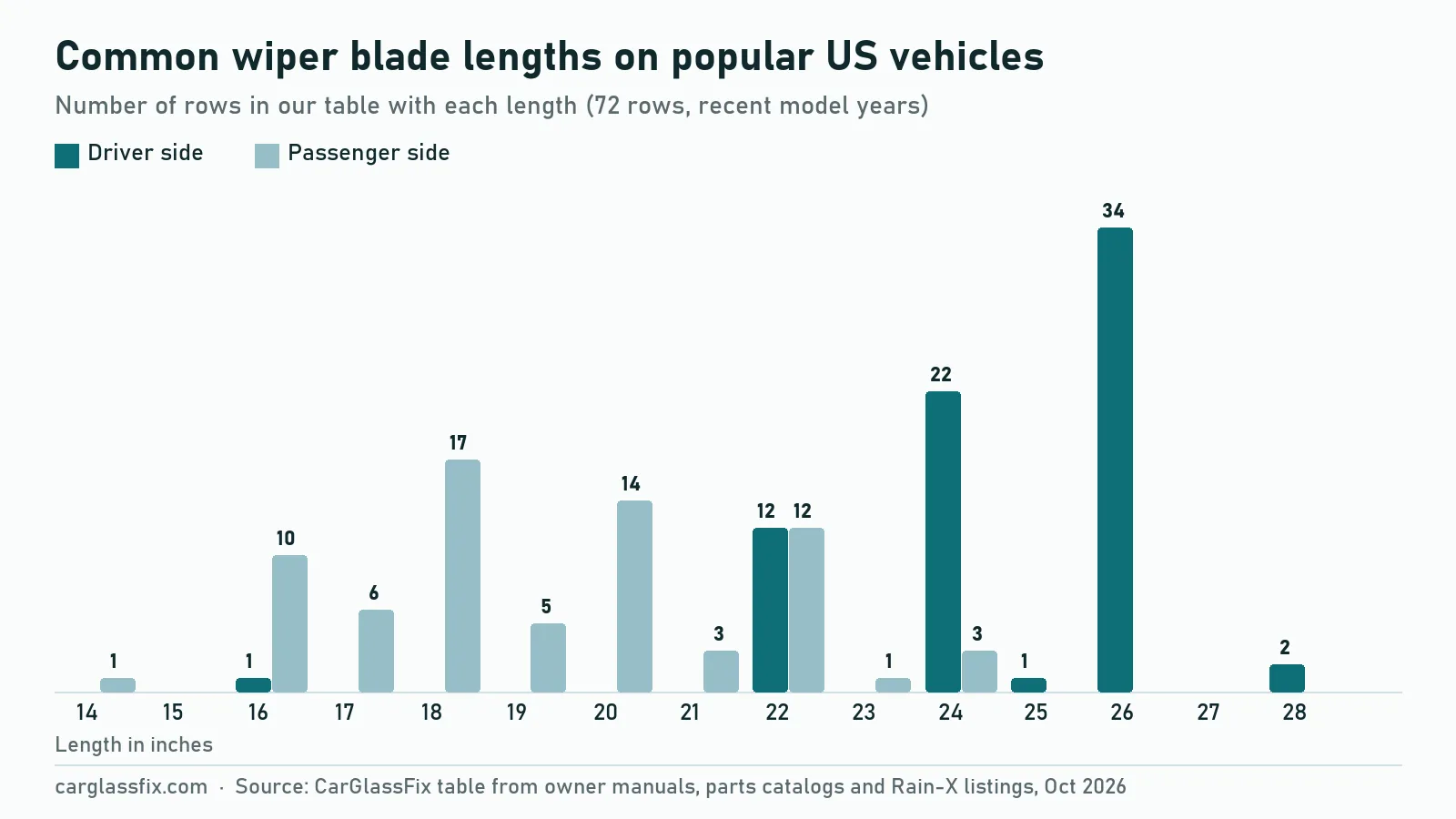
The wiper blade size you need depends on your make, model and year, and the driver and passenger sides often differ. Most popular US vehicles here use 22 to 26 inches on the driver side and 16 to 22 inches on the passenger side. Choose your vehicle below to see both lengths.
Sizes are nominal lengths. Trim and body style can change them, so confirm in your owner’s manual or on your old blades before you buy. Your car not listed? Measure your old blades with the steps below.
How to find what size wiper blades you need
You find your wiper blade size in the size finder above, your owner’s manual or on your old blades. Trico names the same routes: the owner’s manual, measuring the blade, a dealer or manufacturer parts database, and a maker’s lookup tool. Rain-X and ANCO also offer lookups by make, model and year.
The owner’s manual is the first place to check, because it describes your own vehicle. Some manuals no longer print lengths. GM manuals up to 2024 list lengths, while several 2025 GM manuals tell owners to see a dealer. Ford lists part numbers in the Motorcraft Parts section of the manual, under Capacities and Specifications.
Our finder covers 59 popular models. Each result names its source. If your vehicle is missing, measure the old blades with the steps in this guide. Once you have the size, the guide on how to replace windshield wiper blades covers the swap.
Wiper blade sizes for popular vehicles
Popular US vehicles usually use a long driver blade and a shorter passenger blade. Full-size pickups are the common exception, and several use two equal blades. This table shows ten examples from the finder.
| Vehicle | Driver | Passenger | Rear |
|---|---|---|---|
| 2018-2024 Toyota Camry | 26 in | 20 in | Not listed |
| 2019-2025 Toyota RAV4 | 26 in | 16 in | Not listed |
| 2022-2024 Toyota Corolla | 28 in | 14 in | Not listed |
| 2022-2025 Honda Civic Sedan | 24 in | 19 in | Not listed |
| 2023-2025 Honda CR-V | 24 in | 19 in | 10 in |
| 2021-2025 Ford F-150 | 22 in | 22 in | Not listed |
| 2020-2024 Chevrolet Silverado 1500 | 22 in | 22 in | Not listed |
| 2019-2025 Ram 1500 | 24 in | 24 in | Not listed |
| 2018-2025 Jeep Wrangler | 16 in | 16 in | Not listed |
| 2019-2025 Nissan Altima | 26 in | 17 in | Not listed |
“Not listed” means our sources did not confirm a rear size for that row. It does not mean the vehicle has no rear wiper. The Silverado figures come from GM manuals and the CR-V and Civic figures from an OEM Honda parts catalog. Rain-X vehicle listings supply the others.
How to measure your old wiper blades
You measure a wiper blade along the rubber, from end to end. Trico says to measure the rubber blade and not the metal frame, and to measure both sides. Round to the nearest whole inch, because blades are sold by nominal length.
How to measure a wiper blade
Lift the arm
Raise the wiper arm away from the glass with the car off.
Measure the rubber
Run a tape along the rubber from tip to tip.
Measure the other side
Repeat on the passenger side, because the lengths often differ.
Check the rear
Measure the rear blade separately if your vehicle has one.
Note the connector
Look at where the blade meets the arm, and take a photo.
Old blades can be the wrong size if a past owner fitted them, so compare the result with the finder or the manual. Write down both lengths and the model year before you shop. Keep the old blades until the new ones fit, so you can compare them side by side. If your wipers stop working or leave marks after the swap, read how to fix windshield wipers.
Why driver and passenger blades are different lengths
Driver and passenger blades differ on most vehicles in our table. Trico notes that the two sides often differ, and 60 of our 72 rows confirm it. Check each side before you buy a pair.
A few vehicles break the pattern. The Silverado 1500, Sierra 1500, Tahoe, Yukon, F-150, Ram 1500, Tundra and Wrangler all list equal lengths in our table. The gap can also be large. The Toyota Corolla row lists 28 inches and 14 inches. Rear blades are separate again, and the rows that list one range from 10 to 16 inches.
Fit also differs inside one model. Honda’s Civic hatchback has a rear blade that the sedan does not, so the finder lists them apart. The CR-V changed its front sizes between 2022 and 2023. Always match the exact model year and body style.
Connector types: length is not the only fit
A wiper blade must match the arm connector as well as the length. Trico lists hook, bayonet and pinch tab among the attachments to match. Toyota, Trico, ANCO and Bosch documents also name side pin, side lock, push button and top lock styles.
Tesla warns that a different connector may stop the blade from connecting to the arm. Most aftermarket blades include adapters, so one blade can often fit several arms. Rear blades have their own connectors, and ANCO lists 12. Check the package or the maker’s fit guide before you buy.
GM’s manual says replacement blades come in different types and are removed in different ways. That is a good reason to look at your arm before you pull the old blade off.
What happens if you use the wrong size
The wrong size can reduce your view or damage the wiper system. Trico says short blades compromise visibility and blades that are too long can scratch your windshield. A Ford Everest manual, written for a non-US model, warns that blades of the wrong length can clash and damage the wiper system.
Tesla’s Model 3 manual also says inappropriate blades can damage the wiper system and windshield. Stay with the listed length unless your manual allows another. A one-inch change is not something our sources approve, so ask the blade maker’s fit guide first.
Streaks and noise can come from wear rather than size. See how to fix wiper marks on a windshield, how to check windshield wipers for wear and how to stop windshield wipers from squeaking.
How we built the size finder
We built the finder from pages and manuals we opened on October 31, 2026. Automaker sources come first where we could read them: GM owner manuals and Tesla manuals. Honda and Subaru rows use dealer-run OEM catalogs that print lengths in millimeters, converted at 25 mm to the inch. Most other rows use Rain-X vehicle listings.
A blade maker’s listing shows the blade it sells to fit, which may differ from the factory length. Where we could compare, Rain-X matched OEM data on 11 of 14 checks and was one inch off on the others. The finder shows a warning on rows where sources disagree. Year ranges come from sampled years, usually the first, a middle and the last. Models we could not verify are left out, including the 2021 to 2025 Nissan Rogue.
Frequently asked questions
What size wiper blades do I need?
Your size depends on your make, model and year. Use the finder on this page, your owner’s manual or a tape measure on your old blades. Check both sides, because the lengths often differ.
Are driver and passenger wiper blades the same size?
Usually not. 60 of the 72 rows in our table list different lengths. Full-size pickups such as the F-150 and Silverado 1500 are common exceptions, with equal blades.
Can I use a wiper blade one inch longer?
Our sources do not approve it. Trico warns that blades that are too long can scratch the windshield. Stay with the listed length, or check the blade maker’s fit guide for your vehicle.
How do I measure a wiper blade?
Measure the rubber from tip to tip, not the metal frame. Measure each side separately, and round to the nearest whole inch. Note the connector type at the same time.
Where is the wiper size in the owner’s manual?
Look for a maintenance, replacement parts or capacities section. GM manuals up to 2024 list lengths under maintenance replacement parts. Ford points owners to Motorcraft Parts under Capacities and Specifications.
Sources
- Trico: wiper blade size guide
- Trico: how to replace your windshield wipers
- Ford: how do I change my windshield wiper blades?
- Rain-X: choosing the right size
- ANCO: FAQ
- ANCO: rear blade installation
- GM owner manuals, Tesla owner’s manuals, Honda and Subaru parts catalogs and Rain-X vehicle listings, linked for each vehicle in the finder

Similar Posts