Ceramic vs Carbon Tint Comparison: Price and Heat Tool
Senior Automotive Glass Diagnostic Specialist & Master Technician at CarGlassFix · AGSC Master Certified Auto Glass Technician, NGA Certified Installer, I-CAR Automotive Safety Specialist · 12+ Years in Automotive Glazing, Windshield Structural Bonding, ADAS Camera Calibration & Precision Chip Restoration
Ceramic tint costs about $150 to $250 more than carbon tint on a sedan, based on 2026 published ranges. Heat rejection depends on the film line. SunTek Carbon 35 rejects 38% of solar energy and SunTek CIR 30 rejects 55%, while SunTek CXP, a carbon line, reaches 53%.
| Compared |
|---|
Price ranges are the same TintFinder 2026 ranges used in the window tint cost calculator. Heat figures are total solar energy rejected (TSER) from each maker’s sheet, checked October 31, 2026. Shade numbers are product names, so the real VLT is shown. This is not a quote.
How the ceramic vs carbon tint comparison works
The ceramic vs carbon tint comparison pairs a price gap for your vehicle with heat figures for two film lines. Choose a vehicle, a shade, one carbon line and one ceramic line. The tool then shows the price range for each film type and the total solar energy rejected (TSER) by each line.
Price ranges come from the TintFinder guide and match our window tint cost calculator. They describe a film type on a vehicle, and they are not prices for a named line. Heat figures come from each maker’s own sheet, and the test basis is shown beside them.
Shade names are product names, so the tool shows measured light transmission too. CIR 30 lets through 33% of visible light, and Carbon 35 lets through 36%. SunTek has no CIR 35, so CIR 30 is the nearest match at that shade. The price gap is a planning figure, and a local shop sets the final price.
Heat rejection by film line at about 35%
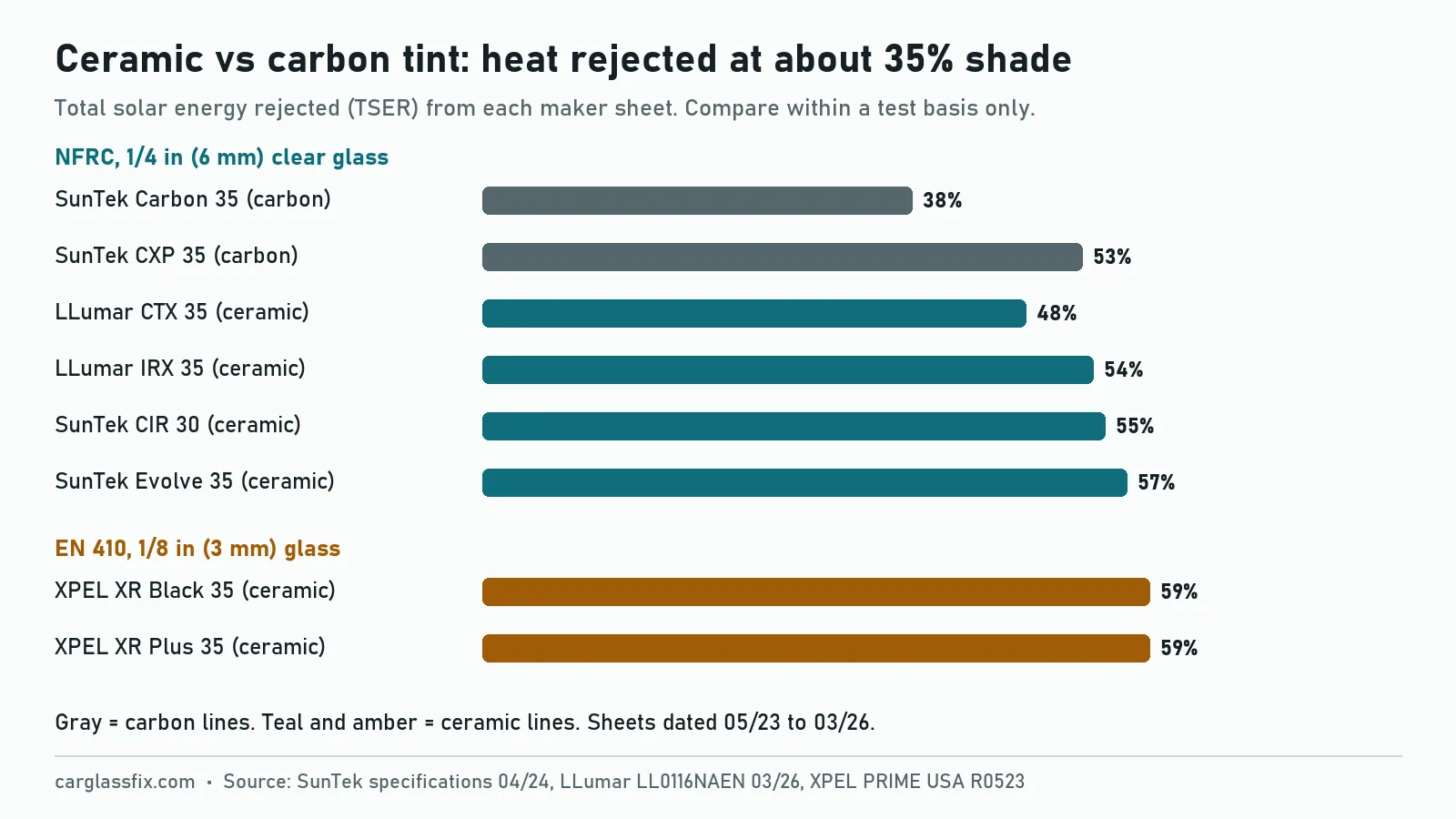
Heat rejection changes more between film lines than between the words carbon and ceramic. The sheets below list TSER, which counts all solar energy the film stops. The range among these lines runs from 38% to 59%.
| Film line | Type on the sheet | VLT | TSER | Test basis |
|---|---|---|---|---|
| SunTek Carbon 35 | Carbon | 36% | 38% | NFRC, 6 mm clear glass |
| SunTek CXP 35 | CarbonXP | 33% | 53% | NFRC, 6 mm clear glass |
| LLumar CTX 35 | Ceramic | 37% | 48% | NFRC, 6 mm clear glass |
| LLumar IRX 35 | Infrared-rejecting ceramic | 39% | 54% | NFRC, 6 mm clear glass |
| SunTek CIR 30 | CeramicIR | 33% | 55% | NFRC, 6 mm clear glass |
| SunTek Evolve 35 | Evolve series | 38% | 57% | NFRC, 6 mm clear glass |
| XPEL XR Black 35 | Ceramic, per Tint Man FL | 36% | 59% | EN 410, 3 mm glass |
| XPEL XR Plus 35 | Ceramic, per Tint Man FL | 38% | 59% | EN 410, 3 mm glass |
SunTek’s two carbon lines show why the line name matters. CXP 35 rejects 15 more points than Carbon 35. It also sits 2 points under CIR 30. Our guide to the best car window tint for heat rejection covers more shades.
Ceramic vs carbon tint price by vehicle
Ceramic costs about $100 to $400 more than carbon, depending on the vehicle. The table uses TintFinder’s 2026 ranges for side windows and the rear window. The gap column subtracts low from low and high from high, and that arithmetic is ours.
| Vehicle | Carbon | Ceramic | Gap |
|---|---|---|---|
| Coupe | $200 to $350 | $300 to $550 | $100 to $200 |
| Sedan | $250 to $450 | $400 to $700 | $150 to $250 |
| Pickup truck | $280 to $480 | $450 to $750 | $170 to $270 |
| SUV | $350 to $550 | $500 to $900 | $150 to $350 |
| Van | $400 to $600 | $600 to $1,000 | $200 to $400 |
TintFinder lists the van ceramic figure as $1,000 or more, so a large van can pass it. Shades do not usually move these prices. Tint Man FL says darkness does not affect its price, except 5% limo. The full ceramic price picture sits in our guide on how much ceramic car window tint costs.
What shops charge for carbon and ceramic
Shops that post both films show gaps from $50 to about $200. The figures below are examples from single markets. Each one names the job it covers, because the jobs differ.
| Shop and place | Job | Carbon | Ceramic | Gap |
|---|---|---|---|---|
| MK Auto Design, Tulsa, OK | Full vehicle | SunTek Carbon $275 | SunTek CIR from $415 | $140 |
| MK Auto Design, Tulsa, OK | Full vehicle | SunTek CXP from $305 | SunTek CIR from $415 | $110 |
| Galaxi Sound, Miami, FL | Sedan | About $329 | About $499 | About $170 |
| Galaxi Sound, Miami, FL | SUV | About $379 | About $549 | About $170 |
| Chattanooga Auto Film, TN | Front two windows | From $99 | From $149 | $50 |
Some shops do not sell carbon at all. Blackout Window Tinting in Gilroy states that carbon has no price on its menu. Its $380 entry package is dyed LLumar ATC, so that step is dyed to ceramic. Galaxi Sound puts its own gap at $150 to $200, depending on the vehicle. Ask for the brand and series on any quote. A package called ceramic can mean several film lines at different prices.
Why TSER figures from different makers do not line up
TSER figures only compare fairly on one test basis. XPEL applies film to 3 mm glass and reports with the EN 410 method. LLumar and SunTek report on 6 mm clear glass under NFRC guidelines. The tool warns you when a pair crosses those two groups and stops showing a point gap.
Sheets carry their own limits too. XPEL lists a tolerance of plus or minus 3% on its values. SunTek says real performance varies with glass type and other factors. A film on your own glass will not match a lab sheet exactly.
Shop claims can sit far above a sheet. MK Auto Design advertises up to 80% heat rejection for CIR, while SunTek’s sheet tops out at 62% TSER for CIR 5. The shop page does not say what its figure measures, so look for TSER on the maker’s sheet. Our guide on whether car window tint helps with heat covers those measures.
How to choose between carbon and ceramic
Choose by the TSER you want at the shade your state allows, then compare price. Start with the legal shade, because lighter shades generally reject less heat. SunTek Carbon drops from 38% TSER at 35 to 31% at 55. The state tint law checker gives your limit.
Next, ask a shop for two lines from one maker. That keeps the test basis the same. On SunTek’s figures at about 35%, moving from Carbon to CIR adds 17 points. Moving from CXP to CIR adds 2 points. At MK Auto Design, the first step costs $140 and the second costs $110.
Carbon stays the lower-priced choice in every range above. Ceramic costs more on each list, and its advantage depends on which carbon line you compare. For a definition of the film, read what ceramic windshield tint is.
Frequently asked questions
How much more is ceramic tint than carbon?
TintFinder’s 2026 ranges put ceramic about $150 to $250 above carbon on a sedan and $150 to $350 above it on an SUV. Shop examples show gaps from $50 to about $200.
Is ceramic tint better than carbon for heat?
On SunTek’s sheet, CIR 30 rejects 55% of solar energy and Carbon 35 rejects 38%. SunTek CXP, also a carbon line, rejects 53%, so the line matters as much as the type.
Is ceramic tint worth it over carbon?
That depends on the two lines and the price gap. On SunTek’s figures, stepping up from basic Carbon adds 17 points for $140 at one shop, while stepping up from CXP adds 2 points for $110.
What is ceramic tint heat rejection percentage?
TSER on ceramic lines at about 35% runs from 48% (LLumar CTX) to 57% (SunTek Evolve) on the NFRC basis. XPEL lists 59% on a different test basis.
Sources
- SunTek automotive window film specifications, 04/24 (read 31 October 2026)
- LLumar performance data LL0116NAEN, 03/26 (read 31 October 2026)
- XPEL PRIME USA specification sheet, R0523 (read 31 October 2026)
- TintFinder: window tinting cost (read 31 October 2026)
- Tint Man FL: pricing (read 31 October 2026)
- Tint Man FL: film specs (read 31 October 2026)
- MK Auto Design: pricing (read 31 October 2026)
- Galaxi Sound: ceramic vs carbon window tint (read 31 October 2026)
- Chattanooga Auto Film: tint pricing (read 31 October 2026)
- Blackout Window Tinting: ceramic vs carbon (read 31 October 2026)

Similar Posts