How to Fix Wiper Marks on a Windshield: Clean, Then Check
Senior Automotive Glass Diagnostic Specialist & Master Technician at CarGlassFix · AGSC Master Certified Auto Glass Technician, NGA Certified Installer, I-CAR Automotive Safety Specialist · 12+ Years in Automotive Glazing, Windshield Structural Bonding, ADAS Camera Calibration & Precision Chip Restoration
To fix wiper marks on a windshield, clean the glass first and the blades second, then judge the parts. Remove wax, oil and road film until water stops beading, wipe the rubber with washer fluid or mild soapy water, and test with the washer. Marks that remain point to a worn blade, a faulty arm or a scratch.
How do you fix wiper marks on a windshield?
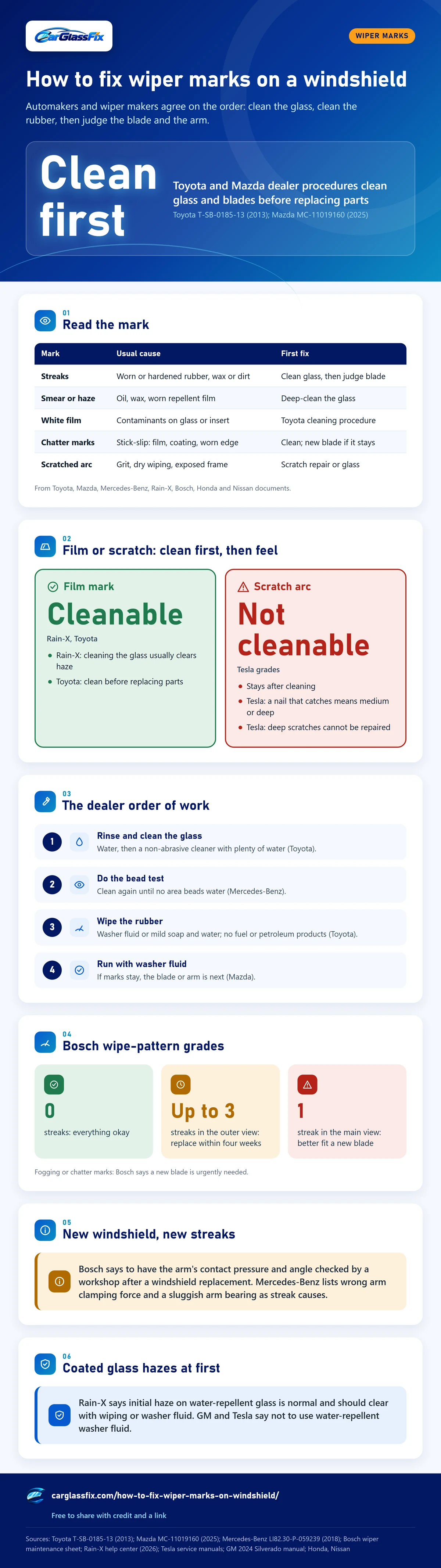
You fix wiper marks by removing whatever sits between the rubber and the glass, and only then replacing parts. Automakers write their dealer procedures in that order. Toyota’s technical service bulletin T-SB-0185-13 tells technicians to complete inspection and cleaning before deciding to replace wiper inserts or other wiper parts. Mazda’s bulletin MC-11019160 starts with cleaning the windshield and fitting new blades, then checks the arm only if the wiper still chatters.
Film is the first suspect in these documents. Toyota lists bugs, sap, road grime and car wax treatments on the rubber or the glass as causes of streaking, incomplete removal and a white film left behind. Mercedes-Benz names wax or dirt residue on the windshield as the first cause of streaking in its service document LI82.30-P-059239.
The order of work below follows those documents:
- Clean the glass until water no longer beads anywhere.
- Clean the blade rubber, unless your automaker says not to.
- Run the wipers with washer fluid and read the wipe pattern.
- Replace the blades if streaks stay on clean glass.
- Have the arm checked if new blades still leave marks.
- Treat marks that stay on clean glass as scratches.
What kind of wiper mark do you have?
The kind of mark tells you the likely cause: streaks and missed bands usually mean rubber or film, a greasy smear or haze means film on the glass, and a fixed arc means a scratch. Bosch, a wiper maker, uses the wipe pattern itself to decide when a blade has to go.
| Mark on the glass | Usual cause named by makers | First fix | Source |
|---|---|---|---|
| Thin streaks or unwiped bands | Hard, cracked or worn rubber; wax or dirt residue; ice in blade joints | Clean glass and rubber, then replace the blade | Toyota, Mercedes-Benz, Rain-X |
| Smear or haze across the sweep | Oil, wax, pollen or worn rain repellent film | Deep-clean the glass | Rain-X |
| White film left behind | Contaminants on the glass or the rubber insert | Toyota cleaning procedure | Toyota |
| Chatter marks (a stuttered, dashed pattern) | Stick-slip from oil film, uneven water repellent or a worn edge | Clean, then replace the blade if it stays | Mazda, Bosch |
| Fogging after each wipe | Blade at the end of its life | New blade | Bosch |
| Fixed arc you can see on dry glass | Grit, dry wiping or an exposed blade frame | Scratch repair or glass replacement | Honda, Nissan, Toyota |
How Bosch grades a wipe pattern
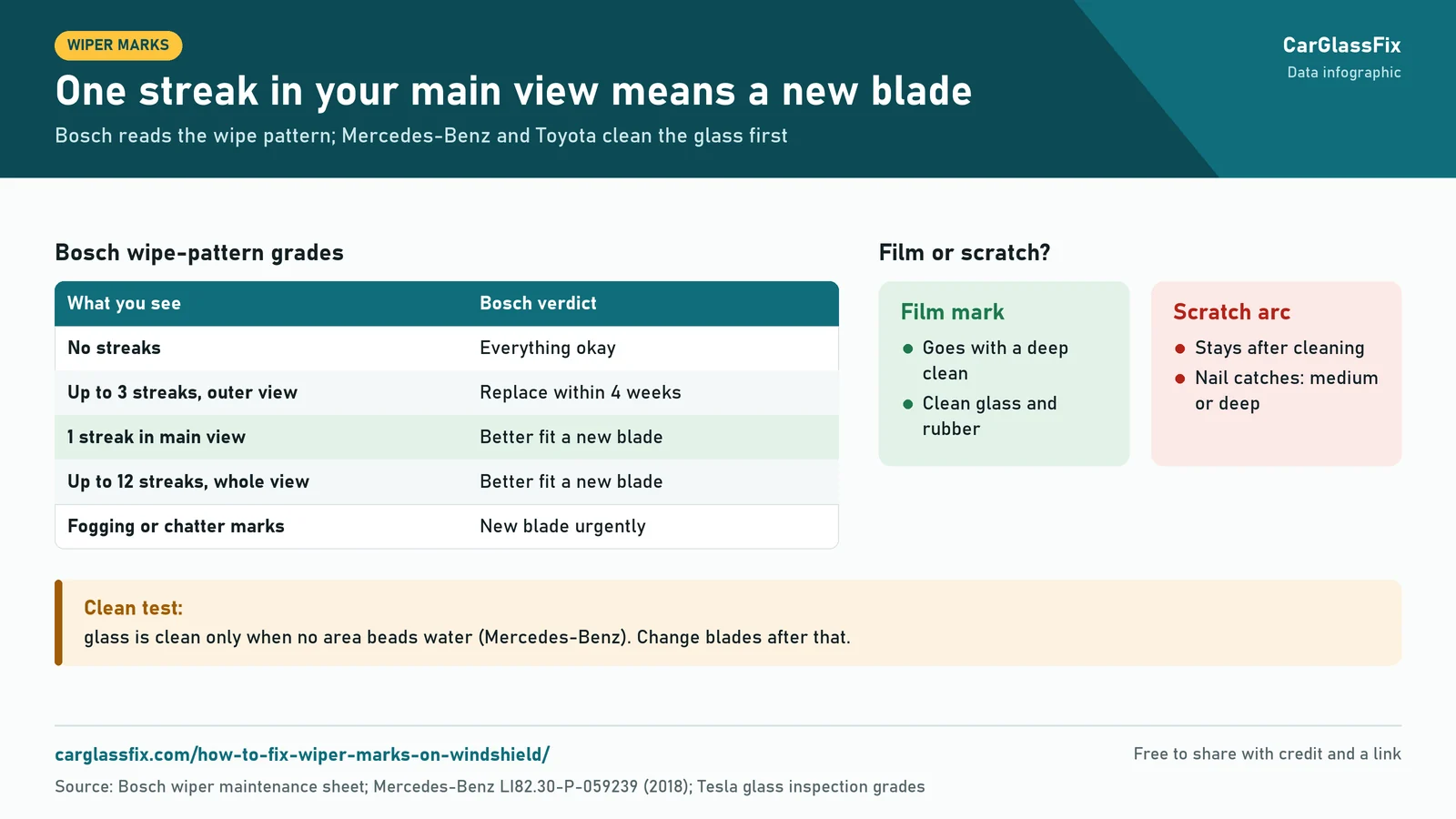
Bosch grades streaks by count and position in its wiper maintenance guide. No streaks means everything is okay. Up to three streaks in the outer field of view count as minor defects, and Bosch says to replace the blades within the next four weeks. One streak in the main field of view, four to five in the outer field, or up to 12 across the whole field means Bosch says it is better to install a new blade. Fogging and chatter marks mean a new blade is urgently needed.
Grade the pattern only on clean glass. A blade can look worn on a windshield that carries wax, and the same blade can wipe cleanly once the film is gone. Rain-X ties streaks to both causes: a squeegee that dries, hardens and cracks, and tree sap, road tar and other substances on the glass or the blade.
Film, wax and road grime on the glass
Film on the glass is the first cause automakers check, and it comes off with a thorough wash. Rain-X says road grime, oil, pollen, waxes and worn rain repellent can create a film that keeps the blade from getting a clean swipe. It links that film to streaking, smearing, skipping, chattering and squeaking.
Where the film comes from
Car washes are a named source. Mercedes-Benz says residues from car washing facilities can be identified by water beading, and that it is mostly wax residue from the wash system. The same document adds water-repellent nano-particle paint coatings and silicone-based washer fluid. Tesla’s Model S owner’s manual lists wax spray from car washes, bird droppings and tree sap as contaminants. Rain-X adds tree sap and road tar on the glass or the blade.
The water-beading test
The water-beading test tells you when the glass is truly clean. Mercedes-Benz tells technicians to check how water flows after cleaning and to repeat the cleaning until no area beads. It notes that a windshield can still have beading spots even though it appears to be clean. Mercedes-Benz also says to replace blades only once the windshield no longer has water-repellent areas. Wax on glass works against the wipers, which is why how to deep clean a windshield matters more here than a quick wipe.
Toyota’s bulletin gives the cleaning method in a few short steps:
How to clean the glass and blades to remove wiper marks
Rinse the glass
Rinse the windshield with water to float off loose grit before anything touches it.
Clean with a non-abrasive cleaner
Toyota names Bon Ami or an equivalent non-abrasive cleaner applied with a sponge, with plenty of water for any powder cleaner so it does not scratch.
Check for beading
Spray water and look for spots where it beads; clean those areas again until no area beads (Mercedes-Benz).
Wipe the rubber
Wipe the blade edge with a cloth or paper towel soaked in washer fluid or mild detergent and water; never fuel, kerosene or petroleum products (Toyota).
Test with washer fluid
Run the wipers with the washer and read the pattern; Tesla also cycles the wipers after cleaning with isopropyl alcohol wipes.
Check your own manual before you clean the rubber. Mercedes-Benz says not to clean its genuine blades during the intensive glass clean, because that damages their graphite coating. Toyota and Rain-X tell owners to wipe the rubber. For the wiping technique on the glass itself, see how to clean car windshield without streaks.
Water-repellent coatings and washer fluids
Water-repellent products on the glass or in the washer can leave haze and chatter marks, especially while they are new or wearing off. Rain-X says wiper blades can leave haze on a windshield that carries a water-repellent coating, including its own repellency treatments and repellent-coated blades. It says initial hazing on treated glass is normal and should disappear with wiping or washer fluid.
Uneven coatings cause a different mark. Mazda’s bulletin lists an uneven water-repellent treatment, an oil film and a worn or peeled blade edge as the conditions that make friction unstable. Mazda calls the result stick-slip: the blade sticks and slides in turn instead of moving smoothly, which shows as chatter. ANCO, a wiper maker, says a glass treatment may cause squeak or chatter and that the fix is to remove the product.
Washer fluid can add film every time you spray. GM’s 2024 Chevrolet Silverado 1500 owner’s manual says not to use water-repellent washer fluid because it can cause wiper chatter and skipping. Tesla tells Model S owners not to add washer fluid that contains water repellent or bug wash. Trico says silicone wiper blades can leave a residual film on the windshield that can reduce visibility in certain conditions.
A worn coating needs one of two decisions. You can keep it and maintain it, as covered in how to clean hydrophobic coated glass. Or you can strip it fully, as covered in how to remove hydrophobic coating from windshield, so that no patchy areas remain under the blades.
Worn, hardened or bent blades
A blade that still streaks on clean glass has usually lost its sharp, flexible edge and needs replacing. Toyota says heat and time in service make the rubber hard and brittle, so it does not turn over at each reversal, which leaves streaks and unwiped areas. Rain-X says streaking occurs when the squeegee dries, hardens and cracks, and that rounded edges reduce wipe quality.
What wears the edge
Toyota’s bulletin lists the main wear sources. Dust or dirt on the glass wears the edge quickly. Winter sand and salt do the same, so snowy regions need more frequent insert replacement. Ice scrapers used near the blades damage the insert. Pulling blades off a frozen windshield can tear them, and using the wipers instead of a scraper can dull, nick or tear the rubber. Trico adds that long UV exposure in sunny, dry climates dries the rubber out.
Bent frames, parked curvature and frozen joints
Shape faults leave marks even when the rubber looks fine. Trico says bent or damaged blades leave streaks where the rubber is no longer snug against the glass. Rain-X says bent vertebrae or frames cause inconsistent contact, and a blade left in the parked position for a long time develops a curvature that makes it skip. Mercedes-Benz says blades can deform permanently even when unused in the park position. Toyota adds that ice in the blade’s pin joints causes streaks; it says to compress the blade and rubber by hand to loosen frozen joints.
Mercedes-Benz recommends replacing blades twice a year, preferably in spring and fall, while Rain-X gives six months to a year. To spot wear before it marks the glass, see how to check windshield wipers for wear. The fitting steps are in how to replace windshield wiper blades.
Wiper arm pressure, bent arms and a new windshield
When new blades on clean glass still leave marks, the arm is the next suspect. Mercedes-Benz lists a wiper arm clamping force that is not correct as a streaking cause, and its document shows streaking from excessive arm downforce. Its remedy is to check the arm for sluggishness in the bearing, then restore its movement or replace the arm.
Bent arms cause chatter marks. Mazda says chatter can come from bent wiper arms or from loose arm retaining nuts, and that both result from pulling on or forcing the arms. Mazda’s procedure replaces a damaged arm together with its blade, and it notes there is no warranty coverage for outside influence such as a bent arm. Toyota’s bulletin also lists arm deformation as a reason to replace the arm assembly. Rain-X names uneven pressure as one cause of chatter.
A replacement windshield changes the surface the arm presses on. Bosch’s checklist says that if the windshield was replaced, you should have the contact pressure and angle of contact checked and adjusted by a workshop. Arm angle is a measured adjustment in factory service manuals, so this is a job for a shop rather than for bending by hand. Noise from the same causes is covered in how to stop windshield wipers from squeaking.
Arcs scratched into the glass
An arc that stays visible on clean, dry glass is a scratch, and no cleaner removes it. Cleaning first is still the right step, because it rules out film before you judge the damage.
Several automakers explain how wipers scratch glass. Honda’s 2024 CR-V Hybrid owner’s manual says not to use the wipers on a dry windshield, because the windshield will get scratched or the rubber blades damaged. Nissan says the metal or plastic frame of a severely worn or damaged wiper may also scratch the windshield. Toyota says slamming a wiper on the glass to shed ice can bend the blade and pull the rubber out, increasing the potential to scratch the glass. Trico warns that blades that are too long can scratch the windshield.
Tesla’s service manual grades glass scratches with a fingernail. A light scratch cannot be felt with a fingernail. A medium scratch can be felt but shows no discoloration. A deep scratch can be felt and shows discoloration, and Tesla says deep scratches cannot be repaired. Tesla’s table covers door and roof glass, so treat it as a guide for a windshield. Polishing methods and their limits are covered in how to remove scratches from windshield glass.
How to keep wiper marks from coming back
Wiper marks stay away when the glass stays free of film and the blades never work on dry, frozen or gritty glass. Bosch tells drivers to clean the windshield and wiper rubbers regularly, washing off insects, resins and pollen. Rain-X suggests cleaning the windshield every time you fill the gas tank and wiping the squeegee with a damp paper towel.
- Use washer fluid before every dry-weather wipe. Trico says never to run the wipers without fluid on the windshield.
- Keep the reservoir filled with the right mixture, as Bosch advises.
- Do not wipe over leaves or coarse dirt; Bosch says they can damage the rubber.
- Never run the wipers on a frozen windshield (Bosch), and use a scraper or the defroster instead (Rain-X).
- Lift the blades at night in winter or put cardboard or foil under them, as Bosch suggests.
- Skip water-repellent washer fluid if your owner’s manual rules it out, as GM’s and Tesla’s manuals do.
Mercedes-Benz says that water pulled back from the A-pillar on the downstroke, and washer water spraying for a few cycles after a wash, are normal operating conditions on its cars. Those marks are not a fault.
Frequently asked questions
Why are my windshield wipers leaving marks?
Most wiper marks come from film on the glass (wax, oil, sap, road grime or worn rain repellent) or from hardened, worn or bent blades. Toyota and Mercedes-Benz both list wax residue as a cause of streaking, and Rain-X says rubber that dries, hardens and cracks streaks too.
How do I fix a streak mark on my windshield?
Clean the glass with a non-abrasive cleaner until water no longer beads anywhere, wipe the blade rubber with washer fluid or mild soapy water, and test with the washer. If the streak stays on clean glass, replace the blade, using how to replace windshield wiper blades for the steps.
Do new wiper blades fix wiper marks?
New blades fix marks caused by worn rubber. Film on the glass stays until you clean it off. Mercedes-Benz says to replace blades only after the windshield has no water-repellent areas left, and Toyota says to clean before replacing parts.
Why do wipers smear after a water-repellent treatment?
Rain-X says initial haze on glass treated with a water repellent is normal and should disappear with wiping or washer fluid. Mazda adds that an uneven repellent layer makes friction unstable and can cause chatter, so a patchy coating may need to be removed.
Can wiper marks be scratches?
Yes. A mark that stays on clean, dry glass is a scratch, and Tesla’s service manual grades a scratch as medium or deep when a fingernail can feel it. Honda says running wipers on a dry windshield can scratch it.
Sources
- Toyota, T-SB-0185-13 Wiper Blade Maintenance and Cleaning (Dec 19, 2013), via NHTSA
- Mercedes-Benz (Daimler), LI82.30-P-059239 Complaints about noises or poor windshield wiper wiping performance (02-12-2018), via NHTSA
- Mazda, service bulletin on wiper chatter and A-pillar contact (2025), via NHTSA
- Bosch, Tips and tricks concerning the maintenance of Bosch wiper blades (checked 2026-11-06)
- Bosch, Tips and tricks for replacing wiper blades (2024/07)
- Rain-X help center, Why do windshield wiper blades leave haze
- Rain-X help center, Weatherbeater blade streaks
- Rain-X help center, Why do windshield wiper blades chatter
- Rain-X, Wiper blade information and maintenance
- Trico, Four signs you should replace your wiper blades
- Trico, Silicone wiper blades vs rubber
- Trico, How to replace your windshield wipers
- ANCO, When to replace wiper blades
- Tesla Model S service manual, Wiper Blades – Adjust
- Tesla Model S owner’s manual, wipers and washers
- Tesla Model X service manual, pre-installation glass inspection
- GM, 2024 Chevrolet Silverado 1500 owner’s manual
- Honda, 2024 CR-V Hybrid owner’s manual, windshield wipers
- Nissan USA, 2016 Rogue wiper blades maintenance

Similar Posts