Kentucky Window Tint Laws: 35% Front, 18% Rear by Window
Senior Automotive Glass Diagnostic Specialist & Master Technician at CarGlassFix · AGSC Master Certified Auto Glass Technician, NGA Certified Installer, I-CAR Automotive Safety Specialist · 12+ Years in Automotive Glazing, Windshield Structural Bonding, ADAS Camera Calibration & Precision Chip Restoration
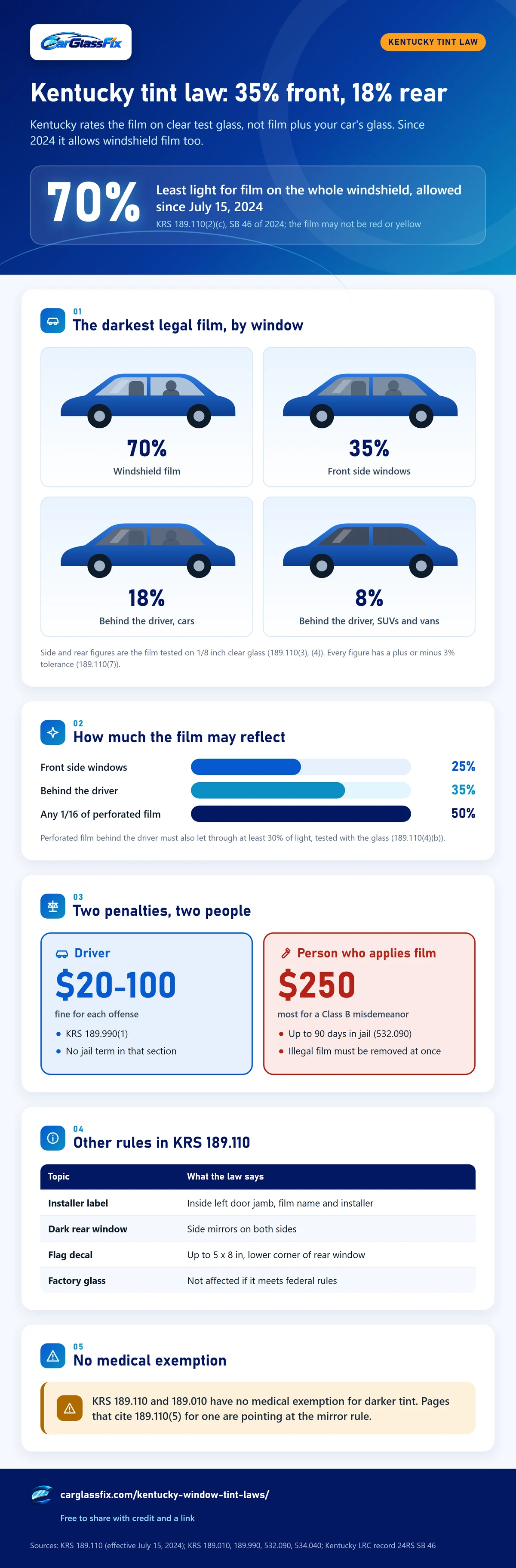
Kentucky window tint laws require film that passes at least 35% of light on the front side windows and 18% on the side and rear windows behind the driver. Multipurpose vehicles such as most SUVs and vans may go to 8% behind the driver. The windshield may carry a clear strip above the AS-1 line, or film that keeps 70%.
Kentucky window tint limits by window
Kentucky allows 35% on the front side windows and 18% behind the driver, or 8% behind the driver on a multipurpose passenger vehicle. The rules sit in Kentucky Revised Statutes 189.110, with definitions in KRS 189.010(20) to (23). The front rule covers the side windows “forward of or adjacent to the operator’s seat” on either side, so the front passenger window follows it too. The rear rule covers “any windows behind the driver”, which takes in the rear side windows and the back glass. Chapter 189 does not define a multipurpose passenger vehicle. The federal safety standards define one as a vehicle built for 10 or fewer people on a truck chassis or with features for occasional off-road use (49 CFR 571.3). That covers most SUVs, many vans and pickups. Check how your vehicle is classed on its federal certification label before you pick an 8% film.
| Window | Sedan | SUV, van, pickup |
|---|---|---|
| Windshield | Clear strip above the AS-1 line, or film at 70% or more with the glass; not red or yellow | Same |
| Front side windows | 35% or more, reflectance 25% or less | Same |
| Side windows behind the driver | 18% or more, reflectance 35% or less | 8% or more if a multipurpose passenger vehicle, reflectance 35% or less |
| Rear window | 18% or more; side mirrors on both sides if it is made nontransparent | 8% or more if a multipurpose passenger vehicle; same mirror rule |
| Perforated film behind the driver | 30% or more with the glass, reflectance 35% or less | Same |
| Tolerance | Plus or minus 3% on every percentage | Same |
How Kentucky measures tint: the 1/8 inch test glass
Kentucky rates the film itself, tested on a sheet of clear glass, rather than the finished window on the car. Subsections (3) and (4) both say the film counts as legal if, “when tested on one-eighth (1/8) inch clear glass,” it meets the light and reflectance figures. Ohio, Missouri and Virginia write their limits for film and safety glass together, so a Kentucky number is not directly comparable with theirs.
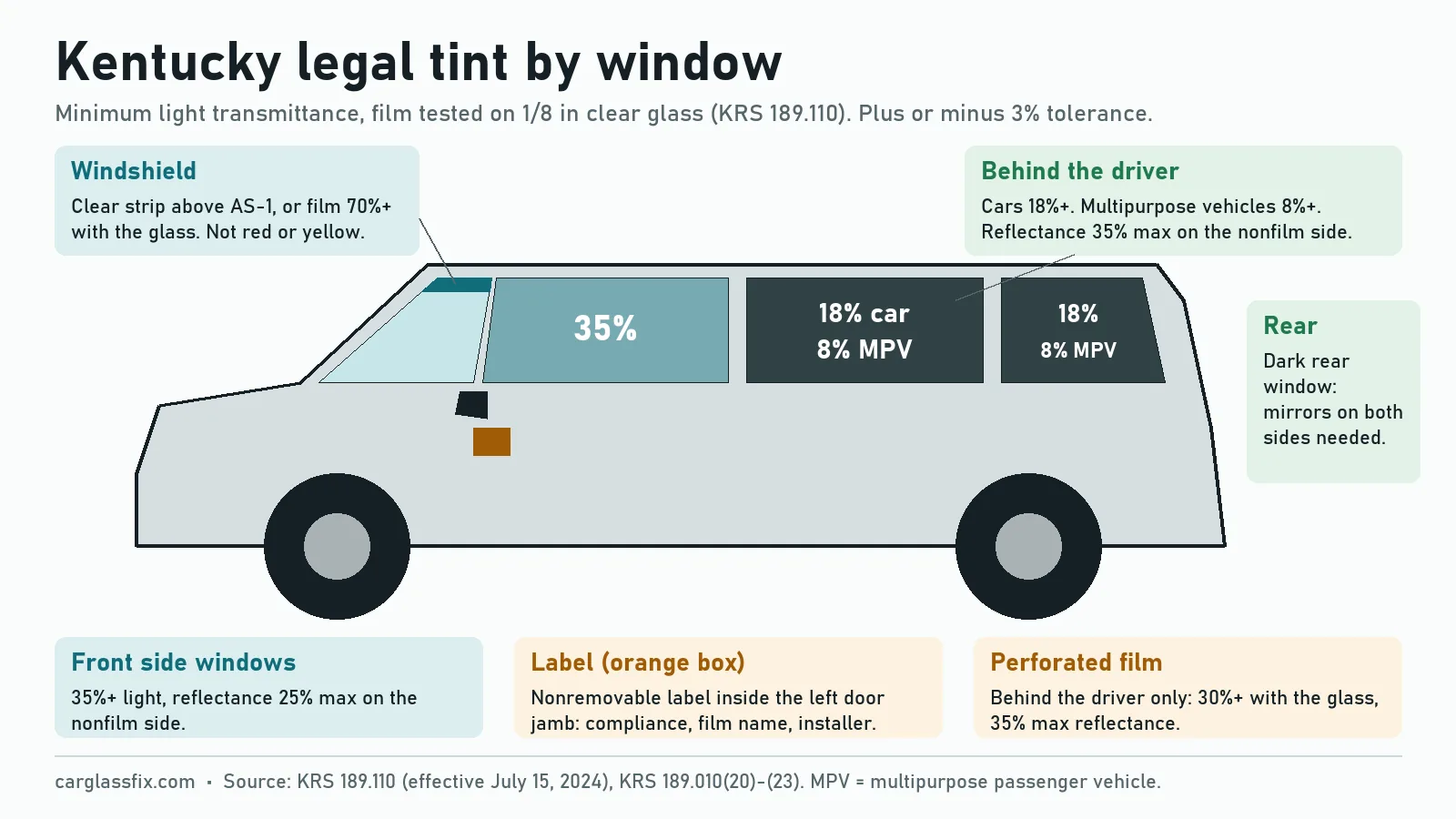
The definition of transmittance in 189.010(22) includes the glazing the light passes through, which on this test is the 1/8 inch clear sheet. Factory glass on a real car already blocks some light, so a legal 35% film will read lower once it sits on your window. Our how to measure window tint guide shows the glass-times-film math. The statute does not say how an officer measures at a stop, and we found no Kentucky State Police page on it. A window tint meter reads the net figure through glass and film, which is the number a roadside reading would show. Perforated film is the exception: Kentucky tests it “in conjunction with existing glazing or film material”, so its 30% floor is a finished-window figure.
Windshield tint in Kentucky since July 2024
A Kentucky windshield may carry film over its whole surface if the film and the glass together pass at least 70% of light and the film is not red or yellow. That rule is KRS 189.110(2)(c), added by Senate Bill 46 and in force since July 15, 2024. Before that date, the only tint allowed was a transparent strip at the top that does not reach into the AS-1 portion defined in federal safety standard FMVSS 205. That strip rule, now (2)(b), still stands. It gives no inch figure and no percentage, so the AS-1 mark on the glass is the only line to follow; see the AS-1 line on a windshield to find it.
The 70% test is film plus glass, written as material used “in conjunction with the safety glazing materials of the windshield.” Many windshields already pass well under 100% before any film goes on, so a 70% film on its own can push the finished glass below the limit. The 2024 act also extended the 3% tolerance and the installer ban in subsections (7) and (8) to the windshield. The red and yellow ban appears only in the windshield rule.
Is there a medical exemption for tint in Kentucky?
No. KRS 189.110 and the definitions in KRS 189.010 contain no medical exemption, no physician statement and no permit for darker film. We read both sections in full in the edition effective July 15, 2024. Several tint shop pages and a Bing AI answer checked for this page say Kentucky allows a medical waiver with a doctor’s certification. Some cite “189.110(5)” for it, but subsection (5) is the rule that a vehicle with a nontransparent rear window needs side mirrors on both sides. We also found no Kentucky State Police or Transportation Cabinet page that offers a tint exemption form. A YouTube video in the Google results points viewers to a paid exemption service; we found no Kentucky law behind it.
A driver who needs sun protection for a medical reason still has legal options. Clear or light film that keeps the windshield at 70% is now allowed, and film down to the legal floor is allowed on every side window. Ask your doctor what level of protection you need, and ask the court or a lawyer before relying on any medical defense.
How the Kentucky tint law changed
The side and rear limits have not changed since at least July 15, 1994; the only recent change is the 2024 windshield rule. The 1994 amendment, 1994 Ky. Acts ch. 42, is the version that stood for 30 years. Two later bills tried to change it and failed.
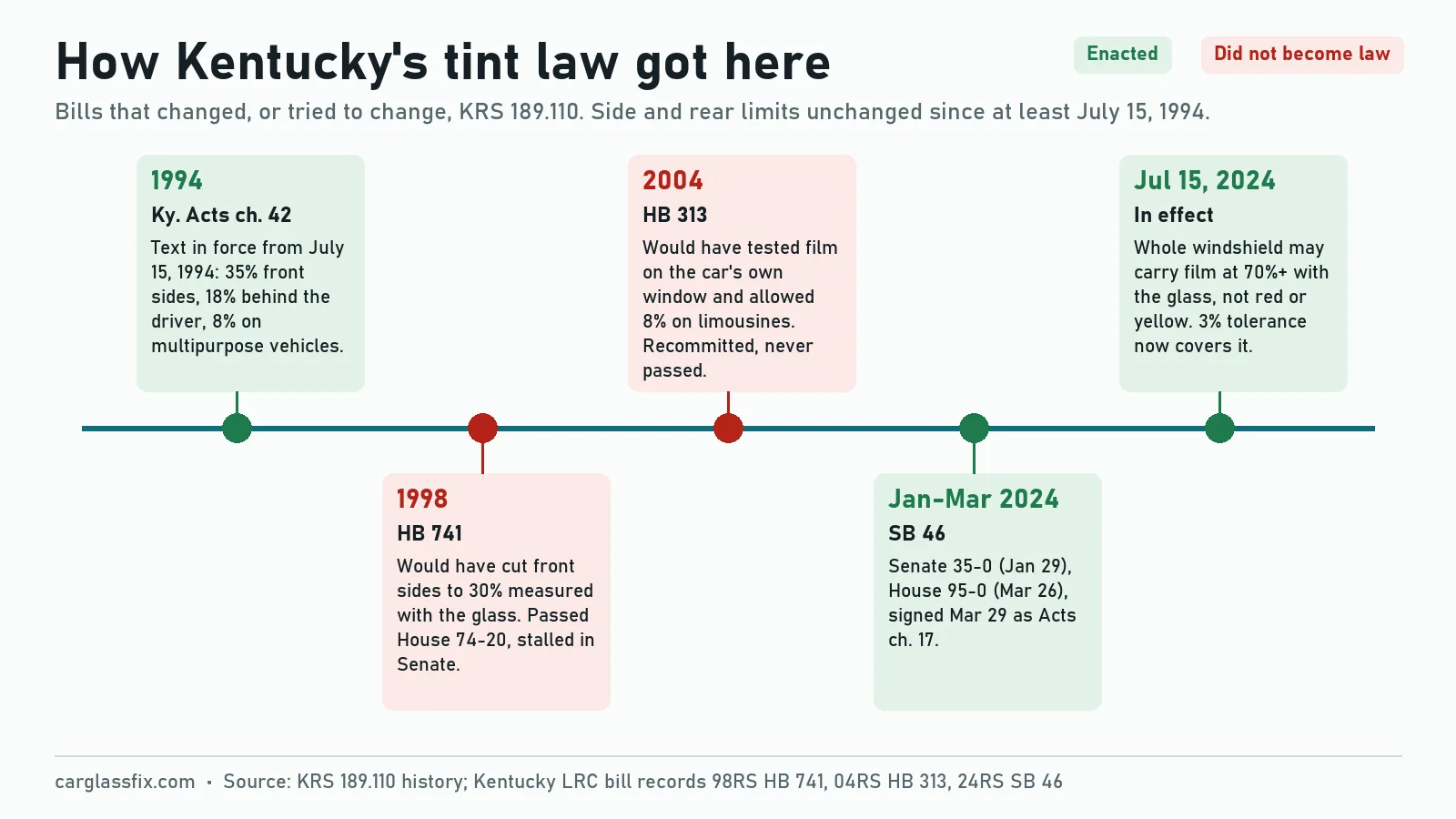
House Bill 741 in 1998 would have set the front limit at 30% measured with the existing glass. It passed the House 74-20 and went no further than the Senate Transportation Committee. House Bill 313 in 2004 would have defined “multipurpose passenger vehicle,” tested film on the car’s own window and allowed 8% on limousines. It was recommitted to Appropriations and Revenue and died. Senate Bill 46, sponsored by Sen. Greg Elkins, passed the Senate 35-0 on January 29, 2024 and the House 95-0 on March 26. The Governor signed it on March 29, 2024. The sponsor’s office said he reviewed Ohio, North Dakota and Hawaii laws before filing it. Older pages that say Kentucky allows windshield tint only above the AS-1 line describe the law before July 2024.
Tint ticket fines and the installer label in Kentucky
A driver cited under KRS 189.110 faces a fine of $20 to $100 for each offense. KRS 189.990(1) lists 189.110 among the sections with a fine “not less than twenty dollars ($20) nor more than one hundred dollars ($100).” Court costs can add to that, and the amount differs by county. The installer faces a heavier charge. Under 189.110(9), a person who applies film in violation of the section is guilty of a Class B misdemeanor. Kentucky’s penal code caps a Class B misdemeanor at a fine of $250 (KRS 534.040) and 90 days in jail (KRS 532.090). Subsection (8) also says illegal film “shall be removed immediately.”
The label rule falls on the shop. Each installer or seller must give a pressure-sensitive, nonremovable vinyl label stating that the film complies with Kentucky law, and the installer must affix it “to the inside left door jamb.” The label must name the film’s trade name and the installer’s or seller’s business. Factory glass that meets FMVSS 205 needs no label. Reflectance limits of 25% in front and 35% behind the driver also rule out most mirror films; see can you put mirror tint on a car.
Who the Kentucky tint limits do not cover
The side and rear window limits apply to vehicles “required to be registered in the Commonwealth,” while the windshield rule applies to any motor vehicle on a Kentucky road. That wording sits in subsections (2) to (5). A visitor’s car registered elsewhere is therefore outside the Kentucky side window rule, though its windshield is not. Drivers from across the river can compare their own state in the Ohio window tint laws guide.
Subsection (12) leaves alone any window treated in a way federal rules approve if it came on the vehicle from the factory, and replacements that meet the same rules. Factory privacy glass on an SUV needs no Kentucky check of its own. The definition of “window” in 189.010(23) leaves out the windshield, roof-mounted glass such as a sunroof, and any glass smaller than 150 square inches. Subsection (10) allows an American flag decal up to 5 by 8 inches in a lower corner of the rear window. Before choosing a shade, try the window tint simulator, and compare every state in what car window tint is legal.
Kentucky tint rules can change in any legislative session. Check the current KRS 189.110 on the Kentucky Legislature website before you tint. This article is general information, not legal advice.
Frequently asked questions
Is 20% tint legal in Kentucky?
A 20% film is illegal on the front side windows, which need at least 35%. It is legal on the windows behind the driver, where the floor is 18% on cars and 8% on multipurpose passenger vehicles.
Is 5% tint legal in Kentucky?
No. A 5% film is darker than every Kentucky floor: 35% in front, 18% behind the driver on cars and 8% behind the driver on multipurpose passenger vehicles.
Is 20% darker than 35% window tint?
Yes. A 20% film lets through 20% of visible light against 35% for the lighter film. The window tint percentage chart shows each shade side by side.
Can you tint your whole windshield in Kentucky?
Yes, since July 15, 2024, if the film and windshield glass together pass at least 70% of light and the film is not red or yellow. Darker tint is allowed only as a transparent strip above the AS-1 line.
Does Kentucky have a medical exemption for window tint?
No. KRS 189.110 contains no medical exemption, and no Kentucky agency page offering one was found. The “189.110(5)” some websites cite is the rear-window mirror rule.
Sources
- KRS 189.110, Unobstructed windshields (copy of the Kentucky LRC file) (effective 15 July 2024; checked 29 October 2026)
- KRS 189.010, Definitions (checked 29 October 2026)
- KRS 189.990, Penalties (checked 29 October 2026)
- KRS 534.040, Fines for misdemeanors and KRS 532.090, Imprisonment for misdemeanor (checked 29 October 2026)
- Kentucky LRC: 2024 Senate Bill 46 record (archived copy read 29 October 2026)
- Kentucky LRC: 1998 House Bill 741 record and 2004 House Bill 313 record (archived copies read 29 October 2026)
- Kentucky Senate Majority: Elkins’ first bill signed into law (4 April 2024)
- 49 CFR 571.3, Federal Motor Vehicle Safety Standards definitions (checked 29 October 2026)

Similar Posts