South Carolina Window Tint Laws: The 27% Rule by Window
Senior Automotive Glass Diagnostic Specialist & Master Technician at CarGlassFix · AGSC Master Certified Auto Glass Technician, NGA Certified Installer, I-CAR Automotive Safety Specialist · 12+ Years in Automotive Glazing, Windshield Structural Bonding, ADAS Camera Calibration & Precision Chip Restoration
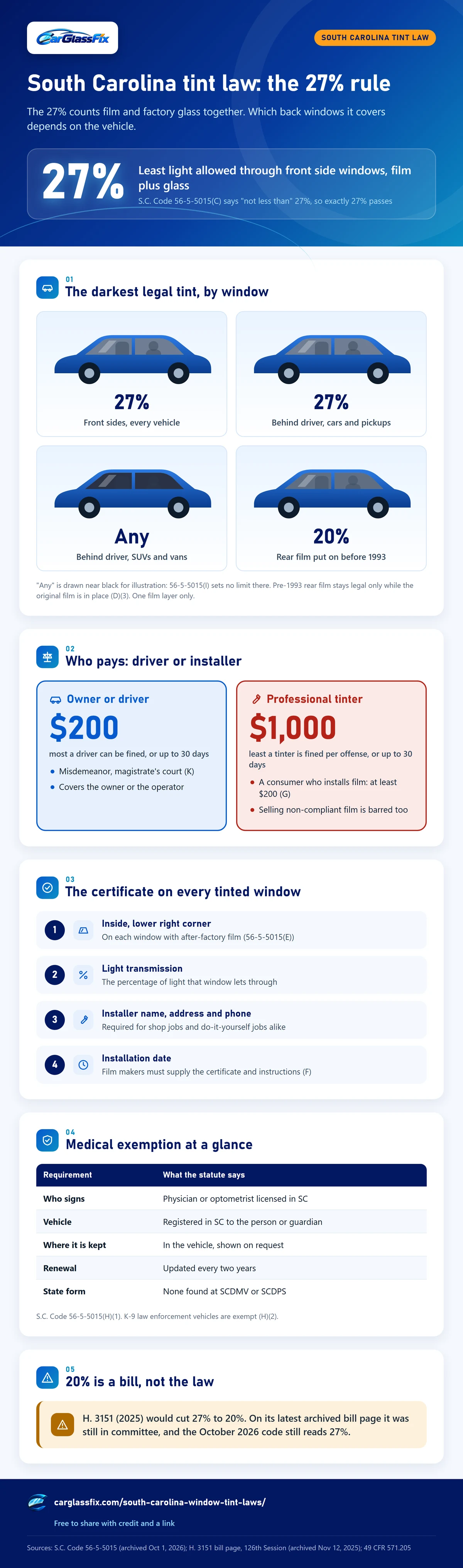
South Carolina window tint laws require at least 27% light transmission, film and factory glass together, on the front side windows of every vehicle. Cars and pickup trucks need 27% on the back side and rear windows too, while SUVs and vans may be any darkness there. Windshield tint must stay above the AS1 line.
South Carolina window tint limits by window
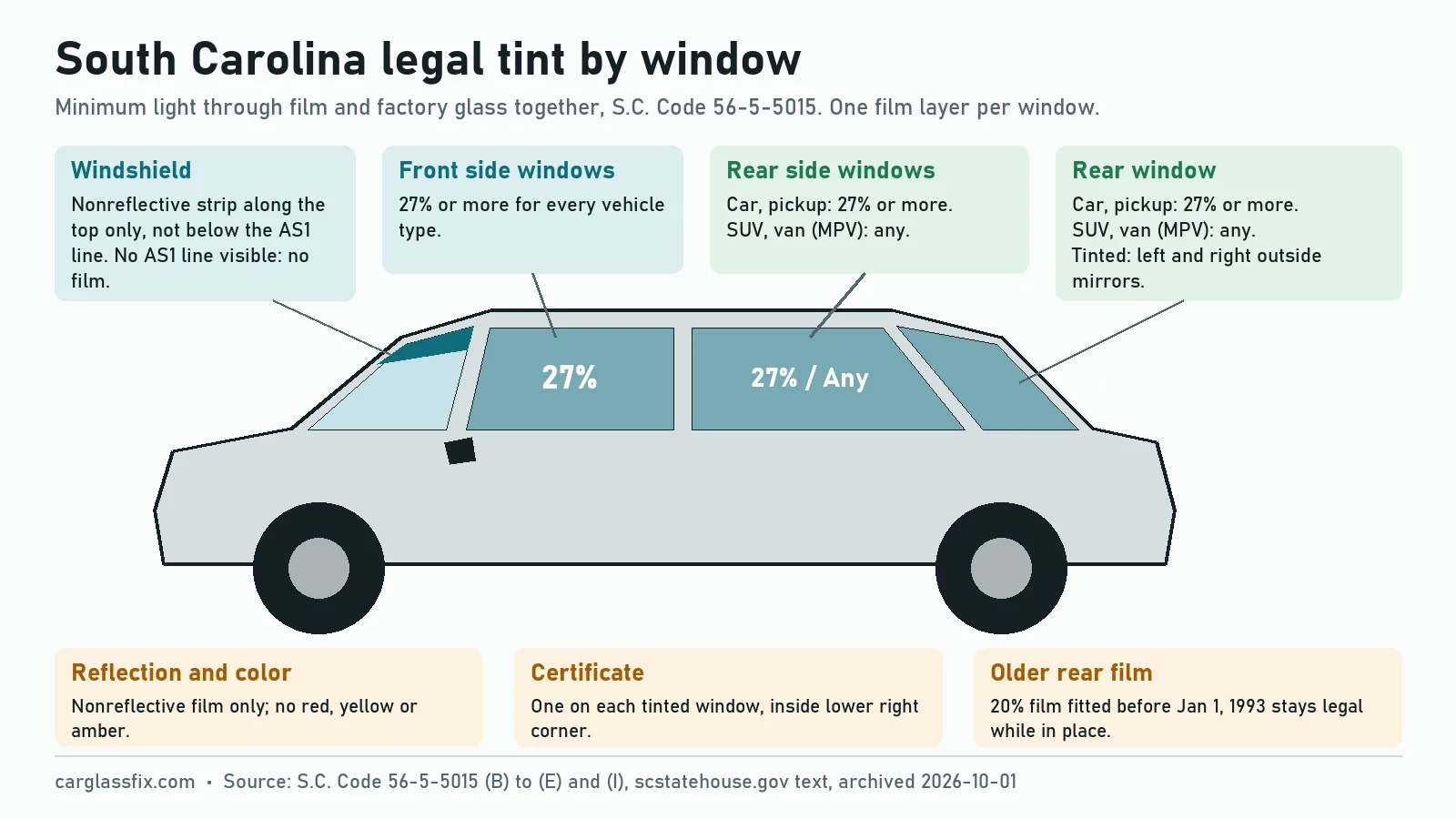
South Carolina allows tint down to 27% light transmission on the side and rear windows of cars and pickups, and on the front side windows of SUVs and vans. The rule is Section 56-5-5015 of the South Carolina Code of Laws, titled “Sunscreen devices”. Its history note runs from 1978 Act No. 484 to 2002 Act No. 339, and the official text archived on October 1, 2026 shows no later change. The statute calls window film a “sunscreening device”. It covers any motor vehicle “required to be registered in this State”. The light rules apply only to film added after the factory, so glass that left the factory dark is not measured under this section. The table puts every window side by side.
| Window | Sedan | SUV, van, pickup |
|---|---|---|
| Windshield | Nonreflective strip along the top only, not below the AS1 line; no film if the AS1 line is not visible | Same |
| Front side windows | 27% or more | 27% or more |
| Side windows behind the driver | 27% or more | SUV and van: any darkness. Pickup truck: 27% or more |
| Rear window | 27% or more, with left and right outside mirrors | SUV and van: any darkness. Pickup truck: 27% or more, with both outside mirrors |
| Measured as | Film plus factory glass, one film layer | Same |
| Reflection and color | Nonreflective; not red, yellow or amber | Same |
How South Carolina measures the 27% limit
South Carolina measures the finished window, so 27% is the light that passes through the film and the factory glass together. Subsection (C) says the “combined light transmission” of the film “with the factory or manufacturer installed sunscreening material must not be less than twenty-seven percent”.
The words “not less than” make a reading of exactly 27% legal. Factory glass already blocks some light, so a film sold as 27% will read lower once it sits on the glass. The how to measure window tint guide shows the math, and the window tint percentage chart shows how dark each shade looks. The statute also says “A single sunscreening device” may be installed, which rules out stacking two films to reach a shade. For the practical side of that, read can you layer car window tint. Section 56-5-5015 states no tolerance, so the law gives no margin below 27%.
Pickups, SUVs and vans: which vehicles may go darker in the back
SUVs and vans may carry any darkness behind the driver in South Carolina, but pickup trucks may not. Subsection (I) says the light rule “applies to windows behind the driver on pickup trucks”. The same sentence exempts the windows behind the driver on other trucks, buses, trailers, mobile homes, multipurpose passenger vehicles and recreational vehicles. The front side windows stay at 27% on all of them.
The statute defines a multipurpose passenger vehicle as one “designed to carry ten persons or less” that is built on a truck chassis or with special features for occasional off-road use. Many SUVs and minivans are certified in that class, and the vehicle’s label settles it. A driver can check the class on the federal certification label, usually on the driver’s door edge or door pillar. Federal rule 49 CFR 567.4(g)(7) requires that label to state the vehicle’s type classification, such as truck or MPV. A label that reads “passenger car” means the car column applies. The window tint simulator previews 27% on a car before an installer starts.
Windshield tint in South Carolina: above the AS1 line only
A South Carolina windshield may carry film only in a band along the top, and that band may not extend below the AS1 line. Subsection (B) adds a rule many states lack: “If the AS1 line is not visible, no sunscreening device may be applied to the windshield.” The statute sets no light percentage for the band, so its limits are position, reflection and color.
The AS1 line is a glazing mark defined in federal standard 49 CFR 571.205, which the statute cites in (J)(11). The marking appears near the top corners of the glass. The guide to the AS-1 line on a windshield shows where to look. Some shop pages describe the band as the top six inches of glass, but the South Carolina statute names no inch figure. Every film in the state must also be “nonreflective”, which the law defines as “primarily designed to absorb light rather than to reflect it”, and it may not be red, yellow or amber. The statute gives no reflectance percentage. Mirror-finish film fails that test; see can you put mirror tint on a car for how reflective film works.
The 1993 rear-window rule and the 2025 bills
Rear-window film installed under South Carolina’s old 20% rule is still legal as long as the original film stays on the glass. Subsection (D)(1) keeps the old wording: rear-most window film with “a light transmission of not less than twenty percent”. Subsection (D)(2) then sets the current rule “Beginning January 1, 1993”: a single film, 27% combined with the factory glass.
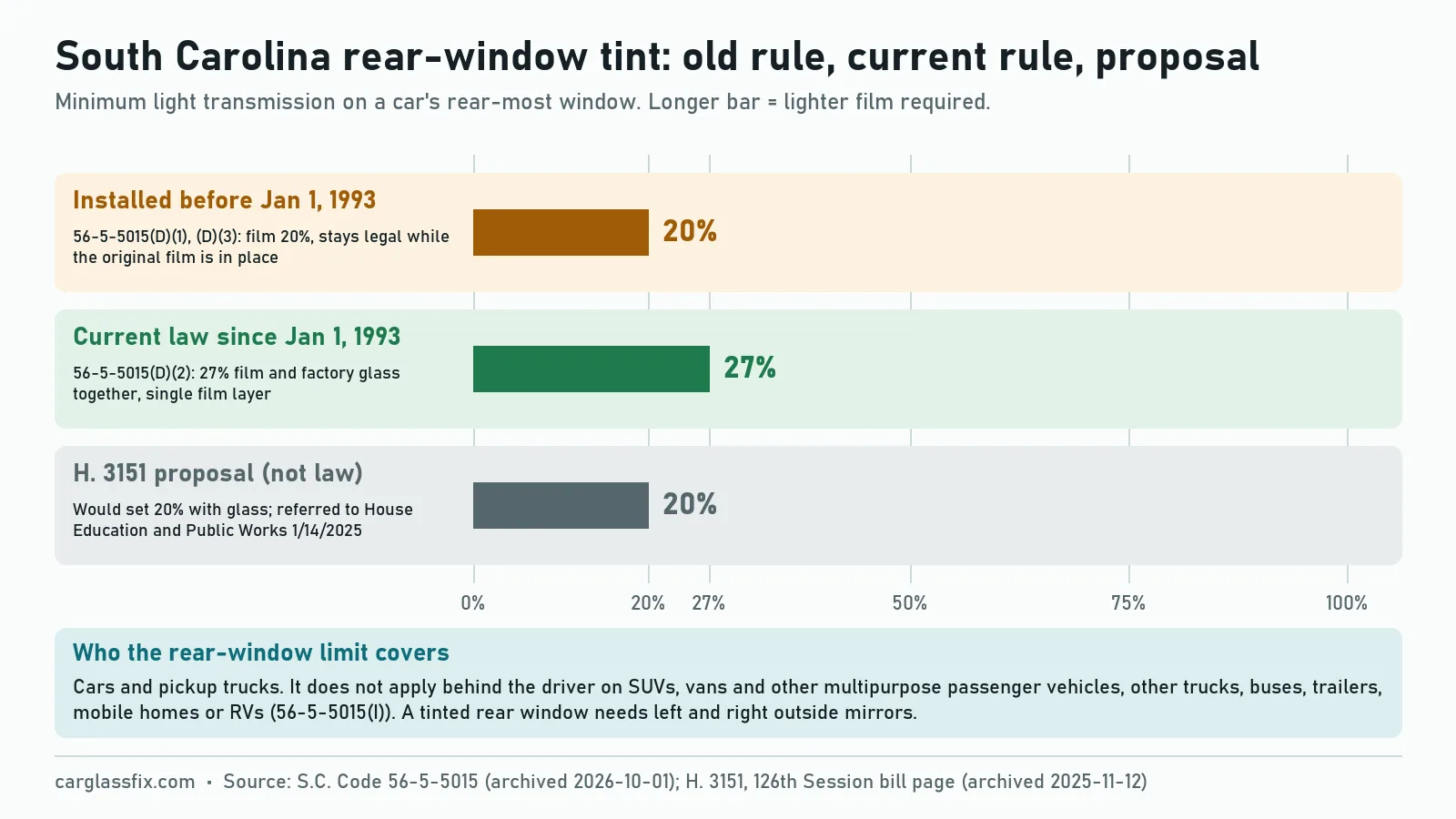
Subsection (D)(3) protects a vehicle whose film met the 20% rule when installed, “so long as the original sunscreen device is in place”. Replacing that film brings the window under the 27% rule. Two bills filed in the 2025-2026 session would change the section. H. 3151 would lower the side and rear limit to 20% and move the dates to 2026. H. 3851 would exempt law enforcement vehicles. The latest archived bill pages show both only referred to the House Committee on Education and Public Works. A bill-tracking summary that calls 20% the current limit is wrong, because the code text still reads twenty-seven percent.
Certificate of compliance on every tinted window
Every South Carolina vehicle with aftermarket film must carry a certificate of compliance on each tinted window. Subsection (E) applies whether a consumer or a professional window tinter did the work. The certificate goes on “the inside and lower right hand corner of each window” with film on it. The Department of Public Safety prescribes its size and form.
Each certificate must show three things:
- the percentage of light transmission the film allows;
- the installer’s name, address and telephone number;
- the date of installation.
Subsection (F) puts part of the duty on the film maker. Film sold in South Carolina must include installation instructions, and the maker must supply the certificate and instructions for attaching it. Subsection (G) bars anyone from selling non-compliant film and from installing film without permanently affixing the certificate. A driver who tints at home is a consumer installer under the statute, so the certificate rule applies to home installs too. Some aggregator pages say the sticker goes between the film and the glass; the statute names only the corner.
South Carolina medical exemption for darker tint
South Carolina’s medical exemption rests on an affidavit from a physician or optometrist licensed in the state, with no permit issued by the state. Subsection (H)(1) exempts a vehicle registered in South Carolina in the name of the person, or the person’s legal guardian, who holds that affidavit. It must state that a physical condition makes darker tint, or higher luminous reflectance, necessary. No tint exemption page or form was found on the SCDMV or SCDPS websites, so the statute is the only official description of the process. The steps below follow its wording.
How the South Carolina tint medical exemption works
Check the registration
The vehicle must be registered in South Carolina in the name of the person with the condition, or that person’s legal guardian.
Get the affidavit
A physician or optometrist licensed to practice in South Carolina signs an affidavit that the condition makes darker or more reflective film necessary.
Keep it in the vehicle
The affidavit must be in the vehicle at all times during operation and must be shown to a law enforcement officer on request.
Renew it
The statute says the affidavit “must be updated every two years”.
Subsection (H)(2) adds one more exemption: law enforcement vehicles used regularly to transport a trained police dog.
Fines for drivers and for installers
A South Carolina driver or owner with illegal tint commits a misdemeanor triable in magistrate’s court. Subsection (K) sets the penalty: a fine of “not more than two hundred dollars” or up to 30 days in jail. Installers face a separate and higher floor under subsection (G). A professional window tinter who breaks the certificate or sale rules “must be fined not less than one thousand dollars” or jailed up to 30 days, or both, for each offense. A consumer who breaks those same rules faces a fine of not less than two hundred dollars or up to 30 days.
Older pages that say a driver faces a “minimum” $200 fine mix up the two clauses. The $200 minimum belongs to consumer installers under (G), while the driver’s $200 in (K) is a maximum. Neighbouring states set different numbers, so see North Carolina window tint laws and Georgia window tint laws before a road trip. The hub on what car window tint is legal compares every state. Rules change, so check the current statute or the SCDMV before you tint; this page is not legal advice.
Frequently asked questions
Is 15 percent tint legal in SC?
15% tint is not legal on any front side window in South Carolina, or on the back side and rear windows of a car or pickup, because those need 27% with the glass. On an SUV or van, 15% film is legal behind the driver, since subsection (I) exempts those windows. A medical affidavit under subsection (H)(1) can allow darker film.
Is 20% tint legal in South Carolina?
20% is below the 27% minimum, so it is not legal on front side windows, or behind the driver on cars and pickups. It is legal behind the driver on SUVs and vans, and original rear-window film installed at 20% before January 1, 1993 stays legal while in place.
Is 35 or 20 tint darker?
20% tint is darker, because the number is the share of light that passes through. 35% film passes more light and is legal on every South Carolina window except the windshield below the AS1 line, as long as the reading with the glass stays at 27% or more.
Can you tint your windshield in South Carolina?
Yes, only with a nonreflective band along the top that does not extend below the AS1 line. If the windshield has no visible AS1 line, no film is allowed on it at all under subsection (B).
Does the South Carolina tint law apply to out-of-state cars?
Section 56-5-5015 covers a motor vehicle “required to be registered in this State”, so the wording reaches vehicles that must be registered in South Carolina. A driver who has moved to the state should check the registration rules with the SCDMV and bring the tint to 27% when the car is registered there.
Sources
- South Carolina Code of Laws, Section 56-5-5015, Sunscreen devices (South Carolina Legislature), read on the archived official page dated October 1, 2026, checked October 29, 2026
- Internet Archive copy of Title 56, Chapter 5 of the South Carolina Code (October 1, 2026)
- H. 3151, 126th Session (2025-2026), Sunscreen devices (South Carolina Legislature), archived November 12, 2025, checked October 29, 2026
- H. 3851, 126th Session (2025-2026), Sunscreen devices (South Carolina Legislature), archived February 18, 2026, checked October 29, 2026
- 49 CFR 567.4, Requirements for manufacturers of motor vehicles (certification label), checked October 29, 2026
- 49 CFR 571.205, Glazing materials (AS1 marking, cited in 56-5-5015(J)(11))

Similar Posts