North Carolina Window Tint Laws: 35% Rule by Window
Senior Automotive Glass Diagnostic Specialist & Master Technician at CarGlassFix · AGSC Master Certified Auto Glass Technician, NGA Certified Installer, I-CAR Automotive Safety Specialist · 12+ Years in Automotive Glazing, Windshield Structural Bonding, ADAS Camera Calibration & Precision Chip Restoration
North Carolina window tint laws require at least 35% total light transmission on every window except the windshield, with film and glass measured together, and reflectance of 20% or less. A meter reading above 32% counts as legal. Windshield tint may cover only the top 5 inches or down to the AS1 line, whichever is longer.
North Carolina tint limits by window
North Carolina allows tint on every window of a sedan as long as each tinted window passes at least 35% of light and reflects 20% or less. The rule is General Statute 20-127(b). It treats the front side windows, back side windows and rear window the same way, which makes North Carolina stricter than many neighbors on the back half of a sedan. The film must also be nonreflective and may not be red, yellow or amber. Larger passenger vehicles get a different rule. Subsection (c)(9) exempts any window of a multipurpose vehicle that sits behind the driver. The statute defines a multipurpose vehicle as a passenger vehicle for 10 or fewer people that is built on a truck chassis or has features for occasional off-road use, and it names minivans and pickups outright.
| Window | Sedan | SUV, van, pickup (multipurpose vehicle) |
|---|---|---|
| Windshield | Tint only along the top: 5 in or down to the AS1 line, whichever is longer. Clear UV film allowed below. | Same, no exceptions |
| Front side windows | 35% light or more, 20% reflectance or less | 35% light or more, 20% reflectance or less |
| Back side windows | 35% light or more, 20% reflectance or less | Any darkness |
| Rear window | 35% light or more, 20% reflectance or less | Any darkness |
| Meter reading treated as legal | Above 32% | Above 32% on the front sides |
| Colors | No red, yellow or amber film; film must be nonreflective | Same on every window |
How North Carolina measures the 35% limit
North Carolina measures the whole tinted window, film and factory glass together, and a meter reading above 32% is accepted as meeting the 35% rule. Subsection (b)(1) speaks of the “total light transmission of the tinted window”, not the rating printed on the film. It then says a window that reads more than 32% on a light meter approved by the DMV Commissioner “is conclusively presumed” to comply.
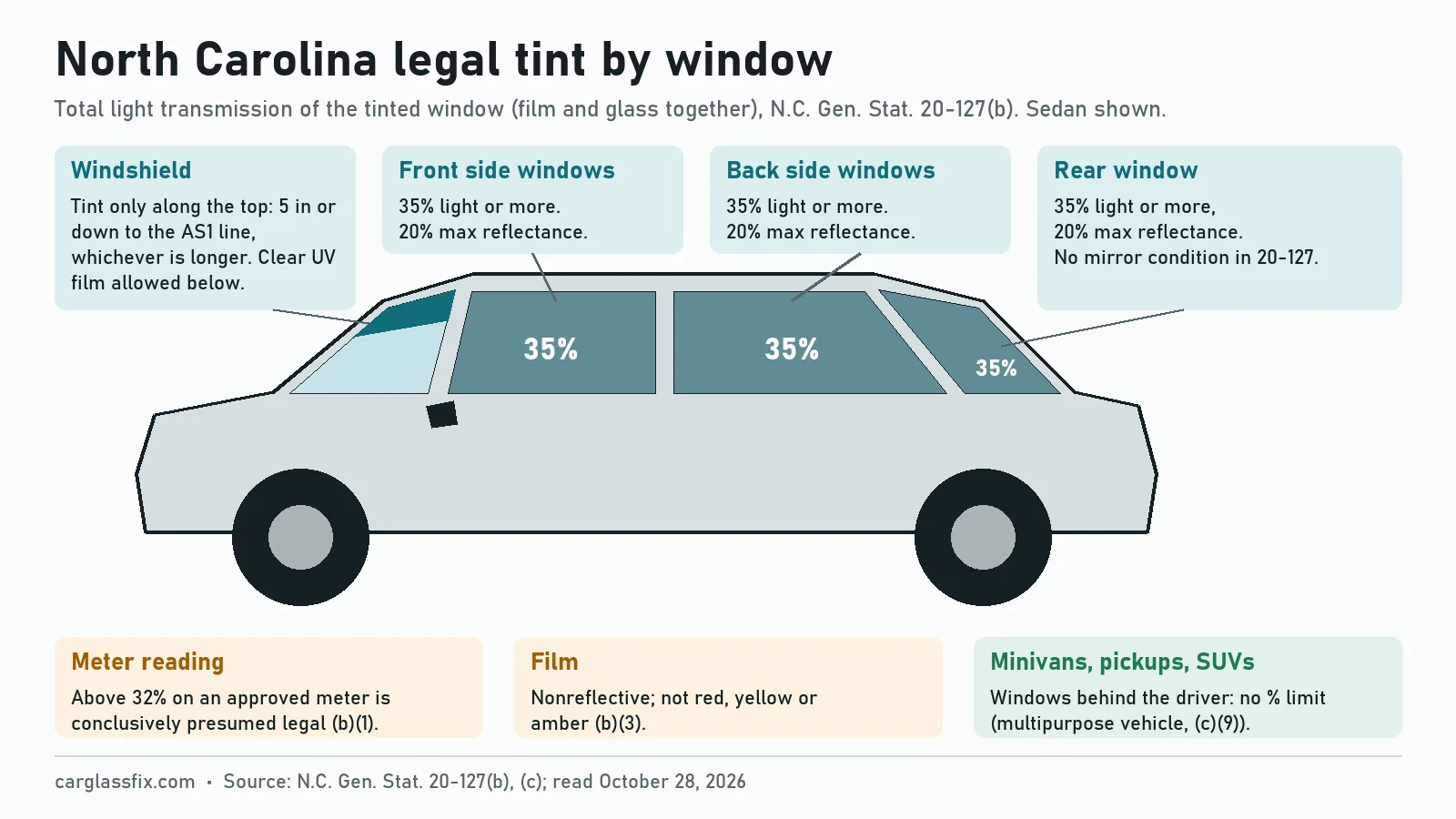
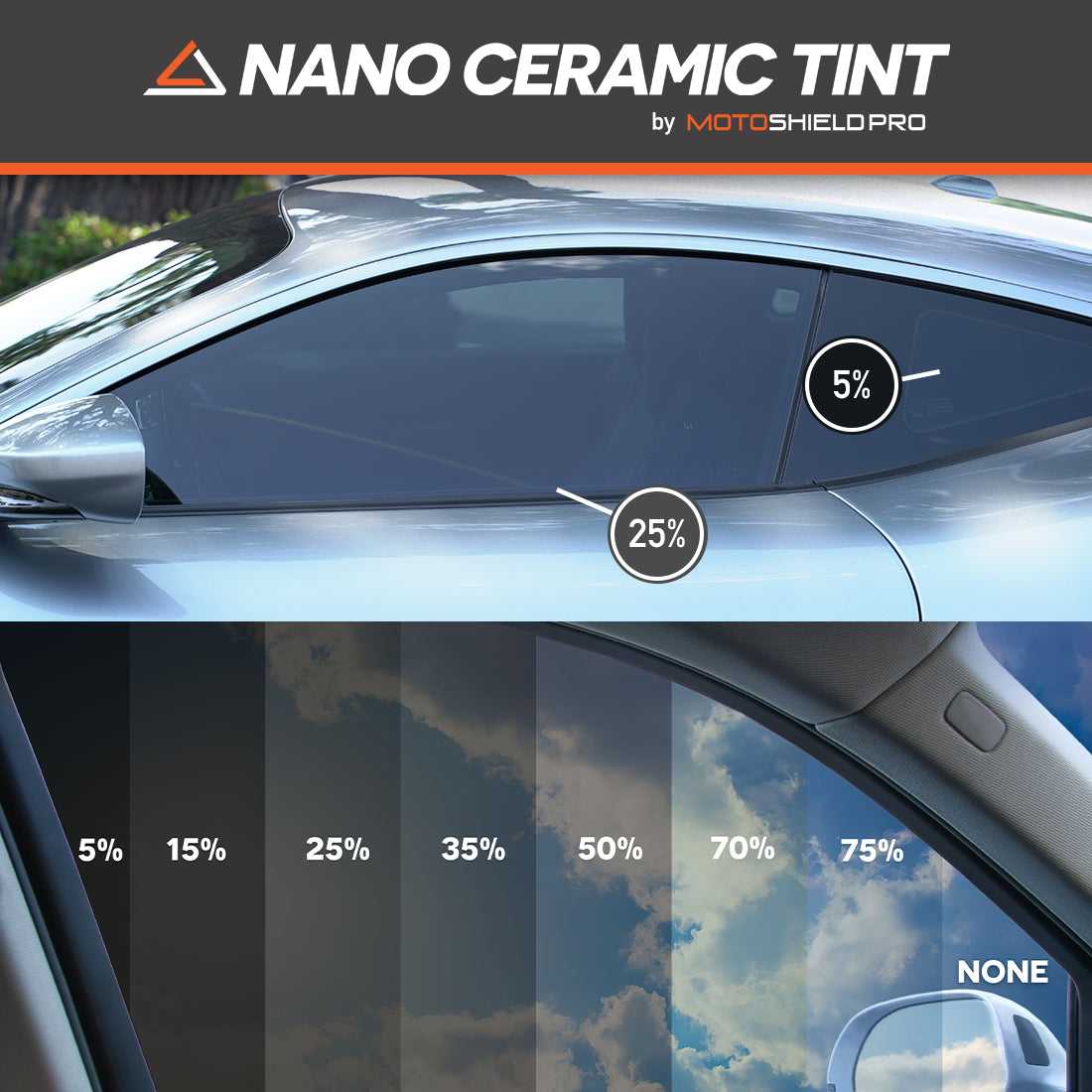
The 3-point gap between 35% and 32% works as a margin for meter error and glass variation. It does not make 32% film legal. Factory side glass already blocks some light, so a film sold as 35% usually reads below 35% once installed. Our how to measure window tint guide shows how the glass and film numbers multiply. A window tint meter reads that combined figure, which is the number an officer’s meter would show. Reflectance has its own cap of 20%, so mirror and strongly metallic films can fail even when they pass enough light. To see how dark 35% looks next to 20% or 5%, open the window tint percentage chart.
Windshield tint in North Carolina: 5 inches or the AS1 line
A North Carolina windshield may be tinted only along the top, down to 5 inches from the top or to the AS1 line, whichever measurement is longer. The longer of the two wins, so a windshield whose AS1 mark sits 6 inches down may carry a 6-inch strip. The statute sets no darkness figure for that strip, so the strip may be darker than 35%. The color ban in (b)(3) is written for the other windows. Subsection (c) adds that the windshield rules apply “without exception”, so no medical permit, vehicle type or out-of-state registration allows tint below the line.
A clear film is the one product allowed on the rest of the windshield. The statute permits “an untinted clear film” that does not obstruct vision and reduces or eliminates ultraviolet radiation. The AS1 mark is printed near the top edge of the glass; what is the AS-1 line on a windshield shows where to find it. For how other states handle the strip, read is it illegal to have tint on a windshield.
Vehicles exempt from the 35% and 20% limits
Several vehicle types are exempt from the 35% and 20% limits, but none are exempt from the windshield rule or the color ban. Subsection (c) lists the windows that the light and reflectance numbers do not cover:
- windows of a multipurpose vehicle behind the driver, which covers minivans, pickups and most SUVs;
- the rear window of a property-hauling vehicle;
- all windows of a limousine, motor home, ambulance, excursion passenger vehicle or law enforcement vehicle;
- windows of a vehicle registered in another state that meets that state’s rules;
- windows covered by a DMV medical exception permit.
Two items were removed from the list by S.L. 2012-78 and no longer apply. The out-of-state exemption matters for visitors and new residents: a car tinted legally under its home state’s law stays legal while it keeps that registration. Once it is registered in North Carolina, the 35% rule applies. Vehicles covered by Part 393 of the federal motor carrier rules follow those rules instead, under subsection (b1). An SUV does not qualify by name. It qualifies because the definition covers vehicles built on a truck chassis or with off-road features.
Tint and the NC safety inspection since December 1, 2025
Window tint is no longer checked at the North Carolina safety inspection. NCDMV says that “as of December 1, 2025, window-tint checks are no longer required” and that the extra $10 tint inspection fee was eliminated by S.L. 2025-47. The inspection list in G.S. 20-183.3(a) now covers brakes, lights, horn, steering, wipers, signals, tires, mirrors and the exhaust system, with no windows item.
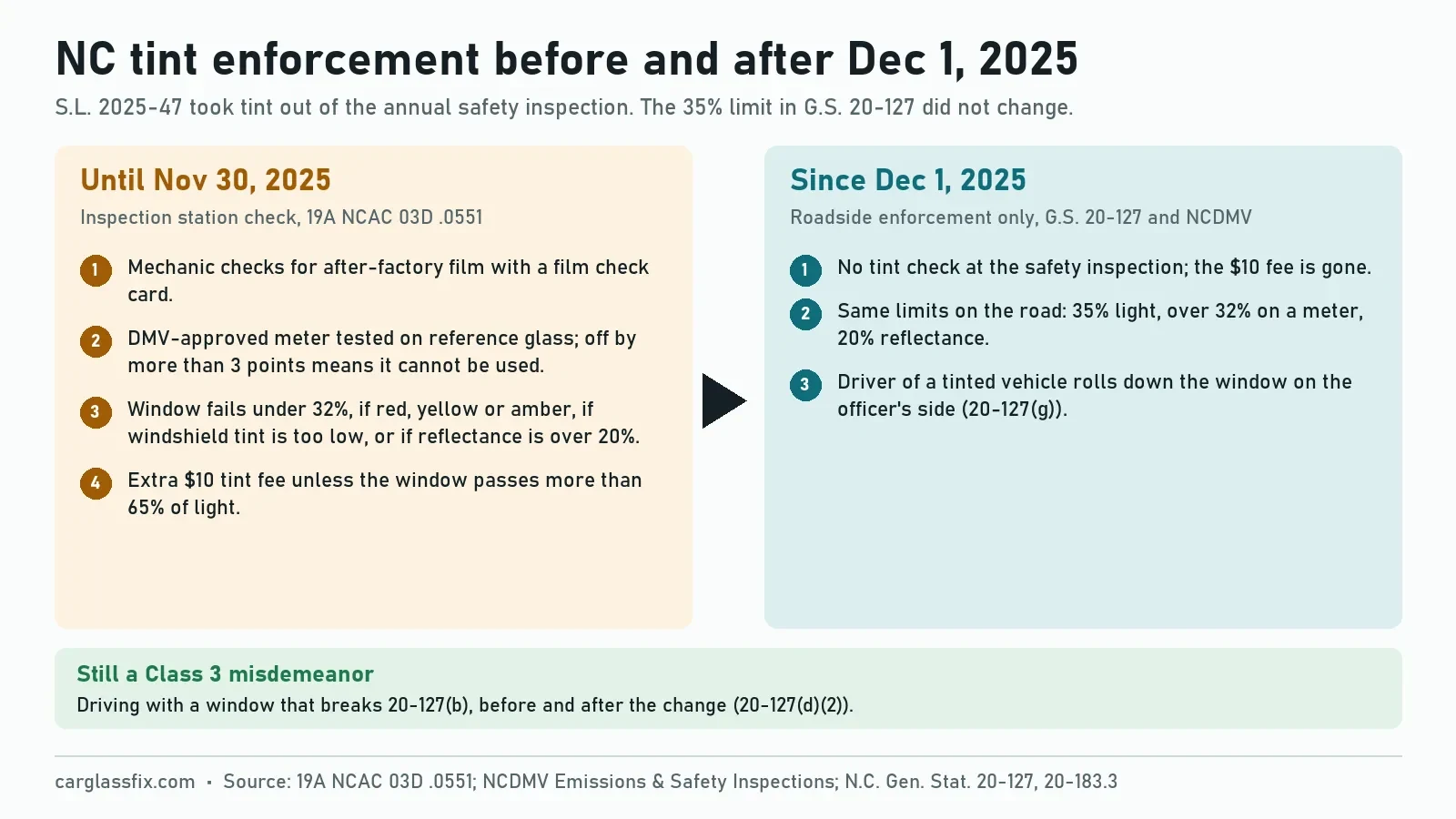
Before that date, the meter check followed rule 19A NCAC 03D .0551. The mechanic first looked for after-factory film with a film check card. The station’s DMV-approved meter was tested against a reference glass sample, and a meter that was off by more than 3 percentage points could not be used. A window failed under 32%, with a red, yellow or amber tint, with windshield tint too low, or with reflectance over 20%. The tint fee applied unless the window passed more than 65% of light. The limits themselves did not change, so enforcement now happens at traffic stops. The annual inspection still checks the wipers, as explained in will a cracked windshield pass inspection in NC.
Medical exception permit for darker tint
A driver who is photosensitive to visible light can get a medical exception permit from NCDMV’s Drivers Medical Evaluation Program. Subsection 20-127(f) sets out the process. The permit lasts five years from issue unless the program sets a shorter term, and renewal needs a new medical certification. Each permit names the vehicle, the windows that may be tinted and the allowed levels.
How to get a North Carolina medical tint permit
Apply in writing
Send a written application to the NCDMV Drivers Medical Evaluation Program (G.S. 20-127(f)).
Have your doctor complete the form
The doctor fills in the medical evaluation form provided by the Division of Motor Vehicles.
Receive the permit and sticker
The permit lists the vehicle, the windows and the permitted tint levels.
Place the sticker
It goes in the lower left corner of the rear window, between the glass and the film, when the film is installed.
Carry the permit
Keep it in that vehicle whenever it is driven on a highway, and renew before the term ends.
Failing to display the sticker is an infraction with a $200 fine under the same subsection. The sticker tells later buyers that the windows do not meet the normal limits.
Tint tickets, the 15-day defense and the roll-down rule
Driving with a window that breaks the tint rules is a Class 3 misdemeanor in North Carolina, and so is applying illegal tint to a vehicle subject to safety inspection. Subsection 20-127(d) creates both offenses. G.S. 15A-1340.23 caps the fine for a Class 3 misdemeanor at $200 unless another law says otherwise. For a person with no more than three prior convictions, the judgment is a fine only. Court costs are set separately and are not part of that cap.
Subsection (e) gives a defense. The driver must remove the illegal tint within 15 days after the charge, so the window complies again. The driver then produces a certificate from the DMV or the State Highway Patrol in court, or gives it to the prosecutor before trial. Since December 1, 2025, subsection (g) also requires the driver of a tinted vehicle to roll down the driver window when an officer approaches, or the passenger window if the officer comes from that side. Some tint shop pages say tint tickets are not criminal, but the statute calls them a misdemeanor. Others say the rear window needs dual mirrors, a condition that 20-127 does not contain.
Frequently asked questions
Is 20% tint legal in NC?
No, not on a sedan. Every sedan window except the windshield must pass at least 35% of light, and a meter reading must be above 32%. On a minivan, pickup or other multipurpose vehicle, 20% film is legal on the windows behind the driver, but not on the front side windows.
Is 35% or 20% tint darker?
20% tint is darker, because the percentage is the share of visible light the window lets through. A 20% window passes 20% of light, while a 35% window passes 35%. The window tint simulator shows both shades on a car.
What tint is legal on the windshield in NC?
Tint is legal only along the top of the windshield, down to 5 inches from the top or to the AS1 line, whichever is longer. A clear film that blocks ultraviolet light and does not obstruct vision may cover the rest of the glass.
Is window tint still checked at NC inspection?
No. NCDMV says window-tint checks stopped being part of the safety inspection on December 1, 2025, and the $10 tint fee ended at the same time. Officers can still cite a driver on the road under G.S. 20-127.
Can cops pull you over for just tint in NC?
Driving with a window that does not meet the tint limits is itself a Class 3 misdemeanor under G.S. 20-127(d)(2). Whether a particular stop was lawful is a question for a lawyer, not this page.
Tint rules change, and this page reflects G.S. 20-127 and NCDMV guidance as read on October 28, 2026. Check the current statute or NCDMV before you tint, and see what car window tint is legal for other states. This page is general information, not legal advice.
Sources
- N.C. Gen. Stat. 20-127, Windows and windshield wipers (read on the FindLaw copy and the archived official page, checked 2026-10-28)
- N.C. Gen. Stat. 20-183.3, Scope of safety and emissions inspections (checked 2026-10-28)
- N.C. Gen. Stat. 15A-1340.23, Punishment limits for each class of offense (checked 2026-10-28)
- 19A NCAC 03D .0551, Window tinting (inspection rule) (readopted October 1, 2021; checked 2026-10-28)
- NCDMV, Emissions and Safety Inspections (page updated October 6, 2026)
- NCDMV, Vehicle Safety Inspection (checked 2026-10-28)

Similar Posts