How to Remove Scratches From Car Window Tint
Senior Automotive Glass Diagnostic Specialist & Master Technician at CarGlassFix · AGSC Master Certified Auto Glass Technician, NGA Certified Installer, I-CAR Automotive Safety Specialist · 12+ Years in Automotive Glazing, Windshield Structural Bonding, ADAS Camera Calibration & Precision Chip Restoration
Scratches in car window tint cannot be polished or buffed out. Window film is a thin polyester layer with a scratch-resistant top coat, and no film maker publishes a repair method for it. A scratch on the outside of the glass can be polished. A scratch in the film means living with it or re-filming that window.
Can scratches be removed from car window tint?
No film maker publishes a way to remove a scratch from automotive window film. The film makers’ own care documents only cover prevention: soft cloths, mild cleaners and no abrasives. IDS Automotive states on its care card that its films have a durable scratch-resistant coating with “protective limitations”. The same card says scratch damage is not covered under warranty. That leaves two outcomes for a scratch in the film. You can accept a fine mark that does not block your view, or you can have the film on that one window removed and replaced. The answer changes if the scratch is not in the film at all. Tint goes on the inside surface of the glass, so the outer face of a tinted window is bare glass. A scratch on that outer face is a glass problem with glass fixes. The next section shows how to tell the four possible locations apart before you spend money or reach for a polish.
Where the scratch sits: film, coat or glass
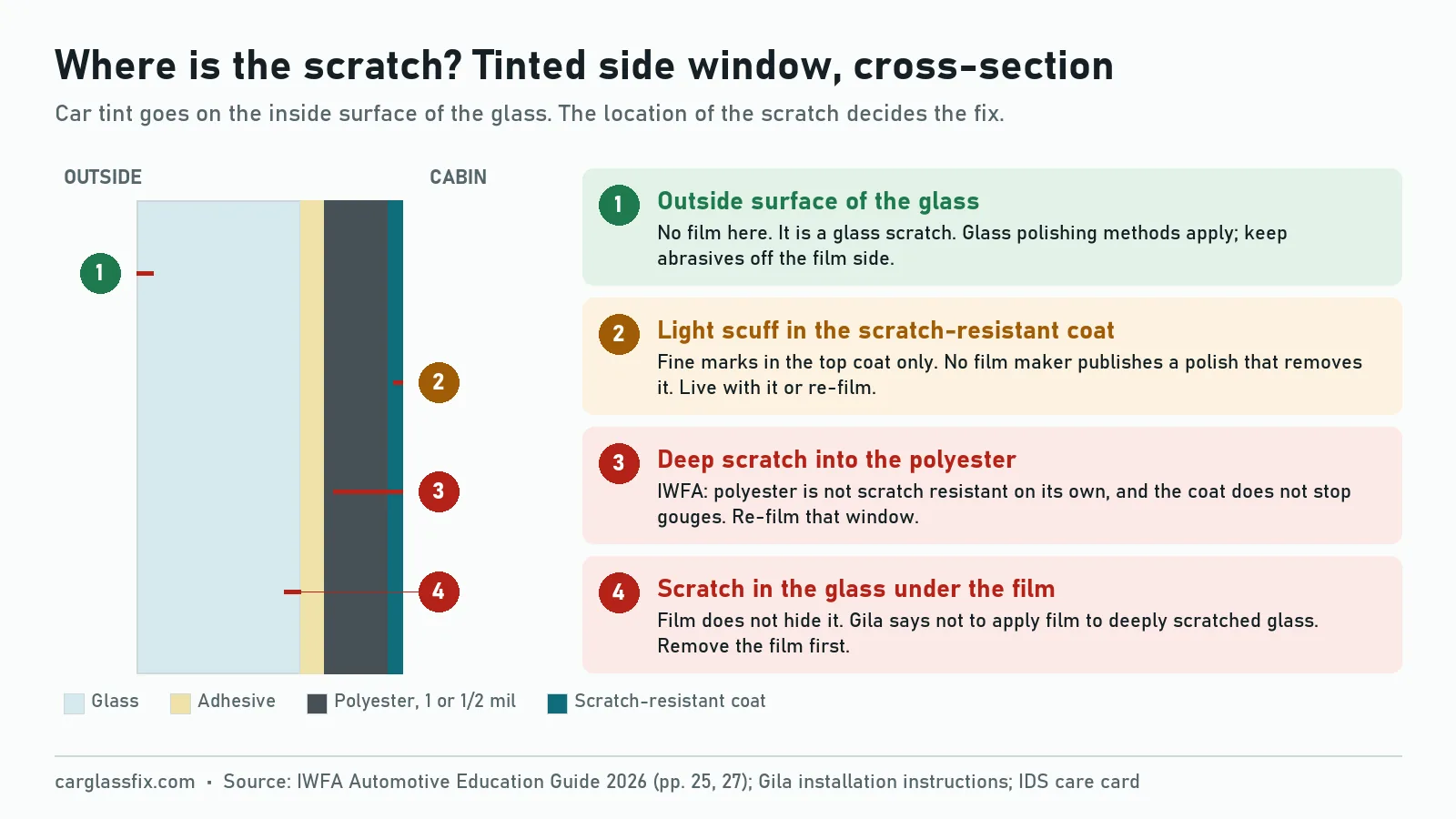
The location of the scratch decides the fix, so find the layer first. IWFA, the window film trade association, describes every window film as polyester with an installation adhesive on one side and a scratch-resistant coat on the other. On a car, the adhesive side faces the glass and the coated side faces the cabin.
| Where the scratch is | How to check | What fixes it |
|---|---|---|
| Outside surface of the glass | A fingernail catches on it from outside the car | Glass polishing methods, used only on the outside face |
| Light scuff in the film’s top coat | Fine marks seen from inside; nothing to feel from outside | No published repair; leave it or re-film |
| Deep scratch into the polyester | A clear line through the tint color, often from a sharp edge | Re-film the window |
| Scratch in the glass under the film | Line sits behind the film; the film surface over it is smooth | Remove the film, deal with the glass, then re-film |
For the first row, follow our guide on how to remove scratches from a car windshield at home, and keep every abrasive off the tinted inside face. Side windows have their own causes, covered in how to fix scratches on a car side window. A glass scratch under the film stays visible after tinting, which is why Gila tells buyers not to apply its film to deeply scratched glass.
Why scratched film cannot be polished like glass
Film cannot be polished like glass because the layer that takes the damage is too thin to cut back. IWFA says standard automotive film is mostly 1 mil (0.001 in, 25 microns) or 1/2 mil (12 microns) of polyester. The scratch-resistant coat on top is thinner still. Polishing a glass scratch works by removing glass around the scratch until the surface is level. Glass is thick enough to lose that material. A film coat is not. Any compound that cuts through the coat exposes bare polyester, and IWFA says polyester by itself is not scratch resistant. That is why the makers’ rules all point the same way. XPEL tells owners of its PRIME tint to avoid abrasive materials such as scouring pads. IDS asks for non-abrasive towels free of contaminants. Gila specifies a low-lint cloth and its application solution. None of these documents lists a polish, compound or repair pen for automotive tint. Forum posts that recommend cerium oxide or sandpaper are describing glass repairs, and those products belong only on the bare outside face of the window.
Light scuffs vs deep scratches
A light scuff marks only the scratch-resistant coat, while a deep scratch cuts into the polyester under it. IWFA explains that the coat is there to handle normal wear and tear. It also says the coat will not protect the surface from gouges or abrasion by sharp objects or tools. Light scuffs usually come from grit dragged across the film by a dirty cloth, which is why XPEL asks for a microfiber cloth and IDS for towels free of contaminants. They show as fine marks when light hits the window at an angle. Deep scratches come from hard edges. IDS names jewelry and seatbelt buckles as examples. A deep scratch shows as a sharp line through the tint color. Neither type has a maker-approved repair. A scuff that sits outside your line of sight is often left alone. A deep scratch in a front side window, or any mark that distracts you while driving, is a reason to re-film that window. Check how many windows are affected before you book, because one window can be replaced on its own.
How rolling the window and dirty felts scratch film
A door window rubs against its seals every time it moves, so grit trapped in those seals scratches whatever surface it touches. The tinted inside face slides past the inner seal at the bottom of the door, and Gila’s instructions tuck the bottom edge of the film under that gasket. GM’s service bulletin 21-NA-065 gives a useful test from the bare-glass side. On the 2020 to 2021 Buick Encore GX and 2021 Chevrolet Trailblazer, GM says vertical scratches parallel to the B-pillar trim are likely caused by debris in the outer belt seal. Scratches that run in other directions are treated as damage. The same direction logic helps on a tinted window. Straight vertical lines that follow the window’s travel point to the seal or the run channel. Random arcs and short lines point to cloths, buckles, rings or cargo. FCA’s bulletin 23-031-20 for the 2020 Dodge Journey shows that run-channel weatherstrips can also split or tear. Clean or replace a dirty or damaged seal before new film goes on, or the new film can be marked the same way.
Replacing a single window of film
Re-filming one window is the standard fix for a scratched film, and it does not require redoing the whole car. The job has two parts: removing the old film with its adhesive, then installing and curing new film. A professional installer can match the new film to the other windows. Gila’s removal instructions say to wait at least 24 hours after removal before applying new film. Avery Dennison warns that it cannot guarantee rear-window demister bars will survive removal, so a scratched back window carries more risk than a side window. The new piece also has to meet your state’s darkness limit, the same as the original. See what car window tint is legal before choosing a shade.
How to replace the film on one scratched window
Confirm the scratch is in the film
Check the outside of the glass first. A scratch you can feel from outside is a glass scratch and re-filming will not remove it.
Read the warranty card
Check what your film’s warranty covers. The IDS card excludes scratch damage and covers product only, not labor, for the defects it does cover.
Find and fix the cause
Look at the direction of the lines. Clean the door seals and run channel, or replace a torn weatherstrip, before new film goes on.
Remove the old film
Use steam, heat or a film remover and keep razors away from defroster and antenna lines, as Gila and Avery Dennison instruct.
Wait and re-clean the glass
Gila asks for at least 24 hours between removal and new film. Clean off all adhesive residue first.
Install matching, legal film
Ask for the same product and shade as the other windows and check it against your state’s limit.
Keep the window up while it cures
IDS says at least 2 days, XPEL 1 to 5 days and Gila a week to 10 days, depending on the film and weather.
For removal detail, read how to remove car window tint. Shade matching is covered in how to match tint on replacement side glass, and the cure rules in why you can’t roll down windows after tint.
What film makers say about cleaning tinted windows
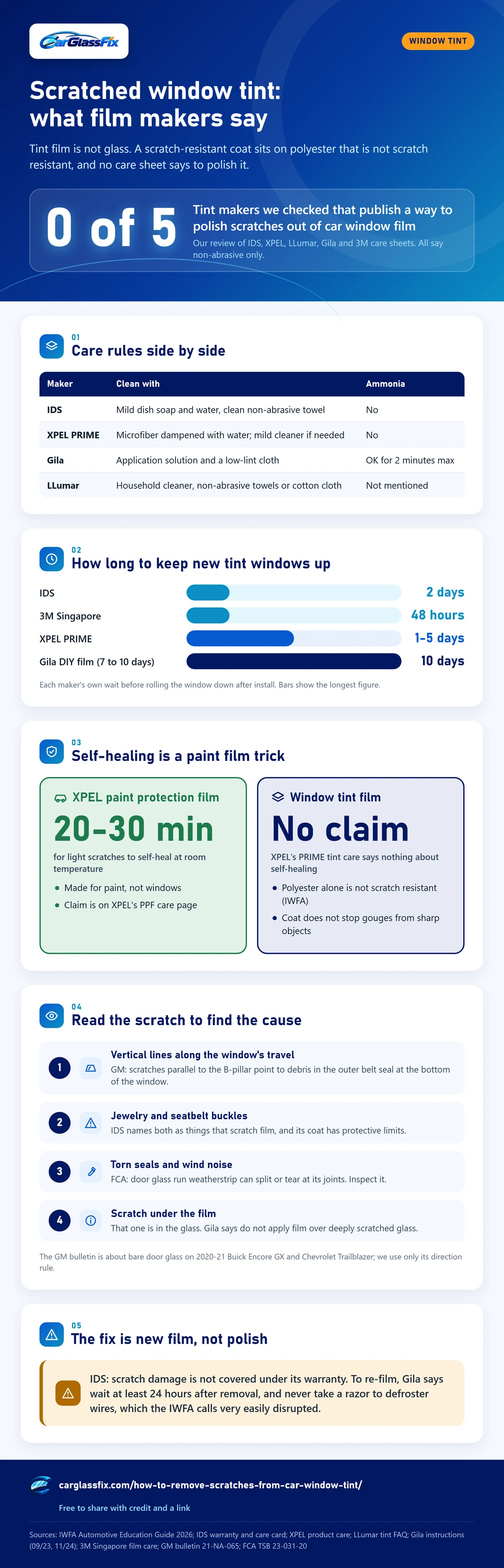
Film makers agree on soft, clean, non-abrasive cloths, but they disagree on ammonia and on how long to wait after installation. The table lists what each maker’s own document says. Follow the care card that came with your film when it differs from the general advice.
| Film maker | Cleaner | Cloth | Wait after installation |
|---|---|---|---|
| IDS Automotive | Mild dish soap and water; no ammonia | Non-abrasive towels free of contaminants | 2 days before cleaning or rolling down |
| XPEL PRIME | Water; mild non-ammonia glass cleaner if needed | Microfiber, slightly damp; no scouring pads | About 1 to 5 days, by climate |
| LLumar | Household cleaner | Non-abrasive paper towels or cotton cloths | Not stated in the FAQ |
| Gila (DIY film) | Application solution; ammonia cleaner on film no more than 2 minutes | Low-lint cloth | 3 days before cleaning |
| 3M (Singapore care page) | Not specified on that page | Not specified on that page | 48 hours before lowering windows; 7 days before cleaning |
One claim causes confusion. XPEL says light scratches in its paint protection film self-heal in 20 to 30 minutes at room temperature. That statement is on XPEL’s paint protection film care pages, not its window tint care. XPEL’s PRIME tint instructions make no self-healing claim, so heat will not erase a tint scratch. For a full cleaning routine, see how to clean tinted side glass.
Frequently asked questions
Is it possible to remove scratches from window tint?
Not from the film itself. Film makers such as IDS, XPEL, LLumar and Gila publish care rules against abrasives and no repair method, so a scratch in the film is either left alone or fixed by re-filming that window.
Can I use a polish or cerium oxide on scratched tint?
No. Cerium oxide and glass polishes remove material, and IWFA says the polyester under the film’s coat is not scratch resistant. Use glass polish only on the bare outside face of the window, as described in our guide on how to remove scratches from a car windshield at home.
Does the tint warranty cover scratches?
Usually not. The IDS Automotive warranty card states that scratch damage to the film is not covered, and its coverage is limited to defects such as peeling, bubbling and discoloration. Check the card for your own film.
Will a magic eraser remove scratches from tinted windows?
No. A melamine sponge cleans by fine abrasion, and every film maker reviewed here asks for non-abrasive cloths only. Using one on film can add scuffs. See what not to use to clean car windows.
Why did scratches appear on my tint after I rolled the window down?
The window slides past rubber seals each time it moves, and grit in those seals can mark the glass or film. GM’s bulletin 21-NA-065 links vertical door-glass scratches to debris in the belt seal, so clean the seals and check for torn weatherstrips.
Sources
- IWFA Automotive Education Guide 2026, pages 20, 24, 25 and 27 (checked 25 October 2026)
- IDS Automotive Window Tint care and limited warranty card (checked 25 October 2026)
- XPEL Product Care: PRIME automotive window film and paint protection film (checked 25 October 2026)
- LLumar Automotive Window Tint FAQ (North America) (checked 25 October 2026)
- Gila: Install automotive adhesive window tint, side roll-down windows (09/23)
- Gila: Window film adhesive remover instructions (11/2024)
- Avery Dennison Instructional Bulletin 7.1, Automotive Window Film (January 2026)
- 3M Singapore: General care and information for 3M Automotive Window Films
- GM Service Bulletin 21-NA-065: Warranty coverage of scratched door window glass (April 2021), NHTSA copy
- FCA TSB 23-031-20: Door glass run channel weatherstripping split or torn (November 2020), NHTSA copy

Similar Posts