How to Clean Tinted Car Windows Without Damaging the Film
Senior Automotive Glass Diagnostic Specialist & Master Technician at CarGlassFix · AGSC Master Certified Auto Glass Technician, NGA Certified Installer, I-CAR Automotive Safety Specialist · 12+ Years in Automotive Glazing, Windshield Structural Bonding, ADAS Camera Calibration & Precision Chip Restoration
To clean tinted car windows, wait out the film maker’s first-cleaning period, which runs from 48 hours to 30 days. Wipe cool glass with a damp microfiber towel or an ammonia-free glass cleaner, then dry it with a second clean towel. Never use abrasive pads, brushes, razor blades or scrapers on the film.
What is safe to use on tinted car windows
Water or an ammonia-free glass cleaner on a soft microfiber towel is safe on tinted car windows. XPEL starts with a towel slightly dampened with water and adds a mild non-ammonia glass cleaner only if necessary. 3M US accepts pH-neutral cleaners that contain no abrasives. Solar Gard suggests 1/2 ounce of liquid dish soap in 1 quart of fresh water. SC Johnson recommends Windex Ammonia-Free for car windows, tinted ones included. The product choice has its own page, the best glass cleaner for tinted car windows.
| Product | Use on film? | Who says so |
|---|---|---|
| Clean water | Yes | XPEL, 3M US |
| Dish soap and water | Yes | Solar Gard (1/2 oz per quart), IDS, Avery Dennison |
| Ammonia-free glass cleaner | Yes | XPEL, Relzon, Windex FAQ |
| pH-neutral cleaner, no abrasives | Yes | 3M US |
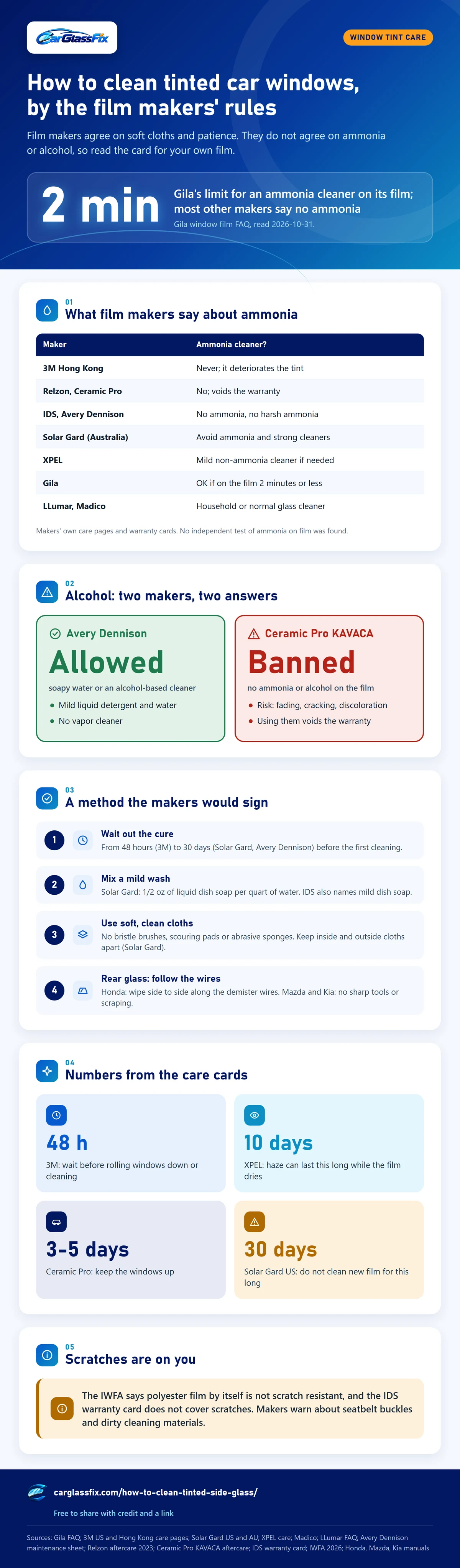
| Alcohol-based cleaner | Check your film | Avery Dennison lists it; Ceramic Pro bans it on KAVACA film |
| Ammonia cleaner | Avoid | Most makers warn against it; Gila allows two minutes of contact |
| Abrasive cleaners and scouring pads | No | 3M US, XPEL, Solar Gard, Madico |
The alcohol line matters for homemade mixes. A car glass cleaner made at home from rubbing alcohol suits bare glass. Check your film’s care sheet before using one on tint.
How long to wait after tint is installed
Wait for the period your film maker sets, because published waits run from 48 hours to 30 days. The wait exists because film goes on with a water-based solution, and that moisture has to dry out before the adhesive finishes bonding. Solar Gard says cold or sunless weather lengthens the dry-out and warm sun shortens it.
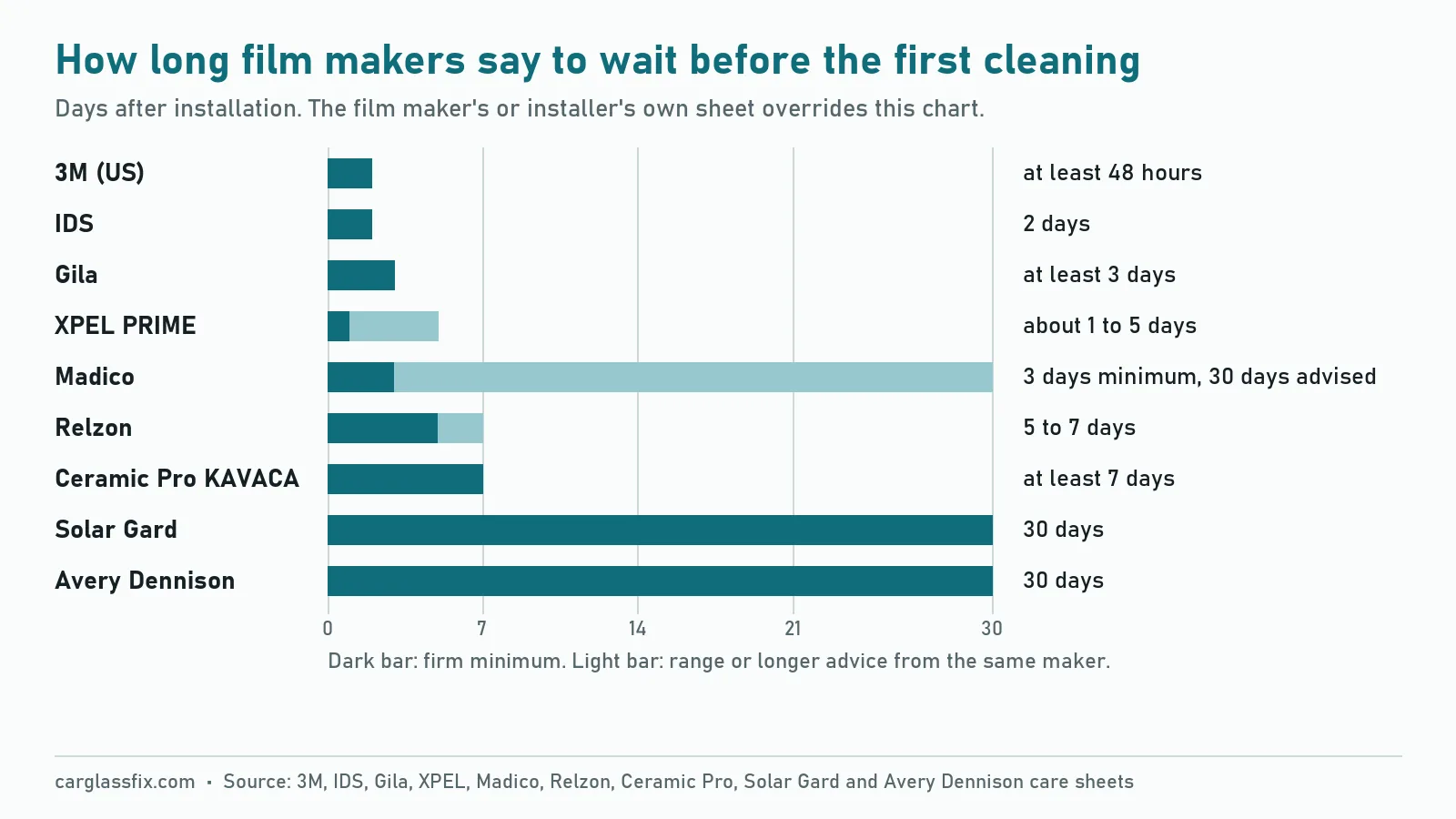
| Film maker | First cleaning | Windows down | Ammonia position |
|---|---|---|---|
| 3M (US page) | At least 48 hours | At least 48 hours | US page: pH-neutral cleaners. Hong Kong page: never |
| IDS | 2 days | 2 days | No ammonia |
| Gila | At least 3 days | After the cure, a week to 10 days | Allowed for 2 minutes or less on the film |
| XPEL PRIME | About 1 to 5 days | About 1 to 5 days | Non-ammonia cleaners only |
| Madico | At least 3 days; 30 days advised | At least 3 days | No ban stated; no abrasives |
| Relzon | 5 to 7 days | 48 to 72 hours | Non-ammonia only; ammonia voids warranty |
| Ceramic Pro KAVACA | At least 7 days | 3 to 5 days | No ammonia or alcohol; voids warranty |
| Solar Gard | 30 days | Not stated | US page: most glass cleaners. Australia page: avoid |
| Avery Dennison | 30 days | Not stated on this sheet | No harsh ammonia cleaners |
| LLumar | Not stated | Not stated | “Your favorite household cleaner” |
Your installer’s sheet comes first, since it matches the film on your car. If you have no sheet, the 30-day figure is the cautious choice. During the wait, haze and small water pockets are normal, and blurry car window tint usually clears as the film dries. The rest of the first month is covered in what to do after tinting car windows.
How to clean tinted windows step by step
Clean tinted windows on cool glass, one window at a time, with two clean towels. Ceramic Pro, Relzon and SC Johnson all advise cool glass, and SC Johnson adds that it should be out of direct sun. Solar Gard says to avoid using the same materials inside and outside, since outside towels pick up grit. Film sits on the inside surface, so the inside towel is the one that touches it.
How to clean tinted car windows
Confirm the wait is over
Check your film sheet. If the car was tinted in the last 30 days and you have no sheet, wait.
Park in the shade
Let the glass cool until it feels cool to the touch.
Clean the outside first
Use a separate towel for the outside glass and keep it away from the inside.
Dampen a clean microfiber towel
Use water, or a light mist of ammonia-free cleaner. Do not soak the glass or the film edges.
Wipe with light pressure
Work across the window with the damp towel. Do not rub hard.
Dry with a second towel
Buff with a dry microfiber towel, or flip to a dry side, until streaks are gone.
Clean the top edge
Lower the window slightly and wipe the part that sat in the seal, once the film has fully cured.
Check the towel
Swap to a fresh towel as soon as it looks dirty, because trapped grit scratches film.
Ceramic Pro and Relzon both ask for light pressure around film edges during the first month. Grit in the seals also matters. Ceramic Pro and Relzon warn about sand and dirt building up in the window gasket, where a moving window can drag it over the film.
Why ammonia is the main risk, and where makers disagree
Ammonia is the cleaner most film makers warn about, although their published positions differ. 3M’s Hong Kong page says ammonia “will deteriorate the tint over time”. Relzon names hazing, fading and cracking as the results. Ceramic Pro lists fading, cracking and discoloration, and both brands say ammonia cleaners void the warranty. Armor All and Stoner, which sell ammonia-free cleaners, report that ammonia weakens the adhesive and can cause bubbling and peeling.
Other makers are less strict. Gila says ammonia cleaners are safe if they stay on the film for no more than two minutes. LLumar says “your favorite household cleaner” is fine. Madico accepts typical off-the-shelf glass cleaners with no abrasives. Solar Gard’s US page says most glass cleaners work, while its Australian page says to avoid ammonia.
None of these pages publishes test data, so the damage claims are makers’ statements. An ammonia-free cleaner satisfies all of these makers and stays clear of the warranty exclusions above. Windex Original lists ammonium hydroxide as an ingredient, and the car glass cleaner vs Windex comparison covers it in detail.
Abrasives and tools that scratch window film
Anything rough or dirty can scratch window film, including some paper towels. The International Window Film Association says polyester film alone is not scratch resistant, so it relies on a thin coating that does not stop gouges from sharp tools. IDS states that its scratch-resistant coating has “protective limitations”, and scratch damage is not covered under its warranty.
3M US says to use a soft sponge or cloth and no brush. XPEL rules out scouring pads. Solar Gard adds bristle brushes, abrasive sponges and any material contaminated with dirt. Solar Gard also warns that some paper towels leave fine scratches, even on hard-coated film. LLumar and Madico accept non-abrasive or soft paper towels, so microfiber is the choice that satisfies all of them. Razor blades and scrapers stay off the film for the same reason.
Everyday contact causes damage too. 3M, IDS, Ceramic Pro and Relzon all warn about seatbelt buckles hitting the glass. Ceramic Pro adds dog claws. A scratch already in the film cannot be cleaned away, and scratches in car window tint need a different plan. For the full list of off-limits items, see what not to use to clean car windows.
Factory privacy glass vs aftermarket film
Factory privacy glass has no film to protect, so these film rules apply only to aftermarket tint. GM’s service documents describe privacy glass as glass rated at a nominal 20% light transmission, fitted to rear doors, quarter windows and back glass. Aftermarket film is a separate layer, and Gila says it goes on the inside surface of the window.
Some cars have both, with factory glass in the back and film added elsewhere. If you bought the car used and do not know its history, treat every window as filmed. An ammonia-free cleaner and a soft towel work on plain glass as well, so the cautious method loses nothing. Armor All describes its ammonia-free wipes as suitable for factory tint and most aftermarket tint, and it still tells owners to check the film maker’s guidance.
Tinted rear windows and defroster lines
Wipe a tinted rear window side to side along the defroster lines, with no scraping. A Honda owner’s manual says it is critical to wipe from side to side along the heating wires. Mazda’s manual says not to use sharp instruments or abrasive window cleaners on the inside of the rear window. Kia’s says not to scrape it. Those warnings protect the grid, and they match the film makers’ rules on abrasives, so one gentle method covers both. A soft towel with little pressure suits both the film and the lines beneath it. The full routine, including how to reach the glass, is in how to clean the rear windshield inside. Check the film’s care sheet first, since the rear window follows the same wait as the side glass.
Frequently asked questions
Can you use Windex on tinted car windows?
SC Johnson recommends Windex Ammonia-Free for car windows, including tinted ones. Windex Original contains ammonium hydroxide, and most film makers warn against ammonia.
Can you use Dawn dish soap on tinted windows?
Yes. Solar Gard suggests 1/2 ounce of liquid dish soap in 1 quart of fresh water, and IDS also lists mild dish soap and water. Dry the glass with a clean soft towel afterward.
Can you use vinegar on tinted car windows?
None of the film maker pages reviewed here lists vinegar. 3M US asks for pH-neutral cleaners and vinegar is acidic, so dish soap and water is the better documented choice.
How soon can you clean windows after tinting?
Film makers give from 48 hours (3M US) to 30 days (Solar Gard and Avery Dennison). Follow your installer’s sheet, and use 30 days if you do not have one.
What if I already used an ammonia cleaner on my tint?
Makers describe ammonia damage as gradual, so switch to an ammonia-free cleaner and watch the film. If it fades, bubbles or peels, see how to fix car window tint.
Sources
- 3M US, After Installation Product Care Instructions (checked 2026-10-31)
- 3M Hong Kong, Caring for your wrap and window films (checked 2026-10-31)
- Gila, Automotive Window Tint FAQ (checked 2026-10-31)
- XPEL, Product Care Instructions (checked 2026-10-31)
- Madico, Automotive Window Tint (checked 2026-10-31)
- LLumar, Automotive Window Tint FAQ (checked 2026-10-31)
- Solar Gard, Care Instructions (checked 2026-10-31)
- Solar Gard Australia, Care and Maintenance of Window Film (checked 2026-10-31)
- Avery Dennison, Solar Films Maintenance Recommendations
- Relzon IR Window Film, Aftercare (2023)
- Ceramic Pro, KAVACA Window Film Warranty and Aftercare
- IDS, Automotive Window Tint Warranty Card
- International Window Film Association, Automotive Education Guide 2026
- Windex, Frequently Asked Questions (checked 2026-10-31)
- SC Johnson, Windex Original Glass Cleaner ingredients
- Armor All, Glass Wipes
- Stoner Car Care, Tint-Safe Glass Cleaners Explained
- GM Preliminary Information PIT3237F (NHTSA archive, 2012)
- Honda owner’s manual, Rear Demister Button (Jazz, India)
- Mazda CX-5 owner’s manual, Rear Window Defogger
- Kia owner’s manual, Cleaning the interior window glass

Similar Posts