Wyoming Window Tint Laws: 28% Limit by Window
Senior Automotive Glass Diagnostic Specialist & Master Technician at CarGlassFix · AGSC Master Certified Auto Glass Technician, NGA Certified Installer, I-CAR Automotive Safety Specialist · 12+ Years in Automotive Glazing, Windshield Structural Bonding, ADAS Camera Calibration & Precision Chip Restoration
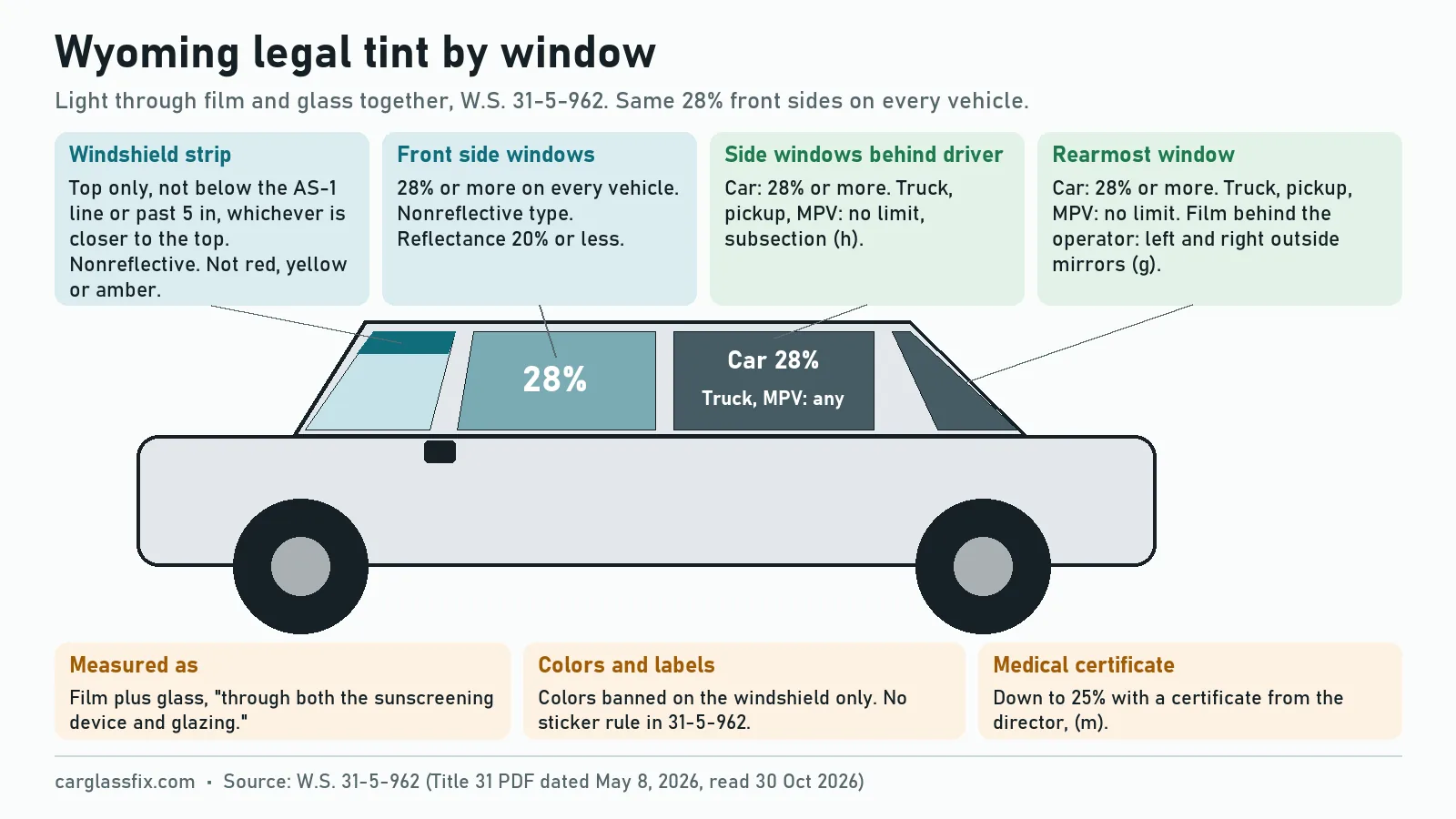
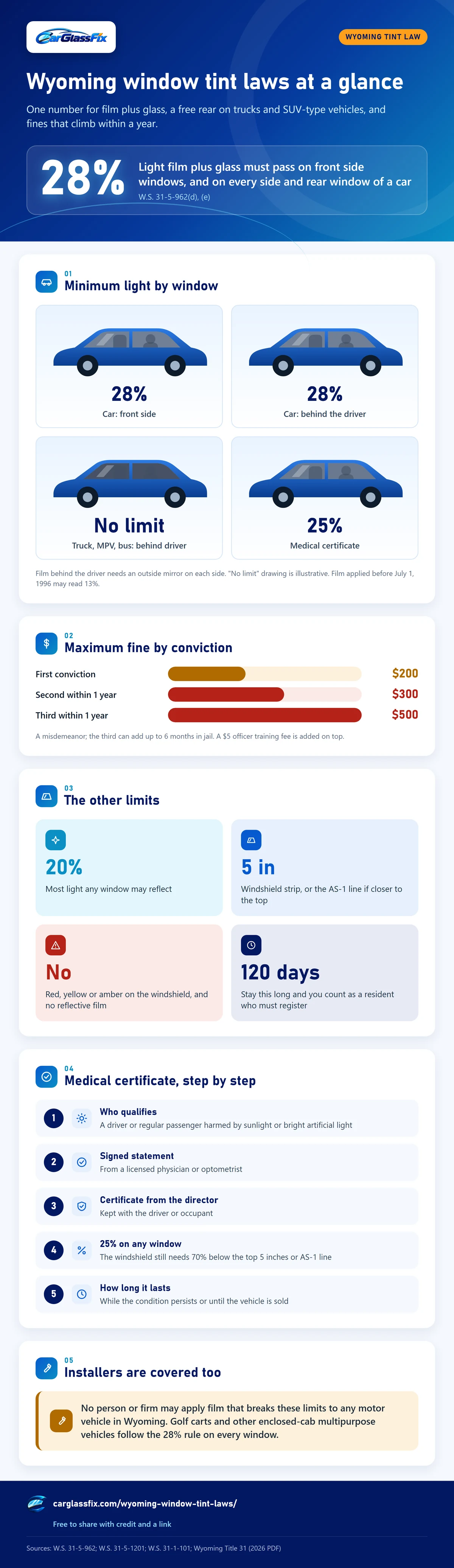
Wyoming law requires at least 28% light through film and glass together on front side windows, and on the back side and rear windows of passenger cars. Trucks, buses and multipurpose passenger vehicles have no limit behind the driver. Windshield tint may run only along the top, above the AS-1 line or within 5 inches.
Wyoming window tint limits by window
Wyoming sets one number, 28%, for every tinted side and rear window that the law covers. The rule is W.S. 31-5-962, titled “Sunscreening devices.” It applies to an enclosed motor vehicle registered or required to be registered in Wyoming, on any public highway, road or street. The statute sorts vehicles by type and does not use the words SUV, van or crossover. The SUV column below therefore depends on whether the vehicle counts as a multipurpose passenger vehicle, which the section on exempt vehicles explains. Subsection (b) names the windshield, the front side wings, the side windows beside the driver and the windows behind the driver. Limits are the lowest legal reading, so a higher percentage is lighter and passes.
| Window | Sedan | SUV, van, pickup |
|---|---|---|
| Windshield | Top strip only, not below the AS-1 line or more than 5 in from the top, whichever is closer to the top; nonreflective; not red, yellow or amber | Same |
| Front side windows | 28% or more; nonreflective type; reflectance 20% or less | Same |
| Side windows behind the driver | 28% or more; nonreflective type; reflectance 20% or less | No limit on trucks and multipurpose passenger vehicles |
| Rearmost window | 28% or more; nonreflective type; reflectance 20% or less | No limit on trucks and multipurpose passenger vehicles |
| Outside mirrors | One left and one right if film is behind the operator | Keep both; see the mirror note below |
| Measured as | Film and glass together | Same |
| Tolerance | None stated in the statute | Same |
How Wyoming measures the 28% limit
Wyoming measures the film and the window glass together, so 28% is the reading of the finished window. Subsection (d) requires “total light transmission through both the sunscreening device and glazing” of at least 28%. Subsection (a)(ii) defines light transmission as the share of total light that passes through the product or material.
A film sold as 28% will therefore read below 28% once it sits on glass that already blocks some light. Multiply the glass figure by the film figure to get the result. On glass that passes 80%, a 35% film lands on exactly 28%, because 0.80 times 0.35 is 0.28. On glass that passes 70%, the film must be 40% or lighter. Those two glass figures are examples, so measure your own window. Our how to measure window tint guide covers the method, and the window tint percentage chart shows how each shade looks. Section 31-5-962 states no tolerance, so a reading of 27% has no written margin. A window tint meter reads the same combined figure the statute describes.
Windshield tint in Wyoming: the AS-1 line or 5 inches
A Wyoming windshield may carry tint only along the top, and the strip stops at the AS-1 line or 5 inches from the top, whichever is closer to the top. That wording is in subsection (c). On a windshield where the AS-1 mark sits 4 inches down, the strip stops at 4 inches. On one where it sits 6 inches down, the strip stops at 5 inches. See what is the AS-1 line on a windshield to find the mark on your glass.
The windshield rule sets no percentage for the strip. It sets two other tests instead: the film must be a “nonreflective type” and it “may not be red, yellow or amber in color.” Subsection (a)(v) defines nonreflective as designed to absorb light rather than reflect it. Wyoming Highway Patrol paid particular attention to this glass in 2022. Sheridan Media reported that troopers in the Riverton and Lander areas were watching for tinted windshields after seeing more of them. A full windshield film without a medical certificate breaks subsection (c). For how other states treat this glass, read is it illegal to have tint on a windshield.
Which Wyoming vehicles have no limit behind the driver
Trucks, buses, motor homes, ambulances, limousines and multipurpose passenger vehicles have no tint limit behind the driver. Subsection (h) says the section’s requirements “shall not apply to windows behind the driver” of those vehicles. That lifts the 28% floor, and it also lifts the 20% reflectance cap on those windows. The front side windows and windshield keep the normal rules.
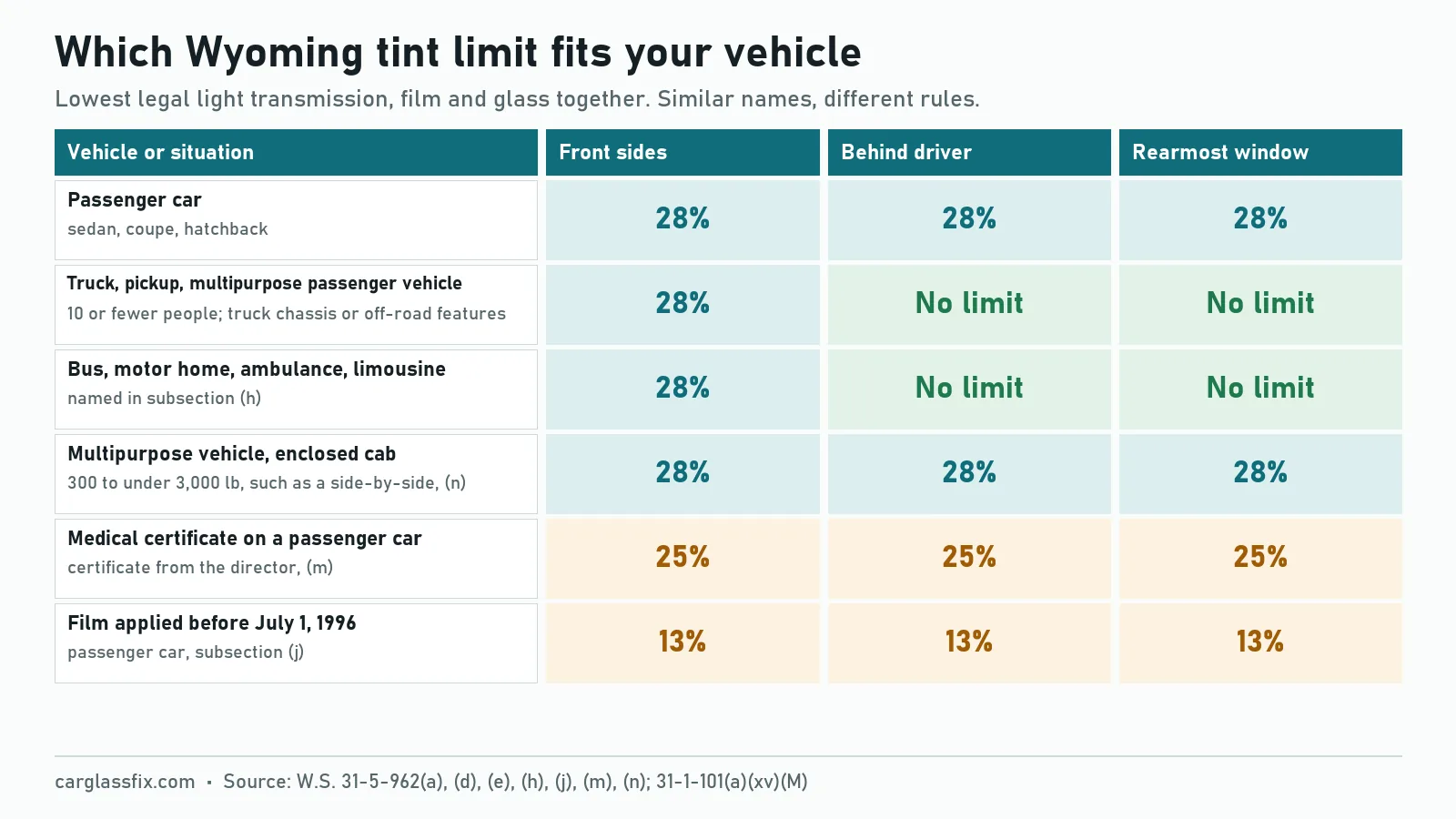
Subsection (a)(iv) defines a multipurpose passenger vehicle as one designed to carry 10 persons or less, built on a truck chassis or with special features for occasional off-road operation. Body-on-frame SUVs fit that wording, and pickups count as trucks. A car-based crossover or minivan is less clear. The federal definition in 49 CFR 571.3 uses almost the same words, and the federal label in the door jamb states the type (49 CFR 567.4(g)(7)). “MPV” on that label is a useful clue, though Wyoming’s statute does not refer to it.
A similar name causes a trap. Subsection (n) applies the whole section to “multipurpose vehicles” with a windshield and enclosed cab. W.S. 31-1-101(a)(xv)(M) defines those as machines of 300 to under 3,000 pounds, including golf carts. A cab side-by-side is therefore safest at 28% on every window, because the statute does not explain how (h) and (n) interact.
Reflectivity, colors and the Wyoming mirror rule
Film on any Wyoming window covered by the law may not reflect more than 20% of light. Subsection (f) sets that cap for “any window,” and subsections (d) and (e) separately require a nonreflective type on the side and rear glass. A film can pass the 20% number and still be questioned if it was designed to reflect, because the definition looks at design. Mirror finishes are the obvious risk. Read can you put mirror tint on a car for how those films work.
The color ban sits in the windshield subsection only. The side and rear subsections name no colors. Subsection (g) adds a mirror condition: film on any window behind the operator requires one left and one right outside rearview mirror. Read literally, (h) lifts that condition too for exempt vehicles, since it removes “the requirements of this section” for those windows. News reports on Highway Patrol enforcement in 2022, however, described the rear-window freedom on trucks and SUVs as depending on both side mirrors. Keeping both mirrors avoids the argument. Section 31-5-962 has no sticker or label requirement.
Wyoming medical exemption for window tint
Wyoming allows film down to 25% for a medical condition, but only with a certificate from the director. A doctor’s note alone does not meet subsection (m). The exemption covers a vehicle operated by or regularly used to transport a person whose condition makes them susceptible to harm from sunlight or bright artificial light. It reaches the windshield and any or all windows. The windshield must stay at 70% or more, except in the upper 5 inches or above the AS-1 line, whichever is closer to the top. The side windows gain only three percentage points over the normal 28%. The windshield is the larger change.
How to get a Wyoming medical exemption for window tint
Get a signed statement
A licensed physician or licensed optometrist must identify you and state that the film is necessary to safeguard your health.
Ask for the certificate
The statement goes to the director, who issues the certificate. Other parts of Title 31 define the director as the head of the Wyoming Department of Transportation.
Keep it with the vehicle
The driver or an occupant must have the certificate while the vehicle is on a highway.
Replace it when needed
It lasts while the condition persists or until the vehicle is sold, whichever comes first.
The director may issue one or more certificates to an individual or a family. We found no published WYDOT form or web page for this certificate, so contact WYDOT before the film goes on.
Wyoming tint tickets and penalties
A Wyoming tint violation is a misdemeanor with a fine of up to $200 for a first conviction. Section 31-5-962 sets no penalty of its own, so the general rule in W.S. 31-5-1201 applies. A first conviction is “not more than two hundred dollars ($200.00).” A second conviction of the same offense within one year is “not more than three hundred dollars ($300.00).” A third or later conviction within one year of the first is up to $500, up to six months of imprisonment, or both. Subsection (h) of 31-5-1201 adds court fees and a “five dollars ($5.00)” officer training fee.
The installer carries risk too. Subsection (k) of 31-5-962 says no “person or firm” may apply non-compliant film to any motor vehicle in Wyoming, and a 2022 Oil City News report said businesses that purposely break the law can be cited. Enforcement happens at traffic stops. We found no periodic safety inspection program in Title 31, and 31-5-962 states no fix-it or dismissal rule. W.S. 31-5-970 separately bars driving a vehicle whose equipment is out of order or unsafe. Wyoming Highway Patrol spokesman Sgt. Jeremy Beck warned in 2022 that dark tint can hide an animal, child or pedestrian at night, as reported by Sheridan Media.
Out-of-state cars and film from before 1996
Subsection (b) reaches only vehicles registered or required to be registered in Wyoming, so a visitor’s car falls outside it. A move changes that. W.S. 31-2-201(a)(iii) requires registration upon becoming a resident, and 31-2-201(a)(iv) requires it immediately when a vehicle is used for work in the state. The residency definition in 31-1-101(a)(xxi) includes anyone who stays 120 days or more, or who works in Wyoming and lives there for that job. A driver moving from a state with darker limits should check the film before registering. A Wyoming shop is still bound by subsection (k), whatever plate the car carries.
Very old film has its own number. Subsection (j) sets 13% for a device applied before July 1, 1996, on the side and rear windows, in a nonreflective type. The statute does not say how to prove the date. Before you choose a shade, try the window tint simulator, and compare other states in what car window tint is legal.
Wyoming tint rules can change with any legislative session. Check the current W.S. 31-5-962 or ask WYDOT before you tint. This article is general information, not legal advice.
Frequently asked questions
What is the darkest legal tint in Wyoming?
The darkest legal reading is 28% on the front side windows of any vehicle, and on every side and rear window of a passenger car. Windows behind the driver of trucks and multipurpose passenger vehicles have no limit, and a medical certificate allows 25%.
Is 20% tint legal in Wyoming?
A 20% reading is illegal on front side windows and on any window of a passenger car. It is legal behind the driver on the trucks, buses, motor homes, ambulances, limousines and multipurpose passenger vehicles listed in subsection (h).
Is 35% or 20% tint darker?
A 20% tint is darker because it passes 20% of visible light, against 35% for the lighter film. In Wyoming a 35% film can land near the 28% limit once the glass is counted, as the window tint percentage chart helps show.
Are Wyoming window tint laws different for trucks?
Yes, for the windows behind the driver only. Trucks and pickups have no limit there, while the front side windows still need 28% and the windshield rule still applies.
Does a doctor’s note make dark tint legal in Wyoming?
No, a note alone is not enough. The signed statement from a licensed physician or optometrist supports a certificate from the director, and the driver or an occupant must have that certificate on the highway.
Sources
- Wyoming Statutes Title 31, official PDF from the Wyoming Legislature: W.S. 31-5-962, 31-5-970, 31-5-1201, 31-1-101, 31-2-201 and 31-5-102 (file dated 8 May 2026; checked 30 October 2026)
- FindLaw copy of W.S. 31-5-962 (checked 30 October 2026)
- 49 CFR 571.3, definition of multipurpose passenger vehicle (checked 30 October 2026)
- 49 CFR 567.4, certification label requirements (checked 30 October 2026)
- Wyoming Department of Transportation: Driver Services (checked 30 October 2026)
- Sheridan Media: Wyoming Highway Patrol Cautions Drivers From Tinting Windows Too Dark (19 April 2022)
- Oil City News: WHP cracking down on illegal window tinting around Lander, Riverton (6 April 2022)

Similar Posts