DC Window Tint Laws: 70% Front, 50% Rear, Mini-Van Rules
Senior Automotive Glass Diagnostic Specialist & Master Technician at CarGlassFix · AGSC Master Certified Auto Glass Technician, NGA Certified Installer, I-CAR Automotive Safety Specialist · 12+ Years in Automotive Glazing, Windshield Structural Bonding, ADAS Camera Calibration & Precision Chip Restoration
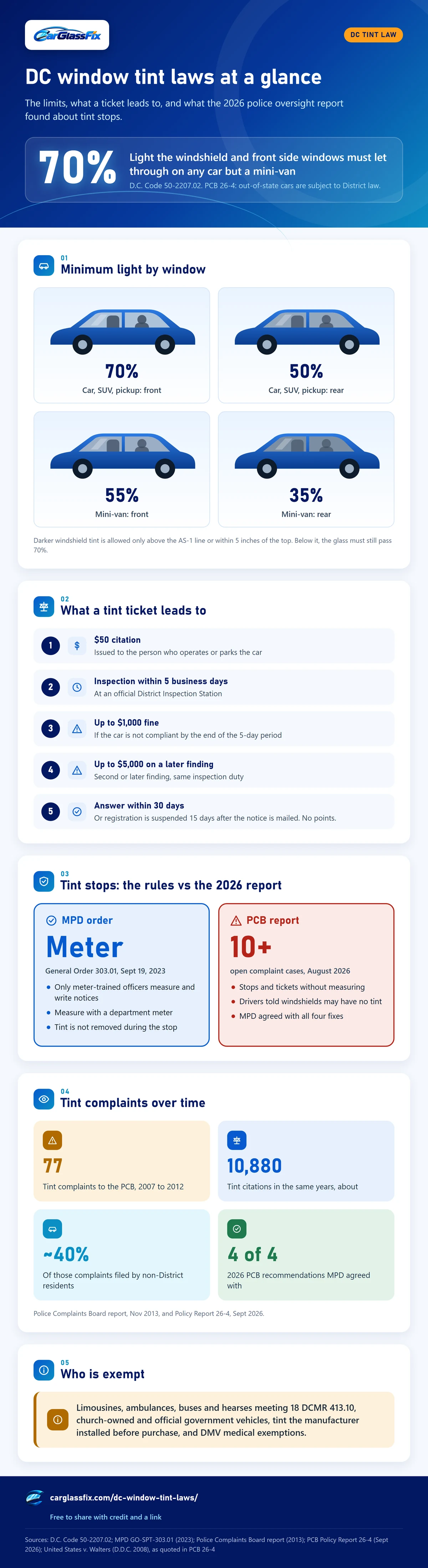
DC window tint laws require at least 70% light through the windshield and front side windows and 50% through the rear side and rear windows on sedans, SUVs and pickups. Mini-vans need 55% and 35%. Darker windshield tint is allowed above the AS-1 line or within 5 inches of the top.
DC window tint limits by window
DC sets a 70% minimum for front glass and a 50% minimum for rear glass on every vehicle except a mini-van. The rule is D.C. Code 50-2207.02, and it covers a vehicle that is “operated or parked” on public streets or spaces in the District of Columbia. A parked car can break it. The Council wrote one vehicle split: mini-van, or everything else. SUVs and pickups are therefore in the 70% and 50% group by the text, even though many states treat them as a looser class.
| Window | Sedan | SUV, van, pickup |
|---|---|---|
| Windshield | 70% or more; darker only above the AS-1 line or within 5 in of the top | SUV, pickup: same. Mini-van: 55% or more, same top strip |
| Front side windows | 70% or more | SUV, pickup: 70%. Mini-van: 55% |
| Rear side windows | 50% or more | SUV, pickup: 50%. Mini-van: 35% |
| Rear window | 50% or more | SUV, pickup: 50%. Mini-van: 35% |
| Reflectance, colors, mirrors, label | Not addressed in the section | Same |
| Tolerance | None stated | None stated |
The limits are older than most tint guides. The 1994 Act set a flat 70% and 50% with no mini-van class. D.C. Law 13-289, effective April 27, 2001, rewrote subsections (a) and (h). That is when the mini-van limits and the factory and medical exemptions entered the text. The section’s history notes list no amendment after 2005, and we found no 2025 or 2026 bill changing it.
What 70% and 50% mean on real glass
The DC limits describe the light the finished window lets through, so the reading covers the glass and the film together. The statute speaks of windows that “allow less than” the percentage and never rates the film alone. It also does not define light transmittance.
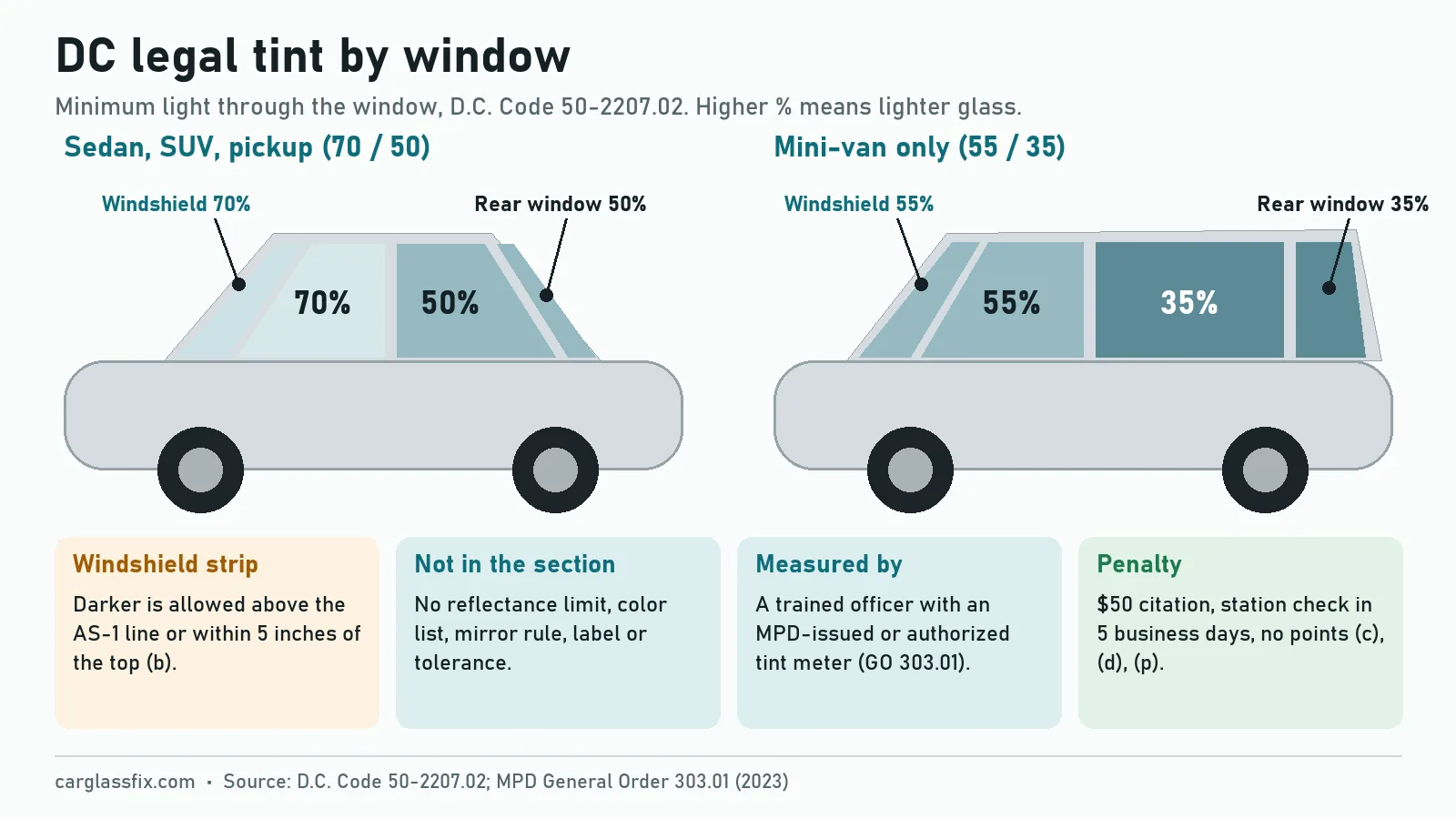
A 70% floor leaves little room, because bare automotive glass already blocks some light. Film and glass multiply. As an example, glass passing 80% with a film rated 85% gives 68%, which is under the DC limit. Use our guide on how to measure window tint to run that math with your own numbers, and the window tint percentage chart to see each shade. The window tint simulator shows how a shade looks from outside. A window tint meter gives the net reading a shop can confirm before you leave.
The section sets no reflectance limit, names no banned colors, and has no mirror, label or certificate rule. Some guides list those items for DC. We did not find them in the section or on the DC DMV pages we read, and we did not read every chapter of the DC regulations.
Windshield tint in DC is limited, not banned
A DC windshield may carry tint below the AS-1 line if the glass still allows at least 70% light. Subsection (b) adds that the windshield may go below 70% “above the AS-1 line, or within 5 inches from the top”. Those are the only two places darker tint is allowed. To find the mark, see the AS-1 line on a windshield.
This point is widely misstated. A Police Complaints Board (PCB) report released September 29, 2026 says officers told drivers that front windshields cannot contain any tint, and that the claim is legally inaccurate. The report says an MPD Instagram video made the same error about glass below the AS-1 line. It asks MPD to correct its training and public material, and MPD agreed with all four recommendations.
A clear film can still be illegal if the finished windshield reads under 70%, so the percentage decides the question. The PCB report also describes an officer who said his meter tested only side windows. Keep the film’s specification sheet and a meter reading from the installer if you add any windshield film.
Mini-vans, SUVs and factory glass
Only a mini-van gets the 55% and 35% limits in DC, and the section does not define the word. An SUV or pickup is a vehicle “other than a mini-van” on a plain reading, so it stays at 70% and 50%. A passenger van is the gray area. If yours is not clearly a mini-van, ask DC DMV before you tint to the lower numbers. The mini-van paragraph opens with the same exception for subsection (b), so the top strip rule reaches mini-vans too, although (b) itself mentions only 70%.
Factory glass is the main relief for SUV and pickup owners. Subsection (h)(4) exempts “vehicles with tinted windows installed by the manufacturer prior to purchase.” The PCB report distinguishes that from aftermarket film applied after purchase. Dark factory privacy glass is therefore outside the limits. Film added over it is the risk, and the exemption wording gives it no clear cover. Shops are covered too: subsection (g) bars anyone from installing tint in DC that would put a non-exempt vehicle in violation. If a car already fails, see how to remove car window tint.
Maryland and Virginia cars in DC
Out-of-state cars must meet the DC limits while on DC streets, even when the tint is legal at home. The PCB’s 2026 report says such a motorist “is subject to District law”. It relies on United States v. Walters, a 2008 federal court ruling on a Maryland car, which held that the limit applies “regardless of where the car is registered.”
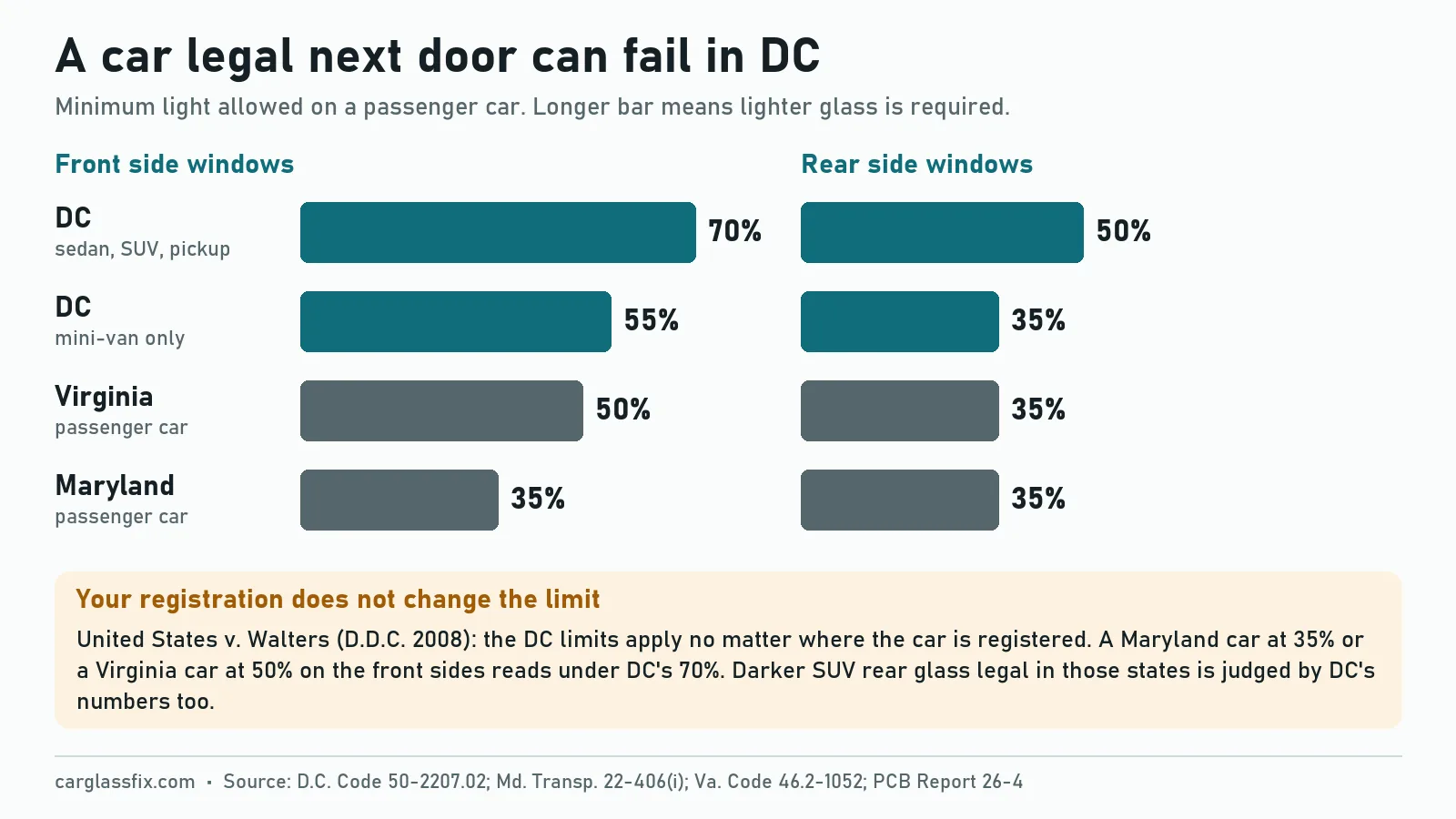
This trips commuters. Maryland window tint laws allow 35% on a passenger car, and Virginia window tint laws allow 50% in front, so both read under DC’s 70%. Older pages may recall a 1995 MPD order, SO-95-14, that told officers not to cite cars legal in their home state. The PCB’s 2013 report called that order contrary to the statute, and General Order 303.01 lists it as rescinded in 2023. Of the 77 tint complaints in that 2013 report, almost 40% came from non-District residents.
A home-state medical waiver is treated differently. General Order 303.01 says “operators who possess a medical waiver from their jurisdiction are exempt,” and that proof varies by state. Carry the paper.
What happens after a DC tint stop
A DC tint stop should end with a meter reading, and a confirmed violation brings a $50 citation plus a compliance deadline. MPD General Order 303.01, effective September 19, 2023, sets the police side. D.C. Code 50-2207.02 sets the rest. The PCB report describes cases where officers skipped the measurement, and complaint examiners sustained complaints over some of those tickets.
DC window tint stop and citation process
Officer explains the stop
The officer tells you the tint may exceed the limit, that the glass will be measured, and checks for an exemption.
Trained officer measures
Only members who completed MPD tint meter training may measure and issue the notice, using a department-issued or authorized meter.
Notice is issued
A confirmed violation brings a notice of infraction or a warning notice, and the statute sets a $50 citation under 50-2207.02(c). The order says tint is not removed during the stop.
Vehicle goes to the station
Subsection (d) requires inspection at an official District Inspection Station within 5 business days of the finding.
Fines follow if tint stays
The owner faces a fine of not more than $1,000, or not more than $5,000 after a second or later finding.
Answer the mailed notice
You have 30 calendar days to answer. If you do not, registration is suspended 15 days after the suspension notice is mailed.
These later fines are adjudicated as moving violations, yet subsection (p) says no points are assessed. The statute also uses both “5 business days” and “5-day period,” and the MPD order says five days, so act by the earliest date on your notice. An officer can order a car to a station at once if tint puts public safety at risk. The PCB report also says a 2016 $1,000 tint ticket had no lawful basis, because the regulation cited had been repealed.
DC DMV says it does not require safety inspections for private passenger vehicles, so routine visits there are for emissions. Commercial, taxi and limo vehicles still get safety checks, and “unacceptable window tint” is a listed failure for them. Call DC DMV before you take a cited private car to 1001 Half Street, SW.
DC medical exemption and other exemptions
DC exempts a vehicle when a signed medical letter is kept in it, and DC DMV’s page names no separate form. The letter must be on letterhead and signed by a physician, physician assistant, ophthalmologist or optometrist. It must certify that protection from sunlight or bright lights is needed because of a medical condition of the registered owner or a member of the owner’s household. The statute itself speaks of a vehicle exempted by the DMV Director because the owner has a condition, so the household wording comes from DMV. The page states no darkness floor, fee or renewal. Check with DMV if you need those answers.
Other exempt vehicles are limousines, ambulances, buses and hearses meeting 18 DCMR 413.10, church-owned vehicles and official government vehicles. Compare other states in our guide to what car window tint is legal.
Tint rules can change. Check the current D.C. Code or DC DMV before you tint. This article is general information, not legal advice.
Frequently asked questions
Is 35% tint legal in DC?
A 35% reading is legal in DC only on the rear side and rear windows of a mini-van. On a sedan, SUV or pickup it is too dark for every window, because those vehicles need 70% in front and 50% in the rear.
Is 20% tint legal in DC?
No. A 20% reading is below every DC limit, including the 35% mini-van minimum. It is legal only with an exemption, such as factory-installed tint or a medical letter.
Can I get a ticket in DC if my tint is legal in Maryland or Virginia?
Yes. The DC limits apply regardless of where the car is registered, so a car at Maryland’s 35% or Virginia’s 50% front limit reads under DC’s 70%. A medical waiver from your home jurisdiction is treated as an exemption under MPD General Order 303.01.
How do I get a DC tint waiver?
Get a letter on letterhead signed by a physician, physician assistant, ophthalmologist or optometrist, and keep it in the vehicle. The DC DMV page lists no separate form.
Is window tint checked at DC inspection?
DC DMV does no safety inspection on private passenger vehicles, and tint is not on its failure list for them. Tint is a listed failure for commercial and for-hire vehicles, and a cited vehicle must still be taken to a District station under 50-2207.02(d).
Sources
- D.C. Code 50-2207.02, Tinted windows prohibited (checked 30 October 2026)
- D.C. Law 10-163, Motor Vehicle Tinted Window Amendment Act of 1994 (checked 30 October 2026)
- D.C. Law 13-289, Motor Vehicle and Safe Driving Amendment Act of 2000 and D.C. Law 15-307, Department of Motor Vehicles Reform Amendment Act of 2004
- MPD General Order GO-SPT-303.01, Traffic Enforcement (effective 19 September 2023; checked 30 October 2026)
- Police Complaints Board Policy Report 26-4, Window Tint Enforcement and release of 29 September 2026
- Police Complaints Board report on MPD enforcement of the window tint law (2013), which quotes United States v. Walters, 563 F. Supp. 2d 45 (D.D.C. 2008)
- DC DMV: Medical Waivers for Vehicle Window Tinting Restrictions (checked 30 October 2026)
- DC DMV: Inspection Station and Common Causes of Inspection Failure, For-Hire Vehicles (checked 30 October 2026)

Similar Posts