New Hampshire Window Tint Laws: Legal Limits by Window
Senior Automotive Glass Diagnostic Specialist & Master Technician at CarGlassFix · AGSC Master Certified Auto Glass Technician, NGA Certified Installer, I-CAR Automotive Safety Specialist · 12+ Years in Automotive Glazing, Windshield Structural Bonding, ADAS Camera Calibration & Precision Chip Restoration
New Hampshire window tint laws require at least 70% light transmittance on the windows beside the driver and front passenger, and at least 35% on the rear windows of passenger cars. Aftermarket windshield tint is banned, except a top strip no wider than 6 inches at 35% or lighter. Rear tint requires mirrors on both sides.
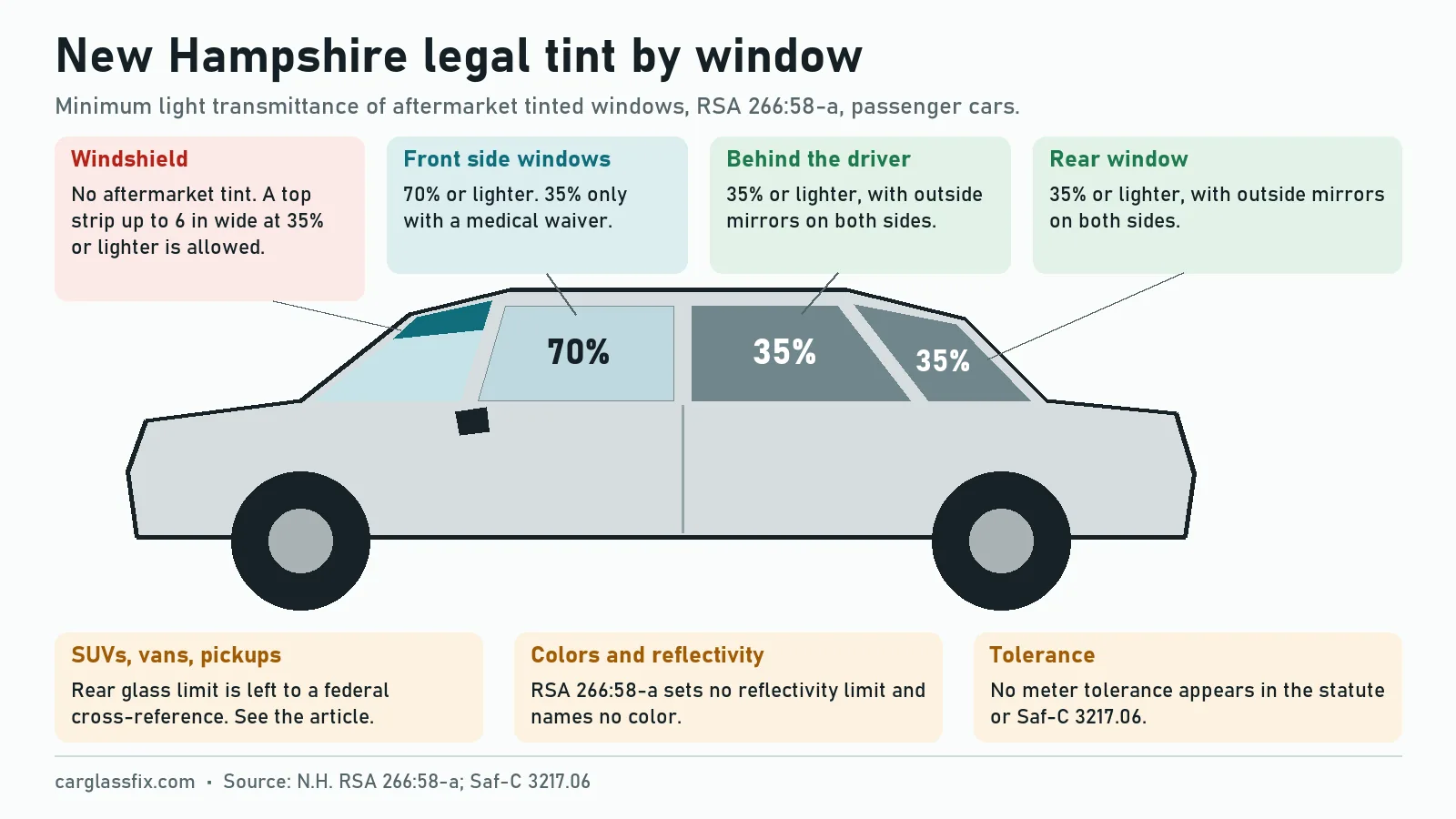
New Hampshire tint limits by window
New Hampshire allows 70% tint on the front side windows and 35% tint behind the driver on passenger cars. RSA 266:58-a, III says the light transmittance of windows “to the left and right of the driver” shall not be less than 70 percent. That wording covers the driver’s window and the front passenger’s window. The same paragraph sets 35 percent for “rear windows.” The inspection rule, Saf-C 3217.06, applies the 35% figure to all windows “to the rear of the driver,” so back side windows and the back glass share one number. Higher numbers are lighter here, and the window tint percentage chart shows how each shade looks. For an overview of the rules in general, see our guide on what car window tint is legal.
| Window | Sedan | SUV, van, pickup |
|---|---|---|
| Windshield | No aftermarket tint, except a strip at the very top up to 6 in wide, 35% or lighter | Same |
| Front side windows | 70% or lighter | 70% or lighter |
| Side windows behind the driver | 35% or lighter, with mirrors on both sides | Not stated clearly; see the SUV section below |
| Rear window | 35% or lighter, with mirrors on both sides | Federal cross-reference, no number in state law; see below |
| Reflectivity and colors | No limit in RSA 266:58-a | Same |
How New Hampshire measures light transmittance
New Hampshire applies its limits to the tinted window, so the reading that counts is the window as installed. The statute speaks of the “light transmittance of after-market tinted windows,” and it never says film alone. Factory glass already blocks some light.
A film rated 85% on glass that passes 80% gives about 68%, which is under the front side limit. Those inputs are only an example. See how to measure window tint for the math. A window tint meter gives the combined reading.
RSA 266:58-a and Saf-C 3217.06 name no test method and no meter tolerance. Some websites advertise a plus or minus 3% allowance for New Hampshire, and neither text contains one. The statute also has no reflectivity limit, color ban, installer label or certificate. Websites that list a metallic or red and amber ban point to no section we could find in these texts; for film types, see can you put mirror tint on a car. Perforated film and wraps have their own rule in Saf-C 3217.06(b): 35% or lighter from the inside, a clear view out, none on the windshield or front side windows, and mirrors on both sides. You can preview a shade with the window tint simulator.
Windshield tint in New Hampshire: the 6-inch strip
New Hampshire bans aftermarket windshield tint, with one exception for a top strip. RSA 266:58-a, V allows a strip “not wider than 6 inches located at the very top of the windshield,” with light transmittance of at least 35 percent. New Hampshire measures this strip in inches. The statute does not use the AS-1 line that many other states rely on, as our guide to the AS-1 line on a windshield explains.
The ban reaches several separate acts. It is unlawful to sell or inspect a vehicle with windshield tint. It is unlawful to install it on a vehicle registered in New Hampshire. It is unlawful to drive a New Hampshire registered vehicle with it. RSA 265:95 repeats the driving ban “as prohibited under RSA 266:58-a.” The inspection rule, Saf-C 3217.06(a)(1), rejects “any aftermarket tinting on the windshield” and does not mention the strip. Saf-C 2502.02 confirms the strip, so the rules read together allow it. Clear film gets no separate mention, and the waiver rules define after market tinting as “any window tinting” applied after manufacture. Other states’ rules differ, as covered in is it illegal to have tint on a windshield.
SUVs, vans and pickups: the rule is unclear
New Hampshire law gives no clear number for the rear windows of SUVs, vans and pickups. RSA 266:58-a, III says rear windows of multipurpose passenger vehicles and pickup trucks “may be such percentage as is allowed by 49 C.F.R. section 571.205 with respect to pre-market tinted rear windows.” The front side limit of 70% still applies to these vehicles.
The federal definition of a multipurpose passenger vehicle in 49 CFR 571.3 covers vehicles designed to carry 10 persons or less, built on a truck chassis or with special features for occasional off-road operation. Federal Standard 205 refers to a separate ANSI/SAE glazing standard, which we could not read. An NHTSA letter from 1984 says the standard’s light requirements “do not apply to windows behind the driver” in these vehicles when those windows are not requisite for driving visibility. A 1998 NHTSA notice says the agency has not specified which rear windows are requisite.
The state text says “rear windows” and does not say whether side windows behind the driver count. The inspection rule adds only “or as set forth in RSA 266:58-a.” Many websites simply print 35% for SUVs, and the statute does not say that. The cautious choice is 35% or lighter. If you want darker film, ask the NH DMV for its reading first.
What changed in New Hampshire tint law
New Hampshire’s tint rules have changed several times since 2021, mostly around the medical waiver. The source note for RSA 266:58-a starts in 1989. NHPR reported in 2022 that lawmakers had already set 70% for the front side windows, and the source note shows an amendment effective October 9, 2021.
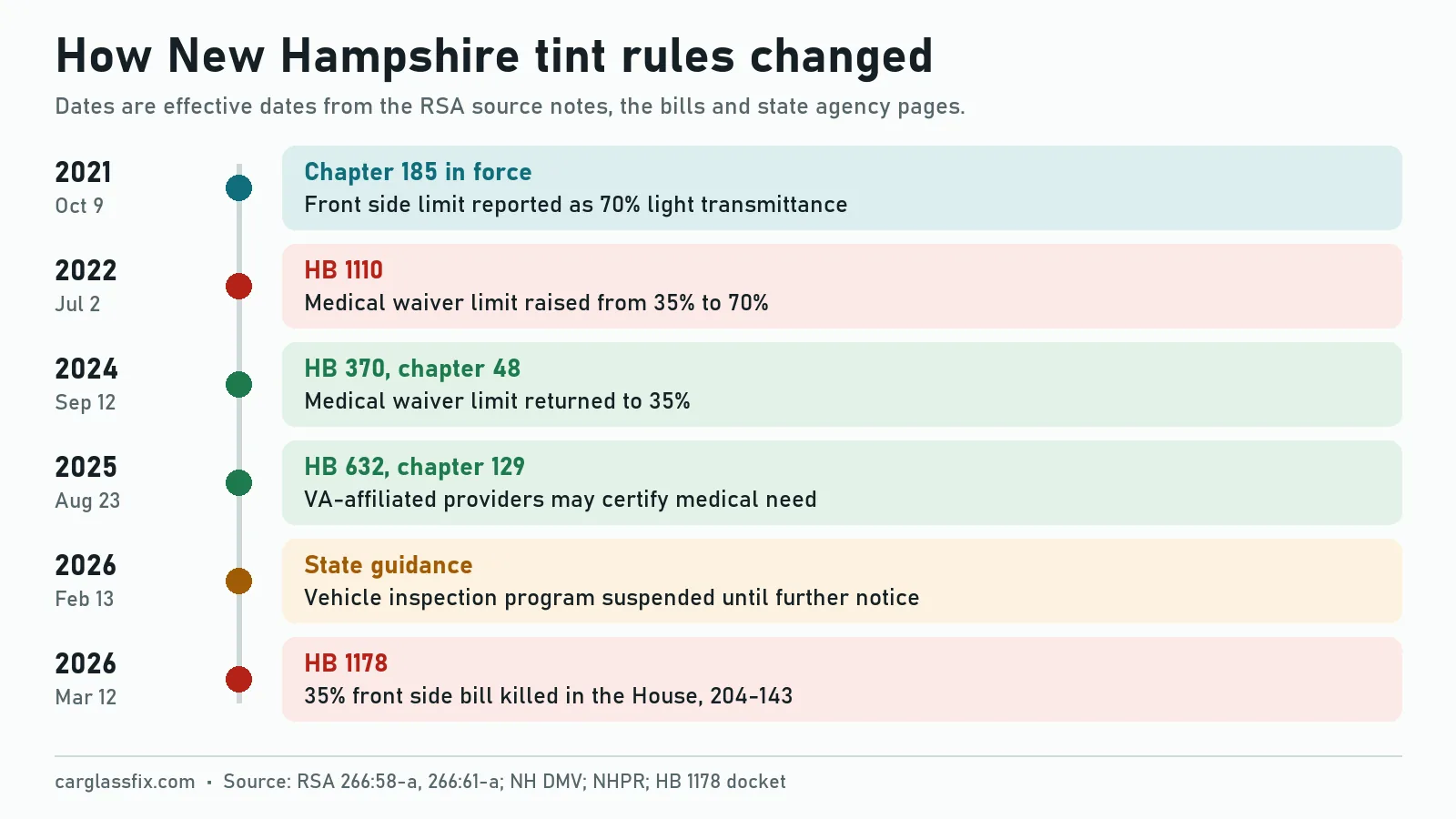
HB 1110 raised the medical limit from 35% to 70% in 2022, and NHPR reported that State Police backed the change. HB 370 returned the medical limit to 35% in 2024. HB 632 added providers affiliated with the Department of Veterans Affairs in 2025. HB 1178 of 2026 would have allowed 35% on front side windows without a waiver. The House voted it Inexpedient to Legislate, 204-143, on March 12, 2026, according to the NHLA bill tracker. Pages that still say no front door tint is allowed are out of date. A 35% front side limit without a waiver is not the law.
Medical waiver: how to apply
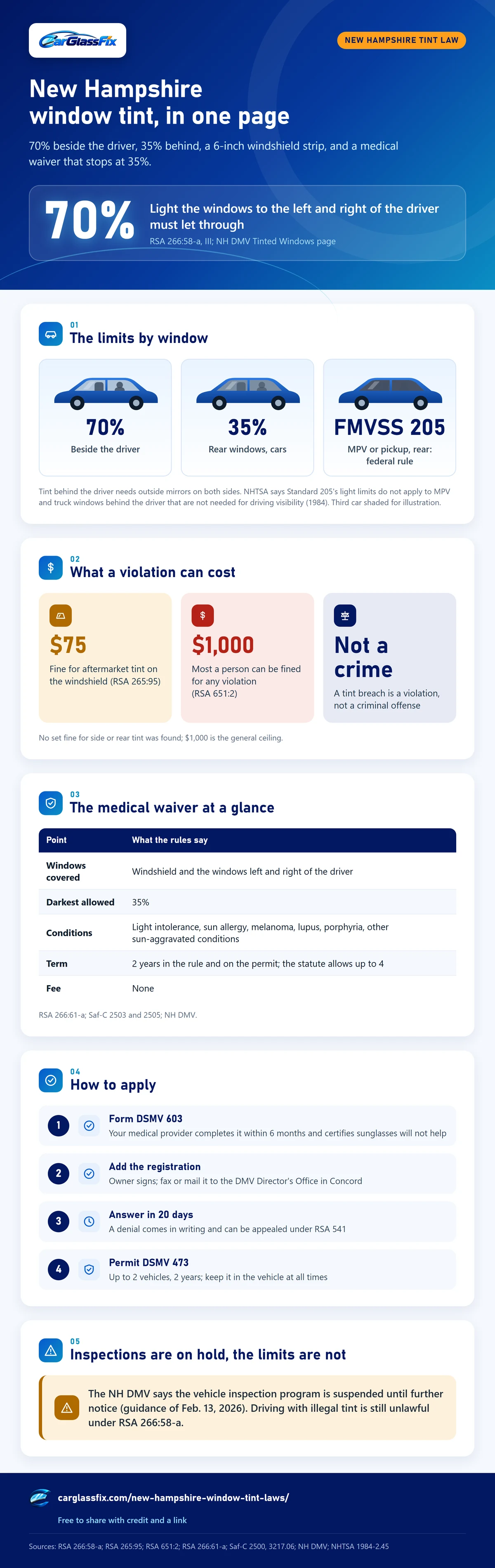
A New Hampshire medical waiver allows tint of 35% or lighter on the windshield and the front side windows. RSA 266:61-a, IX says a waiver “shall only authorize” 35% or lighter, so no waiver permits darker film. Saf-C 2503.02 lists extreme intolerance to light, allergic reactions to the sun, melanoma, lupus, porphyria and any other condition aggravated by the sun. The NH DMV charges no fee.
How to get a New Hampshire tinted window medical waiver
Get form DSMV 603
Use the Application For Medical Waiver of After Market Tinting Restriction from the NH DMV.
See your medical provider
The provider completes the form within 6 months of filing and certifies that sunglasses or other protective equipment will not alleviate the condition.
Add the paperwork
Attach copies of the registration for each vehicle, up to two. The registered owner signs the application.
Send it to the DMV
Fax (603) 271-7800, or mail the DMV Director’s Office, 23 Hazen Drive, Concord, NH 03305.
Keep the permit in the car
The director answers within 20 days. Permit form DSMV 473 must stay in the vehicle at all times.
The rule defines a provider as a physician licensed in New Hampshire, or one licensed in any state and affiliated with the Department of Veterans Affairs. The rule and the DMV page say a permit lasts 2 years. RSA 266:61-a, VII allows up to 4 years when a licensed physician documents a lasting medical necessity, so ask the DMV if that applies to you. A denial comes in writing and can be appealed under RSA 541.
Does tint still get checked at inspection?
New Hampshire inspection stations are not checking tint now, because the state inspection program is suspended. The NH DMV guidance dated February 13, 2026 says the program “is suspended until further notice” and that stations may not issue stickers. The same guidance says drivers remain responsible for safe vehicles under RSA chapter 266. Tint limits did not change with the suspension.
The situation is still moving. A 2025 law set the program to end on January 31, 2026, and a federal court ordered it continued on January 27, 2026. The First Circuit stayed that order on April 30, 2026. On August 11, 2026, the EPA proposed to conditionally approve removing the program from the state’s air plan, with comments due September 25. We found no final EPA action as of October 30, 2026. Saf-C 3217.06 remains the test if inspections return: a station rejects windshield tint, front side tint under 70% without a waiver, and rear tint under the limit. Check the DMV inspection page for the current status.
Fines and penalties for illegal tint
Illegal tint in New Hampshire is a violation, and the fine depends on the charge. RSA 266:58-a, VI says any person who breaks the section “shall be guilty of a violation.” That language reaches sellers and installers as well as drivers. RSA 625:9 says a violation is not a crime.
RSA 265:95 sets a fixed amount for one charge. It bars driving with aftermarket windshield tint, and paragraph IV sets “a fine of $75.” For side and rear windows, RSA 266:58-a gives no dollar figure. The general ceiling for a violation by an individual is $1,000 under RSA 651:2, IV(a). That figure is a maximum, and we found no published fixed fine for side or rear tint. Other figures we saw online cite no source. We also found no fix-it rule in these sections, so ask the court named on your ticket about your options.
Frequently asked questions
Can I tint my front windows in NH?
Yes, if the windows stay at 70% light transmittance or lighter. Tint down to 35% on the front side windows requires a medical waiver from the NH DMV.
How much light does 70% tint let in?
A 70% window lets about 70% of visible light through and blocks about 30%. New Hampshire applies that number to the tinted window, so factory glass counts toward the reading.
Is 35% tint legal in New Hampshire?
Yes, on side windows behind the driver and the rear window of a passenger car, with mirrors on both sides. On the front side windows and windshield, 35% requires a medical waiver, apart from the 6-inch top strip.
Is 5% limo tint legal in New Hampshire?
No on a passenger car, because every window has a limit of 35% or lighter. On an SUV or pickup rear window, the answer depends on the unclear federal cross-reference, so ask the NH DMV first.
Do New Hampshire tint laws apply to out-of-state cars?
The windshield installation and driving bans in RSA 266:58-a name vehicles registered in New Hampshire. The driving ban in RSA 265:95 says “any vehicle” but refers back to that section, so ask the NH DMV if you are moving to the state.
Rules change, and the inspection program is still in dispute. Check the current RSA text or the NH DMV before you buy film. This page is general information and not legal advice.
Sources
- N.H. RSA 266:58-a, Tinted Glass (official text, archive copy of 2026-03-26, checked 2026-10-30)
- N.H. RSA 266:61-a, Equipment Waiver for Disabled (archive copy of 2025-09-21, checked 2026-10-30)
- N.H. RSA 265:95 (archive copy of 2025-03-25, checked 2026-10-30)
- N.H. RSA 651:2 and RSA 625:9 (checked 2026-10-30)
- N.H. Admin. Rules Saf-C 3217.06 (archive copy of 2026-03-08, checked 2026-10-30)
- N.H. Admin. Rules Saf-C 2500, Motor Vehicle Equipment Waiver (archive copy of 2025-11-12, checked 2026-10-30)
- NH DMV, Tinted Windows (checked 2026-10-30)
- NH DMV, Inspections and Emissions (checked 2026-10-30)
- NH Department of Justice, First Circuit stay, April 30, 2026
- US EPA, New Hampshire 176A Petition and I/M Program SIP Revision (checked 2026-10-30)
- NHTSA interpretation letter 1984-2.45
- 63 Fed. Reg. 37820, Glazing Materials, July 14, 1998
- 49 CFR 571.3, Definitions
- HB 370, chapter 48 (2024), final text and HB 1178 (2026) text and docket, NHLA bill tracker
- NHPR, N.H. will soon have tighter rules for tinted windshields, May 10, 2022

Similar Posts