Nevada Window Tint Laws: The 35% Rule by Window
Senior Automotive Glass Diagnostic Specialist & Master Technician at CarGlassFix · AGSC Master Certified Auto Glass Technician, NGA Certified Installer, I-CAR Automotive Safety Specialist · 12+ Years in Automotive Glazing, Windshield Structural Bonding, ADAS Camera Calibration & Precision Chip Restoration
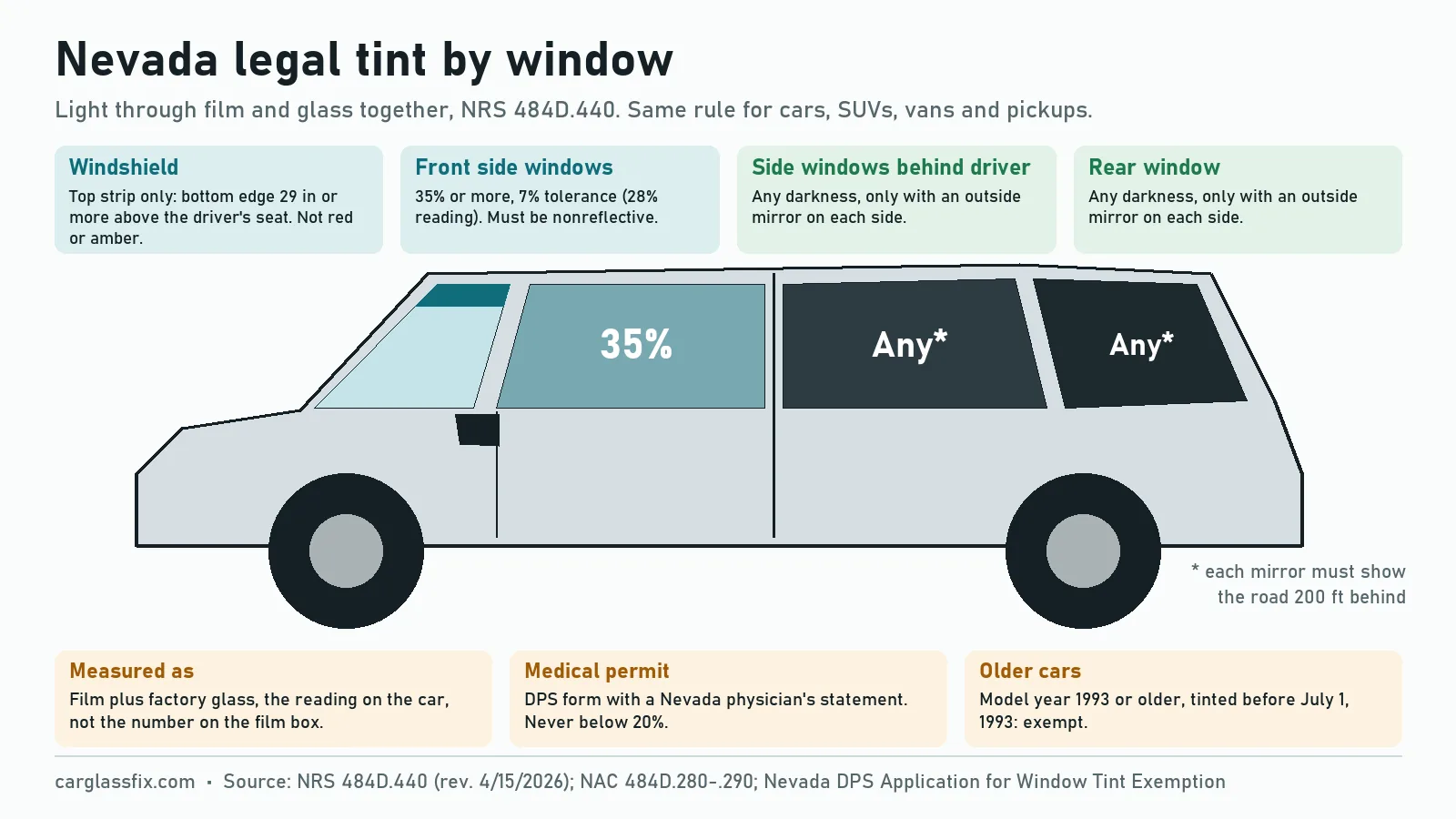
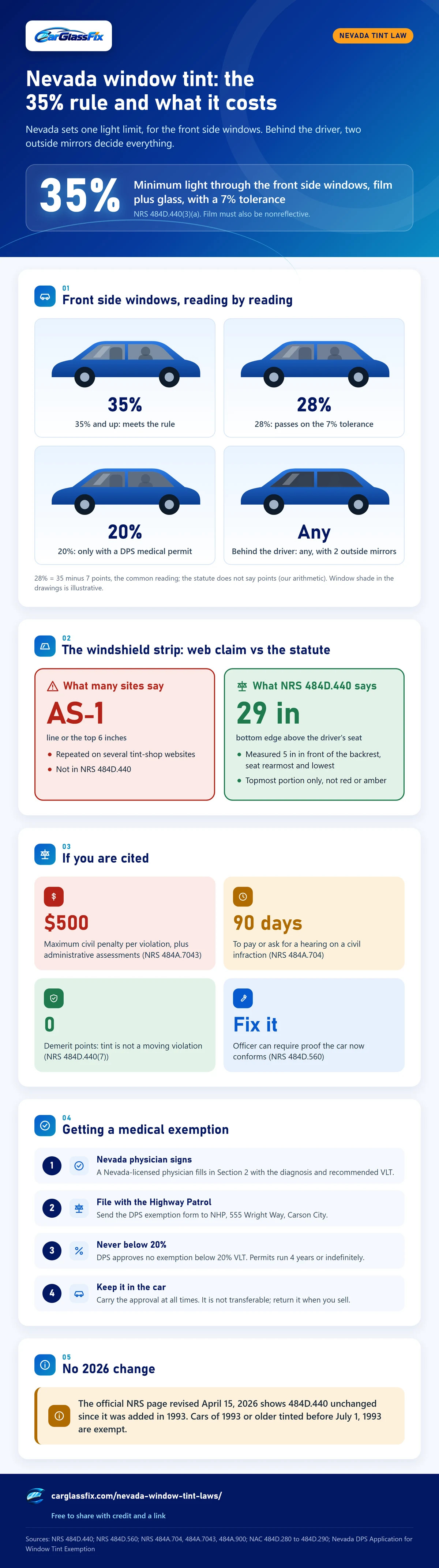
Nevada window tint laws require front side windows to pass at least 35% of light through film and glass together, with a 7% tolerance, and to be nonreflective. Side windows behind the driver and the rear window may be any darkness with outside mirrors on both sides. Windshield tint is limited to a top strip, never red or amber.
Nevada window tint limits by window
Nevada allows 35% tint on the front side windows and any darkness behind the driver, as long as the vehicle has two outside mirrors. The rule is Nevada Revised Statutes (NRS) 484D.440. It starts with a ban on any material that “alters the color or reduces the light transmission” of a window. It then lists three exceptions, one each for the front sides, the windows behind the driver and the windshield strip. Nevada makes no split between sedans and multipurpose vehicles, so SUVs, vans and pickups follow the same limits as cars. The rule covers vehicles “required to be registered in this State.” The official NRS page, revised on April 15, 2026 after the 2025 session, still shows the section exactly as added in 1993.
| Window | Sedan | SUV, van, pickup |
|---|---|---|
| Windshield | Top strip only; bottom edge at least 29 in above the driver’s seat; not red or amber | Same |
| Front side windows (left and right of the driver) | 35% or more, 7% tolerance; nonreflective | Same |
| Side windows behind the driver | Any darkness with an outside mirror on each side; no film without them | Same |
| Rear window | Any darkness with an outside mirror on each side; no film without them | Same |
| Measured as | Film and safety glass together | Same |
| Banned colors | Red and amber, named for the windshield strip | Same |
How the 35% rule and the 7% tolerance work
Nevada measures the whole window, so 35% is the reading of film and glass together, not the shade printed on the film box. The statute asks for “total light transmission through the combination, if any, of transparent material and safety glazing.” It defines light transmission as the share of light that passes through compared with the light that falls on the window.
Factory glass already blocks some light, so a 35% film reads darker once it is on the window. Our how to measure window tint guide shows the glass-times-film math. The limit is “not less than 35 percent with a tolerance of 7 percent.” Most guides read the tolerance as 7 percentage points, which makes 28% the lowest reading that passes. The statute does not say “points,” so a driver near the line is safer at 35%. The front side windows must also be “Nonreflective.” The statute sets no reflectance number, so mirror and metallic films are out on those two windows. See can you put mirror tint on a car for how reflective films differ. The window tint percentage chart shows what 35% and 28% look like.
Windshield tint in Nevada: the 29-inch seat rule
Nevada allows windshield tint only in the topmost strip, and the strip ends where a 29-inch measurement from the driver’s seat says it must. NRS 484D.440(3)(c) says the bottom edge must be “not less than 29 inches above the undepressed driver’s seat.” The measurement starts 5 inches in front of the bottom of the backrest. The seat must be in its rearmost and lowest position, and the vehicle must stand on level ground. The strip must not be red or amber. The statute sets no light transmission figure for the strip.
The Nevada rule does not mention the AS-1 line. A Google AI Overview checked for this page said the strip may reach “the manufacturer’s AS-1 line (or top 6 inches),” and several top results repeat the AS-1 claim. Neither the line nor a 6-inch figure appears in the statute. The AS-1 mark etched on the glass is a different reference, explained in the AS-1 line on a windshield, and the seat measurement is the legal test in Nevada. For other states, read is it illegal to have tint on a windshield.
Dark rear windows need two outside mirrors
Nevada lets the side windows behind the driver and the rear window be any darkness only when the vehicle has an outside mirror on each side. Each mirror must show the driver “a view of the highway” at least 200 feet to the rear. If one mirror is missing or broken off, the exception no longer applies. The general ban in subsection 2 then covers those windows, so no tint film at all is allowed behind the driver until the mirror is back.
The windows behind the driver have no reflectance rule in the statute. The nonreflective requirement is written only for the front side windows. The red and amber ban is written only in the windshield exception. A Google AI Overview said Nevada caps front and rear side windows at 35% reflectance. That figure does not appear in NRS 484D.440 or in the Nevada Administrative Code (NAC) tint sections. A Bing Copilot answer also said tint film sold in Nevada needs manufacturer certification. We found no such rule in the statute or the regulation.
Nevada medical exemption for window tint
A Nevada medical tint exemption is a written permit, applied for on a Department of Public Safety (DPS) form with a sworn statement from the treating physician. NAC 484D.285 lets the Director of the Department of Motor Vehicles issue the permit. The applicant must also swear to being “the primary driver” of the vehicle. NAC 484D.280 says the application goes to the Nevada Highway Patrol in Carson City and must state the light transmission after tinting.
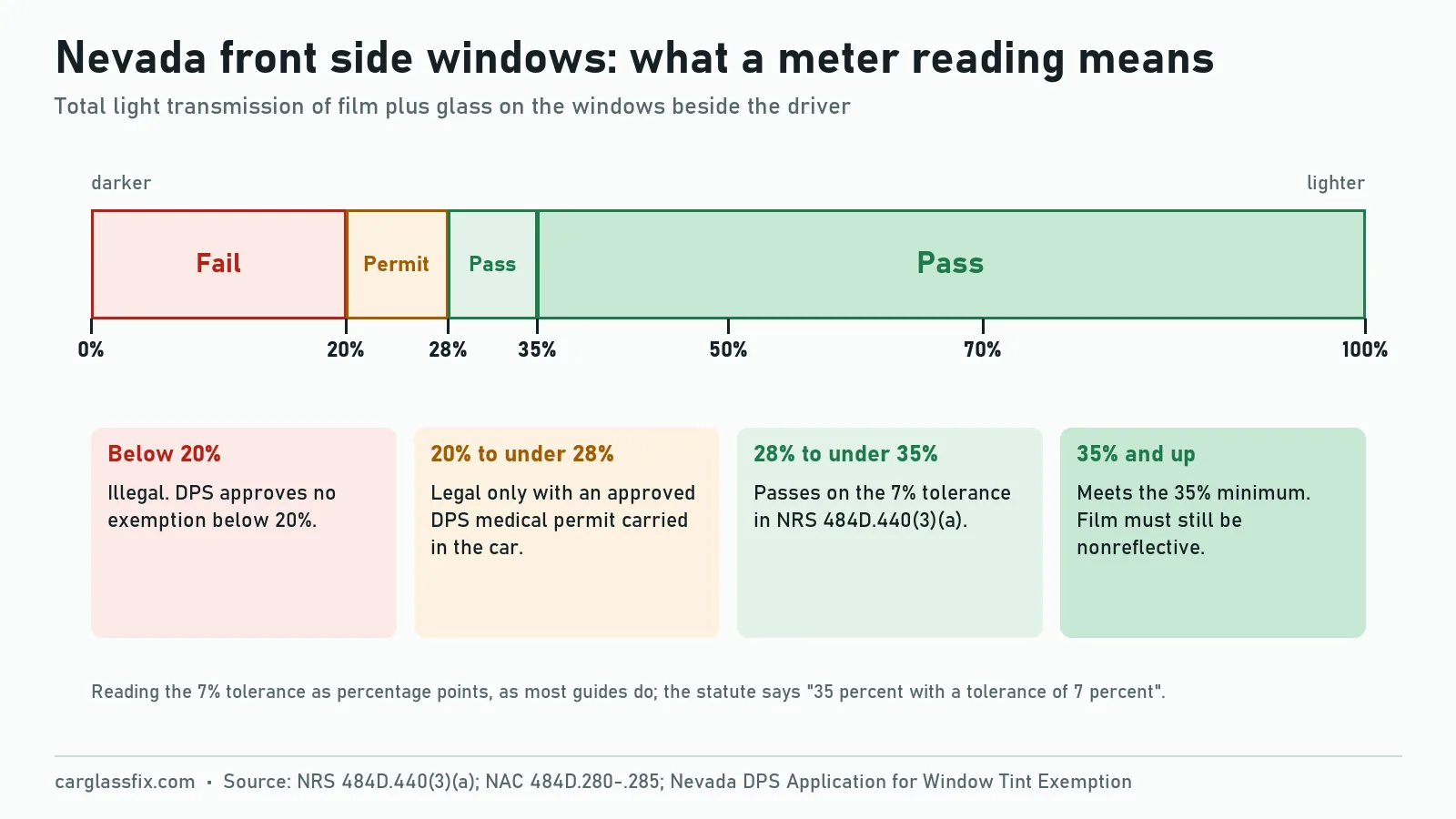
The DPS form adds limits the regulation does not spell out. It says “No window tint exemption less than 20% VLT will be approved.” The physician section must be completed by “a currently licensed State of Nevada Physician.” The form is signed by the DPS Director and the Highway Patrol chief, not by the DMV. The Nevada DMV has no tint page of its own.
The steps below follow the DPS application form and NAC 484D.280 to 484D.290.
How to get a Nevada medical window tint exemption
Download the DPS form
Use the Application for Window Tint Exemption from the Nevada Department of Public Safety, Highway Patrol Division. It covers a primary and a secondary vehicle.
Have a Nevada physician complete Section 2
The physician gives the diagnosis, the recommended light transmission (20% or lighter) and a 4-year or indefinite term.
Sign the declaration
The applicant certifies being the primary driver of every vehicle listed.
Mail it to the Highway Patrol
Send it to the Nevada Highway Patrol, 555 Wright Way, Carson City, Nevada 89711.
Keep the approval in the vehicle
The approved document or a copy “must be carried in the vehicle at all times.” It does not transfer when the vehicle is sold.
Owners of vehicles rated at 10,000 pounds or more under 49 CFR 393.60(b) may not apply (NAC 484D.290).
What happens if you get a tint ticket in Nevada
A Nevada tint violation is a civil infraction, with a civil penalty of up to $500 plus court assessments. NRS 484D.440 sets no fine of its own. NRS 484A.900 then applies, and since a 2021 amendment it makes such violations a civil infraction instead of a misdemeanor. NRS 484A.7043 sets “a civil penalty of not more than $500 per violation” and adds the administrative assessments. The court may waive or reduce the penalty, set a payment plan, or order a traffic safety course. Some free statute sites still show the older misdemeanor wording, so check the official NRS page.
A tint citation must be answered within 90 calendar days, either by paying or by asking for a hearing (NRS 484A.704). The violation “is not a moving traffic violation” under NRS 484D.440(7). That keeps it out of the DMV’s demerit point system in NRS 483.473. Under NRS 484D.560, an officer who stops a vehicle for equipment may also require the owner to show evidence that the vehicle has been made to conform. A window tint meter reading after removal is one way to confirm a window now passes.
Vehicles the Nevada tint rule does not cover
The Nevada tint ban does not reach factory-tinted glass, older cars tinted before July 1, 1993, or vehicles that are not required to be registered in Nevada. Subsection 5 allows windows that the vehicle “could have been sold when new with” under federal rules. Factory privacy glass in the back of an SUV is therefore legal even without the mirror rule. Subsection 4 lets a vehicle of model year 1993 or older keep tint applied before July 1, 1993. NAC 484D.285 also allows permits for ambulances, hearses and law enforcement vehicles used for surveillance, canine transport, or undercover or forensic work.
Older Nevada tint pages often get three points wrong: the AS-1 line, a misdemeanor penalty and a reflectance percentage. The current law uses the 29-inch seat rule, a civil infraction and the single word “nonreflective.” Before choosing a shade, try the window tint simulator, and compare other states in what car window tint is legal. Tint rules can change in any legislative session. Check the current NRS 484D.440 or the Nevada DPS before tinting. This article is general information, not legal advice.
Frequently asked questions
Is 20% tint legal in Nevada?
A 20% reading is illegal on the front side windows unless the driver holds an approved DPS medical permit, and DPS approves none below 20%. On the side windows behind the driver and the rear window, 20% is legal if the vehicle has an outside mirror on each side.
What is the darkest legal tint in Nevada?
The darkest front side reading Nevada accepts is 28%, which is the 35% minimum less the 7% tolerance in NRS 484D.440. Behind the driver there is no limit when the vehicle has two outside mirrors.
Is 20% tint darker than 35%?
Yes. A 20% tint lets through 20% of visible light and a 35% tint lets through 35%, so 20% looks darker. The window tint percentage chart shows the shades side by side.
Did Nevada change its tint law for 2026?
No. The official NRS page revised on April 15, 2026 shows NRS 484D.440 unchanged since it was added in 1993. The penalty changed in 2021, when NRS 484A.900 made violations of the traffic chapters that carry no penalty of their own civil infractions.
Does a Nevada tint ticket add points to my license?
No. NRS 484D.440(7) says a tint violation is not a moving traffic violation, and the Nevada demerit point system in NRS 483.473 counts only moving violations.
Sources
- NRS 484D.440, Restrictions on tinting of windshield or side or rear window (official page revised 15 April 2026; archived copy of 14 July 2026 read on 29 October 2026)
- NRS 484D.560, Inspection by peace officer or inspector (checked 29 October 2026)
- NRS 484A.900, Penalty for violation of traffic law when no penalty provided, with 484A.704 and 484A.7043 (official page revised 15 April 2026; archived copy of 9 September 2026 read on 29 October 2026)
- NRS 483.473, Uniform system of demerit points (checked 29 October 2026)
- NAC 484D.280 to 484D.290, exemptions from the tint standards (official page revised 13 April 2026; archived copy of 10 June 2026 read on 29 October 2026)
- Nevada Department of Public Safety, Highway Patrol Division: Application for Window Tint Exemption (downloaded 29 October 2026)

Similar Posts