Heated Windshield Wiper Blades: How They Work and Wiring
Senior Automotive Glass Diagnostic Specialist & Master Technician at CarGlassFix · AGSC Master Certified Auto Glass Technician, NGA Certified Installer, I-CAR Automotive Safety Specialist · 12+ Years in Automotive Glazing, Windshield Structural Bonding, ADAS Camera Calibration & Precision Chip Restoration
Heated windshield wiper blades are wiper blades with an electric heating element inside the squeegee or the frame. The element runs on the vehicle’s 12-volt system through a cab switch or a temperature-sensing control module. The heat keeps snow and ice from building up on the blade. Heated blades do not defrost the windshield itself.
As an Amazon Associate, CarGlassFix earns from qualifying purchases. Amazon links on this page open a product search on Amazon. They are not products we tested.
What heated windshield wiper blades are
Heated windshield wiper blades are replacement wiper blades that carry their own electric heater and a power lead. A standard blade is passive rubber on a frame. A heated blade adds a resistance element, a wire that runs down the wiper arm, and a switch or control module under the hood or in the cab. ThermalBlade describes a heating element integrated in a replaceable silicone squeegee. Everblades describes sealed heating elements in a silicone blade with a heated frame. Crystal Clear sells two heated blades with a control module as one system.
The search phrase “heated windshield wipers” also covers two factory designs. Some cars heat the glass where the blades rest, which automakers call a heated wiper park or a wiper de-icer. A few cars have had heated blades from the factory. The table separates the four designs.
| Design | Where the heat is | How it is controlled | Example and source |
|---|---|---|---|
| Aftermarket heated blade, manual | Squeegee and frame of the blade | Lighted on/off switch in the cab | Everblades kit |
| Aftermarket heated blade, automatic | Squeegee or blade body | Control module with a temperature sensor | ThermalBlade, Crystal Clear, Ice Liminator |
| Factory heated blade | Heater foil on the blade’s spring rails | Vehicle electronics, by outside temperature and time in use | Mercedes-Benz SL, Daimler press release, 2012 |
| Heated wiper park (wiper de-icer) | Filaments in the windshield under the parked blades | Rear defrost button or remote start | Chevrolet support page; Mazda CX-5 manual |
Aftermarket kits are sold by blade length and arm type. ThermalBlade lists lengths from 13 to 28 inches, Crystal Clear from 16 to 28 inches and Everblades from 12 to 28 inches. Your own lengths are in the wiper blade size finder.
How heated wiper blades work
A heated wiper blade works by passing current through a resistance element that warms the rubber edge and, on some designs, the frame around it. Daimler describes the effect on its factory blade: snow and ice cannot freeze onto the blade, and it remains supple in winter.
Where the heating element sits
The element sits inside or along the wiping edge. A US patent granted to Harvey Friesen in 2018 (US 10,040,429) shows one layout. Its round heating element slides into a central passage in the blade and spans nearly the full blade length. Low-resistance leads carry current from the wiper arm to that element. ThermalBlade puts the element in a silicone squeegee insert that can be swapped for an unheated summer insert. Mercedes-Benz used a different part of the blade. Daimler’s 2012 release says each spring rail carries a heater foil that heats the spoiler and the wipe lip.
Manual switch or automatic control
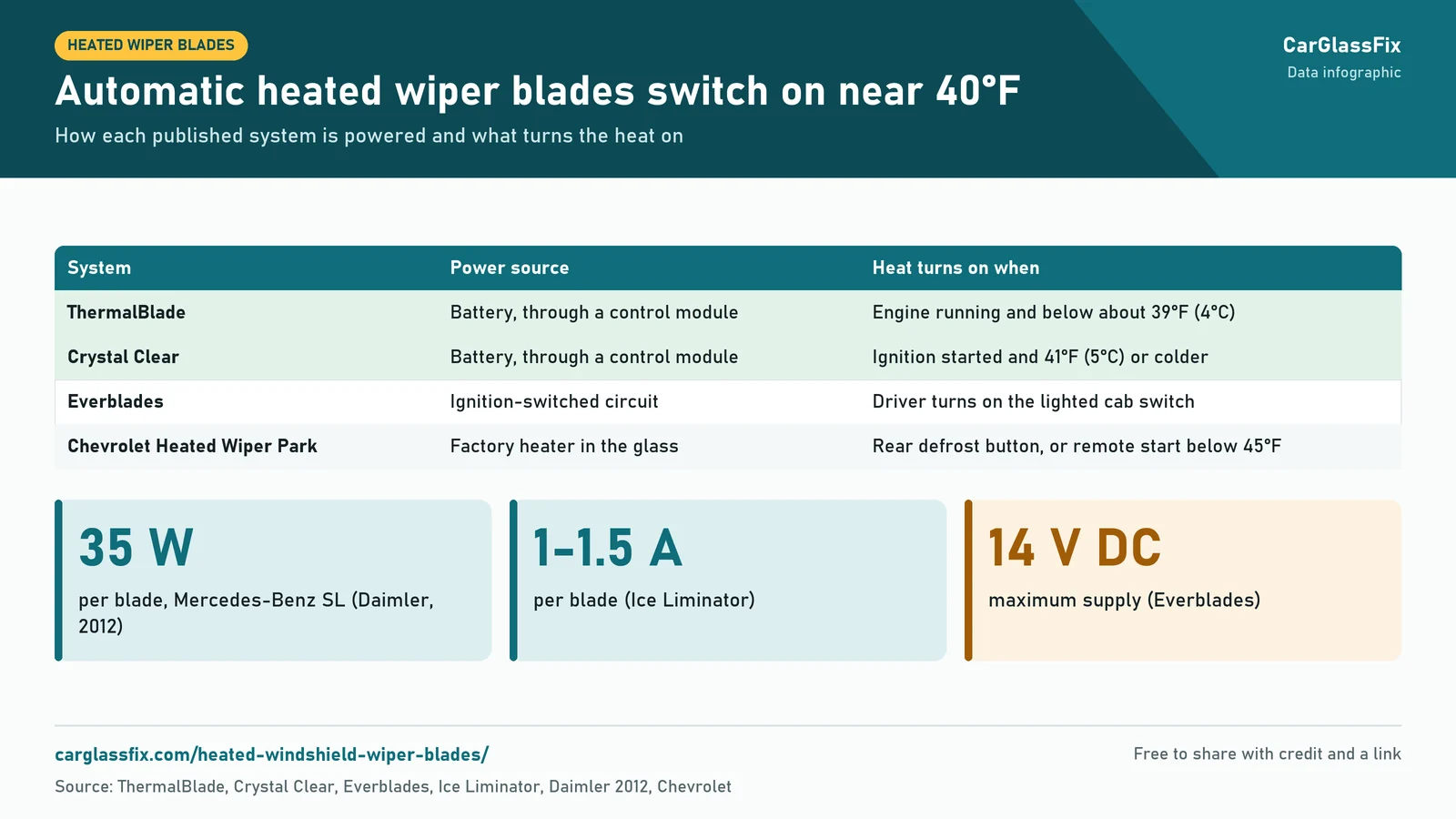
Control is either a driver’s switch or a module that reads the outside temperature. Everblades supplies a lighted switch, and heater power flows only while the switch light is on. ThermalBlade’s Electronic Control Module (ECM) waits in stand-by until two conditions are met. The engine must be running, and the outside temperature must be below 4°C plus or minus 2°C (39°F plus or minus 4°F). Crystal Clear’s module turns the blades on at 5°C (41°F) or colder once the ignition is started. Crystal Clear places the temperature sensor in the blades and adds LED lights that show the blades have power.
How hot the blade gets
Published blade temperatures differ by maker, and none of them comes from an independent test. Everblades’ product page says its elements radiate 230 degrees of heat through the silicone blade. Its installation page says the heater wire along the frame can reach about 300 degrees. Ice Liminator says its blades run at approximately 130 degrees in 32-degree air and approximately 50 degrees at minus 40. Ice Liminator also gives the current: approximately 1 to 1.5 amps per blade. On a 12-volt system that works out to roughly 12 to 18 watts per blade, by our arithmetic. Daimler’s figure for the SL’s factory blade is 35 watts per blade.
How heated wiper blades are wired
Heated wiper blades are wired in one of three ways: through a cab switch on an ignition-switched circuit, through a control module on the battery, or through an adapter in the fuse box. Each design ties heater power to the ignition or to a running engine. The table compares the layouts the makers publish.
| System | Power source | What switches the heat | Turn-on condition |
|---|---|---|---|
| Everblades | A switched circuit that is off with the ignition, plus two grounds | Lighted on/off switch in the dash | Driver turns the switch on |
| ThermalBlade | Battery positive and negative, through the ECM | ECM with a thermistor behind the grille | Engine running and below about 39°F (4°C) |
| Crystal Clear | Battery positive and negative, through the control module | Control module, sensor in the blades | Ignition started and 41°F (5°C) or colder |
| Friesen patent US 10,040,429 | Adapter in the ignition fuse slot with its own auxiliary fuse | Thermostat on the wiper arm | Ignition on and air below a set limit |
Switch kits
A switch kit takes its power from a circuit that goes dead with the key. Everblades’ instructions connect the switch’s red wire to a switched circuit and its blue wire to a good ground. The instructions give a check: a switch light that stays lit with the ignition off means the connection is wrong. A black wire then runs from the switch through the firewall to the blades. Everblades warns, “Do not hook to more than 14 volts DC!”
Control module kits
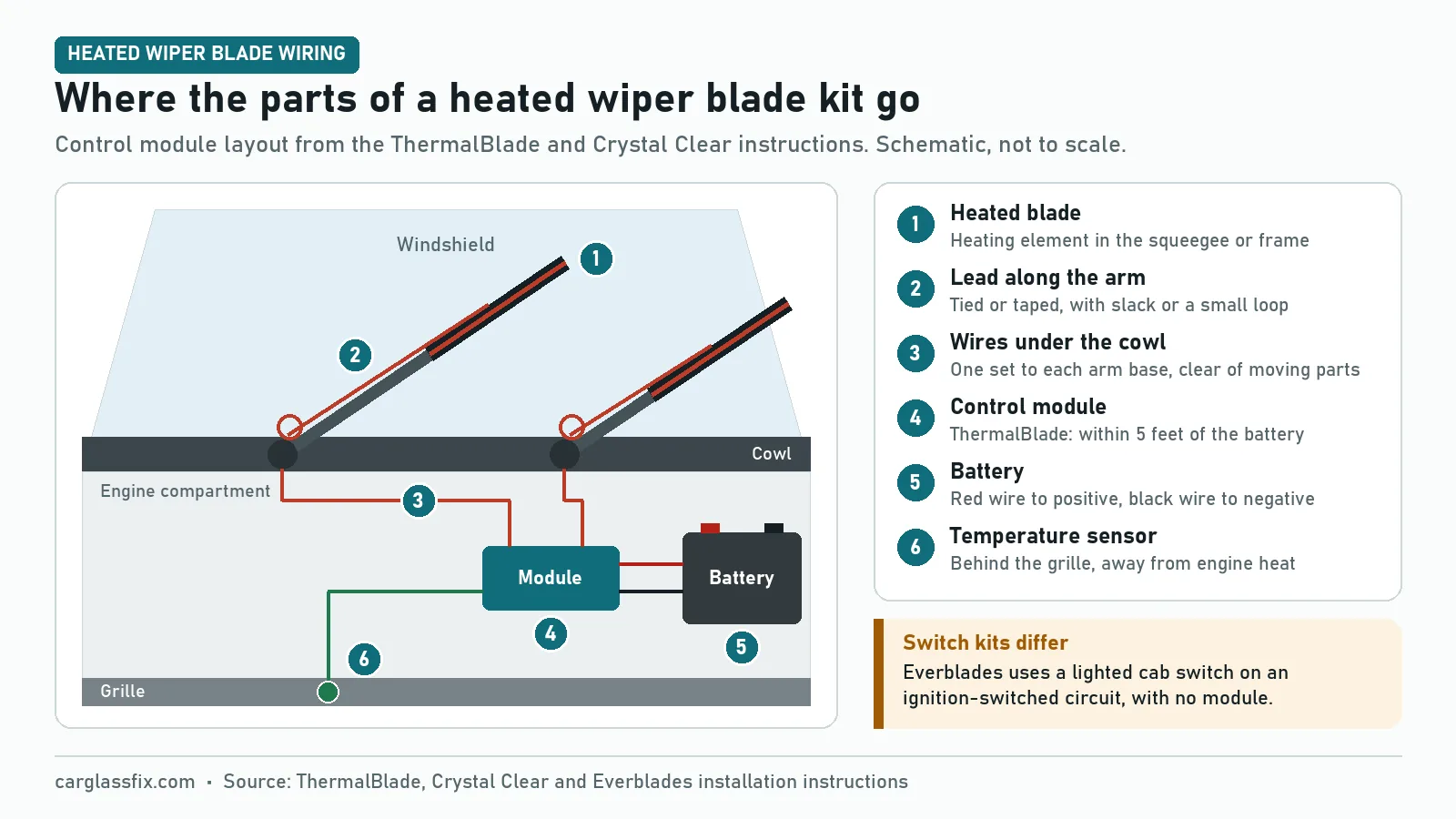
A module kit connects straight to the battery and lets the module do the switching. ThermalBlade’s instructions mount the ECM within 5 feet of the battery, with the red wire on the positive terminal and the black wire on the negative terminal. The thermistor is a small temperature sensor on two wires. It goes behind the grille or in another spot that reads outside air and is not affected by engine or radiator heat. ThermalBlade says the ECM cuts power when the engine is shut off, so the blades cannot drain the battery. Its troubleshooting page covers an ECM that shows no light: start the engine and confirm the alternator works, because battery voltage should be 12.8 volts or higher.
The lead along the wiper arm
The wire on the moving arm is the part every maker gives rules for. The steps below combine the published instructions.
How a heated wiper blade kit is wired
Fit the blades
Mount each heated blade on its arm with the adapter that matches the arm type (Crystal Clear, ThermalBlade).
Mount the switch or module
Everblades puts a lighted switch in the dash. ThermalBlade mounts its ECM within 5 feet of the battery.
Connect power
Module kits: red to battery positive, black to battery negative. Everblades: red to an ignition-switched circuit, blue to ground.
Place the sensor
ThermalBlade’s thermistor goes behind the grille, away from engine and radiator heat.
Route under the cowl
Run one set of wires to each wiper arm base, clear of moving and heated parts.
Secure along the arm
Tie or tape the wire to the arm and leave slack or a small loop so the arm can move.
Test the heat
With the engine running and the heat on, Everblades says the blades should feel warm within a few minutes.
Crystal Clear explains the slack rule: a tight wire can pull the blade away from the windshield. ThermalBlade routes the wire through the arm’s tensioning spring where possible, which keeps it centered. Fitting the blade to the arm follows the same connector steps as how to replace windshield wiper blades. The makers’ pages we read do not publish a fuse rating or wire gauge, so those come from the kit’s own manual.
When heated wiper blades help
Heated wiper blades help in falling snow and freezing rain, when ice builds up on the wiper assembly during the drive. Ice Liminator states the purpose: reducing or eliminating icy build-up on the wiper assembly improves the operator’s visibility.
The other makers describe the same job. Daimler’s release says the heated SL blade prevents the snow build-up on wiper blades that is typical in winter. Ice Liminator says its heat keeps the blade and squeegee pliable. Everblades lists the vehicles it builds for: 18-wheelers, snow plow trucks, buses and pickup trucks. Commercial and work vehicles lead that list.
Heated blades also help at the start of a drive. GM’s 2024 Silverado owner’s manual says to loosen or thaw wiper blades that are frozen to the glass, and warns that heavy snow or ice can overload the wiper motor. Everblades’ instructions cover a frozen windshield in this order. Turn on the blade heat and the inside defroster. Let the blades warm. Start the wipers once water runs down the outside of the blades.
The safety case is visibility. NHTSA counted an estimated 131,698 police-reported crashes in snow or sleet conditions in 2024. NHTSA’s winter advice is to test the defrosters and wipers and replace worn blades before the season. Heated squeegees wear too. ThermalBlade’s streaking tips are to clean the squeegee with rubbing alcohol and to check its edge for defects. The full wear check is in how to check windshield wipers for wear.
Limits of heated wiper blades
Heated wiper blades warm the blade only, so they cannot clear a frosted windshield or replace the defroster. Each limit below comes from a maker’s own page.
They do not defrost the glass
Everblades states the limit directly: the blades are not a defroster and work alongside the defroster. The heat stays in the blade. Clearing the glass is still the job of the HVAC defrost setting, which is covered in how to defrost car windows fast without cracking the glass.
They need a running engine and cold air
Automatic kits do not heat on demand. ThermalBlade’s ECM stays in stand-by until the engine runs and the air is below about 39°F. Its troubleshooting table lists a flashing green light for “temperature too warm” and no light for a battery below 12.8 volts. Crystal Clear’s blade lights come on when the vehicle runs, and the blades stay cold until the air is below 41°F. A parked car with the engine off gets no blade heat from any of these kits.
Wires, heat and voltage
The exposed lead and the hot element add risks a plain blade does not have. Everblades says to keep wires away from sharp edges and not to pull ties or wires tight. It says bending or twisting the blades may cause damage or poor wiping. It also warns that the heater wire can reach about 300 degrees, so the heat should be off and cooled before the blade is handled. That 14-volt limit matches a 12-volt vehicle system.
Wear parts and warranty
The squeegee still wears out. ThermalBlade gives a one-year manufacturer’s warranty that does not cover the squeegees, which it treats as consumables. Everblades covers parts and workmanship for one year. ThermalBlade tells owners to cap the harness connectors when unheated summer inserts are fitted, to prevent corrosion. No independent test of how well any aftermarket heated blade clears ice was found for this page.
Factory heated wipers: wiper park heaters and heated blades
Most factory “heated wipers” are heaters in the glass, and the blade itself is ordinary. Chevrolet’s Heated Wiper Park heats across the bottom of the windshield to limit ice and snow build-up and to make the blades less likely to freeze up. Safelite notes that most typical heated windshields include a heated wiper park. That matters at replacement time, as explained in how to replace a heated windshield.
| Vehicle and source | What is heated | How it turns on | Timer |
|---|---|---|---|
| Chevrolet Heated Wiper Park (Chevrolet support) | Bottom of the windshield | Rear defrost button, or remote start below 45°F with Auto Rear Defog enabled | 15 minutes on first use in a drive, 10 minutes on later uses |
| Mazda CX-5, 2018 (owner’s manual) | Thermal filaments in the windshield | Ignition on, then the rear window defogger switch | Runs with the rear defogger |
| Honda HR-V, 2026, Canadian models (owner’s manual) | Wiper park area | Heated windshield button with power mode on | Switches off after 15 minutes |
| Mercedes-Benz SL (Daimler release, 2012) | The wiper blades, washer hoses and fluid container | Automatic, by outside temperature and time in use | Not stated |
The Mercedes-Benz system is the factory example of a heated blade. Daimler called it the first fully heated wiper and washer system from any manufacturer. The release says the whole system reaches its maximum output of 270 watts only below minus 20°C (minus 4°F). Between 5°C and minus 20°C it runs in an energy-saving mode. The washer fluid in that system flows through channels along the blade. Aftermarket heaters for washer fluid are a separate product, covered in how to install a windshield washer heater. A wiper park heater that stops working is a glass or circuit fault. The tests are in how to fix a heated windshield.
Heated wiper blades vs winter blades and de-icer fluid
Heated blades are one of three ways to keep a wiper working in ice, and the other two need no wiring. NHTSA’s winter driving page names both of them. It says to fill the reservoir with winter fluid that contains de-icer, and to consider heavy-duty winter wipers in areas with a lot of snow and ice.
| Option | What it does | What it needs |
|---|---|---|
| Heated wiper blades | Warm the blade so snow and ice do not build up on it | Wiring to a switch or control module, a running engine |
| Heavy-duty winter wipers | NHTSA suggests them for areas with a lot of snow and ice | A blade swap in the fall |
| Winter washer fluid with de-icer | NHTSA says to fill the reservoir with it before winter | A full reservoir of fluid rated for the cold |
The choice depends on how long the car stays in falling snow. A driver who clears the car and makes short trips can fit heavy-duty winter wiper blades and fill up with winter washer fluid with de-icer. Fluid ratings are explained in how to keep windshield washer fluid from freezing. A driver who spends hours in storms is the user the makers build heated wiper blade kits for. Before ordering a kit, match the blade lengths and the arm connector, and read the kit’s wiring instructions. A shop or auto electrician can do the wiring for owners who do not want to work at the battery or fuse box.
Frequently asked questions
Do heated windshield wiper blades really work?
They are built to keep ice and snow off the blade itself, and the makers say so in those terms. Everblades adds that the blades are not a defroster and work with the vehicle’s defroster. No independent test of their ice-clearing performance was found for this page.
Can heated wiper blades be added to any car?
ThermalBlade says its control module is independent of the vehicle’s computer and suits any 12-volt vehicle. The blades must still match the car’s blade lengths and wiper arm connector, which you can look up in the wiper blade size finder.
At what temperature do heated wiper blades turn on?
Automatic kits switch on near 40°F. ThermalBlade’s module heats below about 39°F (4°C) with the engine running, and Crystal Clear’s heats at 41°F (5°C) or colder. Everblades uses a manual switch, so the driver decides.
How much power do heated wiper blades use?
Ice Liminator says each of its blades draws approximately 1 to 1.5 amps. Daimler’s 2012 release gives 35 watts per blade for the heated Mercedes-Benz SL blade. Other makers’ pages we read do not publish a current figure.
What is the difference between heated wiper blades and a heated wiper park?
A heated wiper blade has the heater in the blade. A heated wiper park has heating filaments in the windshield where the blades rest, and Chevrolet says it switches on with the rear defrost button or with remote start below 45°F.
Sources
- ThermalBlade heated wiper blades installation instructions, published by GateKeeper Off-Road (read 2026-11-26)
- ThermalBlade, Heated and Unheated Wiper Kit product page and Troubleshooting (read 2026-11-26)
- Crystal Clear, Heated Windshield Wipers installation instructions, Version B (read 2026-11-26)
- Crystal Clear, Automatic Heated Wiper Blade System and Heated Wiper Blade (read 2026-11-26)
- Everblades, Heated Windshield Wiper Kit and Installation (read 2026-11-26)
- Ice Liminator, Heated Wiper Blade product page (read 2026-11-26)
- US patent 10,040,429 (application US 2017/0129460 A1), Heated Windshield Wiper Assembly, H. Friesen (read 2026-11-26)
- Daimler AG press release, MAGIC VISION CONTROL adaptive windscreen washing system (March 12, 2012), copy on MarketScreener
- Chevrolet support, Making the most of the Heated Wiper Park (read 2026-11-26)
- Mazda, 2018 CX-5 owner’s manual, Windshield Wiper De-icer
- Honda, 2026 HR-V owner’s manual, Heated Windshield Button
- Safelite, Heated Windshields and Wipers
- NHTSA, Winter Weather Driving Tips (read 2026-11-26)
- GM, 2024 Chevrolet Silverado 1500 Owner Manual

Similar Posts