How to Replace a Heated Windshield: Parts, Wiring, Tests
Senior Automotive Glass Diagnostic Specialist & Master Technician at CarGlassFix · AGSC Master Certified Auto Glass Technician, NGA Certified Installer, I-CAR Automotive Safety Specialist · 12+ Years in Automotive Glazing, Windshield Structural Bonding, ADAS Camera Calibration & Precision Chip Restoration
To replace a heated windshield, a shop orders glass with the same heating type and part number as the original, disconnects the heater leads, and installs the glass with the adhesive maker’s procedure. It then reconnects the leads until they seat fully, calibrates any windshield camera, and checks that the heater switches on and clears the glass.
What replacing a heated windshield involves
Replacing a heated windshield is a standard windshield replacement with three extra jobs: matching the heater type, handling the heater connection and testing the heater afterwards. The glass still bonds to the body with urethane, and the same cure and safety rules apply. The ANSI/AGSC/AGRSS 005-2022 standard tells installers to follow the adhesive maker’s instructions and to use only the full cut method on polyurethane systems.
The heated part sits inside the laminated glass, so it comes with the new windshield. Nothing is moved from the old glass to the new one except the parts mounted on it, such as a camera bracket or rain sensor. Safelite notes that the heater wires lead into the car and are disconnected when the old windshield comes out.
Jaguar Land Rover marks its heated windshield bulletins as work for trained technicians, not for do-it-yourselfers. Fault finding on a heater that already fails belongs to how to fix a heated windshield. This page covers the replacement itself.
Wire or coated: identify the heated windshield type
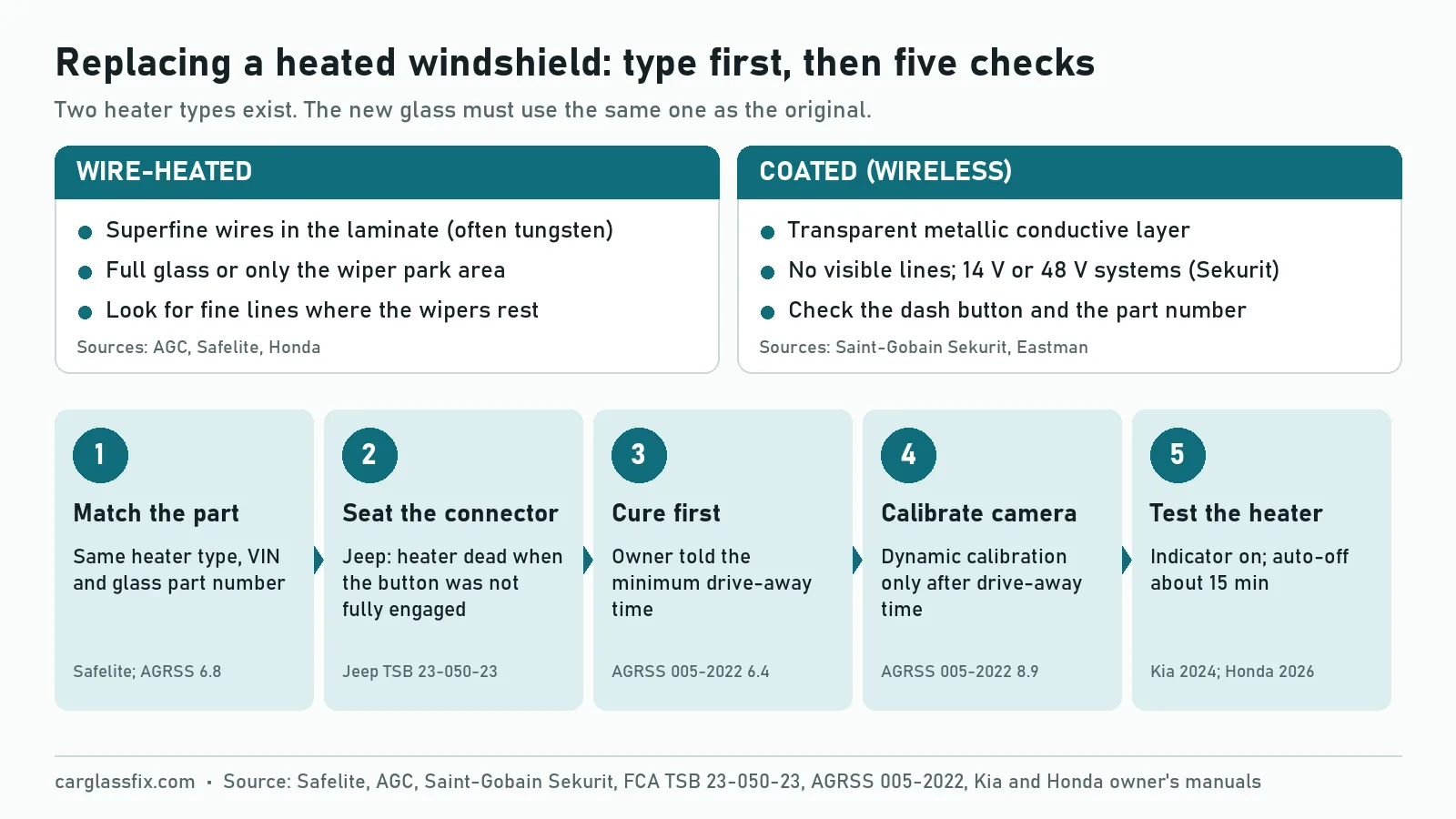
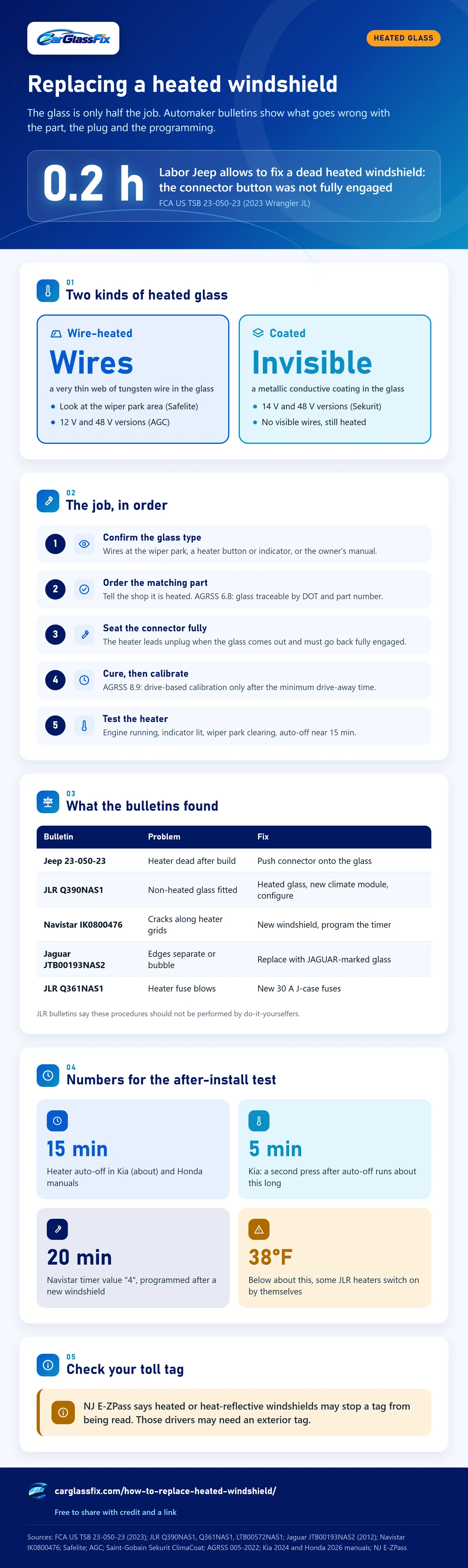
A heated windshield heats the glass with either embedded wires or a transparent metallic coating, and the replacement must use the same type. Safelite tells drivers to look at the bottom of the windshield, where the wipers rest, for small wires in the glass. A heater button or indicator on the dash, or the owner’s manual, also confirms the feature.
| Heated type | What is in the glass | How to spot it | Source |
|---|---|---|---|
| Full wire-heated | Superfine wires across the laminate, often tungsten | Fine lines visible up close, heater button on the dash | AGC; Safelite |
| Heated wiper park | Wires only in the area where the wipers rest | Lines along the bottom edge; Honda’s HR-V button deices only this area | Safelite; Honda 2026 HR-V manual |
| Coated (wireless) | Transparent metallic conductive coating | No visible lines; heater button and the glass label or part number | Saint-Gobain Sekurit ClimaCoat; Eastman Saflex XIR |
AGC says its wire-heated glass runs on 12V and 48V systems. Saint-Gobain Sekurit says its ClimaCoat glass runs on 14V and 48V. For more glass features, see how to identify windshield type.
Match the replacement glass to the car
The replacement windshield has to carry the same heater, connector layout and other features as the glass the car was built with. Safelite advises telling the technicians the windshield is heated so the right glass is ordered. The VIN and the part number on the old glass help the shop find the exact version.
A Jaguar Land Rover bulletin shows what happens when the heater does not match. Some 2014 Range Rover Sport vehicles for Canada left the factory with a non-heated windshield where a heated one was specified. The fix was a heated windshield, a new climate control assembly and an update to the car’s configuration file with the dealer tool.
AGRSS 005-2022 requires that the glass meet ANSI Z26.1, as FMVSS 205 requires. It also requires that the glass be compatible with any ADAS it affects and traceable by DOT number and part number. Jaguar’s bulletin on 2009 to 2011 XF heated windshields accepted only a Jaguar-marked windshield for warranty claims. For the brand choice, see OEM vs aftermarket glass for car replacement.
Step by step: how a heated windshield is replaced
The sequence below combines the AGRSS 005-2022 rules with automaker service notes. The vehicle maker’s procedure for the exact model overrides this outline.
How a heated windshield is replaced
Confirm the heater type and part
The shop checks the VIN, the old glass label and the dash button, then orders glass with the same heater and features.
Check the heater before work
Running the heater and any scan before removal shows whether the circuit worked, so a later fault can be traced.
Disconnect the heater leads
The leads from the car’s harness come off the glass connectors before the cut-out, as Safelite describes.
Cut out the old glass
AGRSS 005-2022 allows only the full cut method on polyurethane systems, leaving about 1 to 2 mm of sound urethane.
Bond the new windshield
The installer follows the adhesive maker’s instructions for primer, bead and conditions.
Reconnect and seat the connectors
Each lead goes back on until it is fully engaged on the glass terminal.
Respect the drive-away time
AGRSS requires the shop to tell the owner the minimum drive-away time before and after the job.
Calibrate and test
The camera is calibrated if fitted, and the heater is switched on to confirm it works.
Two steps differ from an ordinary windshield job. The connector step needs a visual check that each lead is fully seated, because Jeep traced a dead heater on new 2023 Wranglers to a connector that was not fully engaged. The test step needs the engine running or the power mode ON, because the heater does not work otherwise on the Kia and Honda models checked. Some cars also need a dealer tool to finish the job, as the next section shows.
Owners can read what a normal appointment looks like in what to expect during windshield replacement.
Handling the heater connectors and circuit
The heater connection is the most common source of a heated windshield that stops working after replacement, so it deserves its own check. FCA’s TSB 23-050-23 covers 2023 Jeep Wrangler models with an inoperative heated windshield. The bulletin names the cause as an electrical connection button not fully engaged on the windshield, and the repair is to connect it.
Connectors can also be single-use. Jeep’s TSB 23-089-23 calls the rear window defroster connector on the 2018 to 2022 Wrangler “a one time use design” that must be replaced if it comes loose or is removed. That bulletin covers the rear glass, so the windshield connector rule for each model comes from its own service information.
Some vehicles need programming after the glass goes in. Navistar’s service article for International trucks with heated windshield feature 595AMP tells technicians to replace the windshield and then program the heated windshield timer to 20 minutes. Jaguar Land Rover bulletins also link heater faults to fuses and the underhood fuse box. On 2010 and 2011 LR4 and Range Rover Sport models, long automatic operation below about 38°F (4°C) could overheat fuses there.
Camera calibration on a heated windshield
A heated windshield with a forward camera needs the same calibration as any camera windshield, because the heater does not change the automaker’s rule. Honda, Ford, GM, Toyota, Subaru, Nissan, Hyundai, Stellantis and Mazda all require camera calibration after a windshield replacement. Some heated glass also heats the camera zone, and AGC lists targeted heating for cameras and sensors.
AGRSS 005-2022 sets the order. Under section 4.2, a technician who will not follow the calibration clause for a car with ADAS should not take on the installation. Under section 8.9, dynamic calibration starts only after the adhesive’s minimum drive-away time, and the shop tells the owner the result. The same standard asks for glass that is compatible with the ADAS it affects.
The calibration steps, targets and road-drive rules are in how sensors are calibrated after windshield replacement. To check whether the car has a camera at all, see how to tell if your windshield has a camera behind it.
Testing the heater after installation
A heater test after installation confirms that the connector is seated and that the circuit, switch and timer work. Owner’s manuals give the normal behavior to compare against. The table lists what two current manuals describe.
| Check | Kia 2024 Sportage (front glass heater) | Honda 2026 HR-V, Canadian models (heated windshield) |
|---|---|---|
| When it works | Engine running | Power mode ON |
| Area heated | Front window, inside and outside surfaces | Wiper park area |
| Indicator | Light on the button when ON | Button on the dash |
| Auto-off | About 15 minutes; a second press runs about 5 minutes | 15 minutes |
| Caution | Brush off heavy snow first | High power draw; avoid long use at idle |
On a cold or damp morning, frost or fog should clear first over the heated area. If the indicator lights but nothing clears, the connector seating is the first thing to recheck. Navistar’s inspection steps look for cracks along the heater grid and then verify grid operation. Jaguar’s XF bulletin describes heated glass separating or bubbling along the top or side edges, which is a glass defect to raise under warranty.
Heated glass can also affect toll tags. NJ E-ZPass lists heated windshields among the glass types that may stop a tag from being read, and says some drivers need an exterior tag. Other install problems are covered in signs of a poor car glass replacement job.
Frequently asked questions
Can a heated windshield be repaired instead of replaced?
Safelite notes that a chip or scratch in the heater grid can break the electrical contact, so the location of the damage matters. The options are covered in how to repair a heated windshield.
Can I put a non-heated windshield in a car that came with a heated one?
The car’s switch, wiring and settings stay in place, so the heater button no longer does anything for the windshield. Jaguar Land Rover treated a non-heated windshield in a heated-spec Range Rover Sport as an error and fitted heated glass to correct it.
How do I know if my windshield is heated?
Look for fine wires near the bottom where the wipers rest, a heated windshield button on the dash, or the feature in the owner’s manual. Coated heated glass shows no wires, so the button and the glass part number are the surer signs.
Does a heated windshield need ADAS calibration after replacement?
Yes, when the car has a windshield camera, because the automakers’ calibration rules apply to every replacement windshield. AGRSS 005-2022 lets dynamic calibration start only after the adhesive’s minimum drive-away time.
Can I replace a heated windshield myself?
Jaguar Land Rover states that its heated windshield procedures should not be done by do-it-yourselfers. The job adds connector handling, configuration on some cars and camera calibration to a structural glass bond.
Sources
- Safelite: Heated windshields and wipers (checked 2026-10-29)
- AGC Automotive: Heated Wire Windshield (checked 2026-10-29)
- Saint-Gobain Sekurit: All about ClimaCoat (product sheet)
- Eastman: Saflex XIR interlayer
- FCA US TSB 23-050-23: Heated Windshield Inoperative, 2023 Jeep Wrangler (May 10, 2023)
- FCA US TSB 23-089-23: Rear Defroster Inoperative, 2018-2022 Jeep Wrangler (August 8, 2023)
- Jaguar Land Rover Q390NAS1: Non-Heated Front Windshield Fitted, 2014 Range Rover Sport (September 8, 2014)
- Jaguar JTB00193NAS2: Front Windshield Glass Delaminating, 2009-2011 XF (March 9, 2012)
- Jaguar Land Rover LTB00572NAS1: Replacement Engine Compartment Harness, 2010-2011 LR4 and Range Rover Sport (September 27, 2013)
- Navistar IK0800476: Cracked Windshields on Units Equipped With Heated Windshield Feature 595AMP
- Kia 2024 Sportage owner’s manual: Front glass heater
- Honda 2026 HR-V owner’s manual: Heated Windshield Button
- ANSI/AGSC/AGRSS 005-2022 Automotive Glass Replacement Safety Standard (approved July 21, 2022; checked 2026-10-28)
- NJ E-ZPass: Vehicles requiring exterior tags

Similar Posts