How to Seal a Windshield Leak (Find It, Then Use Urethane)
Senior Automotive Glass Diagnostic Specialist & Master Technician at CarGlassFix · AGSC Master Certified Auto Glass Technician, NGA Certified Installer, I-CAR Automotive Safety Specialist · 12+ Years in Automotive Glazing, Windshield Structural Bonding, ADAS Camera Calibration & Precision Chip Restoration
To seal a windshield leak, first find the exact entry point with a hose or soapy-water air test, and rule out sunroof and cowl drains. On a urethane-bonded windshield, the industry standard allows only a compatible polyurethane adhesive for the reseal, never silicone or butyl. If the retest still shows water, the glass has to be removed and reset.
What a windshield leak is and what seals it
A windshield leak is a gap in the bond between the glass and the body flange, called the pinch weld, that lets water or air into the cabin. On most modern cars that bond is a bead of polyurethane adhesive. Safelite describes the same bond as the part that keeps water out and holds the glass in place in a crash.
The bond does more than seal. Ford recall 26V024 covered eight 2026 Explorers whose urethane was applied improperly at the factory. Ford told NHTSA those windshields might not meet FMVSS 212, the federal windshield retention standard. Ford listed increased wind noise and water leaks as the warning signs.
Rust under the glass is another cause. I-CAR says pinch weld corrosion often shows up first as water in the passenger compartment or as excessive wind noise. Older cars and some classics hold the windshield in a rubber gasket instead of urethane alone. Those use different repair rules, covered below. A leak around the back glass is a separate job; see how to stop water leaking through rear windshield.
How to find where the windshield leaks
You find a windshield leak by wetting or pressurizing one short section of the seal at a time while a helper watches the inside. GM’s dealer bulletins use a garden hose with the nozzle removed, so the water flows instead of blasting past the seal. Start with a dry interior so new water is easy to see.
| Test | How it works | Documented by |
|---|---|---|
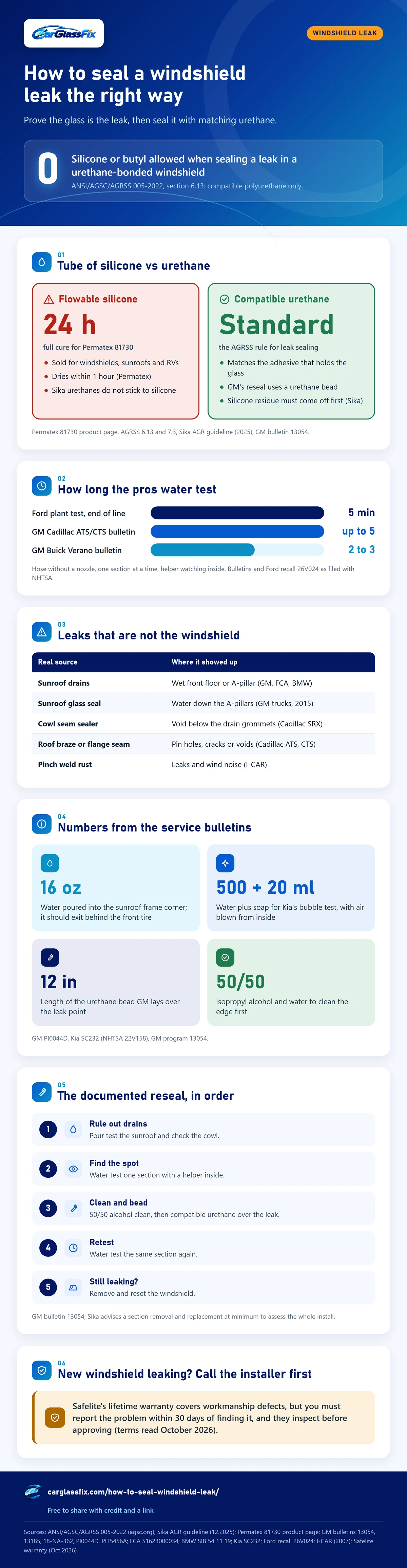
| Hose test | Hose without nozzle on one area of the A-pillar edge for 2 to 3 minutes, assistant inside | GM program 13054 (2012 Buick Verano) |
| Extended flood test | Flood the upper windshield and roof edge for up to 5 minutes while an assistant watches the inside A-pillar | GM bulletin 18-NA-362 (2014 to 2019 Cadillac ATS and CTS) |
| Section spray test | Spray about a foot of seam for at least a minute, then wait several minutes; paper towels taped inside show drips | Mercedes-Benz technical article (2018) |
| Soapy water and air | 500 ml water with 20 ml soap sprayed on the outside seal; air blown from inside; bubbles mark the gap | Kia recall SC232 (2014 to 2016 Cadenza) |
| Ultrasonic test | Transmitter inside with doors closed; receiver traced along the seal outside | Carlex, Mercedes-Benz, International Truck |
International Truck’s ultrasonic procedure marks each detected leak with a marker or masking tape. Progressive quotes a CARiD trainer who says to spray one area at a time and pull carpet if no water shows. FCA’s bulletin for some 2019 Jeep Wranglers uses soapy water in the molding gap with compressed air. No automaker document found for this guide describes a smoke test for windshield leaks.
Rule out the sunroof, cowl and drains first
Water on the A-pillar or front carpet often comes from a sunroof drain or the cowl seam, which sit next to the windshield bond. GM’s drain hose procedure shows the front sunroof drain hoses running along the windshield pillars to the cowl. A clogged or loose tube sends water down that same path.
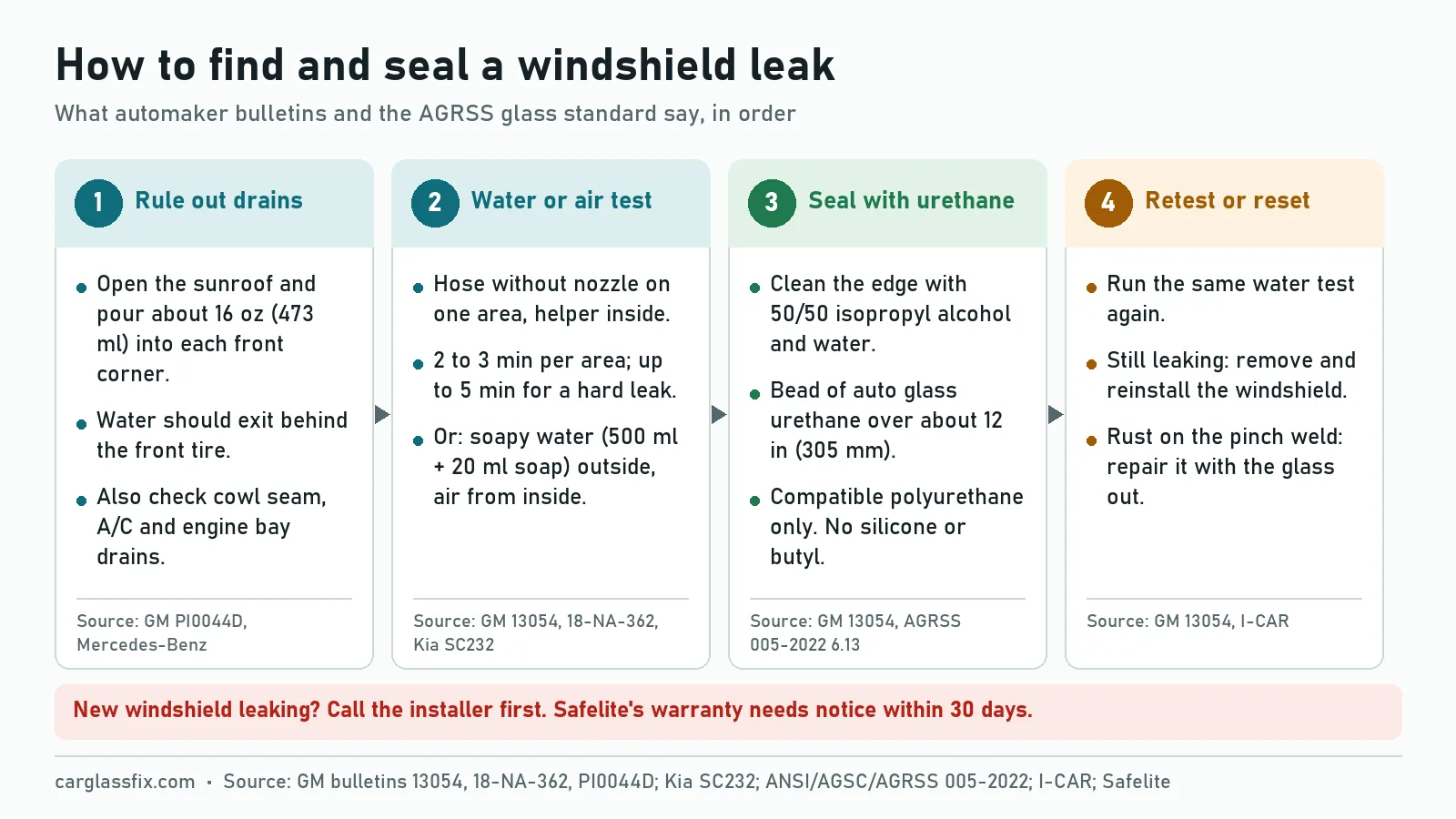
GM’s bulletin for the 2010 to 2013 Cadillac SRX names three common causes of a wet front floor. They are a void in the cowl seam sealer, an unseated sunroof drain grommet and a drain hose routed too tight. Its test is to open the sunroof and pour about 16 ounces (473 ml) of water into the front corner of the frame. The water should come out behind the front tire.
GM also found that sunroof seal leaks on 2015 full-size trucks and SUVs can run down the A-pillars and need an extended water test. FCA and BMW documents list missing, clogged or kinked sunroof drains. A Mercedes-Benz technical article adds the A/C drain and engine compartment drains to the check list. Fogging that never clears can be a symptom too; see why is my windshield always foggy.
Sealant vs resetting the glass: what a DIY sealant can and cannot fix
A sealant can close a small, localized gap in a sound bond, but it cannot fix a windshield that is loose, sitting on rust or bonded with the wrong material. The material also matters. Section 6.13 of ANSI/AGSC/AGRSS 005-2022 says leaks in a polyurethane retention system must be sealed with compatible polyurethane, and “No silicone or butyl may be used.”
Most DIY videos use flowable silicone. Permatex sells its Flowable Silicone Windshield and Glass Sealer for windshields and says it is tack-free in 1 hour and fully cured within 24 hours. Silicone causes a later problem. Sika’s replacement guideline says its urethanes do not adhere to butyl or silicone, so the next installer must remove all of it before new urethane goes on. ANSI notes that use of its standards is voluntary, so the rule binds shops that follow AGRSS, not drivers.
| Situation | What the documents say | Source |
|---|---|---|
| Small leak, urethane-bonded glass | Compatible polyurethane only, no silicone or butyl | AGRSS 6.13 |
| Rubber gasket set with urethane | Compatible polyurethane only, no silicone or butyl | AGRSS 7.3 |
| Leak from someone else’s earlier install | Remove and reinstall to assess the whole job | Sika guideline 11.6 |
| Earlier silicone or butyl found | Remove it completely before new urethane | Sika guideline |
| Rust on the pinch weld | Remove the glass and repair the corrosion first | I-CAR |
| Reseal fails the retest | Follow the windshield replacement procedure | GM program 13054 |
One automaker exception exists. FCA bulletin 23-031-19 tells dealers to apply Mopar silicone sealer between the glass and frame on 2019 Wranglers built July 1 to 5, 2019. Your own vehicle’s procedure decides.
How to seal a small edge leak with urethane
The documented way to seal a localized leak without removing the glass comes from GM’s program for the 2012 Buick Verano. GM says its bulletins are intended for professional technicians, not do-it-yourselfers. The steps show what a correct reseal looks like.
How to seal a windshield leak with urethane
Confirm the leak point
Water test the area with a hose without a nozzle and a helper inside, then mark the spot with tape.
Remove the trim
Take off the reveal molding or garnish over the leak with a plastic trim tool.
Clean the edge
Wipe the glass edge and the surrounding metal with a 50/50 mix of isopropyl alcohol and water on a lint-free cloth.
Apply urethane
Lay a bead of auto glass urethane over about 12 inches (305 mm) centered on the leak point.
Work it in
Press extra urethane into the leak point with a plastic paddle.
Retest
Run the same water test again before the trim goes back on.
Reset if needed
If water still enters, the windshield must be removed and reinstalled.
Refit the trim
Replace one-time clips, such as GM’s garnish tether clip, and reinstall the molding.
Ford’s molding bulletin 13-12-8 says to follow the urethane maker’s cure time, and the same applies to a reseal. If the molding was the real problem, see how to fix loose windshield molding. After a leak, GM’s Verano procedure also checks the wiring connector under the dash for corrosion, because water there caused warning lights and automatic OnStar emergency calls. Kia’s recall procedure adds lane camera calibration after the glass is removed and reattached; see ADAS calibration and windshield replacement.
Leak after a new windshield: go back to the installer first
If a recently replaced windshield leaks, contact the installer before you apply any sealant yourself. Safelite says a leak after replacement usually comes from the installation, such as too little adhesive or poor surface preparation. Safelite’s warranty says the company must be able to inspect the vehicle before it approves a claim.
Warranty terms set deadlines. Safelite’s nationwide lifetime warranty covers defects in material or workmanship for as long as you own or lease the vehicle. It requires notice within 30 days of discovering the defect and a copy of the receipt. It also says rust found under the old glass is the owner’s cost. Check your own installer’s terms with how to check windshield replacement warranty.
The standard gives the shop duties too. AGRSS section 6.11 says installers must report inappropriate materials or methods they find to the owner. Section 6.12 says a shop correcting a bad installation must remove materials that would compromise the bond. Other red flags are listed in signs of poor car glass replacement job.
Preventing air and water leaks after replacement
A leak-free replacement starts with a clean bond, a full bead and a leak check before the car leaves. Sika’s guideline says a clean, uncontaminated bonding area is vital for “safe and leak free” installations. It also recommends a glass leak check after every install. Carlex, which supplies Ford and Lincoln glass, lists a leak test as step 12 and allows ultrasonic or other methods.
Factories test too. Ford’s recall filing says every vehicle at the plant gets a 5-minute water leak test, which is how the bad urethane on the 2026 Explorers was found.
Your part is to follow the cure instructions. AGRSS section 6.4 requires the installer to tell you the minimum drive-away time before and after the job. Sika says tape may hold the glass in position until the adhesive has developed sufficient strength, so leave it until the installer says otherwise. Ask the shop how long to wait before a car wash, since that depends on the adhesive. More aftercare steps are in how to care for your car after glass replacement.
Frequently asked questions
Can I reseal my windshield myself?
You can find the leak yourself with a hose or soapy-water test, and a small gap can be sealed with auto glass urethane. The AGRSS standard rules out silicone and butyl on urethane-bonded glass, so a shop is the safer choice if the glass moves or the leak returns.
How do you fix a leaking windshield without removing it?
GM’s dealer method cleans the edge with a 50/50 alcohol and water mix, lays a urethane bead over about 12 inches of the leak area and retests. If water still enters, GM’s procedure moves to removing and reinstalling the windshield.
Is flowable silicone safe to use on a windshield leak?
Permatex sells flowable silicone for windshields, but AGRSS 6.13 bans silicone for leaks in polyurethane-bonded glass. Sika says its urethanes will not stick to silicone residue, so the next installer must remove it all.
Can a sunroof leak look like a windshield leak?
Yes. GM bulletins show sunroof drain hoses and seals sending water down the A-pillars to the front carpet, so pour water into the sunroof drain corners before you seal the glass.
Will the glass shop fix a leak after a windshield replacement?
Most installers warrant workmanship, and Safelite’s lifetime warranty covers workmanship defects if you report them within 30 days of discovery. Keep your receipt, and see how to stop water leaks from side glass seals if the water comes from a door window instead.
Sources
- ANSI/AGSC/AGRSS 005-2022 Automotive Glass Replacement Safety Standard, sections 6.4, 6.11 to 6.13 and 7.3 (checked 25 Oct 2026)
- Sika, General Guideline for Vehicle Glass Replacement (12.2025) (checked 25 Oct 2026)
- Carlex, Ford/Lincoln glass installation procedures
- Permatex, Flowable Silicone Windshield and Glass Sealer technical data sheet (rev. 02/19)
- GM program bulletin 13054, Windshield Water Leak, 2012 Buick Verano (NHTSA copy)
- GM bulletin 18-NA-362, wind noise or water leak at front roof or windshield (NHTSA copy)
- GM service update 13185, possible windshield water leak, 2013 Cadillac ATS (NHTSA copy)
- GM PI0044D, water leak at front floor, 2010 to 2013 Cadillac SRX (NHTSA copy)
- GM PIT5456A, sunroof water leak, 2015 full-size trucks and SUVs (NHTSA copy)
- FCA STAR case S1623000034, sunroof drain tube inspection (NHTSA copy)
- BMW SIB 54 11 19, sunroof water leak diagnosis (NHTSA copy)
- FCA bulletin 23-031-19, water leak at lower center of windshield, 2019 Jeep Wrangler (NHTSA copy)
- Kia recall SC232 (NHTSA 22V158), windshield primer inspection, 2014 to 2016 Cadenza
- Ford recall 26V024, Part 573 safety recall report, 2026 Explorer windshield urethane
- Ford TSB 13-12-8, A-pillar moulding wind noise, 2013 to 2014 Escape
- I-CAR, Windshield pinchweld corrosion repair
- Mercedes-Benz technical article, Glass, but not Windshields (2018)
- International Truck IK1600272, cab and windshield water leak detection with an ultrasonic detector (NHTSA copy)
- Progressive Lifelanes, Windshield seal repair
- Safelite nationwide lifetime warranty (checked 25 Oct 2026)
- Safelite, Windshield seal and leak issues

Similar Posts