Why Is My Windshield Always Foggy? 6 Causes to Check
Senior Automotive Glass Diagnostic Specialist & Master Technician at CarGlassFix · AGSC Master Certified Auto Glass Technician, NGA Certified Installer, I-CAR Automotive Safety Specialist · 12+ Years in Automotive Glazing, Windshield Structural Bonding, ADAS Camera Calibration & Precision Chip Restoration
A windshield that is always foggy usually has one of six causes: climate settings that trap moist air, a film on the inside of the glass, a clogged or wet cabin air filter, water leaking into the cabin, a leaking heater core, or an A/C system that no longer dries the air. Check them in that order.
Why a windshield stays foggy
A windshield stays foggy when something keeps adding water to the cabin air, stops the air from drying, or leaves a film on the glass. Fog is water that condenses on glass colder than the dew point of the air touching it. The University of Illinois physics department states this rule and explains that the A/C dries the air because water condenses inside it. Ordinary fog clears once warm, dry air reaches the glass. Fog that returns on every drive points to a cause the defroster cannot remove.
The symptoms that come with the fog narrow the cause down. The general physics, including breath and wet clothes, is covered in why car windows fog up on the inside.
| What you notice | Likely cause | Check first |
|---|---|---|
| Fog clears with defrost, then returns with your usual settings | Recirculation, A/C off or an economy mode | Climate controls |
| Haze stays on warm, dry glass | Film on the inside of the glass | Glass cleaning |
| Weak airflow from the vents | Clogged or wet cabin air filter | Cabin air filter |
| Damp carpet, mist from the dash vents or a musty smell | Water leak: A/C drain, cowl, sunroof drains or seals | Front floors and trunk |
| Antifreeze smell, a whitish film and a falling coolant level | Heater core leak | Coolant reserve tank |
| Vents never blow cool air on a warm day | A/C fault | A/C inspection at a shop |
Check the causes in this order
Start with the free checks and finish with the ones that need a shop. Settings take seconds to test, and a film or a clogged filter costs little to fix. Water leaks, a heater core and the A/C usually need a mechanic.
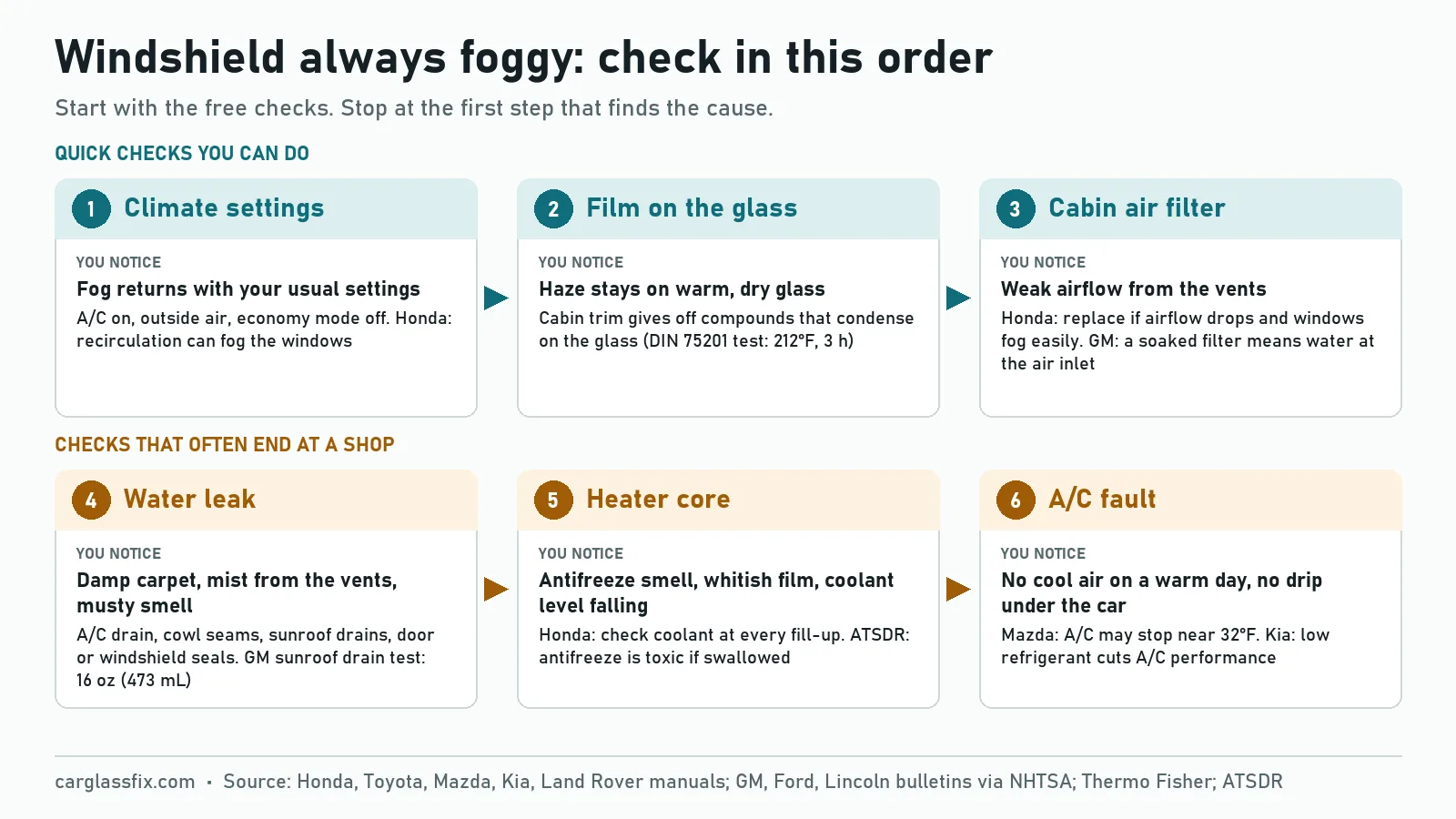
Each step rules out one cause before the next one.
How to find out why your windshield is always foggy
Reset the climate controls
Turn the A/C on, select outside air, switch any economy mode off and send warm air to the windshield. If the fog stays away, the settings were the cause.
Test for a film
Let the defroster clear the glass. Haze that remains on warm, dry glass is a film that needs cleaning.
Check the airflow
Run the fan on high. Honda says weak airflow with windows that fog up easily can mean the cabin air filter needs replacing.
Feel the carpets
Press on both front floors and the trunk floor after rain or A/C use. Damp carpet means water is getting in.
Check the coolant
With the engine cold, read the reserve tank. A level that keeps falling, with an antifreeze smell or a film, points to the heater core.
Check the A/C
On a warm, humid day, the A/C should blow cool air and drip water under the car. If it does neither, have the system inspected.
Several causes can act together. Owners who reported heater core leaks to NHTSA describe a film on the glass, coolant on the passenger-side floor, or both. Do not drive while fog blocks the view. Honda’s manual tells drivers to make sure they have a clear view through all the windows before driving.
Climate settings that keep fog coming back
Recirculation and a switched-off A/C are the settings most often behind fog that keeps returning. Honda’s HR-V manual says the windows may fog up from humidity if the system stays in recirculation mode. Toyota’s Corolla Cross manual says the windows fog up more easily with the A/C off.
A rapid-defrost routine can leave recirculation on. Honda’s sequence for rapidly defrosting the windows uses recirculation, and Honda then tells drivers to switch back to fresh air mode. Economy modes can cut the A/C too. A 2008 Land Rover owner’s handbook says the air conditioning is switched off in its ECON mode. Honda says its ECON mode may reduce cooling performance. Honda also advises against setting the temperature near its upper or lower limit.
Fog on the outside of the glass in humid summer weather has a different cause and fix, covered in how to fix windshield fog on the outside. The full clearing sequence is in how to defog a windshield quickly.
A film on the glass that looks like fog
A haze that stays after the defroster has warmed and dried the glass is a film on the inside of the windshield. Fog is water, so it evaporates once the glass is warmer than the dew point. A film stays, and it scatters light in sun and headlight glare.
The auto industry calls this film “fogging.” A Thermo Fisher technical note explains that heat makes cabin plastics, textiles and leather release semi-volatile compounds, which condense on the cooler windshield. The note says the film limits and bends the light that passes through. Material makers test trim for it under DIN 75201, ISO 6452 and SAE J1756. In one DIN 75201 method, a trim sample is heated to 212°F (100°C) for three hours under a glass plate held at 70°F (21°C).
A whitish film that returns soon after cleaning, with an antifreeze smell, points to the heater core. The cleaning method is in how to get rid of haze on the inside of a windshield.
A clogged or wet cabin air filter
A clogged cabin air filter cuts the airflow that clears the glass, and a soaked filter is a sign that water is entering the air intake. Honda’s HR-V manual says the filter may need replacing if airflow weakens noticeably and the windows fog up easily. Honda’s Maintenance Minder sets the replacement time, and Honda suggests replacing the filter sooner in dusty areas.
Water can reach the filter from outside. GM bulletin PI0826 for the 2012 to 2013 Chevrolet Sonic describes rain running along the edge of the windshield into the fresh air inlet at its base. The bulletin says the filter may then be saturated. GM tells technicians to leave a damp filter in place, because it dries as the system runs, and to replace a saturated or damaged one.
A musty smell is another clue. Toyota’s bulletin T-SB-0094-21 on musty odors after water intrusion says the source of the water must be found and repaired first, and the old cabin filter is discarded.
Water leaks: A/C drain, cowl, sunroof drains and seals
A damp carpet is the clearest sign that water is getting into the cabin. Automaker service bulletins, published in NHTSA’s archive, name the usual paths.
| Leak path | What the bulletin describes | Bulletin and models |
|---|---|---|
| A/C evaporator drain hose | Hose caught on the shift cable; mist from the dash vents, moisture on the inside of the windshield and a wet floor | GM PIC5398C: 2010 to 2014 Buick LaCrosse, 2011 to 2014 Regal, 2013 to 2014 Chevrolet Malibu |
| A/C drain tube seal | Condensation leaks onto the right front floor during or after A/C use | Ford 19-2345: 2018 to 2020 F-150, Expedition, Navigator and Super Duty |
| Seam at the base of the windshield | Water runs through the HVAC fresh air inlet into the right footwell | Lincoln 19-2084: 2017 to 2019 Continental |
| Cowl seams | Water coming off the windshield finds a path behind the HVAC case, or through a sealant gap | GM PI0916D: Caprice PPV and SS; FCA 23-029-15: 2015 Jeep Cherokee |
| Sunroof drains | Drain hose grommets unseated, and gaps in the cowl seam sealer below them | GM PI0044D: 2010 to 2013 Cadillac SRX |
| Door water deflector | A poorly sealed deflector lets door water into a footwell, most often on the driver’s side | GM PI0916D |
| Windshield seal | A sudden leak at the right A-pillar can follow a windshield replacement | GM 08-08-57-003F: Enclave, Traverse, Acadia, Outlook |
GM’s SRX bulletin gives a simple drain check. Pour about 16 ounces (473 mL) of water into the front corner of the open sunroof frame, and look for it flowing out behind the front tire. A working A/C drips water under the car, and a Land Rover handbook says the puddles are no cause for concern. Damp carpet after A/C use points to the evaporator drain. These bulletins are written for professional technicians. Seal repairs are covered in how to seal a windshield leak and how to stop water leaks from side glass seals.
Heater core leak: film, smell and falling coolant
A leaking heater core puts coolant into the air that blows on the windshield, and it can show as a film, a smell and a falling coolant level. In complaints filed with NHTSA, a 2000 Volkswagen Passat owner reported white smoke from a failed heater core, a film on the windshield, an antifreeze odor and a coolant level down by half. A 2000 Mitsubishi Diamante owner reported fog that never fully cleared and a whitish film. The dealer found failed gaskets next to the heater core.
Coolant can also leave through the A/C drain. GM bulletin PI1463 for the 2013 to 2014 Chevrolet Spark describes coolant dripping from the A/C drain hose. A coolant smell alone is not proof. GM’s Cruze bulletins trace some “coolant” odors to reservoir vapor and to grease inside the HVAC case.
Honda recommends checking the coolant level every time you refuel and inspecting the cooling system for leaks. ATSDR, part of the CDC, describes ethylene glycol, used in antifreeze, as odorless with a sweet taste. Swallowing larger amounts can cause serious illness or death. NIOSH lists eye, nose and throat irritation among the symptoms of exposure.
A/C faults and when to see a mechanic
An A/C system that does not run leaves the cabin air wet, so the fog keeps coming back even with the right settings. Mazda says its air conditioner may not function when the outside temperature approaches 32°F (0°C). On a warm day, an A/C that never blows cooler air points to a fault.
Kia’s 2025 owner’s manual says A/C performance drops when the refrigerant is low and tells owners to have abnormal operation inspected by a dealer. The EPA requires anyone who services a vehicle A/C system for pay to be certified under section 609 of the Clean Air Act.
See a mechanic when any of these signs appears:
- The coolant level keeps falling, or an antifreeze smell comes with a film.
- Carpet that has dried gets wet again.
- Mist blows from the dash vents.
- The A/C never cools on a warm day.
- The defroster blows weak or no air. See car windshield defroster not working.
Once the cause is fixed, the habits in how to prevent car windows from fogging up keep the glass clear.

Frequently asked questions
Why does my windshield keep fogging up with the defrost on?
Defrost air clears fog best when the A/C has dried it. Fog that returns with the defroster on points to an A/C that is not running, or to water entering the cabin from a blocked A/C drain, a leaking seal or a heater core.
Can a heater core cause a foggy windshield?
Yes. NHTSA recall 93V015 warned that coolant escaping into the passenger compartment can fog the inside of the windows. Owners who reported heater core failures to NHTSA also describe a film on the windshield and an antifreeze smell.
Can a dirty cabin air filter make the windshield fog?
Yes. Honda says the filter may need replacing if airflow drops noticeably and the windows fog up easily. A soaked filter also points to water entering the air intake, as GM’s Sonic bulletin describes.
Why is my windshield foggy every morning?
The glass cools overnight, and on a clear, calm night it can become colder than the surrounding air, as the National Weather Service explains. Moisture left in the cabin condenses on it. Morning fog with a damp carpet points to a leak.
Why does my windshield look hazy even when it is not foggy?
A haze on warm, dry glass is a film. Heat makes interior plastics and textiles release compounds that condense on the windshield, and a heater core leak can leave a coolant film. Cleaning removes a film, and defrosting does not.
Sources
- University of Illinois Department of Physics: Car Windows Fogging Up
- National Weather Service Grand Junction: frost, freeze and radiational cooling
- Honda HR-V 2026 Owner’s Manual: Using Automatic Climate Control, Dust and Pollen Filter and Engine Coolant (checked 24 October 2026)
- Toyota owner’s manuals: Corolla Cross, air conditioning system section
- Land Rover owner’s handbook (2008): Climate control
- Mazda MX-30 2023 Owner’s Manual: air conditioner note
- Kia Owner’s Manual (2025): Checking the amount of air conditioner refrigerant and compressor lubricant
- Thermo Fisher Scientific application note ANTCFOGTEST0311: Understanding a Fog Testing System (2011)
- GM PI0826: Water Intrusion in Front Passenger Compartment Floor, 2012-2013 Chevrolet Sonic (October 2012)
- Toyota T-SB-0094-21: Odor Remediation After Water Intrusion (November 23, 2021)
- GM PIC5398C: Mist From Instrument Panel Vents, Moisture On Windshield Or Water On Floor (February 2014)
- Ford TSB 19-2345: Water Leaking On Right Front Floor During Or After A/C Use (November 18, 2019)
- Lincoln TSB 19-2084: Water Entering Right Front Footwell Through HVAC Fresh Air Inlet (March 19, 2019)
- GM PI0916D: Floor/Carpet Wet at Front Passenger Side or Any Footwell, Chevrolet Caprice PPV and SS (March 2016)
- FCA 23-029-15: Water In Right Front Floor Footwell, 2015 Jeep Cherokee (July 21, 2015)
- GM PI0044D: Water Leak at Driver/Front Passenger Floor Area, 2010-2013 Cadillac SRX (August 2013)
- GM 08-08-57-003F: Floor Wet Under Carpet (Seal Seam), Enclave, Traverse, Acadia, Outlook (May 2015)
- GM PI1463: Coolant Leaking from HVAC Case Drain, 2013-2014 Chevrolet Spark (April 2015)
- GM PI0740B: Engine Coolant Odor inside Vehicle Passenger Compartment, 2011-2012 Chevrolet Cruze (February 2014) and PI0935D: Odor from HVAC System (March 2015)
- NHTSA owner complaints: 2000 Volkswagen Passat, ODI 10181006 and 2000 Mitsubishi Diamante, ODI 10090591
- NHTSA recall 93V015: BMW cooling system and heater core
- ATSDR (CDC): Ethylene Glycol ToxFAQs (June 2013)
- CDC NIOSH Pocket Guide to Chemical Hazards: Ethylene glycol
- US EPA: Section 609 Technician Training and Certification Programs (page updated June 25, 2026, checked 24 October 2026)

Similar Posts