How to Remove Dust From Car Glass Without Scratching It
Senior Automotive Glass Diagnostic Specialist & Master Technician at CarGlassFix · AGSC Master Certified Auto Glass Technician, NGA Certified Installer, I-CAR Automotive Safety Specialist · 12+ Years in Automotive Glazing, Windshield Structural Bonding, ADAS Camera Calibration & Precision Chip Restoration
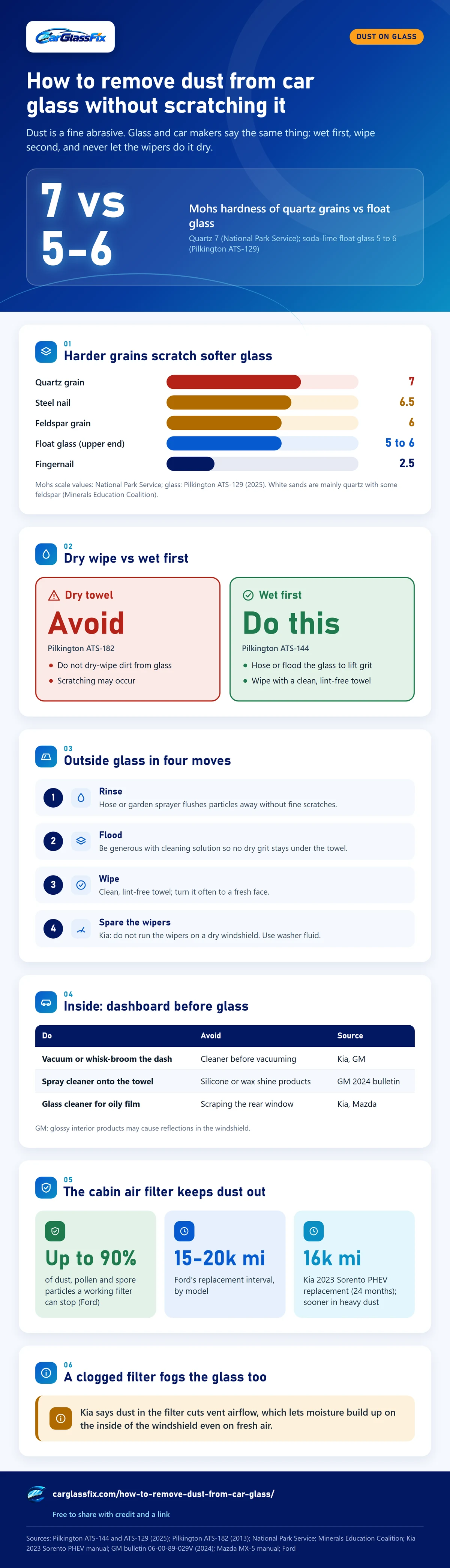
To remove dust from car glass without scratching it, wet the glass before you wipe. Rinse the outside with a hose or plenty of cleaning solution, then wipe with a clean, lint-free towel. Inside, vacuum the dashboard first, then clean the glass with cleaner sprayed onto the towel. Never run the wipers on dry, dusty glass.
How do you remove dust from car glass without scratching it?
You remove dust from car glass without scratching it by lifting the grit off with water or cleaning solution before any towel presses on it. Pilkington North America, a glass maker, puts the risk plainly in its technical bulletin ATS-144. The bulletin says a layer of abrasive dust usually rests lightly on the glass surface. It adds that this dust can easily scratch the glass if too much pressure is applied with too little cleaning solution.
The fix follows from that warning. Pilkington’s routine method floods the surface with spray-on solution or a saturated cloth to wet it fully and remove grit particles. Only then does the bulletin rub the wet glass with a clean, lint-free towel. For heavy dirt, Pilkington flushes the glass first with a hose or a garden pressure sprayer. It says this removes the loose particles without risk of creating fine scratches.
Inside the car, the order matters as much as the method. Kia’s owner’s manual says to remove dust from interior surfaces with a whisk broom or a vacuum. General Motors tells owners to vacuum loose dirt before any cleaning product is used. Cleaning the dashboard and vents first keeps that dust off glass you have already cleaned.
Why dry dust scratches car glass
Dry dust scratches car glass because some of its mineral grains are as hard as or harder than the glass. The Mohs scale ranks a material by its resistance to scratching, and a harder material scratches a softer one.
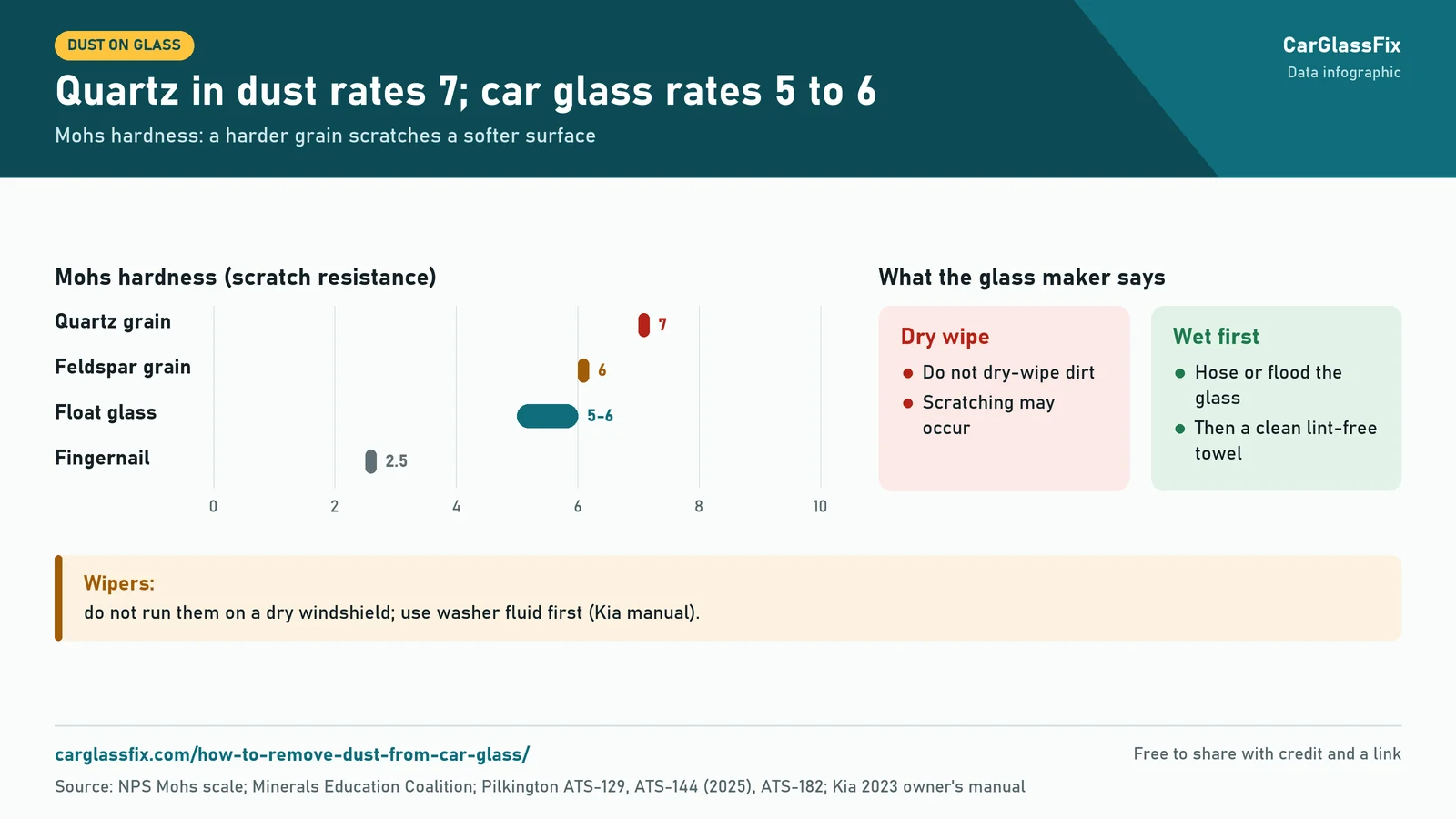
The National Park Service lists quartz at 7 and orthoclase, a feldspar, at 6 on the Mohs scale. Pilkington’s ATS-129 bulletin rates soda-lime float glass at 5 to 6. The Minerals Education Coalition calls quartz one of the most common minerals in the Earth’s crust. It says weathered quartz grains concentrate in soil, rivers and beaches. It also says white sands are usually mainly quartz with some feldspar. OSHA adds that sand, stone, concrete and mortar contain crystalline silica.
| Material | Mohs hardness | Source |
|---|---|---|
| Quartz (common in sand and soil) | 7 | National Park Service, Minerals Education Coalition |
| Steel nail | 6.5 | National Park Service |
| Orthoclase feldspar | 6 | National Park Service |
| Soda-lime float glass | 5 to 6 | Pilkington ATS-129 |
| Glass plate (field test) | 5.5 | National Park Service |
| Fingernail | 2.5 | National Park Service |
No source we found measures how much quartz is in the dust on an average car. The comparison still explains the advice. A hard grain dragged across glass under a dry towel can cut a fine line. Water lifts the grain and lets it roll or rinse away instead. Pilkington’s ATS-182 bulletin says it directly: do not dry-wipe dirt from the surface, as scratching may occur. The same bulletin tells cleaners to rotate the pad to a fresh, clean surface and keep abrasive particles from getting trapped between the glass and the cloth.
How to remove dust from the outside glass
Outside, the safest way to remove dust is to rinse it off before you wipe. The steps below follow Pilkington’s routine and heavy-dirt procedures and Kia’s wiper guidance.
How to remove dust from outside car glass
Rinse first
Flush the windshield, side and rear glass with a hose or a garden pressure sprayer to carry loose grit away (Pilkington ATS-144).
Wet the glass generously
Flood each pane with cleaning solution or a saturated cloth so no dry grit is left under the towel.
Wipe with a clean towel
Rub the wet glass with a clean, lint-free towel and turn it often to a fresh face (Pilkington ATS-182).
Dry before streaks form
Stop wiping when a thin, even film of moisture is left; Pilkington says it evaporates and leaves a clean surface.
Clean the wiper blades
Wipe the blades with a mild detergent and rinse with clean water, as Kia’s manual advises for contaminated blades.
Pilkington explains streaks the same way it explains scratches. It says streaking is dirt and detergent redeposited when there was too much dirt and too little cleaning or rinsing solution. The finishing technique for a clear windshield is covered in how to clean a windshield without streaks.
Do not use the wipers to clear dust
Wipers should not be used to clear dry dust. Kia’s 2023 Sorento Plug-in Hybrid manual says to prevent possible damage to the wipers or windshield, do not operate the wipers when the windshield is dry. The same manual calls for a non-abrasive windshield washer fluid. If dust lands while you drive, spray washer fluid before the blades move. Kia also notes that hot wax from some automatic car washes can make the windshield difficult to clean and reduce wiper performance.
How often to wash dust off
Kia’s manual tells owners to wash the vehicle at least once a month with lukewarm or cold water. It says to wash after each off-road trip. Pilkington says glass should be cleaned as often as needed to keep it looking acceptable, and that visible deposits should not be left to stay on the surface.
How to remove dust from the inside glass and dashboard
Inside, you remove dust from the glass by cleaning the dashboard and vents first, then the glass, with the cleaner applied to the towel. Kia’s manual says to remove dust and loose dirt from interior surfaces with a whisk broom or a vacuum cleaner. If more is needed, Kia uses warm water with a mild non-detergent cleaner, tested on a hidden spot first.
Clean the dashboard first, without shine products
The dashboard sits right under the windshield, so it should be dusted before the glass. A General Motors service bulletin from April 2024 covers interior cleaning on 2025 and earlier GM vehicles. It says to vacuum all loose dirt before any cleaning product is used. It says to spray the cleaner onto a clean towel, not onto the surface. It also says to use a soft-bristle brush in crevices and never a stiff brush.
The same GM bulletin warns against silicone or wax-based products and products with organic solvents such as naphtha or alcohol. GM says they raise the gloss unevenly. It says the increase in gloss may cause reflections in the windshield and even make it difficult to see through the windshield in some conditions. GM adds that too much soap leaves a residue that streaks and attracts dirt.
The film under the dust
A greasy film often sits under interior dust, and wiping dust alone will not remove it. Kia’s manual describes fogged interior glass as covered with an oily, greasy or waxy film. Kia says to clean it with a glass cleaner and follow the directions on the container. Part of that film comes from the cabin itself. SAE J1756, revised in April 2026, is a test method for the tendency of interior materials to produce a light-scattering fog deposit on glass. Intertek, a testing lab, says such tests measure how plastics and elastomers give off substances that condense on other surfaces. The causes and the full removal method are in how to get rid of haze on the inside of a windshield.
Rear and tinted glass
The rear window and tinted glass need gentler tools. Kia says not to scrape or scratch the inside of the rear window, because that can damage the defroster grid. Mazda’s MX-5 manual says not to use sharp instruments or window cleaners with abrasives on the inside of the rear window. The grid technique is explained in how to clean the inside of a rear window. Film on side windows has its own rules, covered in how to clean tinted car windows.
Dry vs damp methods that do not scratch
Damp and wet methods are the ones glass and car makers describe, while dry wiping is the method their guidance warns against. Pilkington’s bulletins never wipe dirt off dry glass. They wet the surface first, rinse heavy dirt with low-pressure water and keep particles from being trapped under the cloth. The table compares common ways to remove dust with what the sources say.
| Method | What the sources say | Use it for |
|---|---|---|
| Hose or pressure-sprayer rinse | Flushes away particles without risk of fine scratches (Pilkington ATS-144) | Outside glass with visible dust or grit |
| Generous cleaning solution, then a clean lint-free towel | Wets the surface fully and removes grit before rubbing (ATS-144) | Outside and inside glass |
| Cleaner sprayed onto the towel | GM’s method for interior surfaces; keeps product off nearby trim | Inside glass and dashboard |
| Vacuum or whisk broom | Removes dust and loose dirt from interior surfaces (Kia); vacuum before any product (GM) | Dashboard, vents, seats |
| Dry towel on dirty glass | “Do not dry-wipe dirt from the surface as scratching may occur” (Pilkington ATS-182) | Avoid |
| Wipers on a dry windshield | Can damage the wipers or windshield (Kia) | Avoid; use washer fluid |
| Razor or metal scraper on tempered glass | Can create fine scratches only visible in full sunlight (ATS-144) | Avoid on tempered side glass |
Pressure and towel care decide most of the outcome. Pilkington links scratching to too much pressure with too little solution, so a light hand matters even on wet glass. A dropped towel can carry grit back to the glass, which is the trap Pilkington warns about. Which cleaner to put on that towel is explained in what is car glass cleaner, and the products that harm glass, tint or trim are listed in what not to use to clean car windows.
How the cabin air filter affects dust on the glass
The cabin air filter is the part that keeps outside dust from blowing into the cabin and onto the inside of the glass. Kia’s 2023 Sorento Plug-in Hybrid manual says the filter behind the glove box filters dust and other pollutants that enter through the heating and air conditioning system. Ford says a properly working cabin air filter can stop up to 90% of dust, pollen and spore particles from entering the passenger compartment.
A clogged filter affects the windshield in a second way. Kia says that when dust builds up in the filter, airflow from the vents may decrease. It says this leads to moisture accumulating on the inside of the windshield, even with the outside air position selected. Kia also says that to keep dust or fumes out for a while, you can set the air intake to recirculation, then return to fresh air. Kia notes the system draws air through the grilles at the base of the windshield, which should be kept clear of leaves, snow and ice.
| Automaker guidance | Normal use | Dusty use |
|---|---|---|
| Kia, 2023 Sorento Plug-in Hybrid schedule | Inspect at 8,000 miles or 12 months; replace at 16,000 miles or 24 months | Replace more frequently on rough, dusty or unpaved roads and in heavy dust |
| Ford support page | Replace every 15,000 to 20,000 miles, depending on model | Replace more often on dirt roads or in excessively dusty conditions |
Intervals differ by model, so the owner’s manual for your car sets the schedule. Kia adds that a filter must be installed properly, or the system may make noise and the filter may work less well.
How to stop dust building up on side glass
You stop dust building up on side glass mainly by washing it off before it bonds and by keeping grit away from the glass. Pilkington says visible deposits should not be left on glass, because some hold moisture and cause staining, and others bond so firmly that harsh cleaning is needed. Kia’s monthly washing advice covers the side windows along with the paint.
A water-repellent treatment can help rain carry dust away. Gelest, a silane maker, says some automotive side windows are treated with fluoroalkylsilanes for self-cleaning properties. It says water beads remove soil as they are blown across the glass while the car accelerates. How such coatings work is explained in what is car glass coating.
AAA’s 2019 vehicle escape tool study says the majority of vehicle side windows are made from tempered glass. Pilkington says razor blades or metal scrapers should not be used on tempered glass, because they can create fine scratches visible only in full sunlight. Fine lines that already show in sunlight are covered in how to fix scratches on a car side window.
Frequently asked questions
Can I wipe dust off my car with a dry microfiber towel?
Glass maker guidance says not to. Pilkington’s ATS-182 bulletin says do not dry-wipe dirt from glass because scratching may occur, so wet or rinse the glass first.
How do I keep dust off my windshield?
Wash the car regularly (Kia says at least once a month), keep the cabin air filter on schedule, and use washer fluid instead of dry wipers when dust lands while driving.
Why does my windshield get dusty on the inside?
Outside dust enters through the heating and air conditioning system, which Kia says the cabin air filter is there to filter. Kia adds that a clogged filter also lets moisture collect on the inside of the windshield, and that an oily interior film needs a glass cleaner.
Why can’t I see through my windshield in the sun?
SAE J1756 treats interior film as a light-scattering deposit on glass, and GM warns that glossy silicone or wax dashboard products can cause reflections in the windshield, and the cleaning fix for glare is in how to clean a windshield without streaks.
Can I remove dust from car glass without washing the car?
Yes, if the glass is wetted first. Pilkington’s method floods the glass with cleaning solution to remove grit before a clean, lint-free towel touches it.
Sources
- Pilkington North America, Technical Bulletin ATS-144: Manual washing of clear and tinted glass (04/2025)
- Pilkington North America, Technical Bulletin ATS-182: Hand washing Pilkington OptiView (2013)
- Pilkington North America, Technical Bulletin ATS-129: Properties of soda-lime silica float glass (04/2025)
- National Park Service, Mohs Hardness Scale (updated April 2023)
- Minerals Education Coalition, Quartz (checked November 2026)
- OSHA, Crystalline silica (checked November 2026)
- Kia 2023 Sorento Plug-in Hybrid owner’s manual: Operating windshield washers
- Kia 2023 Sorento Plug-in Hybrid owner’s manual: Interior care
- Kia 2023 Sorento Plug-in Hybrid owner’s manual: Exterior care
- Kia 2023 Sorento Plug-in Hybrid owner’s manual: Climate control air filter
- Kia 2023 Sorento Plug-in Hybrid owner’s manual: Scheduled maintenance service
- Kia 2023 Sorento Plug-in Hybrid owner’s manual: Climate control system operation
- Kia owner’s manual (2024, BDm): Blade inspection
- Mazda MX-5 owner’s manual: Rear window defogger
- General Motors Bulletin 06-00-89-029V: Interior cleaning (April 2024), via NHTSA
- Ford, When should I change the cabin air filter in my Ford? (checked November 2026)
- SAE J1756_202604, Determination of the Fogging Characteristics of Interior Automotive Materials (revised April 2026)
- Intertek Testlopedia, Fogging SAE J1756, ISO 6452, DIN 75201
- AAA, Vehicle Escape Tool Evaluation (July 2019)
- Gelest, Hydrophobicity, Hydrophilicity and Silane Surface Modification (2006)

Similar Posts