Car Defrost Symbol: Front vs Rear and What Each One Does
Senior Automotive Glass Diagnostic Specialist & Master Technician at CarGlassFix · AGSC Master Certified Auto Glass Technician, NGA Certified Installer, I-CAR Automotive Safety Specialist · 12+ Years in Automotive Glazing, Windshield Structural Bonding, ADAS Camera Calibration & Precision Chip Restoration
The car defrost symbol for the windshield is a curved, fan-shaped window outline with three wavy arrows pointing up. The rear window defrost symbol puts the same three arrows inside a rectangle. Federal standard FMVSS 101 sets both pictures. A light on or next to the button shows that the defroster is running.
Front vs rear defrost symbol: how to tell them apart
The outline around the arrows tells you which glass the button clears. The front symbol is a windshield shape, wide and curved at the top and narrower at the bottom. The rear symbol is a rectangle, like a back window. Both carry three wavy arrows that point up. In a 1982 letter, NHTSA’s chief counsel described them as “three curving arrows (representing rising air)” placed on a windshield or rear-window form.
The two buttons clear the glass in different ways. The front button sends air from the heating and A/C system to the windshield. On the Kia and Mazda models checked, the rear button powers heating lines on the back glass. Kia calls them conductors bonded to the inside of the rear window, and Mazda calls them filaments. For the mechanism behind each one, see how a windshield defogger works and what a rear windshield defroster is.
| Feature | Front (windshield) defrost | Rear window defrost |
|---|---|---|
| Outline | Windshield shape, wider at the top | Rectangle |
| Arrows | Three wavy arrows pointing up | Three wavy arrows pointing up |
| Words allowed instead (FMVSS 101) | Defrost, Defog or Def. | Rear Defrost, Rear Defog, Rear Def. or R-Def. |
| How it clears the glass | Air from the heating and A/C system | Heating lines on the glass |
| Often switches on with it | A/C and outside air (Honda, Kia, Mazda) | Heated side mirrors (Honda, Kia, Hyundai, Mazda) |
| How it turns off | Press the button again (Honda) | Press it again, or a timer stops it |
Defrost and related climate symbols, side by side
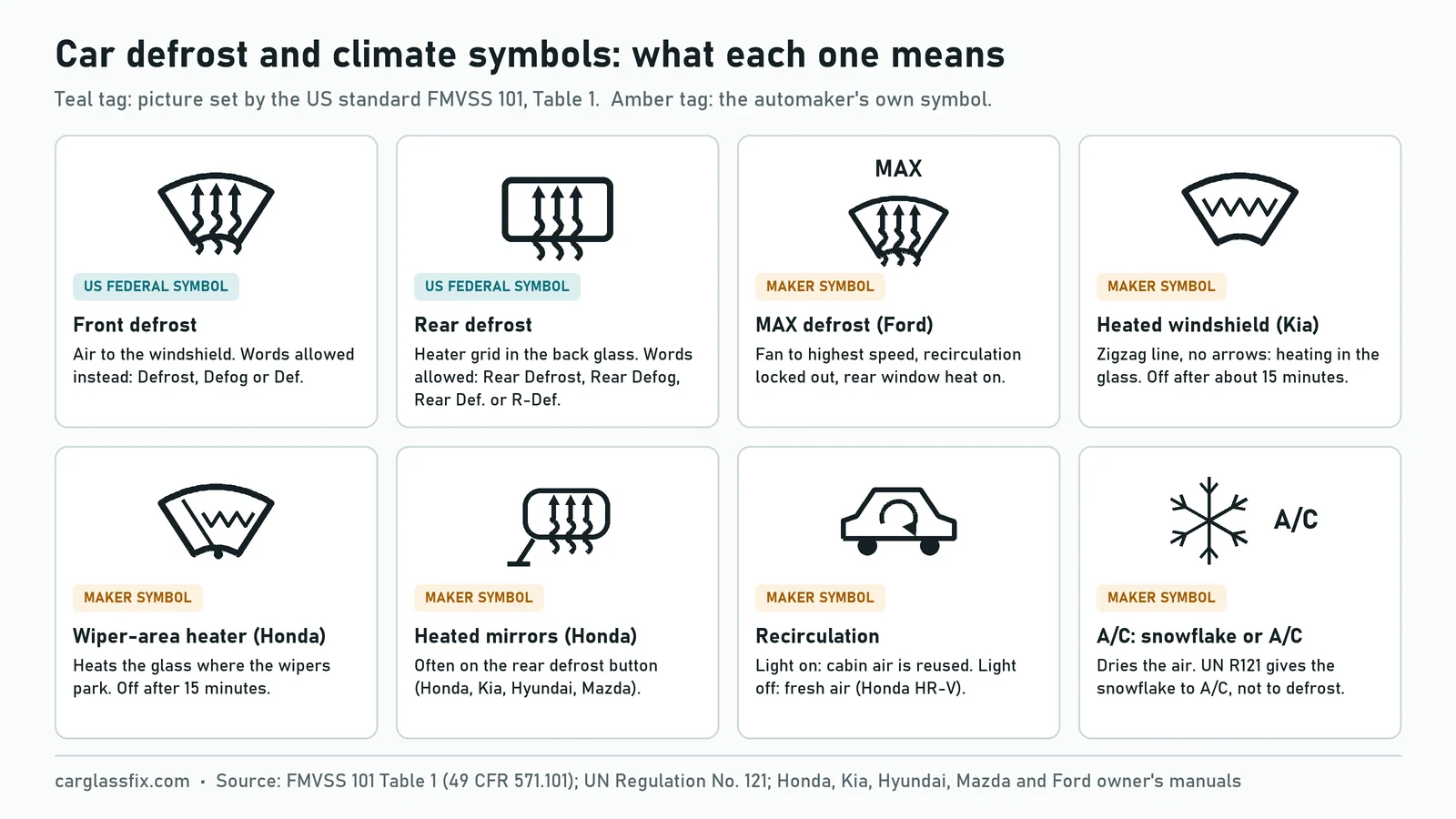
A climate panel mixes three federal symbols with symbols that each automaker designs. The federal ones are the windshield defroster, the rear window defroster and the fan. FMVSS 101 lets makers use any symbol for a control that its tables do not list. The chart shows the common symbols, redrawn from the federal table and from owner’s manuals.
| Symbol | What it looks like | What it does | Where it is documented |
|---|---|---|---|
| Front defrost | Windshield shape with three wavy arrows | Sends air to the windshield | FMVSS 101, Table 1 |
| MAX defrost | Front symbol with the word MAX | Ford: fan at highest speed, no recirculation, heated rear window on | Ford Expedition 2022 manual; Chevrolet support |
| Rear defrost | Rectangle with three wavy arrows | Heats the rear window | FMVSS 101, Table 1 |
| Rear defrost and mirrors | Rear symbol beside a small mirror with wavy arrows | Heats the rear window and the door mirrors together | Honda HR-V 2026 manual |
| Heated windshield | Windshield shape with a zigzag line and no arrows | Heats the windshield to clear frost, fog and thin ice | Kia Sportage 2024 manual |
| Wiper-area heater | Windshield shape with a wiper arm and a zigzag line | Heats the glass where the wipers park | Honda HR-V 2026 manual, Canadian models |
| Recirculation | Car outline with a curved arrow inside | Reuses cabin air while its light is on | Honda HR-V 2026 manual |
| A/C | Snowflake, or the letters A/C | Turns on the air conditioning, which dries the air | UN Regulation No. 121 |
| Fan | Fan blades | Sets the blower speed | FMVSS 101, Table 1 |
| Floor and defrost | Seated figure with air to the feet and a small windshield | Splits air between the floor and windshield vents | Honda HR-V 2026 and Kia Sportage 2024 manuals |
A snowflake marks the air conditioning. UN Regulation No. 121, the United Nations rule on control symbols, lists the snowflake or the letters A/C for that control. The same rule lets makers add an A or AUTO to a symbol to mark an automatic version of that function.
What the federal standard says about defrost symbols
FMVSS 101, the federal standard for controls and displays, sets the two defrost symbols for passenger cars, multipurpose vehicles, trucks and buses. A maker may label each control with the symbol from Table 1 or with the listed words. A symbol must be substantially similar in form to the table’s picture and keep its proportions. Extra words such as MAX, FRONT or REAR may appear next to it.
Both defrost labels must be able to light up whenever the headlamps are on. Controls on the floor console, steering wheel or steering column are exempt. A screen that runs several systems must show the table’s label whenever that function is active.
The federal defroster standard covers only the windshield. FMVSS 103 says each vehicle shall have a windshield defrosting and defogging system, and it sets no rear-window requirement.
NHTSA accepts close variants. In 1982 it let a supplier use the European symbols, whose arrows differed only in the number of curves. UN Regulation No. 121 uses the same two pictures and says its symbols are substantially identical to those in ISO 2575.
What the light on each button means
A light on or above a climate button shows that the function is switched on. Kia, Hyundai and Mazda manuals say the rear defroster indicator lights while the defroster runs. Mazda adds that the light turns off when you stop the defroster. This status light is separate from the backlight that lets you read the symbol at night.
Two lights are easy to misread. On the Honda HR-V, the recirculation light on means cabin air is being reused, and the light off means fresh air. Honda tells owners to keep fresh air mode in normal situations. The A/C light can also mislead. Ford says the A/C compressor may keep running during maximum defrost even after you switch the A/C off.
The electric heaters in the manuals checked run on timers, so a light that goes out by itself is normal on those cars. The timers differ by model.
| Vehicle and manual | Heater | Timer or automatic behavior |
|---|---|---|
| Honda HR-V 2026 | Rear defogger and heated door mirrors | Off after 10 to 30 minutes, by outside temperature; no automatic shutoff at 32°F (0°C) or below |
| Honda HR-V 2026 | Heated door mirrors | May turn on by themselves for 10 minutes below 41°F (5°C) |
| Honda HR-V 2026, Canadian models | Heated windshield at the wiper park area | Off after 15 minutes |
| Mazda CX-30 2024 | Rear window defogger, with the mirror defoggers and wiper de-icer | Off after about 15 minutes; the time can be changed |
| Kia K4 2026 | Rear window defroster and outside mirror defrosters | Off after about 20 minutes, or when the car is turned off |
| Kia Sportage 2024 | Front glass heater | Off after about 15 minutes; a second press then gives about 5 more minutes |
| Hyundai, 2026 manual | Rear window defroster and side mirror defrosters | Off after about 20 minutes, or when the engine is switched off |
Which button to press for which problem
Match the button to the glass and to what is on it. Fog and frost on the windshield call for the front defrost button. Fog or frost on the back glass calls for the rear button. Frozen wipers and icy mirrors need their own heaters, where the car has them.
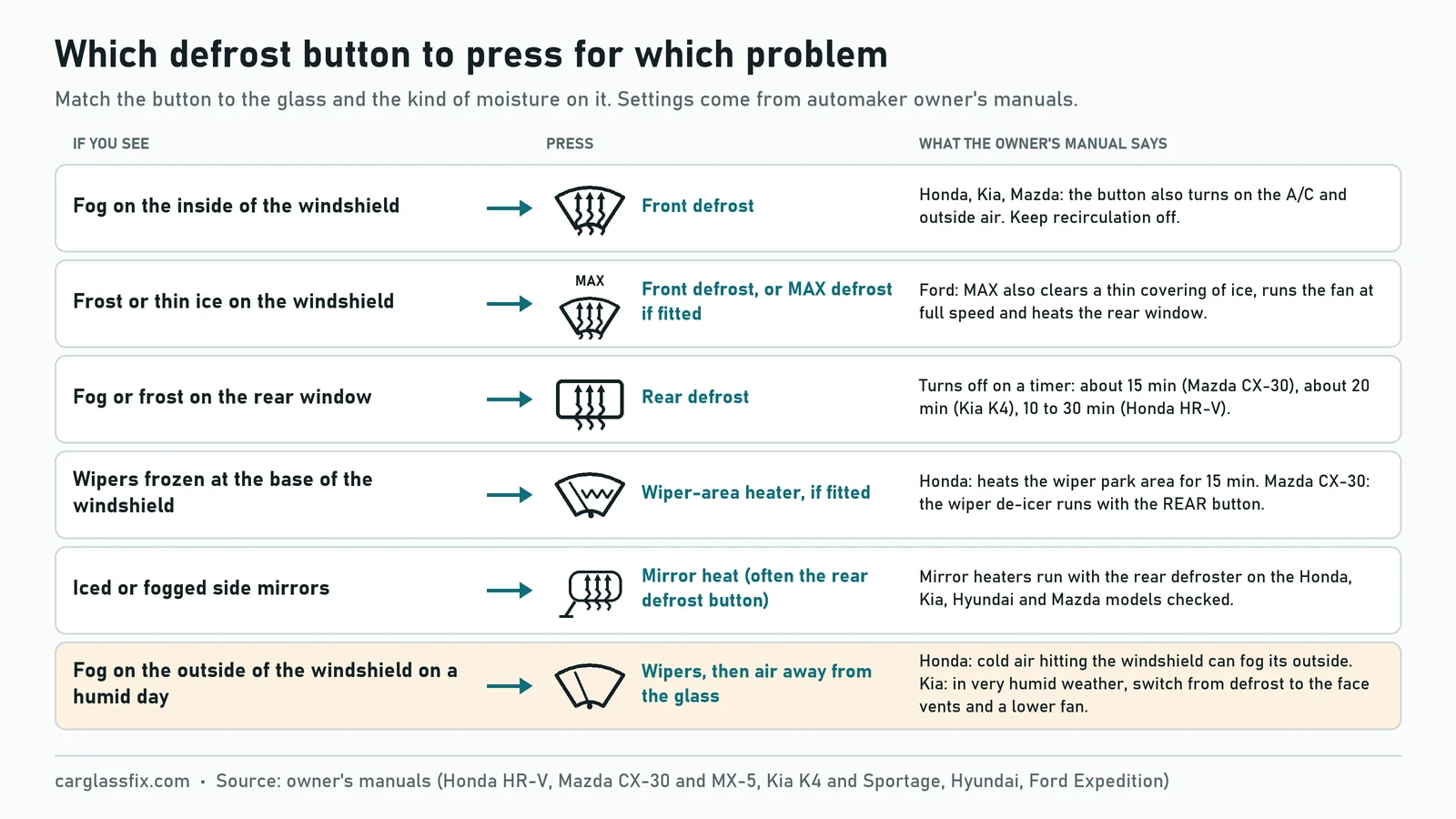
For fog on the inside of the windshield, press front defrost and keep recirculation off. The full sequence is in how to defog a windshield quickly. For frost and ice, Kia says maximum defrosting uses the hottest temperature and the highest fan speed. Scraping and de-icing are covered in how to make car window defrost.
Fog on the outside of the windshield needs a different response. Honda warns that cold air hitting the windshield can fog its outside surface. Kia says to switch from defrost to the face vents and lower the fan in very humid weather. The full steps are in how to fix windshield fog on the outside.
When the symbol lights up but the glass stays foggy
A lit symbol shows only that the switch is on. It does not prove that the glass is heating. Cars.com says that if the rear light comes on but nothing clears, the heated wires in the rear window may be broken. It adds that no light at all can point to a blown fuse. The checks for the grid are in why your rear windshield heater is not working.
A front symbol that lights while the air stays cold or weak is a separate fault. Its causes are covered in car windshield defroster not working. For a heated windshield that stops clearing, see how to repair a heated windshield.
Protect the rear grid while you check it. Kia says never to clean the rear window with sharp instruments or abrasive cleaners. Mazda warns against scratching the filaments when you wash the glass. Honda says the rear defogger uses a lot of power. Running it for a long time at idle can weaken the battery.
Frequently asked questions
Can I drive with the defrost on?
Yes. Chevrolet’s advice for keeping a windshield clear sends air to the windshield and floor, and Honda tells drivers to make sure they have a clear view through all the windows before driving. Honda also says the rear defogger uses a lot of power, so switch it off once the glass is clear.
How do I turn off the defrost in my car?
Press the same button again. On the Honda HR-V, a second press of front defrost also returns the climate system to its previous settings. The rear defrosters on the Honda, Mazda, Kia and Hyundai models checked also switch off by themselves after a set time.
Does the defrost button turn on the A/C?
It does on the Honda, Kia and Mazda models checked. Their manuals say the front defrost button turns on the air conditioning and selects outside air. Kia adds that its A/C turns on according to the outside temperature.
Is the snowflake symbol the defroster?
No. The snowflake marks the air conditioning. UN Regulation No. 121 lists the snowflake or the letters A/C for that control, and US rules leave the A/C label to the automaker.
Why does my rear defroster turn off by itself?
It runs on a timer. Mazda’s CX-30 stops after about 15 minutes, Kia’s K4 after about 20 minutes and Honda’s HR-V after 10 to 30 minutes, depending on the outside temperature.
Sources
- 49 CFR 571.101, FMVSS 101 Controls and displays, S5, S5.1.4, S5.2.1 to S5.2.3, S5.3.1 and Table 1 as amended by 90 FR 459, January 3, 2025 (checked 24 October 2026)
- 49 CFR 571.103, FMVSS 103 Windshield defrosting and defogging systems (checked 24 October 2026)
- NHTSA interpretation 1982-3.34, letter to Tokai Rika on the defrost symbols (December 14, 1982)
- UN Regulation No. 121, location and identification of hand controls, tell-tales and indicators (copy published by Japan’s Ministry of Land, Infrastructure, Transport and Tourism), Table 1 and paragraph 5.2.10 (checked 24 October 2026)
- Honda HR-V 2026 Owner’s Manual: Using Automatic Climate Control, Rear Defogger/Heated Door Mirror Button and Heated Windshield Button
- Mazda CX-30 2024 Owner’s Manual: How to Use the Rear Window Defogger Switch, warnings, mirror defogger and windshield wiper de-icer; Mazda MX-5 2023: Windshield Defrosting and Defogging
- Kia Owner’s Manuals: K4 2026, Defroster; Sportage 2024, Front glass heater, Windshield defrosting and defogging and Defogging inside windshield
- Hyundai Owner’s Manual (2026): Rear Window Defroster
- Ford Expedition 2022 Owner’s Manual: Switching Maximum Defrost On and Off
- Chevrolet Vehicle Support: How to Quickly Defog the Windshield
- Cars.com: How Does a Car Defroster Work? (September 28, 2025)

Similar Posts