How to Fix Scratches on a Car Side Window
Senior Automotive Glass Diagnostic Specialist & Master Technician at CarGlassFix · AGSC Master Certified Auto Glass Technician, NGA Certified Installer, I-CAR Automotive Safety Specialist · 12+ Years in Automotive Glazing, Windshield Structural Bonding, ADAS Camera Calibration & Precision Chip Restoration
Light scratches on a car side window can be polished out with cerium oxide if a fingernail does not stop in them. A scratch that stops a fingernail usually means a new window. Vertical scratches along the window’s travel usually come from grit in the door’s belt seal, so the seal needs cleaning or replacing first.
Can scratches on a car side window be fixed?
Yes, shallow scratches can be fixed by polishing, and deep ones usually cannot. The fingernail test tells the two apart. Drag a fingernail across the scratch. The C.R. Laurence (CRL) training manual for its glass scratch removal system sorts scratches by how they feel, and the table follows its categories.
| Scratch type (CRL) | How it feels and looks | Usual fix |
|---|---|---|
| Rub | Barely felt with a finger, grayish | Polish; the quickest job |
| Light scratch | Felt with a finger, does not stop a fingernail | Polish |
| Average to medium | White inside the scratch; a medium scratch catches a fingernail | Polish with a machine system; takes longer |
| Heavy to deep | A cut into the glass with rough edges; stops a fingernail | Often a new window |
Jaguar uses a similar rule in a 2016 dealer bulletin for the F-TYPE. If a plastic tool slid across the glass can feel the scratch, the dealer replaces the door glass. If it cannot, the dealer polishes the glass with a polishing compound and a cloth. CRL says deep scratches can give good results with its equipment. It adds that the work may cost more than a new piece of glass. For the windshield version of this decision, see how to remove scratches from a car windshield at home.
Why side windows scratch: grit in the belt seal and run channel
Most door window scratches that run straight up and down come from grit trapped against the glass as it moves. The window slides past a rubber and felt strip at the bottom of the window opening, called the belt seal or belt molding. Its upper edges run in a channel lined with felt, called the run channel.
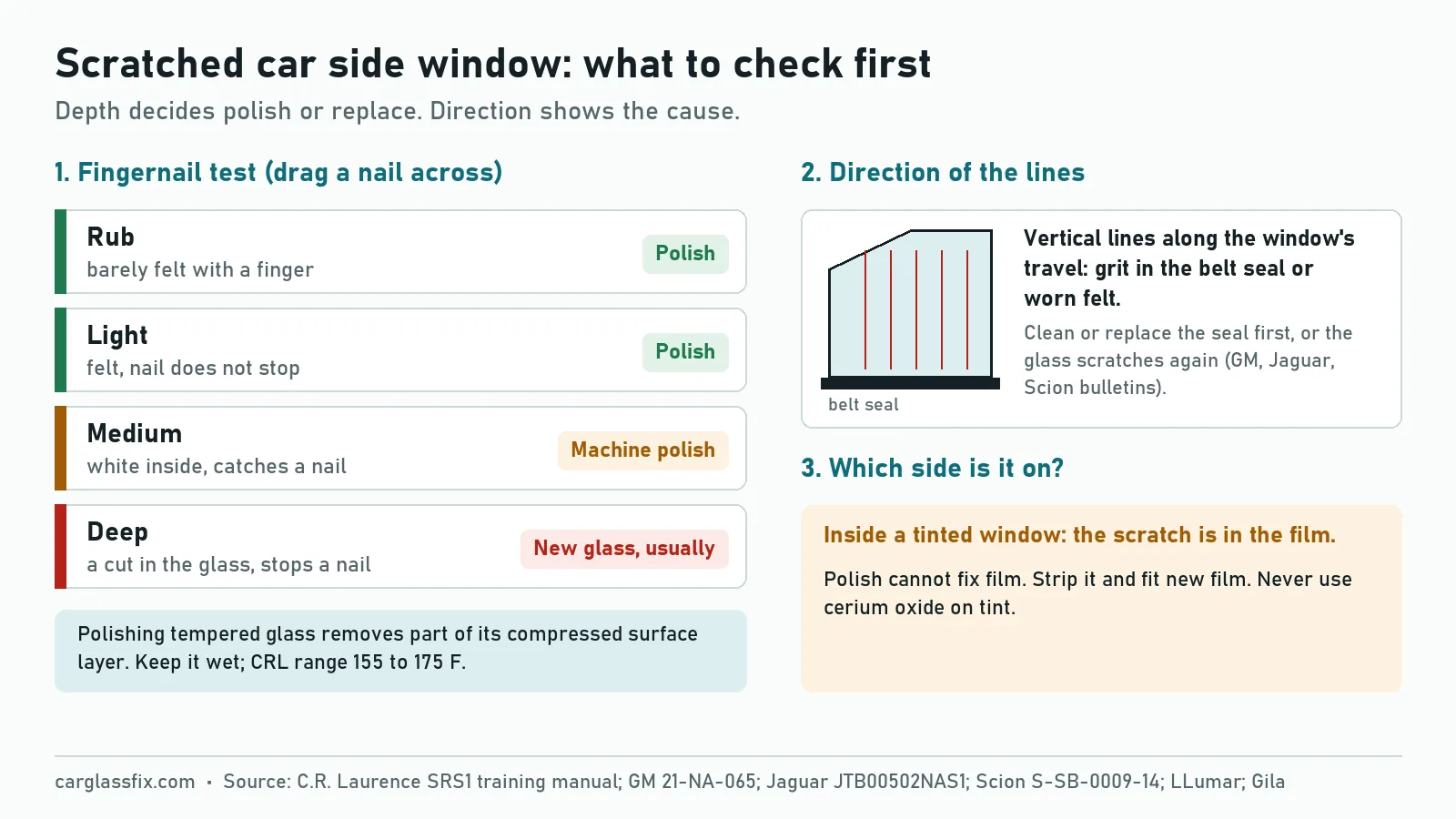
Automakers have written dealer bulletins about this exact problem. The direction of the scratch is the clue.
| Bulletin | Vehicles | What it says causes the scratches | Fix in the bulletin |
|---|---|---|---|
| GM 21-NA-065 (April 2021) | 2020-2021 Buick Encore GX, 2021 Chevrolet Trailblazer | Vertical scratches parallel to the B-pillar trim are likely debris in the outer belt seal | Glass may be a warranty item if the car is washed; scratches in other directions count as damage |
| Jaguar JTB00502NAS1 (June 2016) | F-TYPE, 2014 onward | Seal design lets grit get trapped between glass and seal | New outer waist seal; polish or replace the glass by the feel test |
| Toyota/Scion S-SB-0009-14 Rev2 (2014) | 2013-2014 Scion FR-S | Felt on worn window stabilizers and guides | New outer weatherstrip and glass stabilizers |
Scratches in random directions point elsewhere. CRL lists wiper rubs, tree branches, ice scrapers and handling damage as the usual causes of auto glass damage.
Fix the seal before you polish the glass
Polishing a door window without fixing the seal leaves the same grit to scratch it again. The glass passes the belt seal every time the window goes up or down. GM’s bulletin notes that the owner’s manual recommends frequent washing. It treats a car that is not washed and is exposed to excessive dirt as not covered for scratched glass.
Start by looking at the strip along the bottom of the window opening and the felt in the window frame. Signs of a problem include grit packed into the felt, a torn or loose strip, or felt that has pulled away from its backing. The Scion bulletin describes felt on the window stabilizers that can freeze to the glass or detach from its plastic backing and damage the window. In each bulletin above, the dealer fix replaced the seal or the felt parts.
A window that drags or squeaks is a related sign. Its causes and fixes are in why side glass is hard to roll up. Track care is covered in how to lubricate car window tracks. If your car is still under warranty and the scratches run vertically, ask the dealer whether a bulletin applies. NHTSA’s website lists manufacturer bulletins by vehicle.
How to polish a light scratch out with cerium oxide
Cerium oxide is the polishing powder used in glass polish kits, and it works on light scratches. Lee M. Cook’s 1990 review of glass polishing describes ceria’s action as chemical as well as mechanical. The steps below follow the cerium oxide instructions from Glass Polish, a maker of glass scratch removal kits, with the heat limits from CRL. Work on the outside of the glass only, and only on untinted glass.
How to polish a light scratch out of a car side window
Confirm the scratch is light
Drag a fingernail across it. If the nail stops in the scratch, polishing at home is unlikely to remove it.
Clean the glass
Wash the area so no dust or grit is left. Loose grit under the pad makes new scratches.
Mask the area
Tape off the paint and seals around the window. CRL says compound soaks into porous materials.
Mix the paste
Glass Polish mixes 4 parts cerium oxide to 1 part water. Less water makes a more abrasive paste.
Start the pad flat
Put about half a teaspoon on a felt pad. Start the drill at about 1,000 rpm with the pad flat on the glass.
Polish and keep it wet
Spread the paste, then run at 1,500 to 2,500 rpm with moderate pressure. Mist with water as the paste dries.
Watch the heat
Stop often and check the glass with the back of your hand. CRL’s range for tempered glass is 155 to 175 F.
Clean and inspect
Wipe the area clean and look at it under good light. Repeat if the scratch is lighter but still visible.
Glass Polish also gives a hand method with a microfiber cloth or applicator pad in overlapping circles. It says a machine gives better results when hand rubbing does not work. For product choices, see the best car glass polishing compound guide.
Polishing limits on tempered side glass
Polishing removes glass, and on tempered glass that costs strength. Most car side windows are tempered. CRL notes that side, back and roof glass is normally tempered but sometimes laminated. When the type is not clear, CRL tells technicians to check the mark printed in the corner of the glass or ask the maker. The differences are covered in laminated glass vs tempered glass.
Tempered glass gets its strength from a thin layer of compression at each surface. A 2017 paper from the RCI convention by Schmidt, Morse, Norville and Caldwell measured what polishing does to that layer. The paper studied 1/4-inch tempered building glass, which is thicker than most car side glass, so its numbers show the direction of the effect, not a limit for cars.
| Glass removed by polishing | Surface compression left (redistribution estimate) | Surface compression left (simple estimate) |
|---|---|---|
| None (starting value) | 13,000 psi | 13,000 psi |
| 0.003 in (shallow blemish) | About 12,600 psi | About 11,900 psi |
| 0.009 in (deep blemish) | About 12,000 psi | About 9,900 psi |
The authors found that measured losses were often larger than either estimate. They note that no research predicts the strength loss well. They recommend test pieces first because polishing can cause distortion. CRL also warns that too much heat can distort or break the glass.
Scratches in window tint film need new film
A scratch in tint film is a scratch in the plastic, so polishing the glass cannot remove it. LLumar says auto tint is typically applied to the interior glass surfaces. Gila says its automotive tint goes on the inside surface. Run a fingernail over the inside of the window to find out whether the scratch is in the film.
Cerium oxide and abrasive pads will damage the film. CRL tells technicians to check for factory or aftermarket tint before polishing, because tint can affect whether a scratch can be removed. The 3M Hong Kong warranty terms say abrasive cleaners and bristle brushes that would scratch the film must not be used. None of the film makers’ pages we checked describes a way to repair a scratch in installed film. Gila notes that adhesive film cannot be put back on once it is removed. The fix is to strip the film and install a new piece.
New film needs time before the window is used. Madico says to keep the windows up for two to four days. Gila says not to roll them down while the film cures, which takes a week to 10 days. More on film damage is in how to remove scratches from car window tint.
When to replace the side window instead
Replace the window when the scratch stops a fingernail or when polishing would leave distortion. CRL warns that distortion matters most in the driver’s line of sight. CRL also says restoring a deep scratch may cost more than replacing the glass. Jaguar’s bulletin replaces any door glass whose scratches a plastic tool can feel.
A new side window must meet the federal glazing standard. FMVSS 205 says glass sold for aftermarket replacement has to meet the same standard as factory glass. The maker certifies it by printing “DOT” and an NHTSA-assigned code next to the other marks. Check for that mark before the new glass goes in.
Replace the belt seal or felt at the same time if it caused the scratches. Otherwise the new glass meets the same grit. If the car is new enough to be under warranty, photograph the scratches from the side with the B-pillar edge in view, as GM’s bulletin asks its dealers to do. The removal and fitting steps are in how to replace a car side window glass. Rear glass scratched by a wiper is a different job, covered in how to fix rear windshield wiper scratches.

Frequently asked questions
How do you get fine scratches out of car windows?
Polish them with a cerium oxide paste on a felt pad, keeping the glass wet and cool. Fine scratches that do not stop a fingernail are the type that polishing can remove.
Can toothpaste remove scratches from car glass?
No glass maker or automaker we found recommends toothpaste for glass scratches. Glass restoration tools use cerium oxide compounds, and CRL’s system relies on heat, compound and pressure.
Why does my car door window have vertical scratches?
Vertical scratches along the window’s travel are usually grit trapped in the belt seal at the bottom of the window. GM and Jaguar bulletins both trace them to the seal, so clean or replace it before polishing the glass.
Can a scratched side window be repaired with resin?
Resin repair follows ROLAGS, the Repair of Laminated Automotive Glass Standard, which covers chips and cracks in laminated glass, not scratches. A side window scratch is either polished out or the glass is replaced. See whether a cracked or broken side window can be repaired.
Is a scratch on the inside of a tinted window in the glass or the film?
On a car with aftermarket tint, a scratch on the inside surface is almost always in the film, since tint goes on the inside of the glass. Film scratches cannot be polished out and need new film.
Sources
- C.R. Laurence: Glass Scratch Removal System Training Manual
- GM Service Bulletin 21-NA-065: Warranty Coverage of Scratched Door Window Glass (NHTSA copy)
- Jaguar Land Rover North America Technical Bulletin JTB00502NAS1: Vertical Scratches On Door Windows (NHTSA copy)
- Toyota Motor Sales USA, Scion S-SB-0009-14 Rev2: Outside Door Weatherstrip, Multiple Concerns (NHTSA copy)
- Glass Polish: How to use Cerium Oxide Powder for Glass Polishing
- Schmidt, Morse, Norville and Caldwell: Structural Assessment of Glass Restoration (RCI, 2017)
- Cook, L. M.: Chemical processes in glass polishing, Journal of Non-Crystalline Solids 120 (1990)
- 49 CFR 571.205, FMVSS 205: Glazing materials (checked 29 October 2026)
- LLumar: Automotive Window Tint FAQ
- Gila: Automotive Frequently Asked Questions
- Madico: How to Take Care of Vehicle Film
- 3M Hong Kong: Crystalline Automotive Window Film Warranty Terms
- ANSI/AGSC/NWRD/ROLAGS 002-2022, Repair of Laminated Automotive Glass Standard (title only)
- NHTSA: Recalls and manufacturer communications lookup

Similar Posts