How to Lubricate Car Window Tracks: What Automakers Use
Senior Automotive Glass Diagnostic Specialist & Master Technician at CarGlassFix · AGSC Master Certified Auto Glass Technician, NGA Certified Installer, I-CAR Automotive Safety Specialist · 12+ Years in Automotive Glazing, Windshield Structural Bonding, ADAS Camera Calibration & Precision Chip Restoration
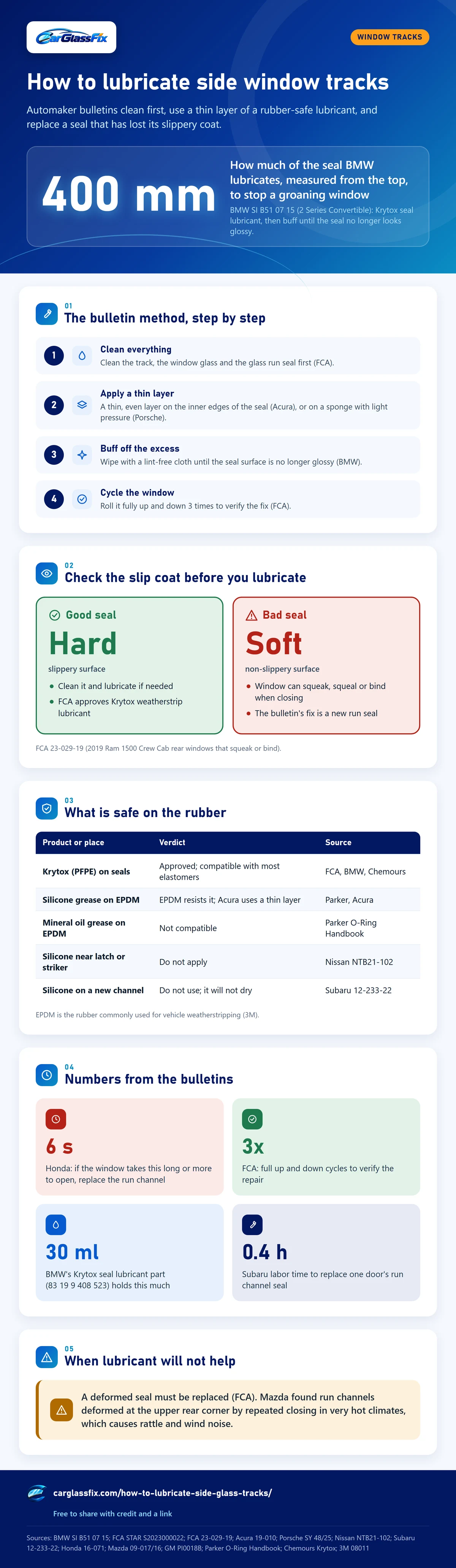
To lubricate car window tracks, clean the rubber glass run channel and the glass, then wipe a thin layer of a lubricant made for weatherstrip onto the channel edges. FCA and BMW specify a Krytox weatherstrip lubricant, and Acura uses silicone grease. Cycle the window, buff off the excess and keep silicone away from the door latch.
What the window track on a car door is
The window track on a car door is the glass run channel, a rubber seal that guides the glass along its front, top and rear edges. Automakers call it the glass run channel, run channel seal or glass run rubber. Most door weatherstrip is EPDM rubber, which 3M’s weatherstrip adhesive data sheet describes as commonly used for vehicle weatherstripping. The channel is not bare rubber where it touches the glass. FCA’s bulletin 23-029-19 for the 2019 Ram 1500 tells technicians to check the channel for a slip coat layer. A hard, slippery surface is good, and a soft surface that is not slippery is bad. Subaru’s bulletin 12-233-22 for the 2019 to 2021 Forester added a new surface material to the channel to reduce friction with the glass. The regulator, the lifting mechanism inside the door, is a separate part with its own lubricant. This page covers the rubber channel. Replacing a torn or worn channel is a different job, covered in the guide on how to replace rubber trim on a car side window.
Which lubricant automakers specify for window tracks
Automakers specify a weatherstrip lubricant for the run channel, and the products they name are a Krytox lubricant or a silicone grease. FCA’s STAR case S2023000022 for slow and noisy windows says that if lubricant is needed, technicians use Mopar part 04773427AB or 05019059AB, which FCA calls an approved Krytox lubricant for weatherstrip.
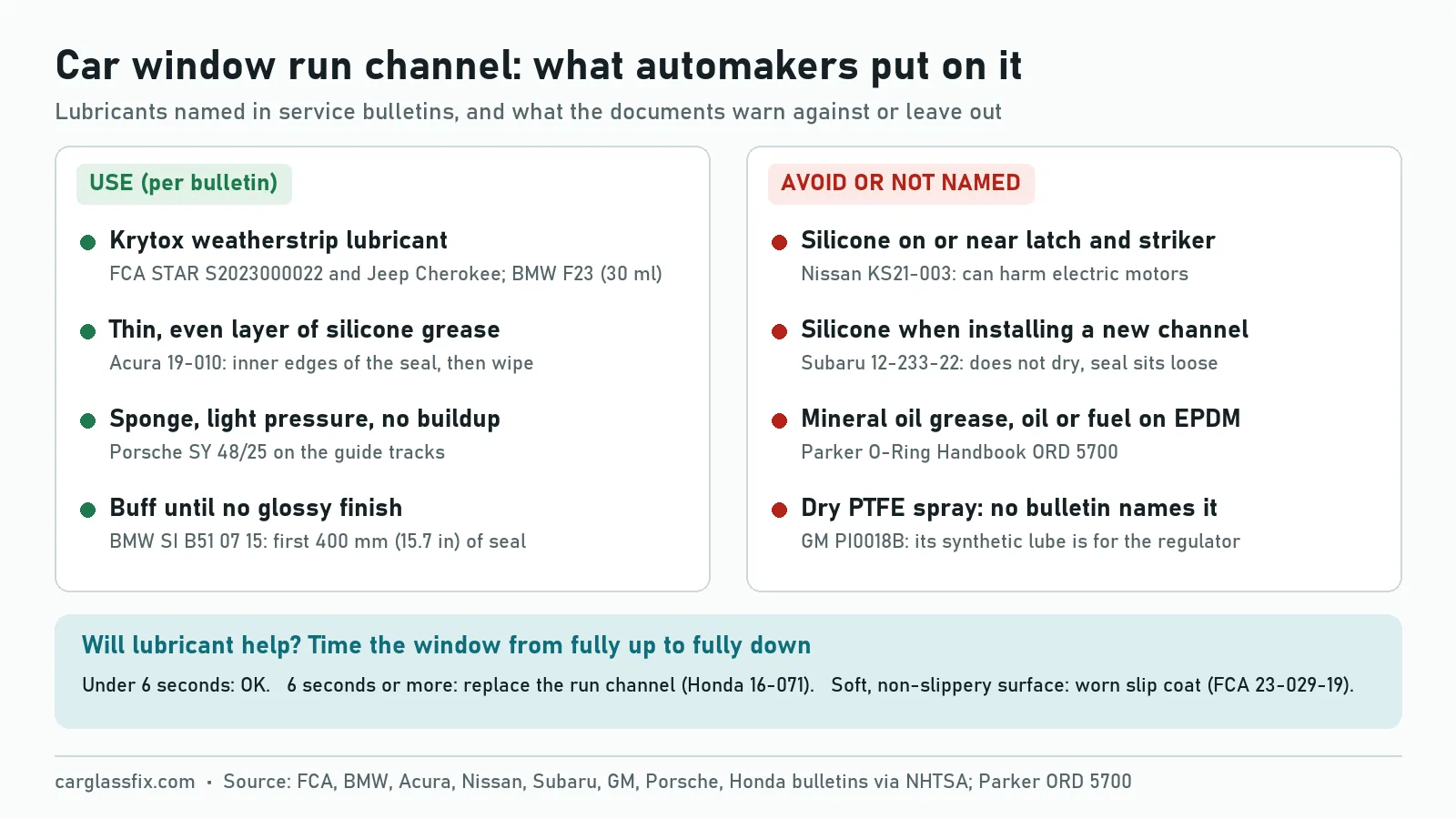
Chemours, the maker of Krytox, describes its oils and greases as perfluoropolyether (PFPE) based and not petroleum based. Its automotive overview lists window guides and weatherstrips among the uses. The table shows what each document names and where it goes.
| Document | Vehicle | Lubricant named | Where it goes |
|---|---|---|---|
| FCA STAR S2023000022 (April 2020) | FCA vehicles | Mopar Krytox weatherstrip lubricant | Glass run seal, only if needed |
| FCA GPOP 9004247 (April 2020) | 2018 to 2020 Jeep Cherokee | Same Mopar Krytox lubricant | Glass run window seal |
| BMW SI B51 07 15 (May 2015) | 2 Series Convertible (F23) | Seal lubricant, 30 ml Krytox | First 400 mm (15.7 in) of the door seal near the A-pillar |
| Acura 19-010 (April 2019) | 2017 NSX | Shin-Etsu silicone grease | Inner edges of the door outer seal |
| GM PI0018B (November 2013) | 2008 to 2014 GM cars and light trucks | GM synthetic multi-purpose lubricant | Window regulator, if required |
| Porsche SY 48/25 (July 2025) | 911 (992) Cabriolet | Isoflex Topas L32 N grease | Power window guide tracks, applied with a sponge |
Silicone, dry PTFE or grease: what not to use
Silicone is acceptable on the rubber channel in small amounts, petroleum grease is not, and none of the bulletins reviewed for this guide names a dry PTFE spray for the channel. Parker’s O-Ring Handbook lists EPDM as resistant to silicone oil and grease. The same handbook says EPDM is not compatible with mineral oil products, including oils, greases and fuels. Automakers still limit silicone. Nissan’s bulletin KS21-003 says not to apply silicone-based lubricant to or around the door latch or striker. Nissan also says to use it sparingly on glass runs, because overspray can reach the door lock actuator and silicone can harm electric motors. Subaru’s Forester bulletin says not to use any silicone-based lubricant when installing a new channel seal. Subaru explains that silicone does not dry and can leave the seal loose in its channel. Subaru uses glass cleaner as the installation lubricant instead, and FCA uses soapy water for the same job. GM’s bulletin lists its synthetic multi-purpose lubricant “w/PTF” for the regulator, not for the rubber. A dry lube spray that lists window tracks on its label is a maker’s claim, so test it on a small hidden area first, as WD-40 advises for its Specialist products.
| Product type | On the rubber run channel | Source |
|---|---|---|
| Krytox (PFPE) weatherstrip lubricant | Named by FCA and BMW | FCA S2023000022, BMW SI B51 07 15 |
| Silicone grease or spray | Thin layer or sparingly; never near the latch or striker | Acura 19-010, Nissan KS21-003 |
| Silicone during new channel installation | Not used; Subaru uses glass cleaner, FCA soapy water | Subaru 12-233-22, FCA 23-031-20 |
| Petroleum (mineral oil) grease or oil | Not compatible with EPDM | Parker ORD 5700 |
| Dry PTFE spray | Not named for the channel in the bulletins reviewed | Product label only |
How to lubricate car window tracks step by step
The steps below follow the order used in the FCA, Acura, BMW, Nissan and Porsche documents. Bulletins are written for trained technicians, and the owner’s manual or a dealer is the place to confirm what fits a specific car. Nissan writes its bulletins for qualified technicians, not do-it-yourselfers, and Subaru says not to assume that a bulletin applies to a given vehicle. The steps keep to the parts of each procedure that work from the open window, without removing the door panel.
How to lubricate a car window run channel
Time the window first
Run the window from fully up to fully down and note the time. Honda uses this check, and a result of 6 seconds or more points to a channel that needs replacing.
Inspect the channel
Lower the glass and look along the channel for tears, a rolled lip or a soft surface. FCA treats a soft, non-slippery surface as a failed slip coat.
Clean the channel and the glass
Remove dirt and debris from the channel, the glass and the track, as FCA’s slow-window case instructs.
Shield the latch area
Keep silicone off the door latch and striker, as Nissan instructs. Nissan warns that overspray can reach the lock actuator, so apply it with a sponge or cloth, the way Porsche applies its grease.
Apply a thin, even layer
Wipe the lubricant onto the inner edges of the channel. Acura specifies a thin, even layer, and Porsche applies its grease with a sponge and light pressure to avoid buildup.
Cycle the window
Raise and lower the glass several times to spread the lubricant. FCA verifies its repairs by running the window fully up and down three times.
Wipe off the excess
Remove any lubricant left on the glass or seal with a clean lint-free cloth. BMW buffs until the seal no longer has a glossy finish.
Retest
Time the window again. If it still takes 6 seconds or more, or the noise returns, the channel needs inspection or replacement.
A tear, a rolled lip or a soft surface found at the inspection step means lubricant is not the fix. FCA and Subaru replace the channel in those cases rather than lubricate it. Acura does its final wipe with the window raised, so the glass that passed through the channel is clean.
How to stop a side window from squeaking
A side window that squeaks is usually glass rubbing on the run channel or door seal, and automakers fix it by cleaning and lubricating the seal or replacing it. FCA’s GPOP 9004247 for the 2018 to 2020 Jeep Cherokee covers glass that squeaks when rolling up or down. It first checks that the glass sits inside the run seal and that the seal is clean. It then cleans the track, glass and seal, reseats the glass and replaces the seal only if it is deformed. If lubricant is needed, it uses the same Krytox weatherstrip lubricant. BMW’s bulletin for the 2 Series Convertible traces a groaning noise to the door seal rubbing the glass near the A-pillar. BMW cleans the seal and lubricates the first 400 mm (15.7 in) from the top on both front doors. Subaru took a different route for the 2019 to 2021 Forester and replaced the channel with a lower-friction version. A rattle when the window is down or a whistle at speed has other causes, covered in the guides on how to fix rattling side glass and whether side glass can cause wind noise.
When lubrication will not fix a slow window
Lubrication will not fix a slow window when the channel is worn, deformed or torn, or when the fault is in the regulator, motor or glass alignment. Honda’s bulletin 16-071 for the 2016 Pilot names friction from the glass run channel as the cause of slow windows. Its fix is a new channel, not lubricant. FCA’s slow-window case found no failures in returned motors and mechanisms, and its last step is a new run seal if the window still moves slowly. Mazda’s bulletin 09-017/16 for the 2007 to 2015 CX-9 describes channels deformed at the upper rear corner by repeated closures in very hot climates. Mitsubishi’s bulletin TSB-16-42A-001 found that too much glass free play between the front and rear channels makes the glass chatter or bind and can damage the regulator. The full list of causes and tests is in the guide on why a car window is hard to roll up. Glass that sits crooked in its frame is covered in how to fix misaligned side glass.
Frequently asked questions
What is the best lubricant for car window tracks?
No single product is named by every automaker. FCA and BMW specify a Krytox weatherstrip lubricant for window seals, and Acura uses a thin layer of silicone grease on the seal edges.
Can I use WD-40 on car window tracks?
None of the automaker bulletins reviewed for this guide names WD-40 for the run channel, and each names its own lubricant. WD-40 says its Specialist Silicone is safe on most rubbers when used as directed and advises testing on a small area first.
Can I use grease on car window seals?
Petroleum grease is the wrong choice for rubber seals. Parker’s O-Ring Handbook says EPDM, the common weatherstrip rubber, is not compatible with mineral oil greases, while it resists silicone grease.
Is silicone spray safe for window seals?
Silicone is used on seals by Acura and allowed sparingly by Nissan, but Nissan says to keep it off the door latch and striker because silicone can harm electric motors. Seal care beyond lubrication is covered in the guide to car window glass seal rubber.
How do I know if the run channel needs replacing instead?
Honda’s test times the window from fully up to fully down, and 6 seconds or more means a new channel. A torn channel, a rolled lip or a soft surface without its slip coat also needs replacing, as described in how to replace rubber trim on a car side window.
Sources
- FCA STAR case S2023000022, Window Slow To Raise Or Lower May Be Noisy (April 9, 2020), via NHTSA
- FCA GPOP 9004247, Glass Run Window Seal, 2018-2020 Jeep Cherokee (April 1, 2020), via NHTSA
- FCA bulletin 23-029-19, Rear Windows Squeaks or Binds When Closing, 2019 Ram 1500 (October 9, 2019), via NHTSA
- FCA bulletin 23-031-20, 2020 Dodge Journey run channel (November 14, 2020), via NHTSA
- BMW SI B51 07 15, Groaning Noise from Front Door Window Glass, F23 (May 2015), via NHTSA
- Acura service bulletin 19-010, Chatter or Rattle Near the Door Tweeter, 2017 NSX (April 27, 2019), via NHTSA
- Nissan KS21-003 / NTB21-102, Silicone Lubricant Can Damage Door Lock Actuator Motors (October 27, 2021), via NHTSA
- Subaru service bulletin 12-233-22, Squeak Sound During Front Window Operation, 2019-21 Forester (February 11, 2022), via NHTSA
- GM preliminary information PI0018B, side door window binds, moves slowly or squeaks (November 2013), via NHTSA
- Porsche SY 48/25, 911 (992) Cabriolet rear side window (July 2025), via NHTSA
- Honda service bulletin 16-071, 2016 Pilot windows move slowly (August 30, 2016), via NHTSA
- Mazda service bulletin 09-017/16, Rattle and/or Wind Noise from Front Door Glass Area, 2007-2015 CX-9 (March 17, 2016), via NHTSA
- Mitsubishi TSB-16-42A-001, Improper Door Glass Function, 2013-15 Outlander Sport/RVR (October 2016), via NHTSA
- Parker Hannifin, O-Ring Handbook ORD 5700, Ethylene Propylene Rubber (checked October 29, 2026)
- 3M Weatherstrip Adhesive 08011 data sheet
- Chemours, Krytox Performance Lubricants: Solutions for the Automotive Industry
- Chemours, Krytox lubricants compatibility data
- WD-40 Specialist Silicone Lubricant product page

Similar Posts