Does Car Glass Replacement Affect Resale Value?
Senior Automotive Glass Diagnostic Specialist & Master Technician at CarGlassFix · AGSC Master Certified Auto Glass Technician, NGA Certified Installer, I-CAR Automotive Safety Specialist · 12+ Years in Automotive Glazing, Windshield Structural Bonding, ADAS Camera Calibration & Precision Chip Restoration
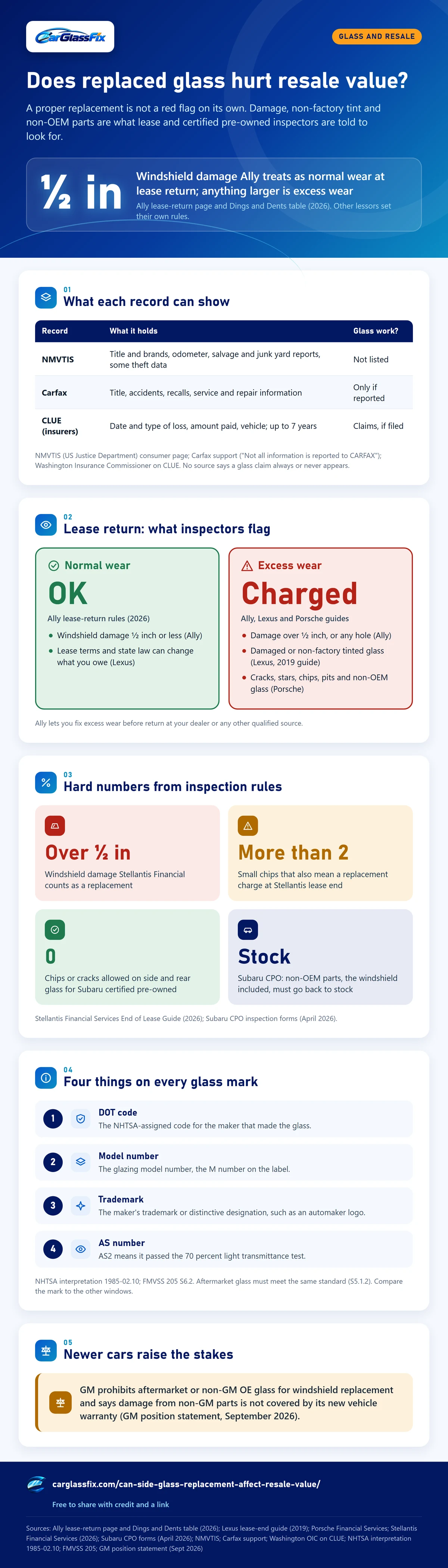
Car glass replacement does not lower resale value by itself, and no lender, automaker or valuation guide reviewed here publishes a deduction for it. Value suffers when an inspector finds damage left unrepaired, non-OEM glass on a car whose lease or certification rules demand factory glass, mismatched tint, or a skipped camera calibration. Keep the invoice and calibration report.
Does replacing car glass hurt resale value?
Replacing car glass does not reduce resale value on its own, because a correctly installed replacement leaves no defect for an appraiser to price. No automaker, lender or valuation guide reviewed for this article publishes a deduction for a replaced window. What lenders and certification programs do publish are rules about the glass that ends up in the car. Those rules decide whether a replacement is neutral or costs money later.
Three situations create a real cost. The first is damage left in place, since lease guides treat chips and cracks above a set size as chargeable wear. The second is glass that does not match the factory part on a car whose contract or program requires original equipment. The third is a replacement that broke something else, such as a windshield camera that was never recalibrated. For a private sale of an older car, no published rule asks who made the glass. On a newer, leased or certified car, the details below matter more. For the general trade-offs between brands of glass, see OEM vs aftermarket glass for car replacement.
Who checks replaced glass, and what they look for
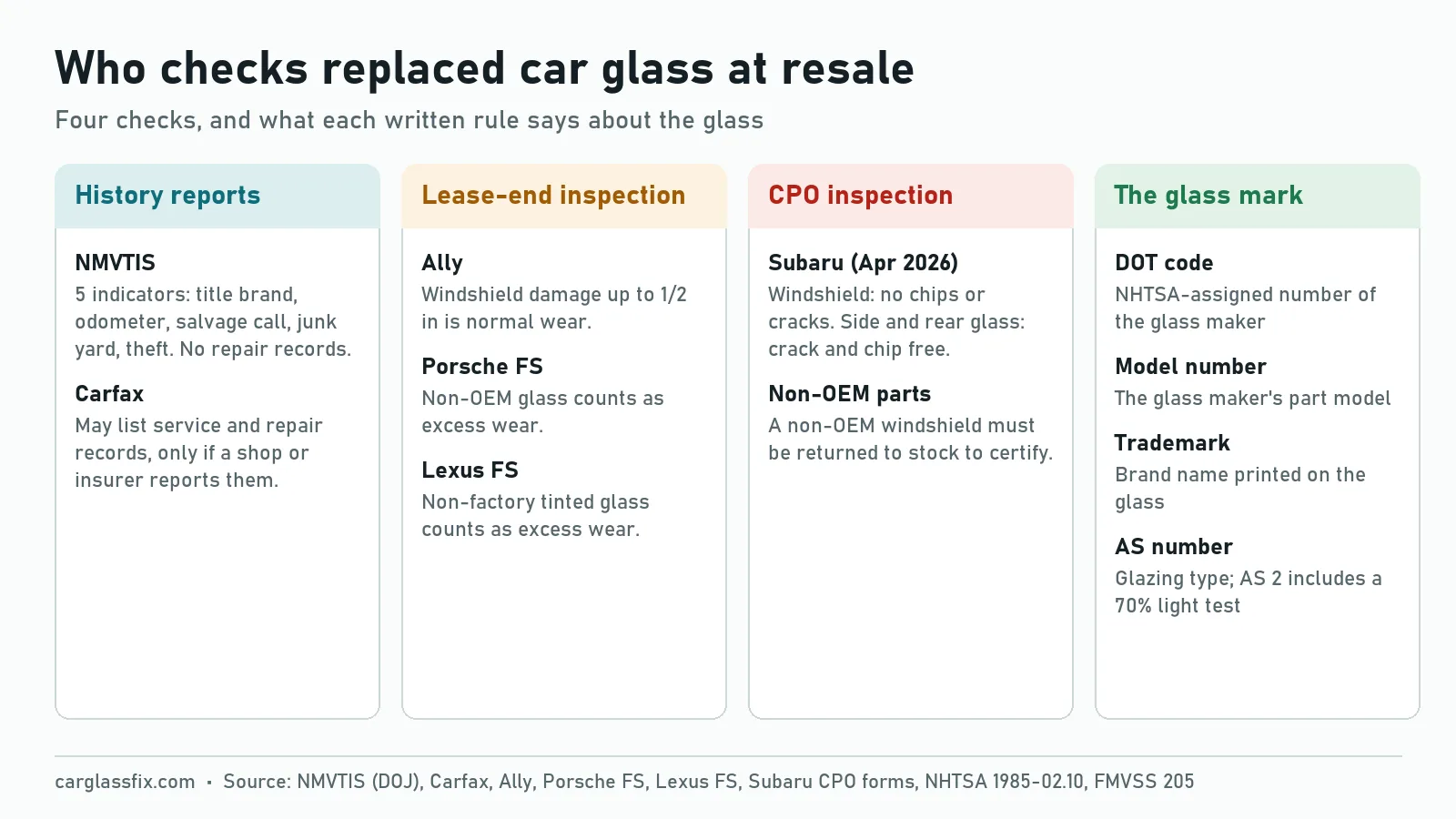
Four groups look at the glass when a car changes hands: vehicle history databases, lease-end inspectors, certified pre-owned (CPO) inspectors and the buyer. Each one checks something different, and only two of them have written rules about glass.
| Who checks | What the written rule says about glass | Source |
|---|---|---|
| NMVTIS (federal title database) | Holds title brands, odometer readings, insurer salvage calls, junk and salvage yard reports and some theft data. No repair records. | U.S. Department of Justice, NMVTIS |
| Carfax report | Can include “service and repair information”, but only what shops, insurers and others report to Carfax. | Carfax support |
| Ally lease return | Windshield damage up to 1/2 inch is normal wear. Replacement parts that do not meet the maker’s specifications, and tinted or engraved glass, are excess wear or modifications. | Ally lease-return page and Dings and Dents table (2026) |
| Porsche lease return (US) | Cracks, stars, chips, pits and non-OEM glass are excess wear. | Porsche Financial Services |
| Lexus lease return | Windshield cracks, stars or bullseyes, and damaged, broken or non-factory tinted glass are examples of excess wear. | Lexus Financial Services (2019) |
| Subaru CPO inspection | Windshield with no chips or cracks, side and rear glass crack and chip free, and no non-OEM parts, including the windshield. | Subaru CPO inspection forms (April 2026) |
A private buyer has no rulebook. They usually see the glass mark, the fit of the moldings and any distortion, and they may run a history report. The other sections cover each of these checks.
Windshield replacement and trade-in or resale value
A windshield replacement keeps trade-in value when the new glass is clear, correctly marked, sealed and calibrated to the car’s cameras. The windshield gets more scrutiny than side glass because it carries driver assistance cameras on many newer cars. GM’s collision position statement of September 18, 2026 says GM “does not approve and strictly prohibits” aftermarket or non-GM glass for windshield replacement. The same statement requires a calibration whenever the windshield is removed and replaced. It also says damage caused by non-GM parts is not covered by the GM New Vehicle Limited Warranty. BMW and MINI issued statements in 2026 that do not approve aftermarket or salvage windshields, as reported by Repairer Driven News.
For a lease, the size of the damage decides the charge. Ally treats windshield damage of 1/2 inch or less as normal wear. Stellantis Financial Services also uses 1/2 inch as its line, and it treats more than two small chips as a replacement. Before you trade in a car with a cracked windshield, compare a repair or replacement quote with the appraisal both ways, and read windshield repair vs replacement to see which one the damage allows. The calibration steps are covered in ADAS calibration and windshield replacement.
OEM vs aftermarket glass: how a buyer tells the difference
A buyer or inspector tells OEM from aftermarket glass by reading the small printed mark in a corner of each window. Federal standard FMVSS 205 requires glazing to meet ANSI/SAE Z26.1-1996. The standard says glass made for aftermarket replacement must meet the same requirements. A prime glazing manufacturer, one that fabricates, laminates or tempers glass, certifies it by adding “DOT” and a code number that NHTSA assigns to that company. In a 1985 letter, NHTSA listed four items on the mark: the NHTSA manufacturer code, the glass maker’s model number, the maker’s trademark or distinctive name and an “AS” number for the glazing type.
| Item on the mark | Example from NHTSA’s 1985 letter | What it tells a buyer |
|---|---|---|
| DOT code | DOT 25, DOT 28 | Which glass company made or tempered the piece |
| Model number | M202 | The glass maker’s part model |
| Trademark or distinctive name | Delodur, Sekurit | The brand name printed on the glass |
| AS number | AS 2 | The glazing type; AS 2 includes a 70 percent light transmittance test |
A replacement window whose mark differs from the other windows on the car is the visible sign of a non-factory part. That difference is what Porsche, Subaru and similar rules look for. It does not mean the glass is unsafe. Carfax’s own windshield guide says an aftermarket windshield “might be cheaper and perfectly fine”, and adds that several automakers will not certify their driver assistance features without their own glass. To source a factory part for a door or quarter window, see how to find OEM side glass.
Do glass claims show on a vehicle history report?
A glass claim can show on a Carfax report, but only if a shop, insurer or other source reported it, and there is no published rule that it always or never appears. Carfax lists “service and repair information” among the items a report can include. Carfax also states that not all information is reported to it. No Carfax page reviewed for this article mentions glass claims specifically. Owners on forums report both outcomes, which fits a system that depends on who shares data.
The federal title database works differently. NMVTIS, run for the U.S. Department of Justice, covers five indicators: title and brand history, the latest odometer reading, an insurer’s salvage determination, transfer to a recycler, junk or salvage yard and, in some cases, theft. A glass replacement is none of these. The insurance industry’s CLUE database does record auto claims, with the type of loss, the amount paid and the vehicle. The Washington insurance commissioner says a CLUE report generally covers up to seven years and is requested by insurers when you apply for coverage. It is not a buyer’s tool. To see how a glass claim is handled, read how to file a windshield insurance claim.
Side windows: mismatched tint, logos and fit
A replaced side window affects value mainly when it looks different from the windows next to it. The shade of a side window comes from the glass itself or from film added later. A replacement from a different maker can carry a different brand name in the mark and a slightly different shade. On a car with factory privacy glass, the AS number on the new rear window should match the original type for that position. A side window also has to fit the door’s channels and seals, which is covered in how to check side glass fitment.
Lease rules are strict about tint. Lexus Financial Services lists “non-factory tinted glass” as an example of excess wear. Porsche Financial Services says tinted glass is an aftermarket alteration that must be professionally removed before return. Ally’s lease-return page treats tinted or engraved glass as a modification, which can include etched windows. If a replacement window needs film to match the others, read how to match tint on replacement side glass first. Whether tint itself adds value is covered on disadvantages of tinting car windows.
How to protect resale value when you replace glass
You protect resale value by choosing glass that meets your car’s rules and by keeping proof of how it was installed. The steps below follow the lease, certification and automaker documents cited on this page. Your lease contract and state law still decide what applies to your car. The same paperwork also answers a private buyer’s questions about the window that was replaced.
How to replace car glass without hurting resale value
Check your contract
If the car is leased, read the excess wear section of your lease guide for glass size limits and any OEM glass rule.
Check the automaker’s position
Ask the shop whether your automaker requires its own glass, as GM, BMW and MINI do for windshields.
Ask which glass will be fitted
Get the glass maker and part number on the quote, and ask whether it is the automaker’s part or an equivalent.
Match the original
Ask for the same tint shade, AS number and features, such as acoustic or heated glass, as the window it replaces.
Get the calibration done
If a camera sits behind the windshield, get the calibration report that shows the procedure was completed.
Keep the paperwork
Store the invoice, part number and calibration report with the car’s service records for the next buyer or inspector.
Ally and Stellantis both draw the lease line at 1/2 inch, so deal with a small windshield chip before it grows past that size. If an insurer pays, ask which glass the claim covers before the work is booked.
Frequently asked questions
Will an aftermarket windshield hurt resale value?
On most private sales it does not, because aftermarket replacement glass must meet the same FMVSS 205 standard. It can cost money at lease end or certification, since Porsche counts non-OEM glass as excess wear and Subaru’s CPO checklist requires a stock windshield.
Does Safelite or another glass shop report to Carfax?
No glass company or Carfax page reviewed for this article says so either way. Carfax reports can include service and repair information that shops or insurers share, and Carfax says not all information reaches it.
Should I replace a cracked windshield before trading in my car?
Compare the replacement quote with the dealer’s appraisal of the car as it is. On a lease, Ally and Stellantis treat windshield damage over 1/2 inch as chargeable, so fixing it first through a qualified shop can avoid a charge. Check whether insurance covers windshield replacement before you pay.
Does a glass claim show on my insurance record?
Yes, a paid glass claim can appear in the CLUE database, which lists the type of loss, the amount paid and the vehicle. Insurers use it when you apply for coverage, and it generally covers up to seven years.
How can I tell if a car has its original glass?
Compare the printed mark in the corner of each window. A window with a different DOT code, brand name or model number from the rest was most likely replaced, which is normal on a used car and not a safety problem by itself.
Sources
- 49 CFR 571.205, FMVSS No. 205 Glazing materials (S4, S5.1, S5.1.2, S6.2, S6.3) (eCFR, checked 2026-10-26)
- NHTSA interpretation 1985-02.10 on glazing markings (April 8, 1985; checked 2026-10-26)
- U.S. Department of Justice, NMVTIS: information for consumers (checked 2026-10-26)
- Carfax support: What’s on a CARFAX Report and how can it help me? (read from the Internet Archive capture of 2025-11-08)
- Carfax: Windshield repair and replacement (read from the Internet Archive capture of 2026-01-16)
- Washington Office of the Insurance Commissioner: CLUE (Comprehensive Loss Underwriting Exchange) (checked 2026-10-26)
- Ally: Return your leased vehicle and Ally: Dings and Dents excess wear table (2026; checked 2026-11-12)
- Porsche Financial Services: Lease-end excess wear (checked 2026-10-26)
- Lexus Financial Services: Lease-End Guide (2019; checked 2026-10-26)
- Stellantis Financial Services: End of Lease Guide (2026; checked 2026-10-26)
- Subaru: Certified Pre-Owned Inspection Forms (updated April 2026; checked 2026-10-26)
- General Motors: Collision Position Statement, Windshield Replacement (September 18, 2026; checked 2026-10-26)
- Repairer Driven News: BMW and MINI require OEM headlamp, windshield replacements for proper ADAS function (July 24, 2026)
Similar Posts