Why Is a Car Window Hard to Roll Up? 6 Causes and Fixes
Senior Automotive Glass Diagnostic Specialist & Master Technician at CarGlassFix · AGSC Master Certified Auto Glass Technician, NGA Certified Installer, I-CAR Automotive Safety Specialist · 12+ Years in Automotive Glazing, Windshield Structural Bonding, ADAS Camera Calibration & Precision Chip Restoration
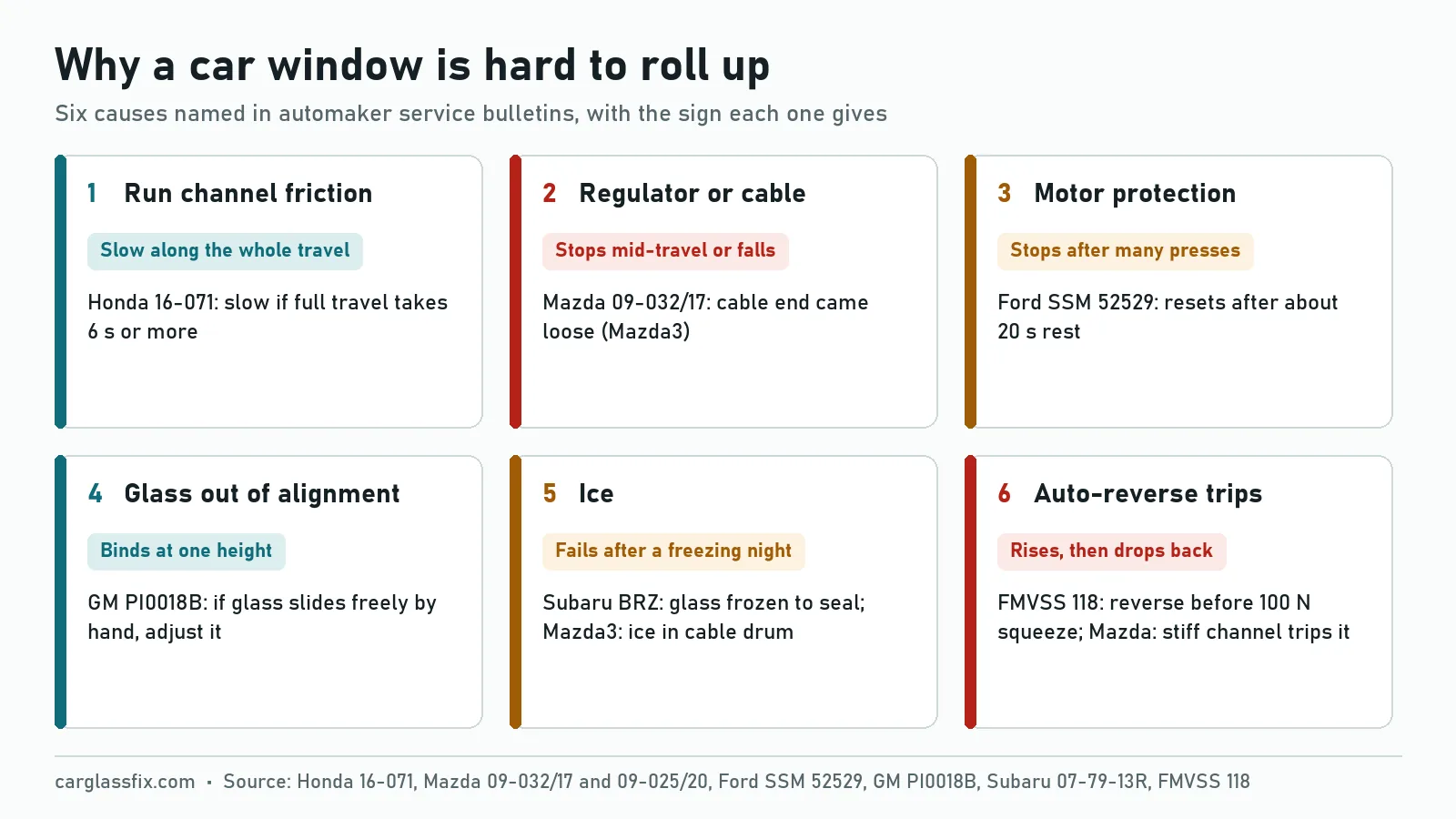
A car side window is hard to roll up when something adds resistance or takes away force. Automaker bulletins name six causes: dry, worn or deformed glass run channels, a failing regulator or cable, a motor that slows or overheats, glass out of alignment, ice, and the auto-reverse safety system reacting to that extra friction.
Why is a car side window hard to roll up?
A side window is hard to roll up when the force needed to lift the glass grows larger than the force the system can deliver. The glass slides inside a rubber or flocked glass run channel on its front, rear and top edges. A regulator inside the door lifts it, using either a cable and drum or a lifting arm. An electric motor drives the regulator, and on most newer cars a control module watches the motor for signs of a trapped object. Each part can fail in its own way. Friction rises when the run channel dries, wears, deforms or fills with dirt. Lifting force drops when the regulator cable frays or slips, or when the motor weakens or overheats. Ice adds both problems at once. Automaker service bulletins show that friction is often the cause, not the motor. FCA reported that motors and regulators returned after repeated slow-window repairs showed no failures. The sections below sort the causes by symptom, with the bulletin behind each one.
Six causes and the sign each one gives
The six documented causes each leave a different sign, so the way the window misbehaves points to the part at fault.
| Cause | Typical sign | Bulletin example | Documented fix |
|---|---|---|---|
| Dry, dirty or worn run channel | Slow in both directions, often slower than the other side | Honda 16-071 (2016 Pilot), Nissan NTB20-014 (2017-2018 Murano) | Replace the glass run channel |
| Deformed run channel | Window rises, then drops back | Mazda 09-024/15 (CX-7, CX-9) | Pads in the channel corners, then initialization |
| Regulator or cable failure | Stops mid-travel, sticks or falls into the door | Mazda 09-032/17 (2014-2017 Mazda3) | Replace the regulator |
| Motor protection or weak motor | Stops after repeated use, works again after a rest | Ford SSM 52529 (2023 Transit) | Rest over 20 seconds, then retest |
| Glass out of alignment | Binds at one point of travel | GM PI0018B (2008-2014 GM) | Adjust the glass and channel position |
| Ice | Fails after parking in freezing weather | Subaru 07-79-13R (BRZ), Mazda 09-025/20 (Mazda3) | New weatherstrip or regulator repair |
Speed and pattern separate the causes. Friction slows the glass along its whole travel and often in both directions. A regulator fault tends to stop the glass at one point or let it drop. Motor protection stops the window after many presses in a row and clears after a short rest. Ice shows up only after the car has stood in freezing weather. A stiff channel can also trip auto-reverse, as the Mazda and Porsche bulletins show. Wind noise and water leaks around the same seals have their own guide on whether side glass can cause wind noise.
Dry, worn or deformed run channels
The glass run channel is the most frequent cause named in slow-window bulletins. Honda’s bulletin for the 2016 Pilot states the cause as “too much friction caused by the glass run channel”. Its fix is a new channel for the affected window. Nissan’s bulletin for the 2017 and 2018 Murano describes a front window that moves slower than the other side, and the fix is a new front door glass run rubber. FCA’s STAR case from April 2020 tells technicians to check that the glass sits in the run seal and that the seal is free of dirt. FCA then cleans the track, glass and seal, and replaces the seal if it is deformed. GM’s preliminary information for 2008 to 2014 cars and light trucks also starts slow-window diagnosis with debris in the run channel. Each maker names its own lubricant. GM specifies its own synthetic multi-purpose lubricant for the regulator, and FCA specifies a Krytox weatherstrip lubricant. Cleaning and lubrication have their own guide on how to lubricate car window tracks. A channel that is torn or out of shape needs replacing, because lubricant does not restore its shape.
Regulator, cable and motor problems
A worn regulator or motor makes a window slow or stops it outright, and bulletins tell technicians to rule out friction first. GM’s preliminary information gives a direct test. A technician loosens the two bolts that hold the glass to the regulator and slides the glass by hand in the run channel. If the glass does not bind, GM says to adjust it and “DO NOT replace the regulator”. On motors with a two-pin connector, GM applies 12 volts straight to the motor to confirm that it runs. Cable regulators fail in a typical way. Mazda found that on some 2014 to 2017 Mexico-built Mazda3 models the cable end came loose from its fixing point. The window then stopped mid-travel, stuck or fell into the door. Audi issued a proactive regulator update for some 2018 A5 models for the same result: a window that no longer opens or closes. Motors also protect themselves. Ford says the 2023 Transit window motor has thermal protection against high current or repeated switch use, and it resets after about 20 seconds of rest.
Why the window goes up and then comes back down
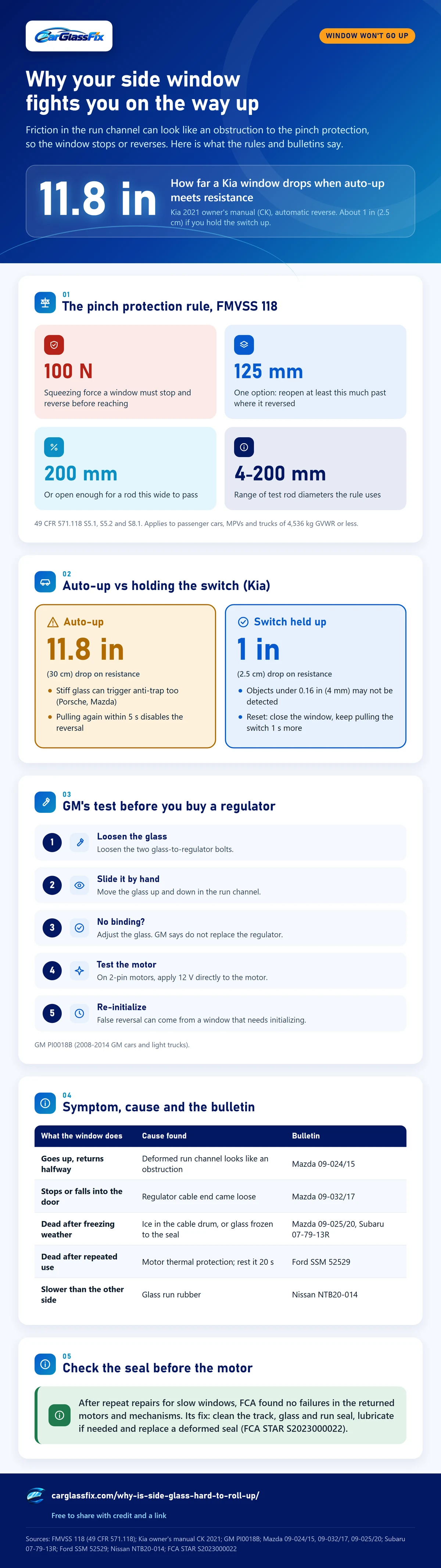
A window that rises and then reverses on its own is usually the pinch-protection system reacting to extra friction. Federal Motor Vehicle Safety Standard 118 requires any power window that can close by itself to stop and reverse before it squeezes a test rod with 100 newtons or more. The test rods range from 4 mm to 200 mm (about 0.16 to 7.9 in) in diameter. After reversing, the window must open at least 125 mm (about 4.9 in) more, return to where closing began, or leave room for a 200 mm rod. The control module cannot tell a trapped arm from a stiff seal. Mazda’s bulletin for 2007 to 2012 CX-7 and 2013 to 2015 CX-9 models says a deformed run channel raised sliding resistance, and the system misjudged it as an obstruction. The window rose and then returned to halfway. Porsche’s 2025 bulletin for the 911 Cabriolet says the anti-trap protection activates when the rear side window is “too stiff to move”. GM lists seals, initialization, alignment and run channel debris as causes of false glass reversal.
How auto-reverse works and how to reset it
In Kia’s system, auto-reverse works on the front windows during one-touch closing, and a reset relearns the window’s limits when it stops working normally. A 2021 Kia owner’s manual says the window lowers about 11.8 in (30 cm) when it meets resistance during auto-up. If the driver holds the switch up instead, it lowers about 1 in (2.5 cm). Kia also warns that an object thinner than 0.16 in (4 mm) may not be detected. Holding the switch through the closing point is the reset in that manual. Kia’s steps are below, with the reminder that auto-reverse is off during a reset, so hands and objects must stay clear.
Reset a power window (Kia procedure)
Switch on
Press the ENGINE START/STOP button twice to the ON position.
Close the windows
Close the driver’s and front passenger’s windows with their switches.
Hold the switch
Keep pulling the driver’s switch up for at least 1 second after the glass is fully closed.
Test auto-up
Check that one-touch closing works without reversing.
Other makers use their own steps, so the owner’s manual for the vehicle is the reference. Nissan and Mazda both list power window initialization as a step after replacing run channel parts. Honda notes that a slow window can make the 2016 Pilot unlearn its auto up and down function. A reset does not cure the friction that triggered the reversal.
Ice, cold weather and frozen seals
Ice makes a window hard to roll up by freezing the glass to its seals or by jamming the regulator inside the door. Kia’s owner’s manuals state that power windows “may not work properly due to freezing conditions” in cold and wet climates. Subaru’s bulletin for 2013 and 2014 BRZ models covers glass frozen to the outer weatherstrip. The BRZ has frameless doors, and the glass drops slightly when the door opens to clear the drip rail. Subaru found that freezing could pull the flocked layer away from the outer weatherstrip and stop the windows or this drop function. Its countermeasures included a revised weatherstrip and new switches that cut the drop from 20 mm to 10 mm (about 0.8 to 0.4 in). Mazda’s bulletin for some 2014 to 2018 Japan-built Mazda3 models describes water that entered the regulator and froze in the cable drum groove. When the window was operated, the cable slipped out of the icy groove and tangled. A window that stops after a cold night may need a dealer check rather than repeated switch presses.
How to narrow down the cause
The bulletins point to a short order of checks that a driver can do before a door panel comes off. Technicians follow the full procedure for the specific vehicle, and a dealer can say whether a bulletin applies.
Narrow down a slow side window
Time the window
Honda’s bulletin times the glass from fully up to fully down; 6 seconds or more counts as slow on the 2016 Pilot.
Compare both sides
Nissan compares the slow window with the other side or a known good vehicle.
Cycle it three times
FCA verifies the fault by running the window fully up and down 3 times.
Let the motor rest
Ford says to rest an inoperative window over 20 seconds before diagnosing it.
Watch for reversal
A window that rises and drops back points to friction tripping pinch protection.
Check the glass position
Glass that sits outside its channel or tilts needs adjustment.
Glass that binds at one height, tilts or leaves a gap at the top is an alignment problem, covered in how to fix a misaligned car side window. Electrical faults such as a dead switch or fuse belong to the wider guide on how to diagnose car window problems. A loose window that buzzes over bumps is covered in how to fix rattling side glass.
Frequently asked questions
Why does my power window go up and then come back down?
The pinch-protection system has detected resistance and reversed the glass, as FMVSS 118 requires above 100 N of squeezing force. Mazda and Porsche bulletins show that a stiff or deformed run channel can trigger it with nothing in the way.
Is a slow window the motor or the regulator?
Often neither. Honda, Nissan and FCA bulletins fixed slow windows with a new or cleaned glass run channel, and GM says not to replace the regulator if the glass slides freely by hand.
Can I use WD-40 on car window tracks?
Automakers name their own products: GM a synthetic multi-purpose lubricant for the regulator and FCA a Krytox weatherstrip lubricant. The guide on how to lubricate car window tracks covers product choice and method.
Why does my window not work after a cold night?
The glass can freeze to its weatherstrip, or water can freeze inside the regulator. Subaru and Mazda bulletins document both cases, and Kia’s manuals warn that windows may not work properly in freezing conditions.
Can new side glass make the window hard to roll up?
Yes, if the glass or its run channel is not set correctly after the job. Nissan and Mazda add a power window initialization after this kind of work; see how to replace a car side window glass for the full procedure.
Sources
- 49 CFR 571.118, FMVSS No. 118 Power-operated window, partition, and roof panel systems (checked 2026-10-28)
- GM Preliminary Information PI0018B, side door window binds, moves slowly or is inoperative (Nov 2013)
- Honda Service Bulletin 16-071, window glass moves slowly, 2016 Pilot
- Nissan NTB20-014, front door glass moves slowly, 2017-2018 Murano
- FCA STAR case S2023000022, window slow to raise or lower (Apr 2020)
- Mazda bulletin 09-024/15, front door window auto-closing inoperative
- Porsche SY 48/25, rear side window is reversed, 911 (992) Cabriolet
- Mazda bulletin 09-032/17, power window will not operate, Mazda3
- Audi 64E5 update, servicing window regulators, 2018 A5
- Ford SSM 52529, 2023 Transit power window inoperative
- Subaru bulletin 07-79-13R, countermeasures for frozen power windows, BRZ
- Mazda bulletin 09-025/20, front door glass does not operate, Mazda3
- Kia owner’s manual 2021, power windows (checked 2026-10-28)

Similar Posts