Can Hail Break Side Windows? Hail Size vs Tempered Glass
Senior Automotive Glass Diagnostic Specialist & Master Technician at CarGlassFix · AGSC Master Certified Auto Glass Technician, NGA Certified Installer, I-CAR Automotive Safety Specialist · 12+ Years in Automotive Glazing, Windshield Structural Bonding, ADAS Camera Calibration & Precision Chip Restoration
Yes. Hail can break car side windows, and NOAA’s National Severe Storms Laboratory names wind-driven hail as a cause. Most side windows are tempered glass, so a hit that breaks one shatters the whole pane into small pieces. Laminated side glass usually cracks and stays in the frame. Comprehensive auto insurance covers hail damage.
Can hail break car side windows?
Hail can break car side windows, and the risk rises with hailstone size and wind. NOAA’s National Severe Storms Laboratory (NSSL) writes that wind-driven hail can “break side windows on cars”. The same NSSL page says hail can damage aircraft, homes and cars.
The type of glass decides what the damage looks like. Most door windows are tempered glass. Tempering puts the glass surface in compression and the core in tension, as a 2017 review by Karlsson in Ceramics-Silikaty explains. When a hailstone breaks through that surface layer, the stored energy is released and the whole pane falls apart into small pieces.
The federal glazing standard, FMVSS 205, requires this behavior. It adopts ANSI/SAE Z26.1-1996, and NHTSA states that no tempered fragment may weigh more than 4.25 g (0.15 oz). Safelite, a national glass company, says side and rear windows break into fragments and are replaced.
Some newer cars have laminated door glass, which usually cracks and stays in the frame. If a side window broke when no hail fell, the causes are covered in why did my side glass shatter.
How big does hail have to be to break a side window?
No agency or glass maker publishes a hail size at which a car side window breaks, but impact energy climbs steeply once hail reaches about 1.5 in. NSSL treats hail of 1 in (quarter size) or larger as severe. A golf ball stone is 1.75 in, and a tennis ball stone is 2.5 in.
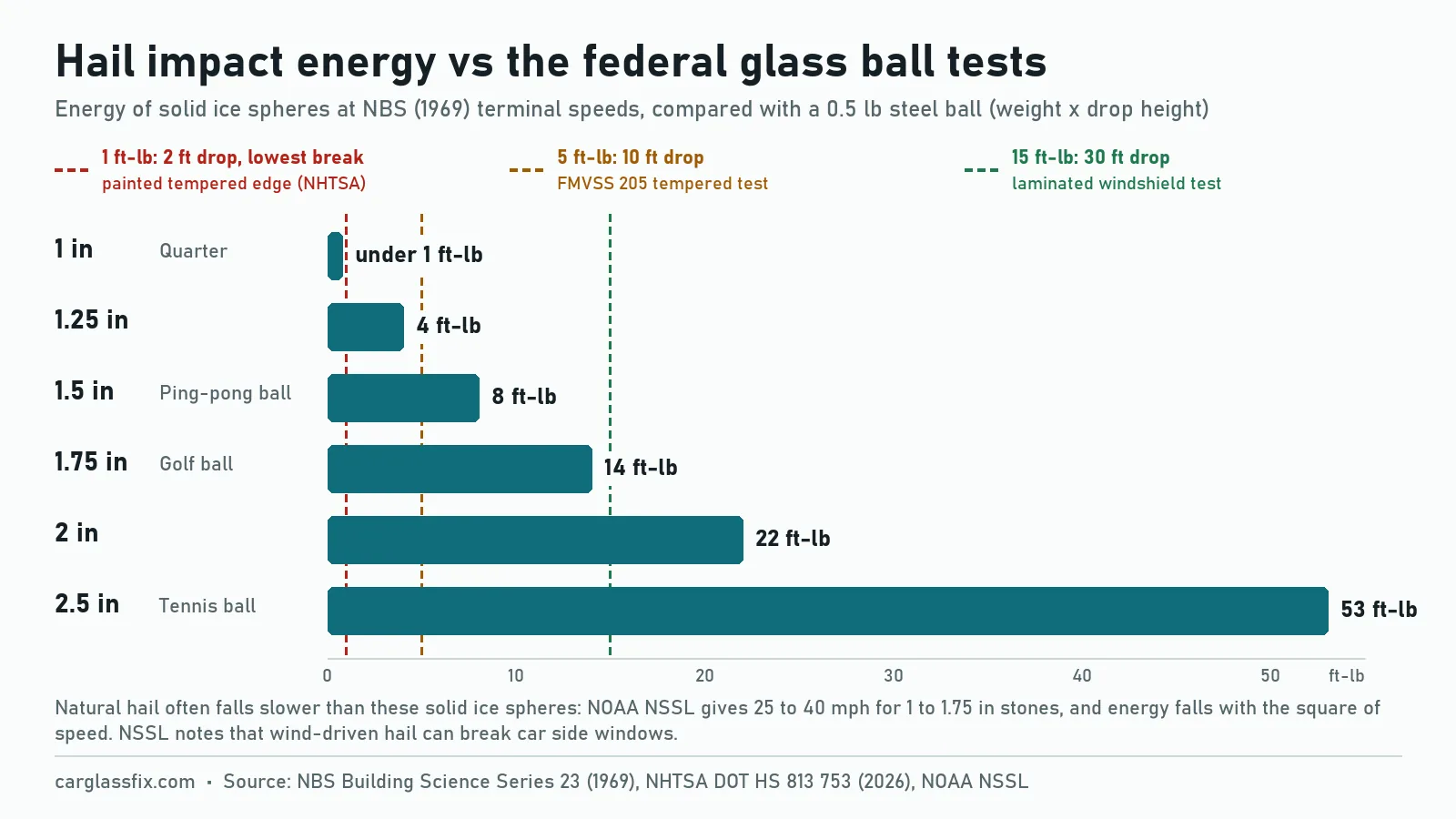
The most quoted energy figures come from Sidney Greenfeld’s 1969 National Bureau of Standards (NBS) study of hail and roofing. Greenfeld treated hailstones as smooth ice spheres falling at full terminal speed. The table below compares his numbers with NSSL’s newer speed estimates.
| Hail size (NSSL name) | NBS 1969 speed | NBS 1969 impact energy | NSSL fall speed range |
|---|---|---|---|
| 1 in (quarter) | 50 mph | under 1 ft-lb | 25 to 40 mph |
| 1.25 in | 56 mph | 4 ft-lb | 25 to 40 mph |
| 1.5 in (ping-pong ball) | 61 mph | 8 ft-lb | 25 to 40 mph |
| 1.75 in (golf ball) | 66 mph | 14 ft-lb | 25 to 40 mph |
| 2 in | 72 mph | 22 ft-lb | 44 to 72 mph |
| 2.5 in (tennis ball) | 80 mph | 53 ft-lb | 44 to 72 mph |
The two sources disagree on speed. NSSL tested 3-D printed hailstone casts in a vertical wind tunnel and found natural hail falls more slowly than solid ice spheres. A 2014 study of 2,295 Great Plains hailstones by Heymsfield, Giammanco and Wright found lower average energies than the sphere values. Energy falls with the square of speed. A golf ball stone at NSSL’s 40 mph carries roughly 5 ft-lb by that rule, not 14.
Tempered vs laminated side glass in a hailstorm
Tempered side glass breaks completely or not at all, while laminated side glass can crack and still keep hail out of the cabin. The federal ball tests show the gap in what each type must survive.
FMVSS 205 tests tempered glass with a 0.5 lb, 1.5 in steel ball dropped from 10 ft. That drop delivers about 5 ft-lb (weight times height). Windshield glass faces the same ball from 30 ft, about 15 ft-lb, and it passes if the ball stays out and the laminate holds together. The windshield glass may crack and still pass.
| Point | Tempered side glass | Laminated side glass |
|---|---|---|
| Federal ball drop | 0.5 lb ball from 10 ft (about 5 ft-lb) | Windshield test: 0.5 lb ball from 30 ft (about 15 ft-lb) |
| Typical hail result | Whole pane shatters into small pieces | Cracks; the plastic interlayer holds the glass |
| Cabin after a break | Open to rain and more hail | Usually closed |
| Fix | Replacement | Glass shop inspects the cracked pane |
AAA counted laminated glass outside the windshield on about 33% of 2018 models, 115 of roughly 350. In AAA’s escape-tool tests, laminated side glass “stayed intact even after being cracked”. Front doors can be laminated while rear doors are tempered, so check each window. The full comparison is in laminated glass vs tempered glass.
Why wind, angle and the black edge band matter
Wind turns hail from a roof and hood problem into a side window problem. NSSL explains that strong surface winds can make hail fall at an angle “or even nearly sideways”. Hail that falls straight down meets a door window at a shallow angle. Hail driven sideways by wind hits the glass more directly, which is the case NSSL links to broken car side windows.
Where the stone lands also matters. A February 2026 NHTSA report, DOT HS 813 753, tested tempered rear quarter glass, back glass and sunroofs. The black ceramic paint band at the edge weakened the glass. At the paint edge, every painted rear quarter and sunroof sample broke in the 10 ft ball drop, while unpainted glass did not.
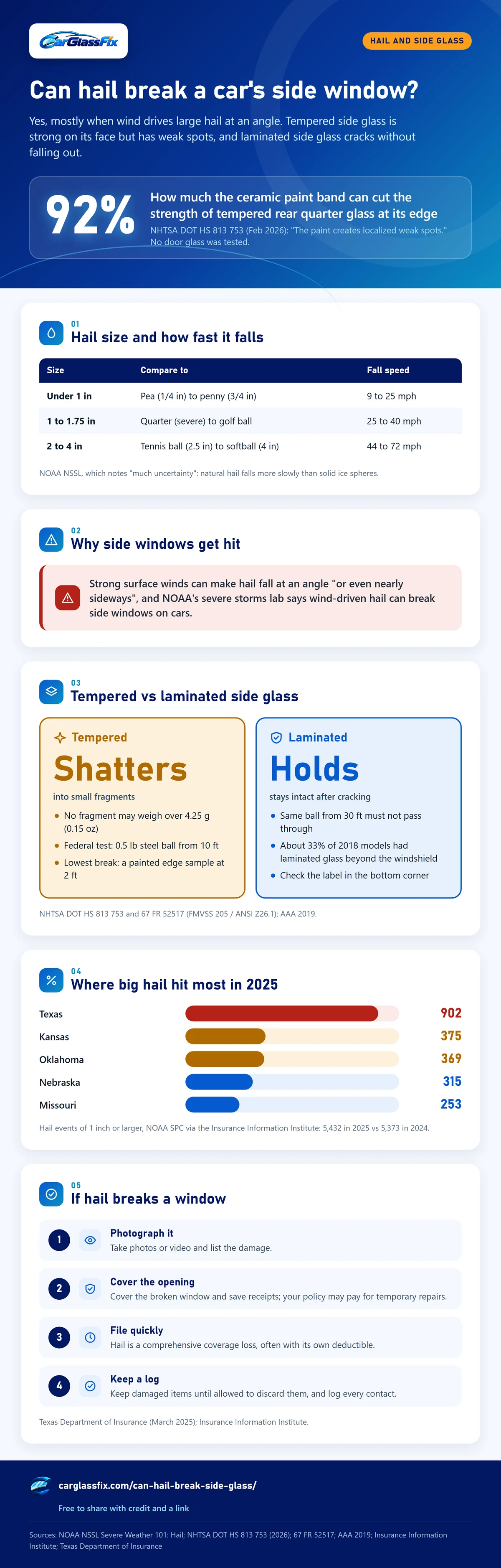
The paint cut rear quarter glass strength by up to 92% at the edge location. The lowest break came from a 2 ft drop, about 1 ft-lb. NHTSA also found the outside face of glass generally stronger than the inside. NHTSA did not test door glass, so these numbers apply to similar tempered glass, not to every side window.
Does insurance cover side windows broken by hail?
Comprehensive auto coverage pays for hail damage, including broken side windows. The Insurance Information Institute (Triple-I) lists hail, windstorm and falling objects among the events comprehensive covers. Triple-I says comprehensive usually carries its own deductible, and some insurers sell the glass part without one.
Liability coverage pays for damage you cause to other people’s property, not for your own car, according to Triple-I. The Texas Department of Insurance (TDI) says your insurer should pay for hail damage if you have comprehensive coverage on your auto policy. TDI ties wind and hail coverage on a homeowners policy to the home and comprehensive coverage to the car.
A hail-broken side window is usually one item in a larger claim. The same storm often dents the roof and hood. TDI advises filing quickly, taking photos or video, and listing every damaged area inside and outside the car. Keep damaged parts until the insurer says they can go.
The deductible decides whether a glass-only claim is worth filing. Your declarations page shows the comprehensive deductible and any glass coverage. Windshield claim rules are covered in does insurance cover windshield replacement.
What to do after hail breaks a side window
After hail breaks a side window, document the damage, close the opening and start the claim before any repair. These steps follow TDI’s claim advice and the facts about tempered glass above. TDI also asks owners to be available for the adjuster and to make sure the adjuster sees all the damage.
After hail breaks a car side window
Wait out the storm
Stay inside a covered area or the car until the hail stops, and keep away from the broken opening.
Photograph everything
Take photos or video of the broken window, glass inside the car, dents and any other storm damage.
Cover the opening
Tape heavy plastic over the frame to keep rain out, and save the receipts, since TDI says a policy may pay for temporary repairs.
Clear the glass
Vacuum fragments from seats, floor and the door track before anyone sits there.
File the claim
Call your insurer quickly, show the adjuster all damage, and log every person you speak with and when.
Replace the glass
Have the tempered pane replaced, because tempered glass cannot be repaired once it breaks.
Tempered glass breaks into small pieces by design, and those pieces spread across the cabin and down inside the door. Fragments can hide deep in the door panel and seat rails. The cleanup method is in how to clean broken glass from car. Whether the car is legal and safe to drive with plastic over the opening is answered in can I drive with broken side glass.
Where hail breaks the most car windows
Hail of 1 in or larger falls most often in the Great Plains, and Texas leads the country. Triple-I, citing NOAA’s Storm Prediction Center, counts 5,432 such hail events in the US in 2025, up from 5,373 in 2024.
Texas had 902 events in 2025, Kansas had 375 and Oklahoma had 369. Nebraska and Missouri followed with 315 and 253. These counts are storms, not damaged cars, so they show where the risk is highest rather than how many windows broke.
NSSL’s record shows how large hail can get. The largest US hailstone fell in Vivian, South Dakota, on June 23, 2010. It measured 8 in across and weighed 1 lb 15 oz.
A garage or covered parking is the most reliable way to keep hail off any car glass. Covers, blankets and parking choices are compared in how to protect car windshield.
Frequently asked questions
Can hail break a windshield?
Yes, large hail can crack a windshield, but the laminated glass usually stays in one piece. The causes and crack types are covered in what causes windshield cracks.
Can a side window cracked by hail be repaired?
A tempered side window that breaks falls apart and must be replaced. A glass shop has to inspect cracked laminated side glass, and the options are explained in can side glass panels be repaired.
Does homeowners insurance cover car windows broken by hail?
Hail damage to a car is claimed on the auto policy’s comprehensive coverage, according to the Texas Department of Insurance. TDI links homeowners wind and hail coverage to the home.
What size hail is considered severe?
NOAA’s National Severe Storms Laboratory considers hail 1 inch across (quarter size) or larger severe.
How can I tell if my side windows are laminated?
Read the small label in the lower corner of each window, which says LAMINATED or TEMPERED, as AAA advises. Model lists are in which cars have laminated glass.
Sources
- NOAA National Severe Storms Laboratory, Severe Weather 101: Hail (checked 2026-10-26)
- Greenfeld, Hail Resistance of Roofing Products, NBS Building Science Series 23 (1969), Table 1
- Marshall et al., Haag Engineering, Hail damage threshold sizes for common roofing materials (AMS conference paper)
- Heymsfield, Giammanco and Wright, Terminal velocities and kinetic energies of natural hailstones, Geophysical Research Letters (2014)
- NHTSA, Evaluation and Comparison of Glazing Performance in Impact Tests, DOT HS 813 753 (February 2026)
- 49 CFR 571.205, FMVSS No. 205 Glazing materials (checked 2026-10-26)
- NHTSA, 67 FR 52517 (August 12, 2002), tempered fragment weight
- Karlsson, Ceramics-Silikaty 61(3), 2017
- Safelite, Repair or replace damaged glass
- AAA, Vehicle Escape Tool Evaluation (July 2019)
- Insurance Information Institute, What is covered by a basic auto insurance policy?
- Insurance Information Institute, Facts + Statistics: Hail (checked 2026-10-26)
- Texas Department of Insurance, Hail damage? Tips to file an insurance claim (March 2025)

Similar Posts