Why Did My Car Side Window Shatter? 4 Documented Causes
Senior Automotive Glass Diagnostic Specialist & Master Technician at CarGlassFix · AGSC Master Certified Auto Glass Technician, NGA Certified Installer, I-CAR Automotive Safety Specialist · 12+ Years in Automotive Glazing, Windshield Structural Bonding, ADAS Camera Calibration & Precision Chip Restoration
A car side window shatters because most side glass is tempered, so any crack that reaches its stressed core breaks the whole pane at once. Glass makers and NHTSA files name impact and edge damage, door slams and binding window motors, heat acting on damaged glass, and flaws such as nickel sulfide stones or poor tempering.
Why side glass shatters all at once
Side glass shatters all at once because it is usually tempered, and tempered glass holds stored stress. AAA’s 2019 escape tool report says the majority of side windows are tempered. About 33 percent of 2018 models had some laminated windows, according to the same report. Laminated glass cracks but stays in one piece.
Tempering heats the glass and cools it fast with air. The surface ends up in compression and the core in tension. A 2017 review by glass researcher Stefan Karlsson explains that the surface stress is about twice the core stress. Pilkington’s bulletin ATS-165 says a crack past a critical size causes complete fracture into small, roughly cube-shaped pieces.
Federal standard FMVSS 205 requires car glazing to meet ANSI/SAE Z26.1. In its tempered glass fragment test, no piece may weigh more than 4.25 g (0.15 oz), as NHTSA noted in 2002. These small pieces are the safety design. The trade-offs between the two glass types are covered in laminated vs tempered glass.
Documented causes of side window breakage
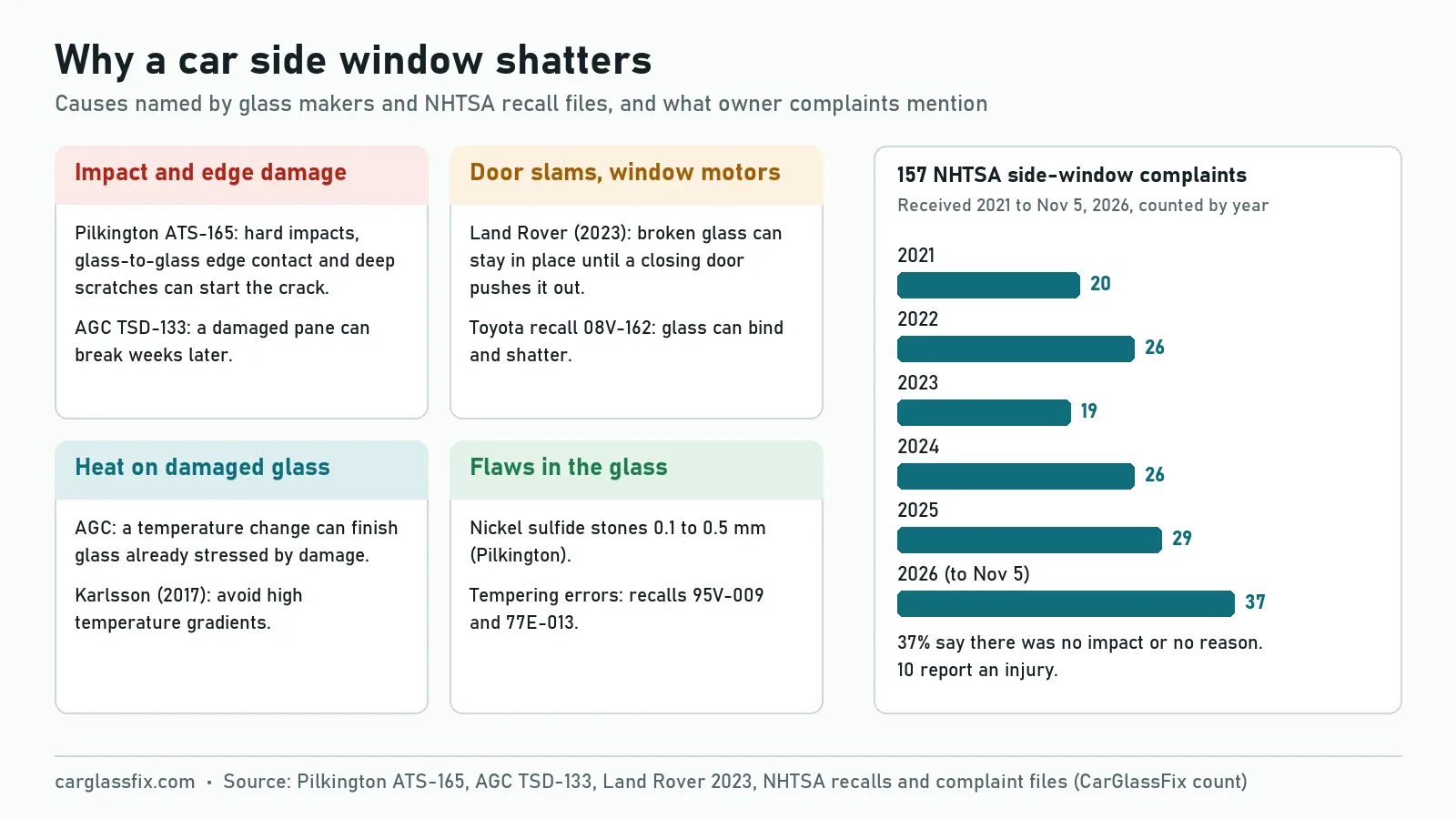
Glass makers, automakers and NHTSA recall files name four causes: impact or edge damage, door and window hardware stress, heat on already damaged glass, and flaws inside the glass. The diagram sums up the cases and what owner complaints mention.
| Cause | Documented case | What the source says | Source |
|---|---|---|---|
| Impact or deep scratch | Tempered glass in general | Hard impacts and scratches that reach the tension zone start the crack | Pilkington ATS-165 |
| Delayed break after damage | Tempered glass in general | A damaged pane may not break until weeks later | AGC TSD-133 |
| Door closing | 2020-2023 Land Rover Defender | Broken glass can stay in place until cabin pressure from a closing door pushes it out | Land Rover field note, 2023 |
| Window regulator | 2003-2004 Toyota Corolla, Corolla Matrix, Pontiac Vibe | Loose glass bolts can let the glass bind and shatter during power window use | NHTSA recall 08V-162 |
| Frame pressure | 2015-2016 Micro Bird buses | Water frozen in the window frame can press on the glass until it shatters | NHTSA recall 16V-434 |
| Poor tempering | 1995 Mercury Mystique | Rear door glass was not tempered correctly, so broken pieces could exceed FMVSS 205 size limits | NHTSA recall 95V-009 |
The causes often stack. An old chip near the edge weakens the pane, and a later bump, door slam or temperature swing finishes the break. AGC’s technical document TSD-133 says much breakage is called spontaneous only because there was no easily visible cause. That is why the impact check comes first.
Impact, edge damage and break-ins
Impact and surface damage are the usual starting points for a side window break. Pilkington lists hard body impacts, glass-to-glass contact where edges bump during installation, and deep scratches that reach the tension zone. Karlsson’s review adds that edge quality matters and that tempered glass should not touch hard or sharp materials.
The break does not have to happen at the moment of damage. AGC says a tempered pane may “release” weeks after it was damaged. Damage can come from manufacturing, shipping, installation, handling or improper cleaning. A rock chip on the highway can therefore end in a break days later in a parking lot.
A small hard point concentrates force on a tiny area. In AAA’s tests, spring-loaded escape tools broke tempered side glass, while two of three hammer-style tools failed. This is also why thieves can break a side window quickly. Ways to make a break-in harder are covered in how to protect side glass from theft. Storm damage has its own guide: can hail break side glass.
Door slams, window motors and frame pressure
A door slam often reveals a break that already happened. Land Rover’s 2023 field note on the Defender says broken tempered glass may stay in place until disturbed. Closing a door raises the air pressure in the cabin, and the loose pieces fall away. Pilkington’s bulletin describes the same behavior: broken pieces tend to stay together “much like a jig-saw puzzle” until another force acts on them.
Hardware inside the door can also break the glass. Toyota recall 08V-162 covered 662,178 Corolla, Corolla Matrix and Pontiac Vibe models from 2003 and 2004. Loose bolts could let the door glass separate from the window regulator, bind and shatter while the power window moved. Dealers replaced the bolts.
Pressure from the frame is a third path. Pilkington lists frame bearing pressure as a stress that slowly grows small cracks. NHTSA recall 16V-434 shows an extreme case on 2015-2016 Micro Bird buses. Water trapped in the window frames could freeze, expand and shatter the glass. A misaligned or binding door window is worth having checked before it fails.
Can side glass shatter in heat?
Heat can shatter side glass mainly when the glass is already damaged or flawed. Pilkington says toughened glass has greater resistance to thermal stress than ordinary annealed glass. Karlsson’s review still lists thermal load as a fracture cause and says high temperature gradients should be avoided.
AGC explains how heat and damage combine. Glass weakened by installation damage or abuse sits close to its breaking point. A later movement or temperature change then forces it to yield. Transport Canada gives the same warning for sunroofs: damaged glass may break later because of a temperature shift or a jolt.
Heat also speeds up one internal flaw. Pilkington says the growth of nickel sulfide stones happens faster when the glass is warmer. No glass maker document reviewed for this guide gives a single safe temperature for car side glass, so this page does not quote one. Blasting very hot or cold air at a chipped window adds stress to a pane that is already weak.
Nickel sulfide and other flaws in the glass
A side window can break with no outside force when the glass has an internal flaw. The best-known flaw is a nickel sulfide stone. Pilkington’s bulletin ATS-165 says these stones are typically 0.1 to 0.5 mm (0.005 to 0.020 in) across. Tempering traps them in a smaller form, and they grow slowly as they change phase.
Pilkington says this breakage can happen with no load at any time, even five or ten years after tempering. It usually does not happen until at least a year has passed. Pilkington cites a 2001 University of Bath paper that found one such stone in every 4 to 12 tons of glass. That figure comes from building glass. No glass maker can guarantee glass free of these stones. Heat soak testing finds most of them but is “never 100% effective”, Pilkington adds.
Poor tempering is a second kind of flaw. NHTSA recall 95V-009 covered 1995 Mercury Mystique rear door glass that was not tempered correctly. Recall 77E-013 covered incompletely tempered side glass that broke more easily in an impact. No NHTSA recall or closing report reviewed for this guide names nickel sulfide as the cause of a car window break.
What NHTSA complaints show and what to do next
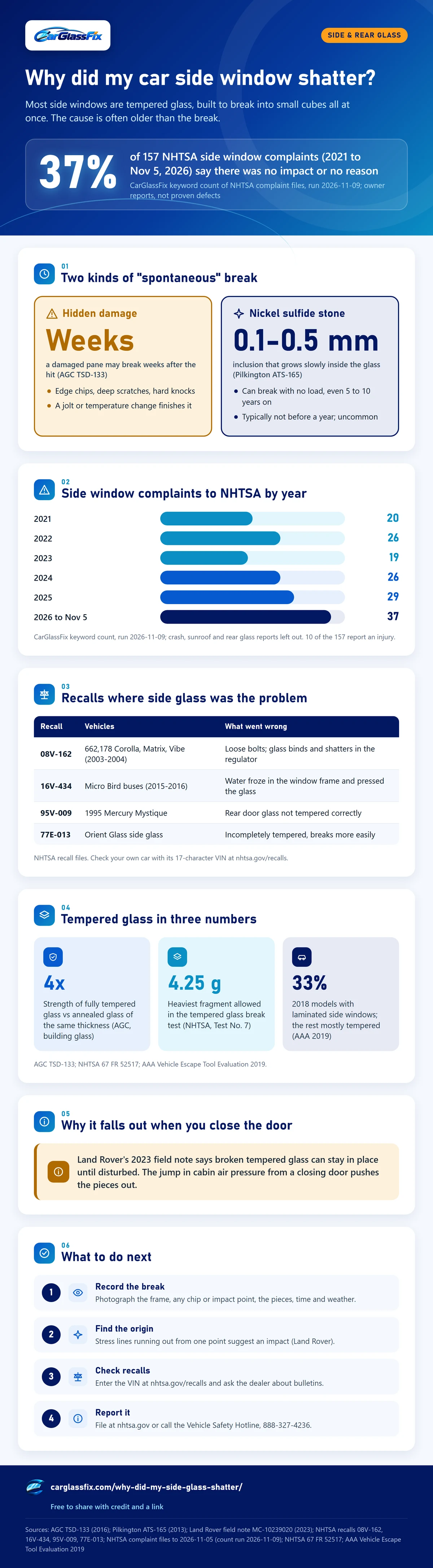
NHTSA complaints show that side windows break while driving, while parked and when a door closes. A CarGlassFix keyword count run on November 9, 2026 found 157 complaints about shattered side windows received from 2021 to November 5, 2026. Crash, sunroof and rear glass reports were left out. The same method found 1,977 rear glass complaints in that period, as covered in what causes a rear windshield to shatter.
| Year received | Side window complaints |
|---|---|
| 2021 | 20 |
| 2022 | 26 |
| 2023 | 19 |
| 2024 | 26 |
| 2025 | 29 |
| 2026 (to Nov 5) | 37 |
Of the 157 complaints, 37 percent say there was no impact or no reason. Ten report an injury. These are owner reports, not proven defects. A few checks help tell the cause before anyone pays for new glass.
What to do after a side window shatters
Get safe
Pull over, keep hands away from loose pieces and check passengers for cuts.
Record the break
Photograph the frame, any chip or impact point and the pieces, and note the time, place and weather.
Look for the origin
Stress lines running out from one point suggest an impact, as Land Rover’s field note explains.
Check recalls
Enter the 17-character VIN at nhtsa.gov/recalls and ask the dealer about service bulletins.
Report it
File a report at nhtsa.gov or call the Vehicle Safety Hotline at 888-327-4236.
Call your insurer
Ask whether your policy covers glass broken by an outside cause.
Glass left in the door or on the seats needs care before the car is used again, and how to get broken glass out of a car door walks through it. Whether the car can be driven meanwhile is covered in can I drive with broken side glass.
Frequently asked questions
Can a car side window shatter for no reason?
A side window can break with no visible cause, but glass maker AGC says many such breaks have a hidden one, such as earlier edge damage. True no-load breaks come from internal flaws like nickel sulfide stones, which Pilkington calls uncommon.
Why did my car window shatter when I closed the door?
The glass was often already broken. Land Rover explains that broken tempered glass can stay in place until a closing door raises the cabin air pressure and pushes the pieces out.
Can a shattered side window be repaired?
A shattered tempered side window cannot be repaired and has to be replaced. The details are in can side glass panels be repaired, and the job itself is in how to replace a car side glass panel.
Can a hot day make a side window explode?
Heat mostly finishes glass that is already damaged, according to AGC and Transport Canada.
Will insurance cover a shattered side window?
Coverage depends on your policy and the cause of the break. Honda, for example, told dealers in 2024 that breakage from an outside cause was not covered by its warranty but may be covered by insurance, so ask both the dealer and your insurer.
Sources
- Pilkington North America, Technical Bulletin ATS-165, Spontaneous Breakage of Tempered Glass (Jan 14, 2013)
- AGC Glass Company North America, TSD-133 Tempered Glass Breakage (Aug 18, 2016)
- Pilkington, Toughened Glass product page (checked Oct 28, 2026)
- Karlsson, Spontaneous fracture in thermally strengthened glass, Ceramics-Silikaty 61(3), 2017
- AAA, Vehicle Escape Tool Evaluation (July 2019)
- 49 CFR 571.205, FMVSS 205 Glazing Materials (checked Oct 24, 2026)
- NHTSA, 67 FR 52517, glazing materials notice (Aug 12, 2002)
- Land Rover field communication, Defender tailgate glass, NHTSA MC-10239020 (June 2023)
- Honda dealer message on 2023 HR-V rear glass, NHTSA MC-10248670 (Jan 2024)
- Transport Canada, Vehicle Safety Advisory V 2021-01, Shattering Vehicle Sunroof
- NHTSA recall and complaint data files: recalls 08V-162, 16V-434, 95V-009, 77E-013; complaints received 2021 to Nov 5, 2026 (count run Nov 9, 2026)
- NHTSA recall lookup by VIN
- NHTSA, Report a Safety Problem

Similar Posts