How to Protect Car Side Windows From Break-Ins
Senior Automotive Glass Diagnostic Specialist & Master Technician at CarGlassFix · AGSC Master Certified Auto Glass Technician, NGA Certified Installer, I-CAR Automotive Safety Specialist · 12+ Years in Automotive Glazing, Windshield Structural Bonding, ADAS Camera Calibration & Precision Chip Restoration
To protect car side windows from break-ins, remove the reason to break in and then add layers. Keep valuables out of sight, lock up and park in light. Add interior security film of 4 mil or more within your state’s tint limit, an alarm with a glass-break sensor, or laminated side glass where available.
Why thieves break side windows
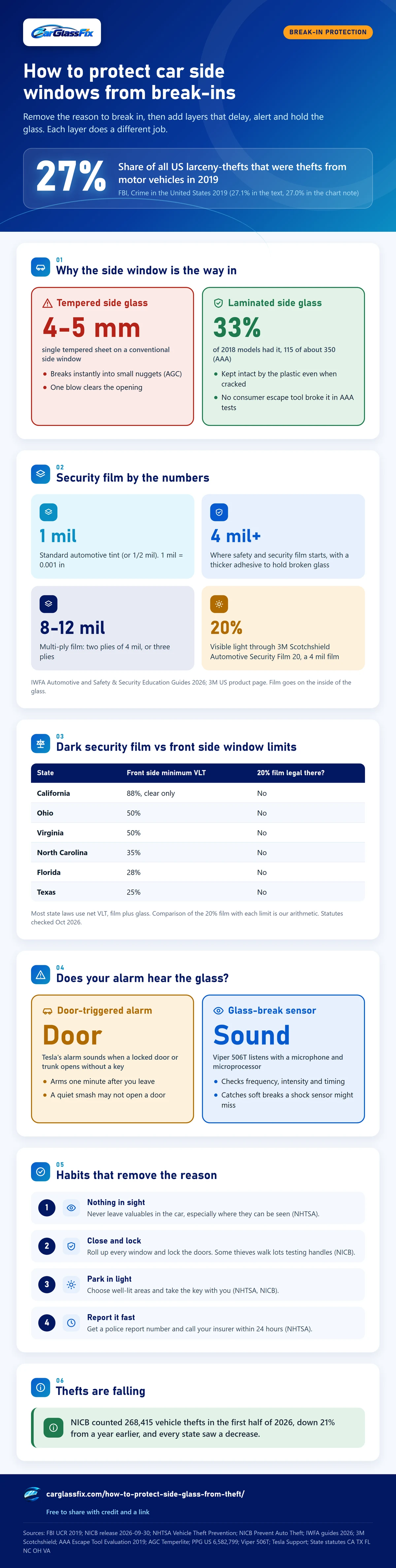
Thieves break side windows because a side window is the fastest way into a locked car. Most side windows are a single sheet of tempered glass about 4 to 5 mm thick, according to PPG patent data. AGC Automotive says tempered glass fractures instantly into small nuggets when it breaks. One sharp blow therefore opens the whole window. The FBI reported that thefts from motor vehicles accounted for about 27 percent of all larceny-thefts in 2019. Thefts of motor vehicle accessories added another 6.5 percent. NHTSA lists air bags, GPS units, cell phones, iPads, laptops and purses among the most popular items stolen from vehicles. Whole-vehicle theft is falling. The National Insurance Crime Bureau (NICB) counted 659,880 stolen vehicles in 2025, down from 1,020,729 in 2023. NICB reported a further 21 percent drop in the first half of 2026. A break-in for the contents does not need the car to move, so the glass remains the weak point even as vehicle theft declines.
Which protection layers work
No single product makes a side window break-in proof, so the useful options work as layers that deter, delay or alert. NHTSA groups anti-theft equipment into audible and visible devices, immobilizers and vehicle recovery systems. NICB calls this a layered approach.
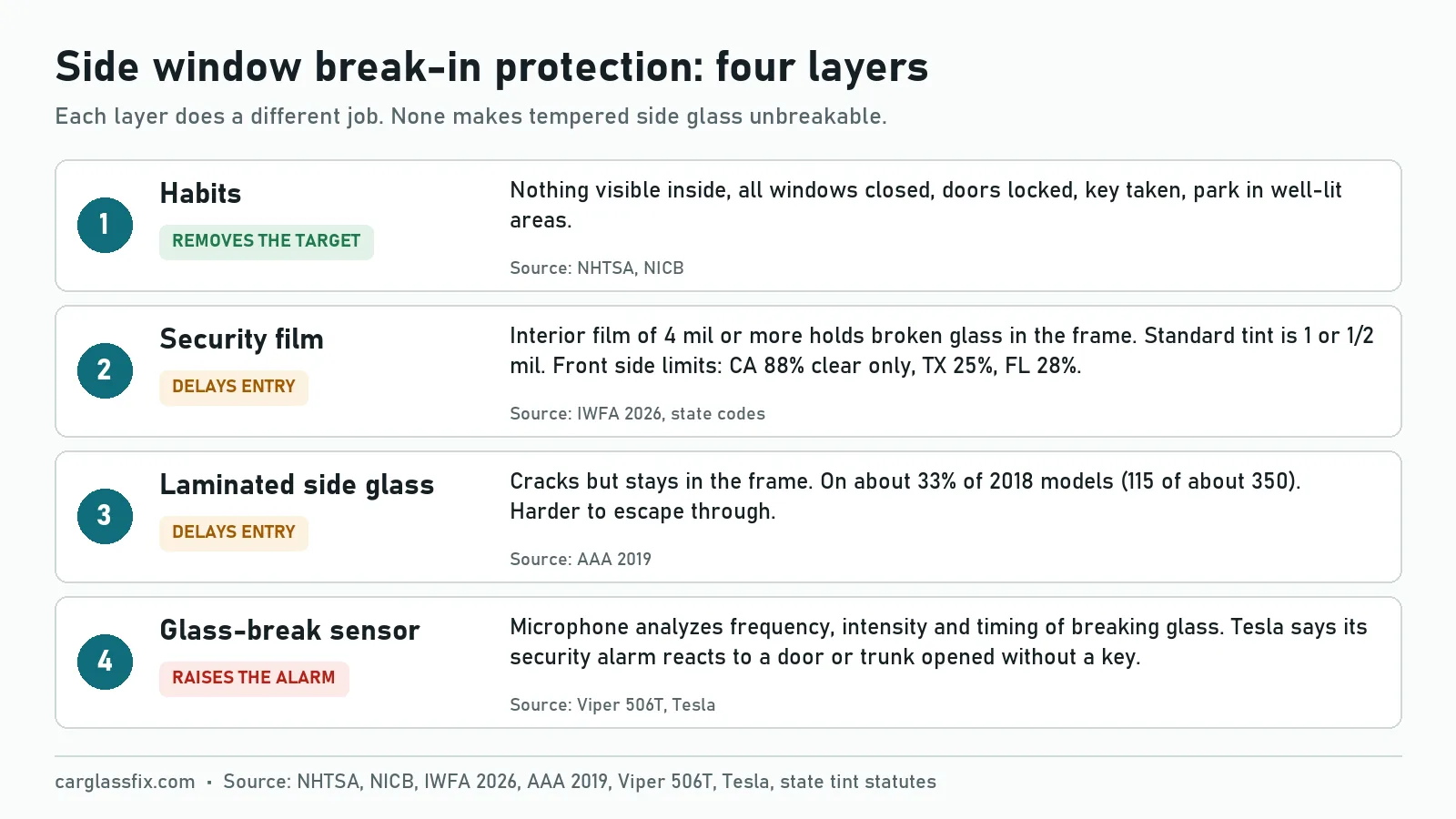
Habits come first because they remove the reason to break the glass. Film and laminated glass come next because they slow entry after the glass breaks. Sensors come last because they only raise an alarm once the attack has started. The table compares the layers by what each one actually does.
| Layer | What it does | Limit | Source |
|---|---|---|---|
| Nothing visible inside, windows up, doors locked | Removes the target | Depends on the driver every time | NHTSA, NICB |
| Security film, 4 mil or more | Holds broken tempered glass in the frame | Front side windows must meet state tint limits | IWFA |
| Laminated side glass | Cracks but stays in the frame | Factory option on some models only | AAA, Pilkington |
| Alarm with glass-break sensor | Sounds an alert when glass is broken | Does not stop entry | Viper, NHTSA |
| Comprehensive coverage | Pays for theft and vandalism damage | Deductible applies | Insurance Information Institute |
Security film: thickness and state tint limits
Security film protects a side window by holding the broken glass together, and the thickness that counts as security film starts at 4 mil. The International Window Film Association (IWFA) describes safety and security films as generally 4 mil and greater. One mil is 0.001 inch. Standard automotive tint is 1 mil or half a mil, so ordinary tint is not security film. The IWFA says the film goes on the inside of the glass. When glass is broken during attempted forced entry, the film can stretch and absorb energy, and the broken glass may stay in the frame. Thicker films stack 4 mil plies to reach 8 or 12 mil. UL does not certify glass and film alone for burglary resistance, the IWFA notes. Film delays a thief but does not make the window unbreakable.
Tint limits apply to security film too, because most states measure net light transmission through film and glass together. 3M’s US automotive security film is a 4 mil product with 20 percent visible light transmission. That is darker than the front side window limit in each state below.
| State | Front side windows, minimum light transmission | Statute |
|---|---|---|
| California | Clear, colorless material only, at least 88 percent | Vehicle Code 26708 |
| Texas | 25 percent | Transportation Code 547.613 |
| Florida | 28 percent | Statutes 316.2953 |
| North Carolina | 35 percent | G.S. 20-127 |
| Ohio | 50 percent, plus or minus 3 | OAC 4501-41-03 |
| Virginia | 50 percent | Code 46.2-1052 |
Check what car window tint is legal before choosing a shade, and ask the installer for the measured net value. Film types are covered in how to strengthen laminated car glass.
Laminated side glass
Laminated side glass resists a smash-and-grab better than tempered glass because the plastic layer keeps the cracked glass in the opening. AAA reported that laminated windows are kept intact by the plastic even when cracked. In AAA’s 2019 test, no consumer escape tool broke through laminated side glass. A ball-peen hammer with repeated strikes could not get the glass out of the frame. AAA counted laminated side windows on about 33 percent of 2018 models, or 115 of roughly 350. Pilkington, a glass maker, lists reduced theft from cars and personal security among the benefits of laminated sidelights. In the UK rating scheme cited by Pilkington, only vehicles with laminated side glazing as standard can earn five stars for theft-from protection.
The same strength has a safety trade-off. AAA advises that a tempered window is the best exit point in an emergency if the car has one. Laminated glass is a factory choice, and replacement glass must meet FMVSS 205. The list of which cars have laminated glass shows where it is fitted, and laminated glass vs tempered glass explains how the two break.
Alarms with glass-break sensors
An alarm protects side glass only if it reacts to breaking glass, and not every alarm does. Tesla’s support page says its security alarm sounds if a locked door or trunk is opened without a valid key. A thief who reaches through a broken window without opening a door may not meet that condition. Tesla’s Sentry Mode adds camera monitoring that reacts to suspicious motion. Tesla says Sentry Mode will not record without a USB drive and stays active only above 20 percent battery outside a Supercharger.
Aftermarket systems can add a dedicated glass-break sensor. Viper describes its 506T as an audio sensor whose microphone and microprocessor analyze the frequency, intensity and timing of intrusion sounds. Viper says it detects quiet “soft breaks” that might not trigger a shock sensor. NHTSA notes that audible devices deter theft by drawing attention to an attempted entry. NICB adds that many insurers offer discounts for anti-theft devices. Check your owner’s manual to see what your factory alarm senses before adding equipment.
Parking and daily habits
Parking and daily habits are the cheapest protection because a car with nothing to take gives a thief no reason to break glass. The steps below combine NHTSA and NICB advice.
Habits that lower side window break-in risk
Clear the cabin
Never leave valuables in the car, especially items that can be seen from outside, as NHTSA advises.
Close every window
Roll all windows up fully before you leave, which NICB says limits points of access.
Lock the doors
Lock the car every time, because NICB says some thieves walk lots testing door handles.
Take the key
Take the key with you and never leave the vehicle running unattended.
Park in light
Choose well-lit lots or spots near streetlights, which NICB says deter thieves.
Use visible deterrents
Add visible devices such as steering-wheel locks, theft decals or window etching, which NHTSA lists.
These habits matter even on a car with film or laminated glass. The IWFA says film can hold broken glass in the frame, but it does not claim the glass will not break. AAA found that laminated glass cracked under tools while staying in place. Both layers slow a thief down. Neither one removes the reason to try. NHTSA notes that thieves want vehicle parts as well as valuables, so a clean cabin does not remove every risk. It removes the visible reward that NHTSA warns about.
What to do after a break-in
After a side window break-in, report it to the police, photograph the damage and contact your insurer. NHTSA’s theft guidance says insurers ask for a police report or case number. The Insurance Information Institute says comprehensive coverage pays for theft and vandalism damage. It usually carries a separate deductible, although some insurers offer glass coverage without one. Read does insurance cover windshield replacement for how glass claims work. Belongings taken from the car may fall under a different policy, so ask your insurer which one applies.
Tempered glass leaves small pieces inside the door and on the seats. Our guide on how to get broken glass out of car door covers the cleanup. Before driving, read can I drive with broken side glass. A replacement window should match the original glass type and meet FMVSS 205.
Frequently asked questions
How do you stop car window break-ins?
Keep valuables out of sight, close every window, lock the doors and park in well-lit areas, as NHTSA and NICB advise. Add security film, a glass-break sensor or laminated glass where they fit your car and state law.
Does regular window tint stop break-ins?
Regular tint does little, because the IWFA says standard automotive tint is 1 mil or half a mil thick. Security film starts at 4 mil and is designed to hold broken glass in the frame.
Does a car alarm go off when a window is broken?
It depends on the sensors. Tesla says its security alarm sounds when a locked door or trunk is opened without a key, while an added audio sensor such as the Viper 506T listens for breaking glass.
Are laminated side windows break-in proof?
No glass is break-in proof, but AAA found laminated side glass stayed in the frame after repeated hammer strikes. That makes a quick grab through the window much harder.
Does insurance cover a window broken in a break-in?
Comprehensive coverage pays for theft and vandalism damage, usually with a separate deductible, according to the Insurance Information Institute. See how to replace a car side glass panel for the repair itself.
Sources
- NHTSA, Vehicle Theft Prevention (checked 29 October 2026)
- National Insurance Crime Bureau, Prevent Auto Theft (checked 29 October 2026)
- NICB, U.S. Vehicle Thefts Fall 21% in First Half of 2026 (30 September 2026)
- Insurance Information Institute, Facts + Statistics: Auto theft
- Insurance Information Institute, What is covered by a basic auto insurance policy
- FBI, Crime in the United States 2019, Larceny-theft
- IWFA, Automotive Education Guide 2026
- IWFA, Safety and Security Education Guide 2026
- 3M, Scotchshield Automotive Security Window Film
- AAA, Vehicle Escape Tool Evaluation (July 2019)
- Pilkington, Laminated Sidelights
- AGC Automotive, Tempered glass Temperlite
- PPG, US Patent 6,582,799 B1
- Viper, 506T Audio Glass Break Sensor
- Tesla Support, Vehicle Safety and Security Features
- 49 CFR 571.205, FMVSS 205 Glazing materials (checked 29 October 2026)
- State tint statutes: Cal. Veh. Code 26708, Tex. Transp. Code 547.613, Fla. Stat. 316.2953, N.C. Gen. Stat. 20-127, OAC 4501-41-03, Va. Code 46.2-1052 (checked 24 to 28 October 2026)
Similar Posts