How to Strengthen Laminated Car Glass: What Actually Works
Senior Automotive Glass Diagnostic Specialist & Master Technician at CarGlassFix · AGSC Master Certified Auto Glass Technician, NGA Certified Installer, I-CAR Automotive Safety Specialist · 12+ Years in Automotive Glazing, Windshield Structural Bonding, ADAS Camera Calibration & Precision Chip Restoration
A laminated windshield cannot be made stronger after it leaves the factory. Its strength comes from heat treatment and lamination that cannot be repeated on finished glass. Side and rear windows can get interior safety film, which the IWFA defines as 4 mil or thicker. State tint laws limit how dark that film can be.
Can you strengthen laminated car glass?
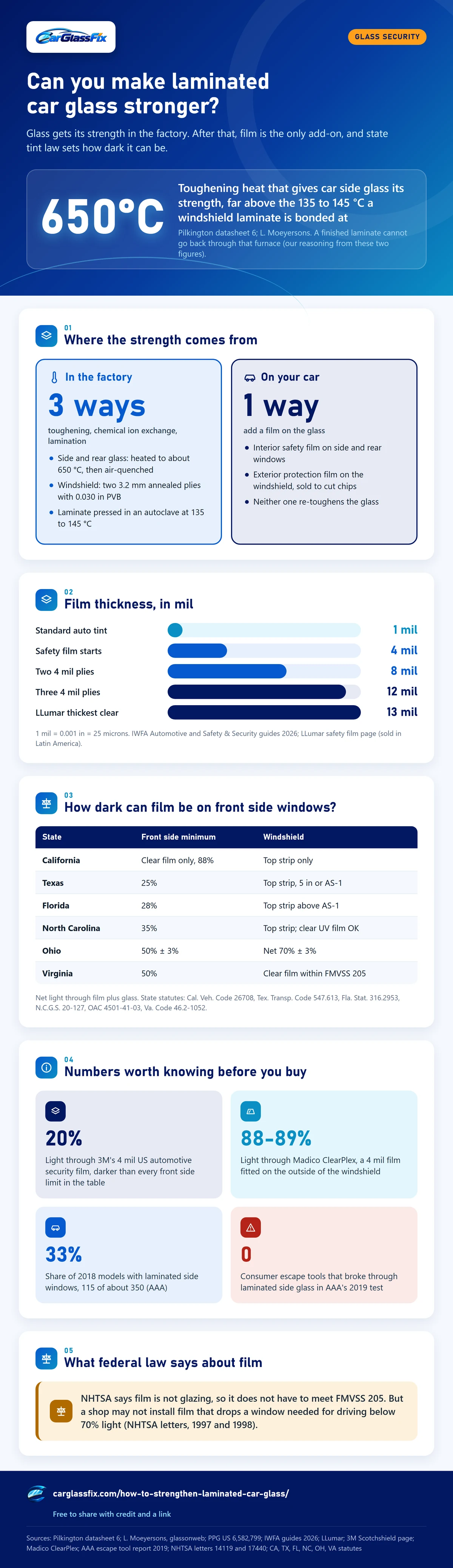
No method adds strength to a laminated windshield once it is made. Pilkington, the glass maker owned by NSG Group, describes two ways car glass is strengthened. Thermal toughening heats glass to about 650 C and quenches it with air jets. Chemical toughening swaps sodium ions in the surface for larger potassium ions, mostly for specialist glazing such as aircraft windows. Both happen in a glass plant before the part is installed. A laminated windshield is a different product. Two glass plies are bonded to a plastic interlayer in an autoclave, and that plastic holds the splinters when the glass breaks. For the layers and how they are made, see what is laminated glass. What a driver can change is limited to three things. You can put film on the glass, choose laminated replacement glass where the automaker offers it, and keep chips repaired before they spread.
Your options by window
The options depend on which window you want to protect. The windshield is laminated on every US car, and its strength is fixed. Side and rear windows are usually tempered, and some newer models use laminated front door glass. The diagram and table sort what each window can take.
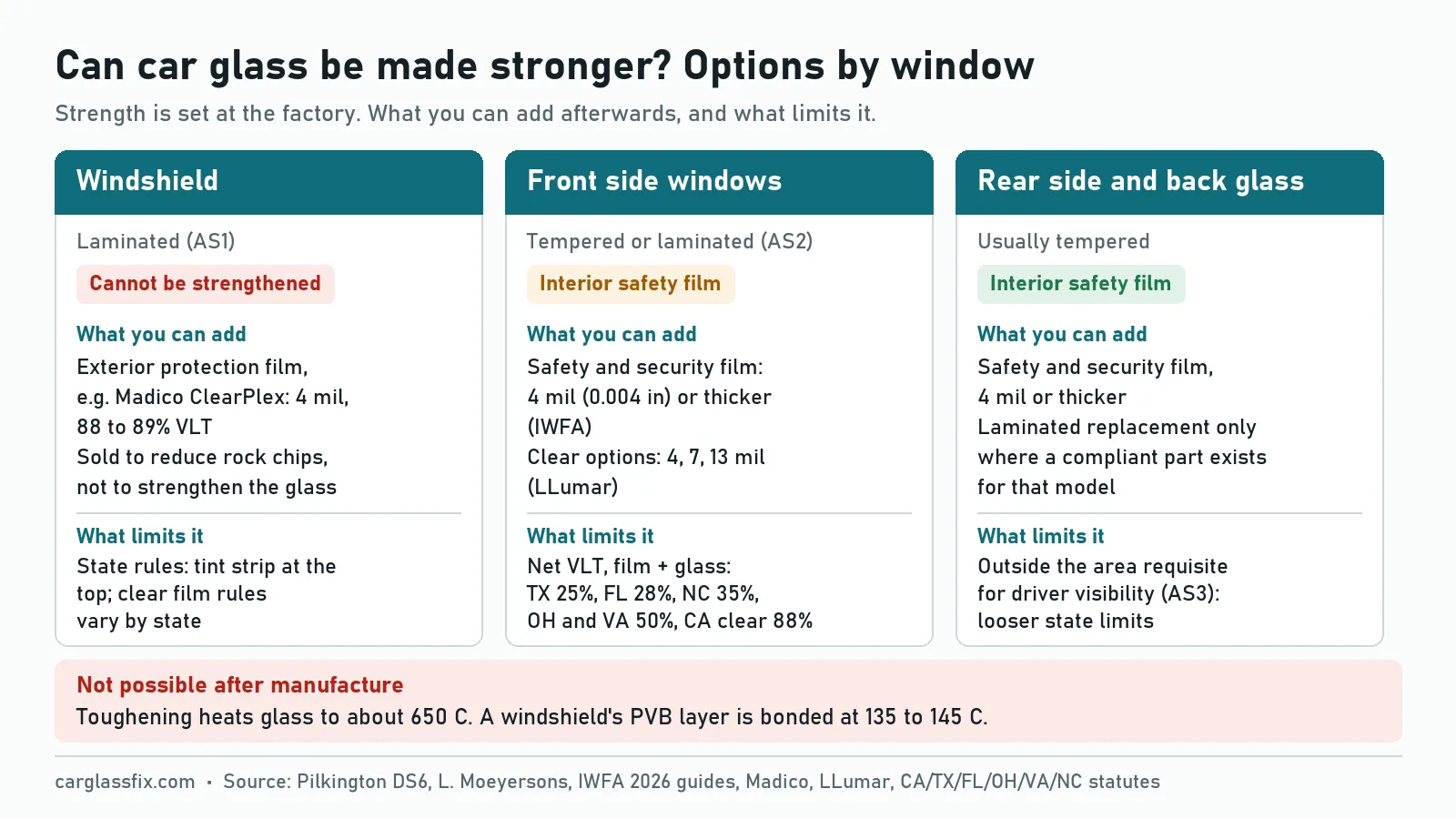
| Window | Usual glass | What you can add | What limits it |
|---|---|---|---|
| Windshield | Laminated (AS1) | Exterior protection film, such as 4 mil ClearPlex | State windshield rules; the film does not make the glass stronger |
| Front side windows | Tempered or laminated (AS2) | Interior safety and security film, 4 mil and up | State net light limits for film plus glass |
| Rear side and back glass | Usually tempered | Interior safety and security film | State rules; the IWFA notes looser limits behind the driver |
| Any side window | Tempered | Laminated replacement glass | Only where a compliant laminated part exists for that model |
AAA counted laminated side windows on about 115 of roughly 350 models in 2018. Check whether your car already has them in which cars have laminated glass.
The IWFA places the top 3 to 6 inches of the windshield and every window behind the front seats outside the area needed for driver visibility. Limits on film there are much less strict. Tempered glass breaks into many small pieces, according to Pilkington. The IWFA says safety film on tempered glass can still reduce injuries from those pieces.
Why a windshield cannot be strengthened after the fact
A finished windshield cannot go back through any process that makes glass stronger. A PPG patent describes a typical windshield as two 1/8 in (3.2 mm) annealed glass plies around a 0.030 in (0.76 mm) PVB interlayer. Annealed glass has not been toughened. Toughening needs the glass at about 650 C, according to Pilkington. The PVB is bonded at 135 to 145 C in the autoclave, according to laminating consultant Luc Moeyersons of LAMI-Solutions. Toughening a finished laminate would mean heating its plastic layer to more than four times the temperature at which it was bonded. No glass maker document read for this article describes a strengthening treatment for installed windshields. Films sit on the surface, and NHTSA does not treat them as glazing. The practical steps are protective ones. Repair chips while they are small. The limits and the method are in how to repair a laminated glass crack. When a windshield must be replaced, FMVSS 205 requires the replacement glazing to meet ANSI/SAE Z26.1-1996, the same standard as the original.
Windshield protection film: chip protection, not strength
Windshield protection film guards the outside surface but does not strengthen the glass. Madico describes ClearPlex as a 4 mil PET film installed on the exterior of the windshield. Its two products list 88% and 89% visible light transmission. Madico markets it for “reducing rock chips and cracks”. The page does not claim that the windshield itself becomes stronger. NHTSA has addressed this kind of product directly. In a 1997 letter about EDGEGUARD, a clear film for the outer 3 inches of a windshield sold to prevent cracks, NHTSA said such films “are not glazing materials themselves”. The same letter says a vehicle maker or dealer that applies film before sale must certify that the glazing still meets Standard 205. Repair businesses may not knowingly install film that degrades the glass’s light transmittance or abrasion resistance. Installation, care and removal are covered in how to use windshield crack prevention film.
Security film on side and rear windows
Safety and security film is the main way to make side and rear glass harder to break through. The International Window Film Association (IWFA) says safety films are “generally considered to be 4-mil and greater”. They use thicker pressure-sensitive adhesive to hold broken glass together. One mil is 0.001 in, or 25 microns, and standard tint film is 1 mil or 1/2 mil. The IWFA says film on the inside of the glass can stretch and absorb energy in a crash or attempted forced entry. The broken glass may then stay in the frame. Thicker films are made by laminating 4 mil plies, such as 8 mil or 12 mil. The IWFA adds that tempered glass needs a more robust installation to keep the pieces from falling out of the frame. In the US, 3M lists Scotchshield Automotive Security Window Film at 4 mil and 20% visible light. LLumar lists clear safety film at 4, 7 and 13 mil, on a page that says the product is sold only in Latin America.
These steps follow the IWFA guidance and the state rules below.
How to choose security film for car windows
Check the glass
Read the label in the corner of each window to see whether it is tempered or laminated.
Look up your state limit
Find the net light limit for each window, film and glass together, before choosing a shade.
Pick the thickness
Choose a film the maker sells as safety or security film, 4 mil or thicker.
Ask for test data
Ask which test the claim rests on and on what glass, which the IWFA advertising policy expects claims to name.
Measure after install
Have the shop meter the film and glass together on the car.
Tint laws limit which film you can use
State law, not federal law, decides how dark film on a used car can be. NHTSA’s 1998 letter says Standard 205 requires at least 70% light through every window in a passenger car. Repair businesses may not tint below that level, but federal law does not restrict owners. The IWFA says most states measure net light, meaning film and glass together. Meter tolerances average about 5% and range from 3% to 7%, and some states allow none. A clear safety film is the only kind that fits the strictest states. A tinted security film, such as 3M’s 20% product, is too dark for the front side windows in all six states below.
| State | Front side windows (net) | Windshield |
|---|---|---|
| California | Clear film only, at least 88%, and glass plus film at least 70% | Top strip only; clear 88% film elsewhere needs a dermatologist certificate |
| Texas | At least 25% | Strip above the AS-1 line or top 5 in, whichever is closer to the top |
| Florida | At least 28% | Transparent strip at the top only, not into the AS-1 area |
| Ohio | At least 50%, plus or minus 3% | Film allowed if the result is at least 70%, plus or minus 3% |
| Virginia | At least 50% | Top sunshield area only; clear film consistent with FMVSS 205 |
| North Carolina | At least 35% | Top 5 in or AS1 line; untinted clear UV film allowed |
Other states are covered in what car window tint is legal, and the windshield rules in is it illegal to have tint on your windshield.
Upgrading to laminated side glass and the trade-offs
Laminated side glass is a real upgrade only where a compliant part exists for your car. Pilkington builds laminated sidelights as two semi-toughened plies around a 0.76 mm PVB layer, 2.1/0.76/2.1 mm or thicker. A PPG patent says a laminated sidelite should be about the same thickness as the 4 to 5 mm tempered glass it replaces. FMVSS 205 requires aftermarket replacement glazing to meet the federal standard. Ask the glass shop for the automaker’s part number for a laminated version of your door glass. The IWFA says laminated glass usually stays in the opening after it breaks, which resists entry. That same strength affects escape. In a 2019 AAA test, no consumer escape tool broke through laminated side glass, and a ball-peen hammer could not clear it from the frame. Plan your exit with how to break laminated glass in an emergency. Film that holds tempered glass in the frame may slow an exit the same way, so ask the installer about it. Neither film nor laminated glass is armor. That topic is covered in can laminated glass stop a bullet.
What does not work
Several common claims do not hold up against the sources. A coating or film on the windshield does not raise the strength of the glass, and NHTSA treats such films as separate from the glazing. Thicker film is not proof of performance on its own. The IWFA says UL will not issue a passing report under UL 972 for glass and safety film alone, only for a complete tested glazing system. The IWFA also warns about members who “exaggerate or distort” what safety film can do. Film on a side window does not replace the ejection protection that FMVSS 226 requires. NHTSA expected automakers to meet that rule mainly with curtain air bags. It noted that advanced glazing can be rendered ineffective in a rollover. A dark security film can also put a car over its state light limit. Even the makers stop short of promising that film keeps a thief out. LLumar says its film “slows down intruders”.
Frequently asked questions
Can a windshield be tempered after it is made?
No. Toughening heats glass to about 650 C, according to Pilkington, while a windshield’s PVB interlayer is bonded at about 135 to 145 C, so a finished laminate cannot be toughened.
What makes tempered glass stronger?
Tempering cools the glass surface faster than the core, which leaves the surface in compression and raises the load the glass can take, according to Pilkington. The comparison with laminated glass is in laminated glass vs tempered glass.
How thick should security film be on a car window?
The IWFA classes safety and security film as 4 mil (0.004 in) or thicker. Makers also sell multi-ply films, such as LLumar’s 7 and 13 mil clear films.
Is clear security film legal on front side windows?
A clear film passes in a state that measures net light if film and glass together meet the limit. California allows only clear film of at least 88% on the front side windows, with an installer certificate.
Does laminated glass crack?
Yes. Laminated glass can crack, but the PVB layer holds the pieces in place. In AAA’s 2019 test, four escape tools cracked laminated side glass and none broke through.
Sources
- Pilkington Technology Datasheet 6, Shaping and strengthening (read 29 October 2026)
- Pilkington knowledge hub: Laminated sidelights
- L. Moeyersons (LAMI-Solutions), Automotive glass: Autoclaving and Inspection, glassonweb
- PPG Industries, US Patent 6,582,799 B1 (background on windshield and sidelite construction)
- 49 CFR 571.205, FMVSS 205 Glazing materials (checked October 2026)
- NHTSA final rule, FMVSS 226 Ejection mitigation, 76 FR 3212 (January 19, 2011)
- NHTSA interpretation 14119.drn (July 3, 1997), windshield film and Standard 205
- NHTSA interpretation 17440.drn (June 22, 1998), aftermarket tinting film
- IWFA Automotive Education Guide 2026
- IWFA Safety and Security Education Guide 2026
- 3M Scotchshield Automotive Security Window Film 20, 4 mil, product page (read 29 October 2026)
- LLumar: Deter smash and grab with safety window film (read 29 October 2026)
- Madico ClearPlex windshield protection film (read 29 October 2026)
- AAA, Vehicle Escape Tool Evaluation (July 2019)
- California Vehicle Code 26708 (checked October 2026)
- Texas Transportation Code 547.613 (checked October 2026)
- Florida Statutes 316.2953 and 316.2952 (checked October 2026)
- Ohio Administrative Code 4501-41-03 (checked October 2026)
- Code of Virginia 46.2-1052 (checked October 2026)
- North Carolina General Statutes 20-127 (checked October 2026)
Similar Posts