How to Remove Scratches From a Motorcycle Windshield
Senior Automotive Glass Diagnostic Specialist & Master Technician at CarGlassFix · AGSC Master Certified Auto Glass Technician, NGA Certified Installer, I-CAR Automotive Safety Specialist · 12+ Years in Automotive Glazing, Windshield Structural Bonding, ADAS Camera Calibration & Precision Chip Restoration
Light scratches on a motorcycle windshield can be polished out with a plastic scratch remover such as NOVUS No. 2, which Harley-Davidson and Zero Gravity name. The method depends on the material. Uncoated acrylic can be polished and, for deeper scratches, wet sanded. Hard-coated polycarbonate cannot be spot repaired once a scratch cuts through the coating.
Can you remove scratches from a motorcycle windshield?
Yes, light scratches can usually be removed, and the screen material decides how far you can go. Most motorcycle windshields are plastic, either acrylic or polycarbonate. National Cycle states that most aftermarket companies use acrylic. Harley-Davidson’s service procedures describe its screens as polycarbonate, and one names a Lexan windshield. Harley-Davidson recommends NOVUS No. 2 Scratch Remover to remove minor surface scratches. Zero Gravity, which makes acrylic sport bike screens, advises applying NOVUS No. 2 periodically for long-term clarity. Deeper damage has firmer limits. Honda’s owner’s manuals for the Gold Wing and the Africa Twin say to replace the windscreen if scratches cannot be removed and they obstruct clear vision. The National Cycle limited warranty covers breakage and excludes scratches and coating failure. For scratches in a car’s laminated glass windshield, the method is different and is covered in the guide on how to remove scratches from a windshield.
Acrylic vs polycarbonate screens
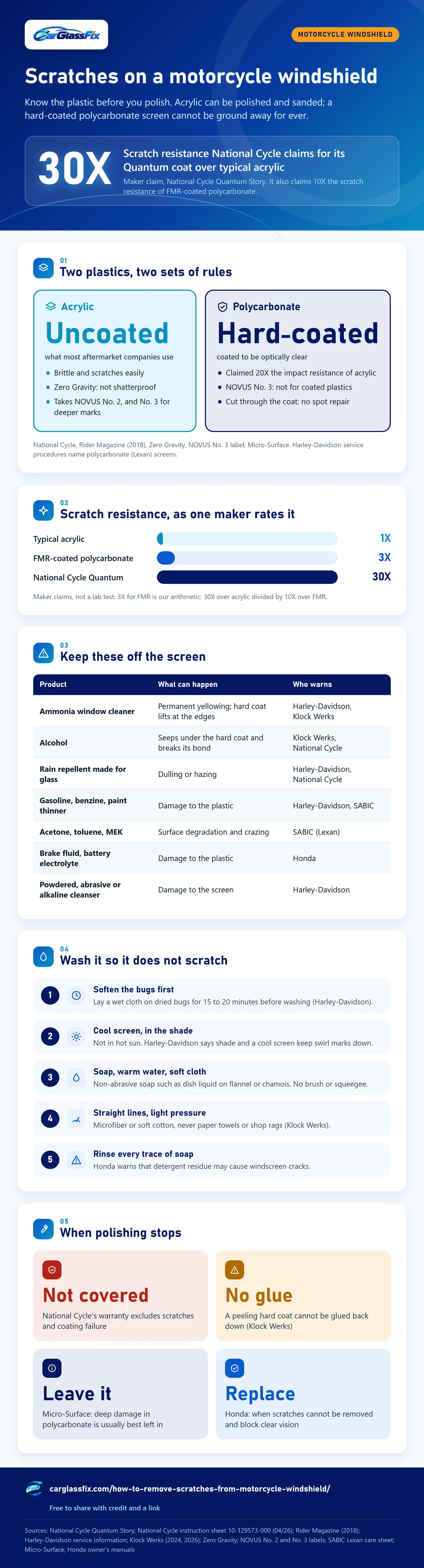
Acrylic and polycarbonate screens need different care, because acrylic is usually uncoated and polycarbonate is usually hard-coated. National Cycle labels plain acrylic screens as uncoated and brittle. Zero Gravity states that acrylic is not shatterproof and that its screens will probably crack if hit by a rock or a bird.
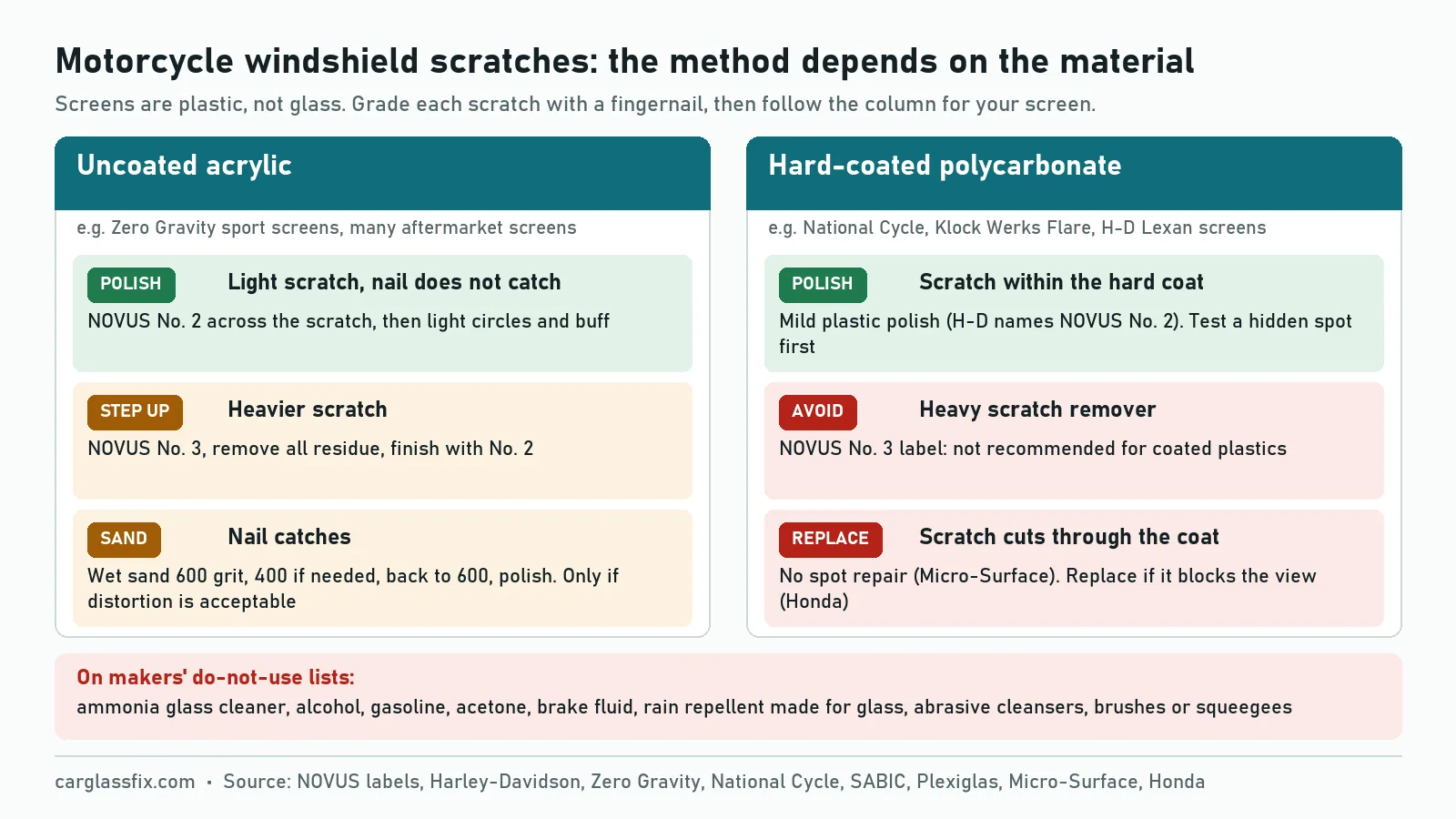
Polycarbonate is the tougher material, and National Cycle claims it is 20 times more impact resistant than acrylic. Its surface is soft, though. National Cycle says polycarbonate must be hard-coated to be optically clear enough for a windshield. Klock Werks applies an FMR hard coat to both sides of its Flare screens. Micro-Surface, a maker of plastic restoration kits, says polycarbonate motorcycle screens are usually coated. To find your material, check the screen maker’s instructions, the part listing or the owner’s manual. If you cannot confirm it, treat the screen as coated.
| Attribute | Acrylic | Hard-coated polycarbonate |
|---|---|---|
| Surface | Usually uncoated (National Cycle) | Hard coat on the plastic (National Cycle, Klock Werks) |
| Impact | Not shatterproof (Zero Gravity) | Higher impact strength (National Cycle claim) |
| Light scratches | NOVUS No. 2 (Zero Gravity) | NOVUS No. 2 (Harley-Davidson) or mild polish after a test (SABIC) |
| Heavy scratch remover | NOVUS No. 3, then No. 2 | NOVUS No. 3 not recommended for coated plastics |
| Scratch through the surface | Wet sanding possible, with distortion risk | No spot repair (Micro-Surface) |
How to polish light scratches out of an acrylic screen
Light scratches in an acrylic screen come out with a liquid plastic scratch remover worked in by hand. The steps follow the NOVUS No. 2 and No. 3 label directions and the Harley-Davidson and Zero Gravity care notes. Work on a cool screen in the shade, because Harley-Davidson and National Cycle both warn against cleaning in hot sun.
How to polish light scratches out of a motorcycle windshield
Wash first
Soak dried bugs under a wet cloth for 15 to 20 minutes, as Harley-Davidson suggests, then wash with mild soap and warm water and dry with a soft towel.
Test a hidden spot
Both NOVUS labels say to shake the bottle and test in an inconspicuous area first.
Polish across the scratch
Apply NOVUS No. 2 liberally and rub firmly back and forth at right angles to the scratches. Keep the cloth saturated with polish.
Finish in light circles
When the worst scratches are gone, spread No. 2 over the whole screen in short circles with light pressure and let it dry to a light haze.
Buff to a glaze
Buff with a clean part of the cloth using firm, short strokes. Follow with NOVUS No. 1 cleaner.
Step up only on acrylic
For heavy scratches, NOVUS allows repeat No. 2 passes or No. 3. Remove all No. 3 residue, then finish with No. 2.
Faint swirl marks can remain. Harley-Davidson calls faint swirl marks normal and says they may show more on tinted windshields. Use soft cotton or microfiber cloths only. Zero Gravity asks for an optical quality soft cloth or 100% cotton.
What polishing can and cannot fix on hard-coated polycarbonate
Polishing can only refine a scratch that stays inside the hard coat on a polycarbonate screen. Once a scratch reaches the plastic underneath, polishing will not restore it. Micro-Surface says that damage still within the coating can be spot repaired and polished back out. Damage that has gone through the coating should not be spot repaired. Micro-Surface says the whole coating would have to be removed, or the repair shows as a bullseye. It adds that bare polycarbonate cannot be restored to optical clarity because it is much softer, and that deep damage is usually best left alone. SABIC, the maker of Lexan sheet, says scratches and minor abrasions can be minimized with a mild automobile polish. SABIC also asks for a test on a small area first. The NOVUS No. 3 label says it is not recommended for coated plastics. National Cycle’s Paul Gomez told Rider Magazine that harsh and abrasive cleaners also harm hard-coated polycarbonate, and Rider adds that you cannot grind away at the coating forever. Klock Werks says a damaged coating that starts to peel cannot be glued back down.
Deep scratches: wet sanding limits and when to replace
A scratch that catches a fingernail needs sanding on acrylic and usually a new screen on hard-coated polycarbonate. The Plexiglas acrylic care text, as reproduced by Dimin, uses the fingernail test. If the scratch can be felt, sanding is required. That text also says scratch removal should only be done if the resulting optical distortion can be tolerated. The steps it gives start with 600 grit open coat paper on a rubber padded block. If the scratch remains, it steps down to 400 grit, sands in directions 30 degrees apart, returns to 600 grit and then polishes. It warns against dry disc or belt sanders, and says heat from sanding may degrade the sheet. Distortion matters more on a windshield than on a sign, because you look through it at speed. Honda’s Gold Wing and Africa Twin manuals say to replace the windscreen if scratches cannot be removed and they obstruct clear vision. Honda’s CBR1000RR manual allows a commercially available plastic polishing compound for minor scratches. Zero Gravity notes that its screens are not DOT certified unless marked as such, so check the marking when you buy a replacement. Federal glazing standard FMVSS 205 applies to motorcycles and their glazing.
Cleaners and solvents that haze, craze or peel a screen
Ammonia, alcohol, fuel and strong solvents are the products screen makers most often warn against. Harley-Davidson says ammonia-based window cleaners cause permanent yellowing and that powdered, abrasive or alkaline cleansers damage the screen. SABIC says MEK and hydrochloric acid can cause crazing of Lexan. Klock Werks says ammonia, alcohol or heavy detergents can seep into the edges or micro-scratches and break the hard coat bond, often starting at the mounting holes. Honda says detergent residue may cause windscreen cracks. Makers disagree on petroleum solvents. National Cycle allows naphtha or turpentine for paint or grease, while Klock Werks says to avoid petroleum-based cleaners. Follow your own screen maker’s sheet. For the same issue on car glass, see what not to use to clean car windows.
| Product or tool | What the maker says | Source |
|---|---|---|
| Ammonia glass cleaner | Permanent yellowing; no household glass cleaners | Harley-Davidson; National Cycle; Klock Werks |
| Alcohol | Do not let it contact the screen | National Cycle; Klock Werks; Plexiglas text |
| Gasoline, benzine, paint thinner | Damages the windshield surface | Harley-Davidson; SABIC |
| Acetone, toluene, benzene | Never use on Lexan | SABIC |
| MEK, hydrochloric acid | Surface degradation and possible crazing | SABIC |
| Brake fluid, battery electrolyte | Will damage the plastic | Honda; National Cycle |
| Rain repellent made for glass | Do not use; can dull or haze | National Cycle; Harley-Davidson |
| Brush, squeegee, razor blade, steel wool | Damages the finish | Harley-Davidson; SABIC |
| Paper towels, shop rags | Do not use | Klock Werks |
Why glass scratch methods do not apply
Glass scratch methods do not apply because a motorcycle screen is plastic, and every screen maker reviewed for this guide lists plastic products only. Cerium oxide polishing is a method for glass. None of the motorcycle or screen makers above lists cerium oxide or glass scratch kits for their screens. National Cycle says not to use rain protective products made for glass. Its Paul Gomez told Rider Magazine that Rain-X and plastics do not play well together. Car headlight lenses raise the same glass or plastic question, covered in are car headlights glass or plastic. Car windshields are laminated glass, a different structure covered in laminated glass vs tempered glass. For glass compounds, see what you can use to polish a windshield. To keep new scratches away, rinse grit off before wiping, as Klock Werks advises. Wipe in straight lines with light pressure. More prevention habits are in the guide on how to protect a windshield from scratches.
Frequently asked questions
Can you buff out scratches on a motorcycle windshield?
Light scratches can be buffed out with a plastic scratch remover such as NOVUS No. 2, which Harley-Davidson and Zero Gravity name. On hard-coated polycarbonate, a scratch that has cut through the coating cannot be spot repaired, according to Micro-Surface.
What is the best scratch remover for a motorcycle windshield?
The best choice is the product your screen or motorcycle maker names. Harley-Davidson and Zero Gravity name NOVUS No. 2. NOVUS says its No. 3 heavy scratch remover is not recommended for coated plastics.
Does WD-40 remove scratches from a motorcycle windshield?
No screen or motorcycle maker reviewed for this guide lists WD-40 for scratches. National Cycle warns that strong solvents can damage the screen, and Klock Werks warns against petroleum-based and aerosol cleaners.
Can I use Windex on a motorcycle windshield?
No. Harley-Davidson says ammonia-based window cleaners cause permanent yellowing, and National Cycle says not to use household glass cleaners. Use mild soap and warm water or a cleaner made for plastic screens.
Can I use a car windshield scratch kit on a motorcycle screen?
No. Car windshield kits use cerium oxide for glass, and motorcycle screens are acrylic or polycarbonate plastic. The glass method is explained in the guide on how to remove scratches from a windshield.
Sources
- Harley-Davidson service information: windshield cleaning procedure (NOVUS No. 2, Part No. 99836-94T) (checked 2026-10-26)
- Harley-Davidson service information: polycarbonate windshield care (checked 2026-10-26)
- National Cycle: Quantum coated polycarbonate windshield technology
- National Cycle instruction sheet 10-129573-000 (04/26): cleaning, maintenance and limited warranty
- Zero Gravity: Mounting and cleaning instructions
- Zero Gravity: Windscreen series information
- Klock Werks: What happens if you don’t care for your Flare windshield properly?
- Klock Werks: How to clean a Klock Werks windshield without damage
- NOVUS Plastic Polish No. 2 Fine Scratch Remover directions (copy)
- NOVUS Plastic Polish No. 3 Heavy Scratch Remover directions (copy)
- SABIC: Lexan sheet cleaning recommendations
- Plexiglas acrylic care and scratch removal text, as reproduced by Dimin
- Micro-Surface Finishing Products: Polycarbonate (Lexan)
- Honda Gold Wing (GL1800) owner’s manual: cleaning the windscreen (page reproduced by bike-parts.fr)
- Honda Africa Twin (CRF1000) owner’s manual: windscreen (page reproduced by bike-parts.fr)
- Honda CBR1000RR owner’s manual: appearance care (page reproduced by bike-parts.fr)
- Rider Magazine: Motorcycle windshield maintenance (2018)
- 49 CFR 571.205, FMVSS No. 205 Glazing materials (checked 2026-10-26)

Similar Posts