Safe Drive-Away Time Calculator for Windshield Replacement
Senior Automotive Glass Diagnostic Specialist & Master Technician at CarGlassFix · AGSC Master Certified Auto Glass Technician, NGA Certified Installer, I-CAR Automotive Safety Specialist · 12+ Years in Automotive Glazing, Windshield Structural Bonding, ADAS Camera Calibration & Precision Chip Restoration
You can drive after a windshield replacement once the adhesive’s minimum drive-away time has passed. Published times run from 30 minutes to 24 hours, depending on the product, temperature and humidity. The data sheet for the exact urethane sets the figure, and your installer must tell you the time that applies.
Follow your installer’s stated time. If it differs from this result, the installer’s time applies, so ask which adhesive and chart it came from.
This tool only looks up published figures. It does not calculate a cure time and it is not a safety clearance. Sheets checked 31 Oct 2026.
What the calculator shows
The calculator shows the time printed on the data sheet for the adhesive you select. It uses no formula. Pick the product your installer named, then the temperature and humidity at the job. The tool returns the matching cell from that maker’s chart, with the document name and date. Some products list one time across a wide temperature range, so those skip the weather inputs. If the sheet gives no figure, the tool says so and shows no number.
The result does not clear your car to drive. The vehicle’s own rules and the shop’s procedure sit outside these charts. Your installer knows those details, so the installer’s stated time comes first. If that time differs from the chart, ask which adhesive and chart it came from. The tool also accepts the time the glass was set. It adds the sheet’s time to that clock time, and the arithmetic is the only calculation on the page. AGRSS defines the time as starting after the glass part is set in place.
Data sheet times by adhesive
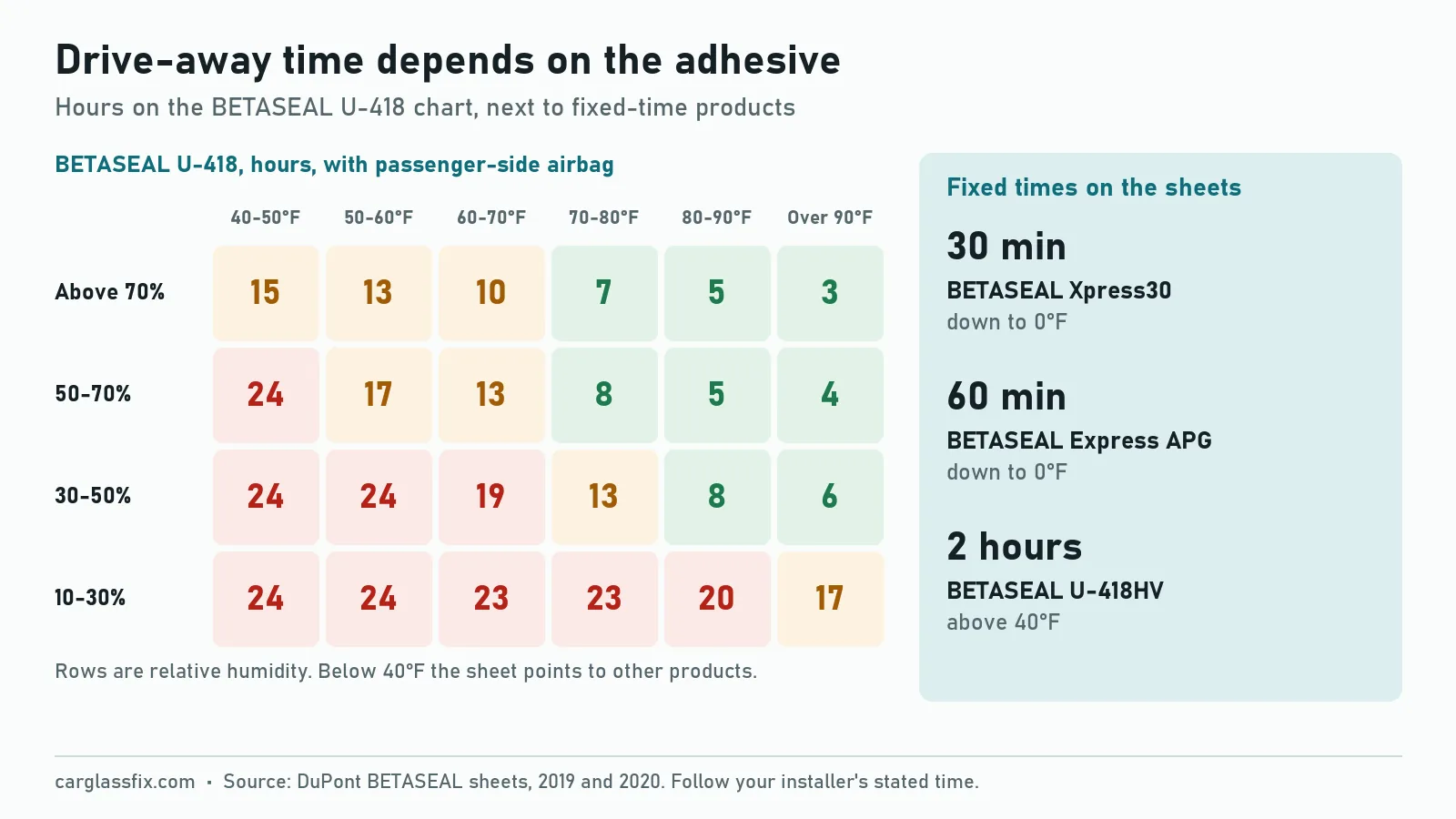
Advanced-cure urethanes list one short time, and conventional moisture-cure urethanes list a chart. I-CAR reports 30 to 60 minutes for fast-cure products and 2 to 8 hours or longer for conventional moisture-cured products. The sheets below fit that split, and BETASEAL U-418 runs longer than I-CAR’s general range when the air is cold or dry. The table groups the products from shortest to longest. Dates matter here, because the Sika chart is from 2017 and the 3M sheet is from 2007. A product can also be reformulated after a sheet is printed, so ask the shop for the current version if the date looks old.
| Adhesive | Stated time | Conditions on the sheet | Document |
|---|---|---|---|
| BETASEAL Xpress30 | 30 minutes | Down to 0°F | DuPont, revised 2020-05-20 |
| SikaTack ELITE, SikaTack PRO | 30 minutes | 14 to 95°F | Sika USA page |
| SikaTack MACH 30 | 30 to 45 minutes | 45 minutes at 65 to 120°F with humidity of 40% or lower | Sika chart, 2017 |
| BETASEAL Express APG | 60 minutes | Down to 0°F | DuPont sheet, undated |
| SikaTack DRIVE (60 min) | 60 minutes with airbag | 41 to 95°F | Sika, 11-2024 |
| SikaTack GO! | 120 minutes | 41 to 95°F | Sika USA page |
| BETASEAL U-418HV | 2 hours | Above 40°F | DuPont, 2019 |
| Sikaflex P2G | 4 to 6 hours | Above 40 to 110°F | Sika chart, 2017 |
| BETASEAL U-418 | 3 to 24 hours | 40°F and above, by humidity | DuPont, 2019 |
| Sikaflex-220+ | 8 to 16 hours, or NR | Above 40 to 110°F, by humidity | Sika, 04-2023 |
| 3M Window-Weld Super Fast 08609 | Not stated | Sheet gives lap-shear charts only | 3M, Rev 3, 2007 |
Why temperature and humidity change the time
Moisture-cure urethane reacts with water in the air, so cold, dry air slows it. Sika’s Sikaflex-220+ sheet says the water content of the air is generally lower at low temperatures and the reaction runs more slowly. I-CAR says the shortest moisture-cure time assumes 75°F and 50% relative humidity. It also says lower temperature or humidity requires a longer time.
The DuPont U-418 chart shows the size of the effect. At 70 to 80°F the time is 7 hours above 70% humidity. The same temperature needs 23 hours at 10 to 30% humidity. Sikaflex-220+ shows 8 hours above 72°F with humidity over 40%. At 20% humidity or lower, that sheet shows NR in every column. Advanced-cure sheets list one time across a wide range, so the weather inputs do not apply to them. For the wider effect of weather on the job itself, read how temperature affects windshield installation. Shops can choose an adhesive to match the day. Sika’s guideline says the speed a customer needs will dictate the adhesive used.
What AGRSS requires from your installer
AGRSS 005-2022 requires the installer to follow the adhesive maker’s instructions and to tell you the drive-away time. Section 5.4 says installers shall obtain and follow current written instructions, including drive-away charts with temperature and humidity variables where applicable. Section 6.3 bars using an adhesive that would not reach drive-away strength by the time the vehicle may reasonably be expected to be operated. Section 6.4 says the owner or operator shall be notified of the time before and after the installation.
The standard defines drive-away strength through the retention system maker, which sets the properties needed to meet FMVSS 208 and 212. Those federal standards cover occupant protection and windshield retention, so the time has a crash-safety purpose. The link between the bond and the passenger airbag is covered in can windshield replacement affect airbags. Sika’s AGR guideline says the vehicle must stay out of service until the time has been reached and the owner has been told. DuPont’s sheet tells installers to tell the customer when the time will be reached. What to expect during windshield replacement covers the rest of the appointment.
When the automaker’s rule is longer
An automaker’s rule can run longer than the adhesive sheet, and the longer rule still applies. I-CAR reports that FCA/Stellantis states 24 hours. I-CAR also reports that Ford/Lincoln says not to release the vehicle until full cure is reached. The calculator shows a warning for those brands and leaves the sheet’s figure visible, so you can raise the difference with the shop.
Specific service documents can also set their own wait. A 2020 Nissan service document for the Pathfinder says the vehicle should not be driven for at least 24 hours or until the urethane has completely cured. An FCA recall instruction from 2016 told dealers to allow at least 4 hours on certain minivans. Those examples are tied to one document, so they do not set a rule for every model. The drive-away time is also separate from full cure. I-CAR says glass urethane may take 24 hours to reach full strength and longer to fully cure. Aftercare for that period sits in how to care for your car after glass replacement.
How to use the result at the shop
The most useful step is to ask for the product name before the job starts. The answer tells you which chart applies. A shop can match the adhesive to the weather and to how soon you need the car, so say when you must drive before the job begins. Written answers help if a question comes up later. Ask the installer these points and compare them with the sheet. The steps below take a few minutes, and they give you a record of the product, the conditions and the time.
Check your drive-away time
Ask for the adhesive
Get the maker and product name, and note the lot number if the shop shares it.
Ask for the conditions
Ask which temperature and humidity the shop used for its chart.
Look up the sheet
Select the product here and compare the time with the one you were given.
Note the set time
Write down when the glass was set, because the time counts from that point.
Wait for the stated time
Do not drive until the installer’s time has passed, even if the chart shows a shorter one.
Frequently asked questions
How long after windshield replacement can I drive?
Wait for the time your installer states. Safelite recommends at least one hour after service for its work, and published adhesive sheets run from 30 minutes to 24 hours depending on the product and conditions.
Is one hour always enough?
No. One hour matches some advanced-cure products, while BETASEAL U-418 lists up to 24 hours and Sikaflex-220+ lists up to 16 hours.
What does NR mean on the Sikaflex-220+ chart?
NR is the entry the sheet shows where it gives no drive-away time. The sheet does not spell the letters out, so ask the installer what they will do in those conditions.
Does the time change for a car without airbags?
It can. The U-418 chart is headed for a passenger-side airbag and SikaTack DRIVE states its time with airbag, so use the figure your installer gives for your car. See how long car glass replacement takes for the full appointment.
What if I drove before the time passed?
Tell the installer and ask them to check the bond. Warning signs of a bad job are listed in signs of a poor car glass replacement job.
Sources
- DuPont BETASEAL primerless-to-glass adhesives sheet, form 001-20131-OIA0519 (2019), checked 31 Oct 2026
- DuPont BETASEAL Xpress30 data sheet, revised 2020-05-20, checked 31 Oct 2026
- DuPont BETASEAL Advanced-Cure Adhesives sheet, checked 31 Oct 2026
- Sikaflex-220+ Product Data Sheet, version 06.01 (04-2023), checked 31 Oct 2026
- SikaTack DRIVE (60 min) Product Data Sheet, version 06.01 (11-2024), checked 31 Oct 2026
- Sika SDAT Charts, REV 03.01.2017, checked 31 Oct 2026
- Sika USA, Minimum Drive-Away Time, checked 31 Oct 2026
- Sika Auto Glass Replacement Guideline (US, 5-2026), checked 31 Oct 2026
- 3M Technical Data Sheet 08609, Rev 3, effective 09/14/2007
- ANSI/AGSC/AGRSS 005-2022, sections 3.13, 3.14, 5.4, 6.3, 6.4, checked 31 Oct 2026
- I-CAR RTS, Minimum Driveaway Time For Urethane Adhesive (validated 2024)
- Safelite help center, checked 31 Oct 2026
- Nissan dealer instructions PC756 (2020)
- FCA Safety Recall S02 dealer instructions (2016)

Similar Posts