Windshield Tint Strip Limit by State: Lookup Tool
Senior Automotive Glass Diagnostic Specialist & Master Technician at CarGlassFix · AGSC Master Certified Auto Glass Technician, NGA Certified Installer, I-CAR Automotive Safety Specialist · 12+ Years in Automotive Glazing, Windshield Structural Bonding, ADAS Camera Calibration & Precision Chip Restoration
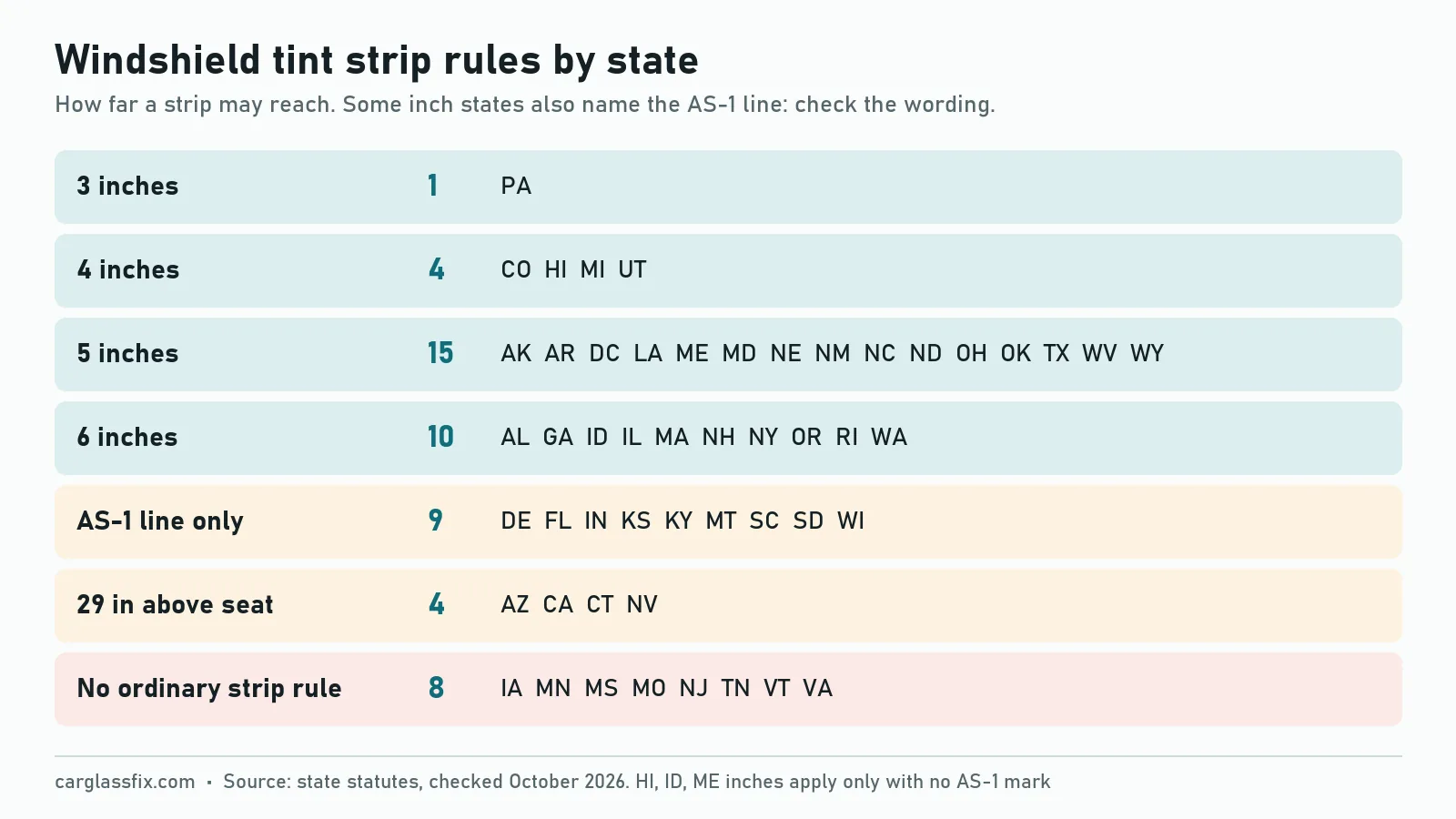
A front windshield tint strip is legal in most states, down to the AS-1 line, a set number of inches from the top, or a seat-height mark. Limits run from 3 inches in Pennsylvania to 6 inches in New York. Eight states have no ordinary strip rule, including Iowa and Minnesota.
From state statutes as listed. A helper reading is a guide, not a legal finding, because most laws do not say exactly where the top of the windshield starts. General information, not legal advice.
How the windshield strip lookup works
The windshield tint strip lookup shows how far a strip may reach in your state and how dark it may be. Pick a state to see the limit, the allowed shade, the statute and the check date. A helper then explains how to measure that kind of limit.
For states with an inch figure, the helper has a box for your own measurement. Type how far the strip reaches down from the top of the glass, and it compares that number with the figure in the law. For AS-1 and seat-height states the box stays hidden, because inches from the top do not decide the question.
The data comes from the same statute file as the site’s state pages. Each result links to the full page for that state. For the basic legal question, read is it illegal to have tint on a windshield. This page stays on the strip itself.
Windshield tint strip limits by state
Windshield tint strip limits fall into four groups: inches, the AS-1 line, a seat-height mark and no strip rule. The chart sorts all 50 states and DC. A state with an inch figure may also name the AS-1 line, so check the wording in the lookup.
| Rule type | Example | Wording in the law |
|---|---|---|
| Inches only | New York, Alabama, Louisiana | Top 5 or 6 inches |
| AS-1 only | Florida, Kansas, Delaware | Strip may not reach below the line |
| Closer of two limits | Texas, Ohio, Oklahoma, New Mexico | AS-1 line or 5 inches, whichever is closer to the top |
| Longer of two limits | North Carolina | 5 inches or the AS1 line, whichever measurement is longer |
| Inches as a fallback | Maine, Idaho, Hawaii | AS-1 line, or inches only if the glass has no line |
| Seat height | California, Arizona, Connecticut, Nevada | Bottom edge 29 inches above the driver’s seat |
| No strip rule | Iowa, Minnesota, Vermont | No exception for a strip |
The tie-break matters. A strip that reaches the AS-1 line can still break the Texas rule if the line sits lower than 5 inches. The same strip can pass in North Carolina. The Texas window tint laws page shows the rest of that state’s limits.
How dark a windshield tint strip can be
Most state laws set no percent for a windshield strip, so a shade limit applies only in a short list of states. Where no number exists, the law usually sets a color or finish rule. Texas requires at least 25% light transmission with the glass, at most 25% reflectance, and no red, blue or amber.
Indiana sets 30% light transmittance and 25% reflectance. New Hampshire requires at least 35% on a strip no wider than 6 inches. South Dakota requires a combined 35%, with a 9% enforcement tolerance. New York allows material under 70% in the top 6 inches and states no minimum.
Other states describe the film instead. Alabama, Georgia and Louisiana say transparent, and not red or amber. Illinois and Idaho say nonreflective. Kansas, New Mexico, West Virginia and Wyoming bar red, yellow and amber. Federal Standard 205 sets no transmittance level for the shade band above the line, according to a NHTSA letter to a Virginia trooper. The window tint percentage chart shows how a percent looks on glass.
How to measure a windshield tint strip
Measure a windshield tint strip by the kind of limit your state uses, since each one starts from a different point. Most laws do not define the top of the windshield. Hawaii measures from the middle of the top moulding, and Arkansas from the top center.
How to measure a windshield tint strip
Check the rule type
Use the lookup to see whether your state uses inches, the AS-1 line or seat height.
Find the AS-1 mark
Look near the top edge for AS-1 or AS1 with an arrow on a short horizontal line.
Measure inches at the center
Hold a tape flat on the glass and measure straight down from the top edge to the lowest edge of the strip.
Measure seat height if needed
With the seat fully back and down, start 5 inches in front of the bottom of the backrest and measure 29 inches up.
Compare and keep a margin
Stop the strip short of the limit, since an officer or inspector may start from a different point.
A windshield with no AS-1 line needs extra care. NHTSA told a Virginia trooper that such a windshield must have at least 70% light transmittance across the whole glass. State law can then add its own fallback, as Maine, Idaho and Hawaii do with inches.
The AS-1 line has no fixed height. Federal Standard 205 places it by SAE J100 or by a 7-degree plane through a design point, so the depth changes by vehicle. The guide to the AS-1 line on a windshield explains the mark in detail.
States with no ordinary windshield strip rule
Eight states have no ordinary strip rule, though the reasons differ. Iowa’s law has no strip exception and requires 70% on the windshield. Minnesota bars material that reduces transmittance in any way. Vermont bars adhered material outside small listed spaces, and its inspection manual rejects aftermarket windshield tint.
Mississippi and Missouri tie the rule to the band that glass makers apply. Virginia allows material only to replace the factory sunshield, and since July 1, 2026 it allows clear film that stays consistent with Standard 205. New Jersey requires a medical exemption from the MVC for any windshield film. Tennessee has no strip wording apart from the maker’s shade band, with 70% for the windshield and 35% for added material.
Federal law adds a limit for shops in every state. NHTSA has said a business may not install tint that takes windows covered by Standard 205 below 70%, and that this rule does not reach owners who do the work themselves. A state exemption does not change that for a shop.
A few states also allow other material lower on the glass if it passes 70% with the glass. Ohio, Kentucky, North Dakota and Rhode Island are in this group. That is a separate rule from the strip. Read whether windshield tint interferes with sensors before covering a camera area.
Frequently asked questions
How far down can a windshield tint strip go?
It depends on the state. Inch figures run from 3 inches in Pennsylvania to 6 inches in states such as New York, and nine states use only the AS-1 line.
Is a windshield brow strip legal?
A brow or visor strip is legal in most states if it stays inside the state limit. Iowa, Minnesota and Vermont are among the states with no strip exception.
How far down is the AS-1 line?
The AS-1 line has no set inch height. Federal Standard 205 places it by a shade band rule, so the depth varies by vehicle. See the AS-1 line guide for how to find it.
Can a tint strip be any shade?
In many states the law sets no percent, but color and reflectance rules still apply. Texas, Indiana, New Hampshire and South Dakota set a percent.
What if my windshield has no AS-1 line?
Maine, Idaho and Hawaii fall back to inches when there is no line. South Carolina allows no windshield tint when the line is not visible.
Sources
- 49 CFR 571.205, FMVSS 205 (read 29 October 2026)
- NHTSA interpretation 11-000697 (read 24 October 2026)
- Tex. Transp. Code 547.613 (read 29 October 2026)
- Cal. Veh. Code 26708 (read 29 October 2026)
- K.S.A. 8-1749a (read 29 October 2026)
- RCW 46.37.430 (read 29 October 2026)
- Va. Code 46.2-1052 (read 29 October 2026)
- Ark. Code 27-37-306 (read 29 October 2026)
- Minn. Stat. 169.71 (read 24 October 2026)

Similar Posts