Tint Laws in Texas: Legal Percentages by Window
Senior Automotive Glass Diagnostic Specialist & Master Technician at CarGlassFix · AGSC Master Certified Auto Glass Technician, NGA Certified Installer, I-CAR Automotive Safety Specialist · 12+ Years in Automotive Glazing, Windshield Structural Bonding, ADAS Camera Calibration & Precision Chip Restoration
In Texas, front side windows must let through at least 25% of light with film and glass together and reflect no more than 25%. Side windows behind the driver may be any darkness, and so may the rear window if the vehicle has two outside mirrors. Windshield tint must stay above the AS-1 line or the top 5 inches.
Texas window tint limits by window
Texas sets a 25% minimum for the front side windows and no minimum for the windows behind the driver. The rule is Texas Transportation Code 547.613, last amended by S.B. 589 in 2009. The statute makes tinted glass an offense and then lists exceptions, so each limit below is an exception the film must fit. The same limits apply to sedans and to multipurpose vehicles. The code defines a multipurpose vehicle as one designed for 10 or fewer people and built on a truck chassis or with features for occasional off-road use (547.001(5)). That covers most SUVs, vans and pickups. Many states give SUVs a looser rear limit, but Texas does not need one, because 547.613(b)(2-a) already exempts the side windows behind the driver on every vehicle.
| Window | Sedan | SUV, van, pickup |
|---|---|---|
| Windshield | Strip only, above the AS-1 line or within 5 in of the top; 25% light or more, 25% reflectance or less; not red, blue or amber | Same |
| Front side windows (left and right of the driver) | 25% light or more, 25% reflectance or less | Same |
| Side windows behind the driver | Any darkness | Any darkness |
| Rear window | Any darkness with an outside mirror on each side; otherwise 25% in the area the driver looks through (DPS rule) | Same |
| Measured as | Film and original glass together | Same |
| Tolerance | DPS may accept front side windows within 3% | Same |
How Texas measures the 25% limit
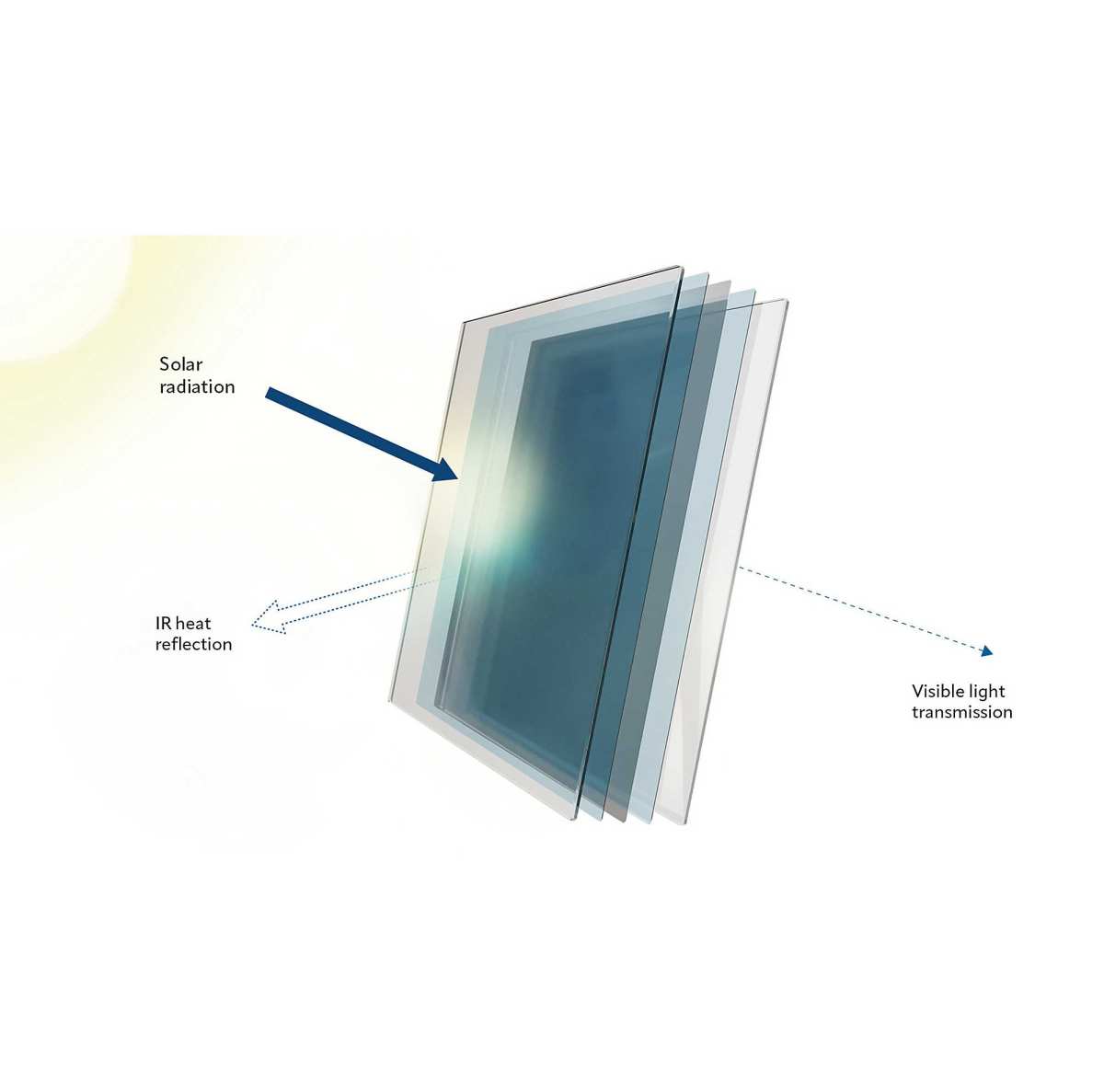
Texas measures the film and the window glass together, so the 25% figure is the reading of the finished window, not the number on the film box. The statute says the device must have 25% light transmission “in combination with the vent or window”. The DPS rule, 37 Texas Administrative Code 21.3, says aftermarket film “will be measured in combination with the vehicle’s original equipment”.
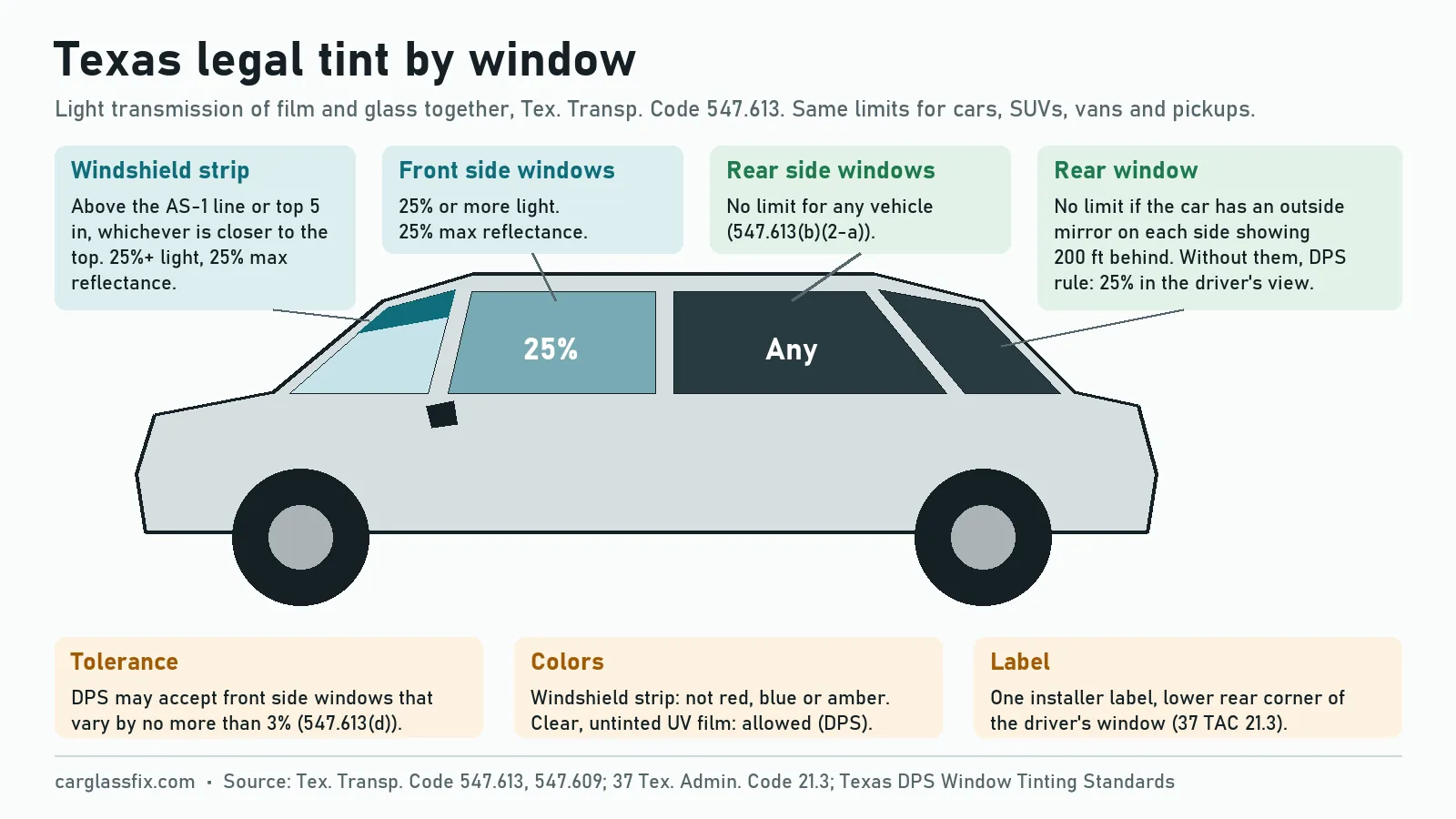
Factory glass already blocks some light before any film goes on. That means a film sold as 25% will read darker than 25% once it sits on the glass. Our how to measure window tint guide shows the glass-times-film math, and the window tint percentage chart shows how dark each shade looks. Subsection (d) lets DPS treat a front side window as legal if its light transmission or reflectance “varies by no more than three percent” from the standard. Reflectance is capped at 25% on the front side windows and the windshield strip, which rules out most mirror films there. A window tint meter reads the net figure an officer would see.
Windshield tint in Texas: the AS-1 line or 5 inches
A Texas windshield may carry tint only in a strip at the top, down to the AS-1 line or 5 inches from the top, whichever is closer to the top. That is the wording of 547.613(b)(1)(D). The strip must pass 25% of light with the windshield, reflect 25% or less, and it may not be red, blue or amber. The color ban is written into the windshield rule only. The side window rule names no colors. The AS-1 line is a mark etched near the top corners of the glass; see the AS-1 line on a windshield to find it.
The DPS rule words the fallback differently from the statute. It says film may not go below the AS-1 line, “or five inches from the top” when the glass has no AS-1 mark. A clear film is a separate case. DPS says a clear, untinted UV film is allowed anywhere on the windshield without a medical exemption, and its rule leaves film “without visible tinting” out of the definition of a sunscreening device. For other states, read is it illegal to have tint on a windshield.
Texas medical exemption for window tint
Texas has no medical tint permit; the driver carries a signed statement from a licensed physician or licensed optometrist instead. The statute makes a medical need a “defense to prosecution” when the driver or a passenger must be shielded from direct sun (547.613(e)). DPS stopped issuing window tint exemption certificates on January 1, 2019, and no longer accepts applications. The DPS rule lets a qualifying vehicle go below 25% on every window except the windshield. On the windshield below the AS-1 line, only an untinted film that cuts total light by no more than 5% is allowed.
How to get a Texas medical exemption for window tint
See a licensed physician or optometrist
The statement must come from one of these two professionals (37 TAC 21.3(e)).
Get a signed statement
It must identify the driver or occupant with reasonable specificity and say that the tint is necessary to safeguard that person’s health.
Keep it in the vehicle
The rule allows the darker tint only while the driver or an occupant has the signed statement.
Show it at a stop
DPS tells drivers to present the statement to an officer during a traffic stop.
The DPS page still tells drivers to show the statement at the annual inspection, a step that no longer exists for most cars.
How the Texas tint law changed, and what older pages get wrong
The 25% limits have not changed since at least 2007, but later changes make many older Texas tint pages wrong. Before September 1, 2009, the 25% rule covered every window other than the windshield, and only multipurpose vehicles had their rear side windows exempt. S.B. 589 added the exemption for side windows behind the driver on all vehicles. It also created the installer offense for leaving out the label.
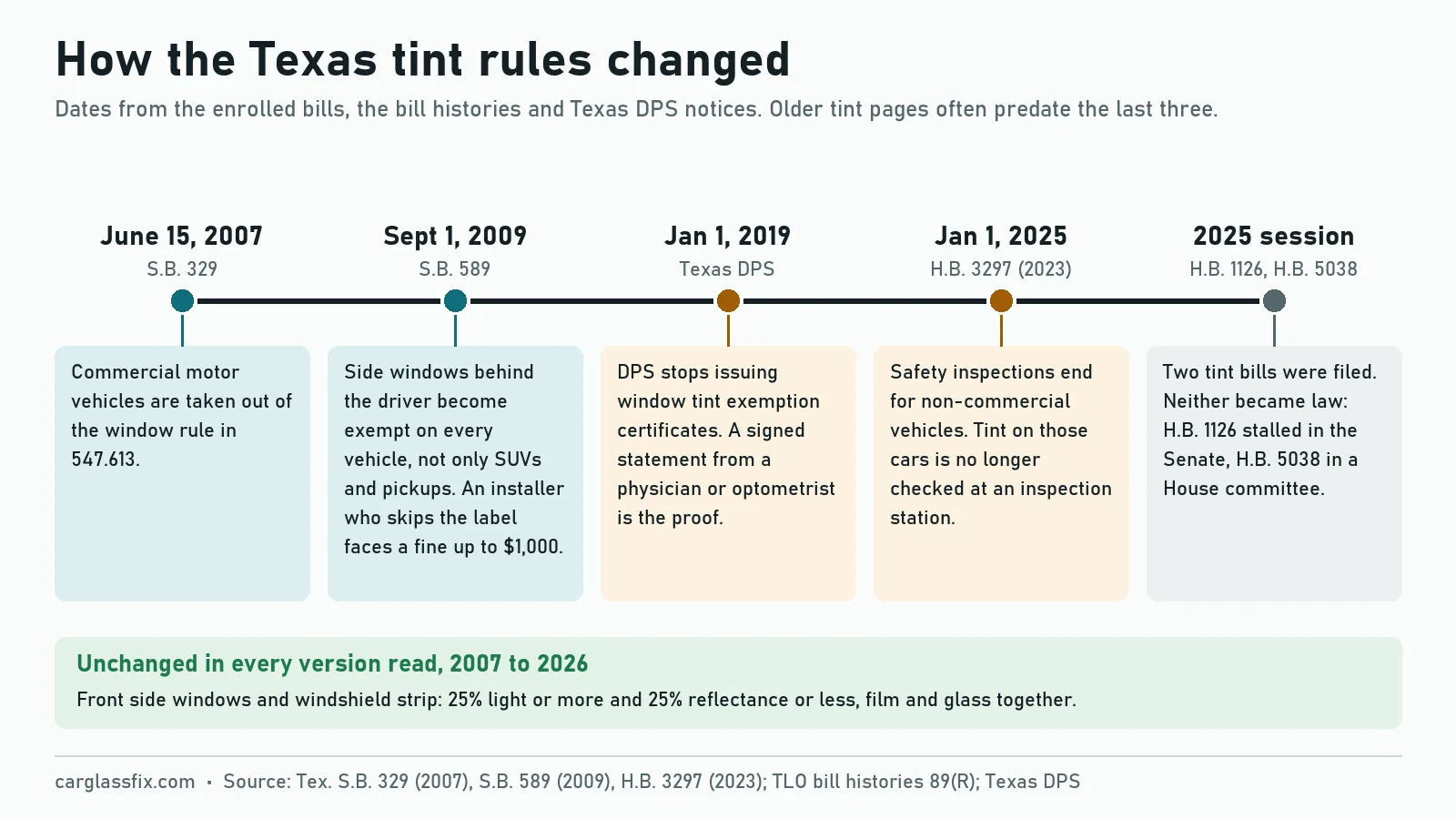
Texas DPS says H.B. 3297 ended safety inspections for non-commercial vehicles on January 1, 2025. Pages that say dark tint “fails inspection” describe a check most cars no longer get. In the 2025 session, H.B. 1126 passed the House and stalled in the Senate, and H.B. 5038 never left the House Transportation Committee. A Bing AI answer checked for this page said red, blue and amber are banned on all windows; the statute bans them only in the windshield strip. The same answer named a DPS medical form. We found no DPS source for that form, and DPS says it stopped issuing certificates in 2019.
How much is a tint ticket in Texas
A Texas tint ticket carries a fine of $1 to $200, plus any court costs. Section 547.613 makes the offense a misdemeanor but sets no fine for drivers. The general penalty in 542.401 then applies: “not less than $1 or more than $200.” A tint business that installs film without the required label faces a fine of up to $1,000 under 547.613(a-1). Totals differ by court. Bexar County’s Justice of the Peace courts list $222 for an owner or operator with improper glass tint. That figure is above the statutory fine cap, so it likely includes court costs, though the page does not break it down.
Some tickets are dismissed after a fix. Section 547.004(c) lets a court dismiss an equipment charge under that section if the defect is fixed before the first court appearance and a fee of up to $10 is paid. Whether that applies depends on the section written on the citation, so ask the court named on it. Since 2025, enforcement for most cars happens at traffic stops; see will a cracked windshield pass inspection in Texas for the inspection change.
Who the Texas tint limits do not apply to
The Texas limits do not apply to vehicles registered in another state, to factory glass that meets federal standards, or to several vehicle classes. Section 547.613(b)(12) exempts “a motor vehicle that is not registered in this state,” so a visitor’s car follows its home state’s rule while in Texas. Subsection (b)(13) exempts factory-tinted or pretinted glass installed by the maker and replacement glass that meets the maker’s specifications. Factory privacy glass therefore needs no Texas tint check of its own.
Other exemptions cover vehicles that regularly carry passengers for a fee under a local license or permit, law enforcement vehicles, and commercial motor vehicles as defined in 644.001. Selling a car with non-compliant tint is not an offense under 547.613(f), so a dealer can sell it, but the buyer who drives it can be cited. Before choosing a shade, try the window tint simulator, and compare other states in what car window tint is legal.
Texas tint rules can change with each legislative session. Check the current Transportation Code 547.613 or the Texas DPS window tint page before you tint. This article is general information, not legal advice.
Frequently asked questions
Is 20% tint legal in Texas?
A 20% reading is illegal on the front side windows, which must pass at least 25% with the glass. It is legal on the side windows behind the driver, and on the rear window if the vehicle has an outside mirror on each side.
What is the darkest legal tint in Texas?
The darkest legal front side window reads 25% with film and glass together, and DPS may accept a window within 3% of that. Side windows behind the driver have no limit, so any shade is legal there.
Is 35% or 20% tint darker?
A 20% tint is darker because it lets through 20% of visible light, against 35% for the lighter film. The window tint percentage chart shows each shade side by side.
Why is 5% tint illegal in Texas?
A 5% tint is illegal only on the windshield and the front side windows, where Texas requires at least 25% light transmission. On the side windows behind the driver, and on the rear window with two outside mirrors, 5% is legal.
Do I need a medical exemption form from DPS?
No. DPS stopped issuing tint exemption certificates on January 1, 2019. Keep a signed statement from a licensed physician or optometrist in the vehicle instead.
Sources
- Texas Transportation Code 547.613, Restrictions on Windows (checked 25 October 2026)
- Texas Transportation Code 547.609, Required Label for Sunscreening Devices (checked 25 October 2026)
- Texas Transportation Code 547.001, Definitions and 547.004, General Offenses (checked 25 October 2026)
- Texas Transportation Code 542.401, General Penalty (checked 25 October 2026)
- 37 Texas Administrative Code 21.3, Standards for Sunscreening and Privacy Window Devices (amended effective 17 November 2022; checked 25 October 2026)
- Texas DPS: Window Tinting Standards (archived copy of 21 July 2026 read)
- Texas DPS: Vehicle Safety Inspection Program Changes Now in Effect (3 January 2025)
- Texas S.B. 589, 81st Legislature, enrolled (2009) and S.B. 329, 80th Legislature, enrolled (2007)
- Texas Legislature Online: H.B. 1126 history and H.B. 5038 history (89th Legislature, checked 25 October 2026)
- Bexar County Justice of the Peace Courts: Ticket Fine Schedule (checked 25 October 2026)

Similar Posts