Tint Laws in Florida: Legal Tint Percentage by Window
Senior Automotive Glass Diagnostic Specialist & Master Technician at CarGlassFix · AGSC Master Certified Auto Glass Technician, NGA Certified Installer, I-CAR Automotive Safety Specialist · 12+ Years in Automotive Glazing, Windshield Structural Bonding, ADAS Camera Calibration & Precision Chip Restoration
Florida law requires front side windows to let at least 28% of visible light through, measured through film and glass together. Windows behind the driver need at least 15% on cars and 6% on SUVs, vans and pickups. Windshield tint is allowed only as a transparent strip above the AS-1 line. Every percentage has a 3% tolerance.
Florida tint limits by window
Florida sets two darkness limits for side and rear glass: 28% for the front side windows and 15% for every window behind the driver. The darkness figure is visible light transmission (VLT), the share of light that passes through. Fla. Stat. 316.2954 raises the darkness allowed behind the driver to 6% on multipurpose passenger vehicles, a group that covers most SUVs, vans and pickups.
Florida also caps reflectance, the share of light the window bounces back. Front side windows may reflect no more than 25%, and windows behind the driver no more than 35%, both “as measured on the nonfilm side”. The windshield has no percentage at all. Only a transparent strip above the AS-1 line may carry film. For the same numbers side by side with other states, see the window tint laws by state table.
| Window | Sedan, coupe, hatchback | SUV, van, pickup (multipurpose passenger vehicle) |
|---|---|---|
| Windshield | Transparent strip above the AS-1 line only | Transparent strip above the AS-1 line only |
| Front side windows | At least 28% VLT, reflectance 25% or less | At least 28% VLT, reflectance 25% or less |
| Back side windows | At least 15% VLT, reflectance 35% or less | At least 6% VLT, reflectance 35% or less |
| Rear window | At least 15% VLT, reflectance 35% or less | At least 6% VLT, reflectance 35% or less |
| Tolerance | Plus or minus 3% | Plus or minus 3% |
| Measured on | Film and glass together, on the car | Film and glass together, on the car |
Which vehicles get the 6% limit behind the driver
The 6% limit applies only to a “multipurpose passenger vehicle”, which Fla. Stat. 316.2951(2) defines by build and seating, not by body name. The vehicle must be designed to carry 10 people or fewer. It must also sit on a truck chassis or have “special features for occasional off-road operation”.
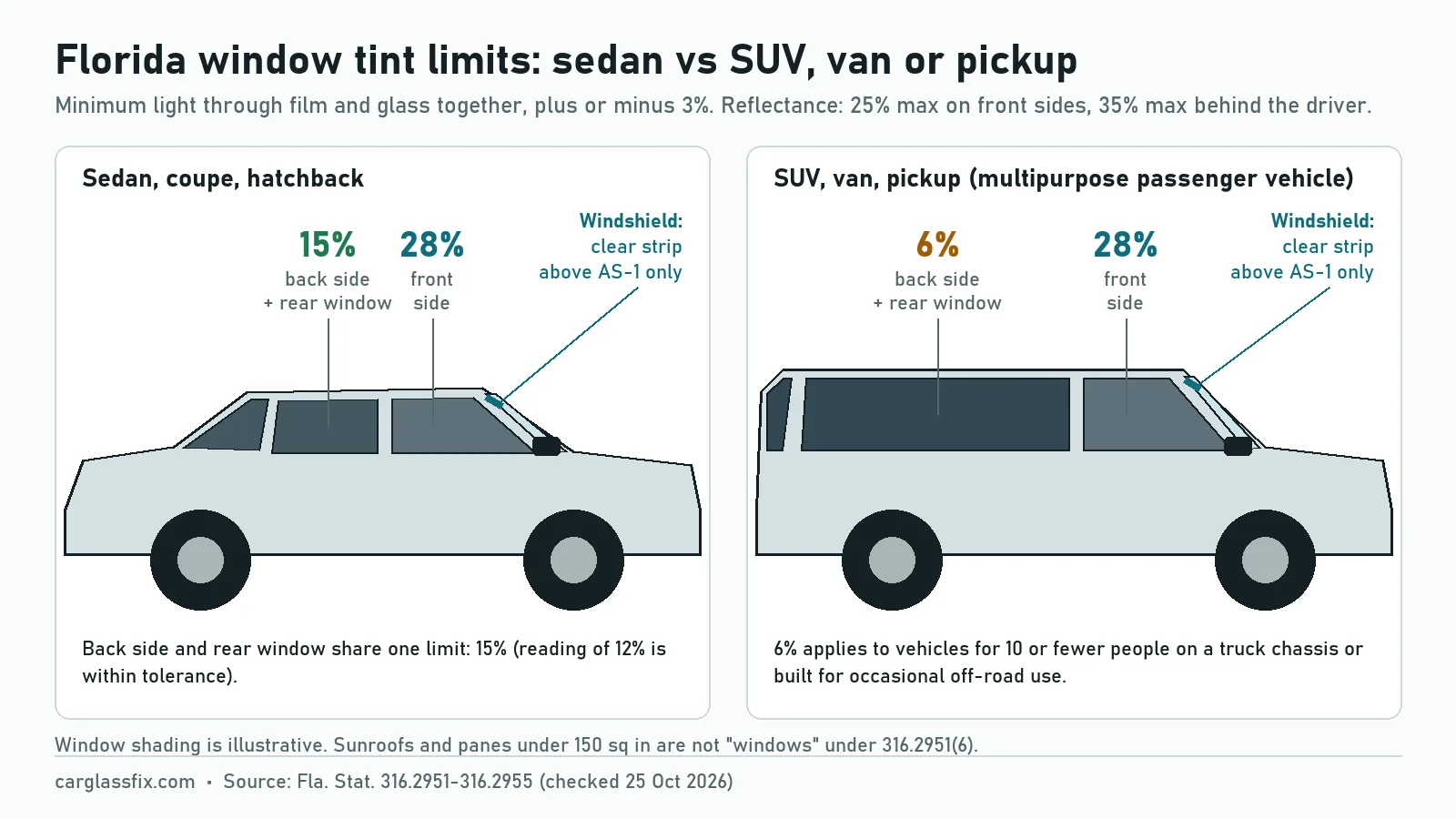
Most SUVs, minivans and pickups fit this definition. A sedan, coupe, hatchback or wagon built on a car platform keeps the 15% limit on its back side windows and rear window. The statute lists no models. A crossover close to the line is a question to settle with the installer before dark film goes on the back windows.
Florida writes its rear limits as one rule for “windows behind the driver”. The back side windows and the rear window therefore always share the same number. A few windows fall outside the law entirely. Fla. Stat. 316.2951(6) says a “window” excludes “any roof-mounted viewing device”, such as a sunroof, and any viewing device smaller than 150 square inches. Tint on those panes is not limited by these sections.
How Florida measures tint: film plus glass, 3% tolerance
Florida measures the window as it sits on the car, film and glass together, and allows 3% either way. Fla. Stat. 316.2953 says the film is “applied to and tested on the glass of such windows on the specific motor vehicle”. The definition of transmittance in 316.2951(5) also includes the glazing. A box of film marked 30% can therefore read lower once it sits on glass that already blocks some light.
The tolerance in 316.2955(2) is “plus or minus 3 percent” on every percentage in the tint sections. Read as percentage points, a front side window that meters 25% is still within the law. A car’s back windows may read 12%, and an SUV’s 3%. Reflectance limits get the same allowance.
Officers measure with light meters. The department must approve the devices by rule, and a reading from an approved device “is presumed accurate” in court. Factory glass that meets FMVSS 205 is outside these sections under 316.2957, so factory privacy glass on an SUV is legal as delivered. The guide on how to measure window tint explains how a reading combines film and glass, and the window tint meter page compares the tools.
Florida medical exemption for darker tint
A Florida driver with a qualifying light-sensitive condition can get a medical exemption certificate from the Department of Highway Safety and Motor Vehicles (FLHSMV). Fla. Stat. 316.29545 names “Lupus, any autoimmune disease, or other medical conditions which require a limited exposure to light”. The certificate allows tint on the windshield, the side windows and the windows behind the driver beyond the normal limits.
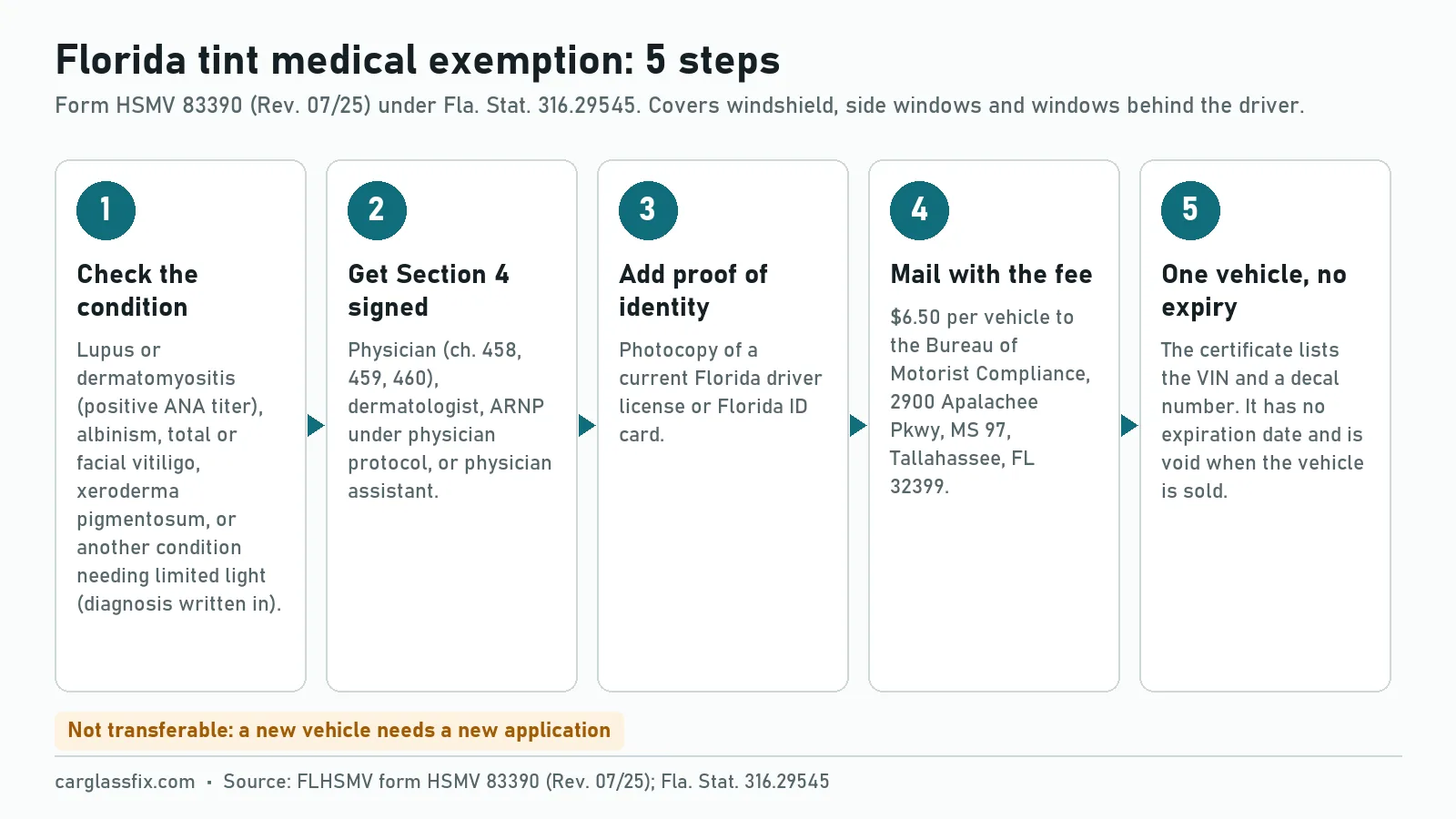
The application is form HSMV 83390 (Rev. 07/25). It lists lupus, dermatomyositis, albinism, total or facial vitiligo and xeroderma pigmentosum. Lupus and dermatomyositis need a positive ANA titer. Any other condition needs a written diagnosis. The form accepts a signature from a physician licensed under chapter 458, 459 or 460, a dermatologist, an advanced registered nurse practitioner under a physician’s protocol, or a physician assistant. Physicians at a military medical facility, state hospital or federal prison may also sign.
The certificate names one vehicle by VIN and carries a medical exemption decal number. It “has no expiration date”, in the form’s words, and it becomes void when the vehicle is sold or transferred.
How to apply for a Florida tint medical exemption
Fill in form HSMV 83390
Choose Original, complete the registrant and applicant sections, and list each vehicle by title number and VIN.
Get the medical section signed
A qualifying physician, dermatologist, ARNP or physician assistant completes and signs Section 4.
Attach proof of identity
Add a photocopy of a current Florida driver license or Florida ID card.
Mail the application with the fee
Send it to the Bureau of Motorist Compliance, 2900 Apalachee Pkwy, Mail Stop 97, Tallahassee, FL 32399, with $6.50 per vehicle.
Keep the certificate with the vehicle
Carry it in that vehicle so an officer can see it, and apply again for a new vehicle after a sale.
Windshield tint and the AS-1 line in Florida
Florida allows windshield film only as a transparent strip at the top that stays above the AS-1 line. Fla. Stat. 316.2952(2)(b) permits “Sunscreening material along a strip at the top of the windshield, so long as such material is transparent”. The strip may not enter the driver’s direct forward view, which the statute ties to the AS/1 portion defined in federal standard FMVSS 205.
The statute gives no inch measure and no VLT number for the strip. Some states use a fixed 4 or 5 inches from the top. Florida uses the AS-1 marking printed on the glass, so the guide to the AS-1 line on a windshield shows where the strip must end. Clear film below the line is still sunscreening material under the definition in 316.2951(4), so the general limits on tint on the windshield apply. The medical exemption is the only route to film across the full windshield.
Reflective film, colors, mirrors and other Florida rules
Florida limits shine, not color names: 25% reflectance on the front sides and 35% behind the driver. Both sections bar any film that “would alter the window’s color” except as the section permits. The statute has no list of banned colors, so pages that name red, amber or blue as banned in Florida are not quoting this law. Highly reflective film is the usual problem, and the page on mirror tint on a car covers why.
Fla. Stat. 316.2954 also covers other window products behind the driver:
- Perforated film must let at least 30% of light through and reflect no more than 35%. Its reflectance is averaged over 16 equal sections, and no section may pass 50%.
- Louvers are legal if they do not reduce the driver’s view by more than 50%.
- Privacy drapes, curtains and blinds must be in an “open and secure position” while driving.
- A rear window made nontransparent needs side mirrors on both sides that meet 316.294.
The installer or seller must give the buyer a nonremovable label stating that the film complies. The label names the film and the installer’s business, and the installer fixes it to the inside left door jamb. Factory glazing that meets FMVSS 205 needs no label.
How much is a tint ticket in Florida
A Florida tint ticket starts at $52.50: a $30 nonmoving penalty, a $12.50 administrative fee and a $10 Article V assessment. Fla. Stat. 316.2956(1) makes driving with film installed in violation of the limits a “noncriminal traffic infraction, punishable as a nonmoving violation”. The $30 comes from 318.18(2), and the two add-ons from 318.18(19) and (20). Local court costs can raise the total, so the county clerk’s figure is the one to pay.
| Who | Offense type | Amount or penalty | Statute |
|---|---|---|---|
| Driver | Noncriminal nonmoving infraction | $30 base penalty | Fla. Stat. 316.2956(1), 318.18(2) |
| Driver | Added to every nonmoving violation | $12.50 administrative fee plus $10 Article V assessment | Fla. Stat. 318.18(19), (20) |
| Seller or installer of illegal film | Second-degree misdemeanor | Up to 60 days in jail and a fine up to $500 | Fla. Stat. 316.2956(3), 775.082, 775.083 |
A driver who does not elect a hearing has 30 days from the citation to pay or set up a payment plan with the clerk under 318.14(4). Paying counts as admitting the infraction. Florida’s point schedule in 322.27 lists moving violations, and a tint citation is nonmoving. Replacing or repairing film that was legal when installed is not a violation.
What changed in Florida tint law and what older pages get wrong
Florida’s tint limits have not changed in years: no bill in the 2025 or 2026 sessions amended them. The history lines of 316.2953 and 316.2954 end with chapter 99-248, and the 2026 text matches the 2025 edition. The only 2025 bill that cited the medical exemption section, SB 826 on process servers, was withdrawn on 7 April 2025.
Several popular pages still get details wrong:
- Some say a “manufacturer’s compliance sticker” goes in the door jamb. The statute puts the label duty on the installer or seller.
- Some say the fine “varies by county”. The $30 penalty and the $22.50 in add-ons are statewide, and only extra local costs vary.
- Some say the medical certificate lasts while the condition lasts. The form says it has no expiration date and ends with the sale of the vehicle.
To preview a legal shade before buying film, try the window tint simulator or the window tint percentage chart.
Frequently asked questions
What is the darkest legal tint in Florida?
On the front side windows, the darkest legal tint is 28% VLT, measured through film and glass, with a 3% tolerance. Behind the driver, the darkest legal tint is 15% on a car and 6% on an SUV, van or pickup, under Fla. Stat. 316.2954.
Will I get pulled over for 20% tint in Florida?
A 20% reading on the front side windows is below Florida’s 28% limit and outside the 3% tolerance, so an officer can cite it. The same 20% on the back side and rear windows is legal on any vehicle, because the limit there is 15% on cars and 6% on multipurpose vehicles.
Is 35% or 20% tint darker?
20% tint is darker, because the number is the share of light that passes through. A 35% window lets 35% of visible light in, and a 20% window lets 20% in. The window tint percentage chart shows each shade.
Are there new window tint laws in Florida for 2026?
No. No bill in the 2025 or 2026 sessions changed Florida’s tint limits, and the 2026 statutes keep 28% on front side windows, 15% behind the driver on cars and 6% on multipurpose vehicles. The flsenate.gov statute pages show the current text.
Does a Florida tint ticket add points to my license?
A tint violation is a noncriminal nonmoving infraction under Fla. Stat. 316.2956, and the point schedule in 322.27 covers moving violations.
Tint rules change, and this page is general information, not legal advice. Check the current Florida Statutes on flsenate.gov or ask FLHSMV before you buy or install film.
Sources
- Fla. Stat. 316.2951, Motor vehicle windows; definitions (2025 edition, checked 25 October 2026)
- Fla. Stat. 316.2952, Windshields; requirements; restrictions (checked 25 October 2026)
- Fla. Stat. 316.2953, Side windows; restrictions on sunscreening material (checked 25 October 2026; 2026 edition identical)
- Fla. Stat. 316.2954, Windows behind the driver; restrictions on sunscreening material (checked 25 October 2026; 2026 edition identical)
- Fla. Stat. 316.2955, Window sunscreening material; compliance labeling; tolerances (checked 25 October 2026)
- Fla. Stat. 316.29545, Window sunscreening exclusions; medical exemption (checked 25 October 2026)
- Fla. Stat. 316.2956, Penalties (checked 25 October 2026)
- Fla. Stat. 316.2957, Exemption for motor vehicle manufacturers (checked 25 October 2026)
- Fla. Stat. 316.294, Mirrors (checked 25 October 2026)
- Fla. Stat. 318.18, Amount of penalties, subsections (2), (19) and (20) (checked 25 October 2026)
- Fla. Stat. 318.14, Noncriminal traffic infractions; procedures (checked 25 October 2026)
- Fla. Stat. 322.27, Point system (checked 25 October 2026)
- Fla. Stat. 775.082 and Fla. Stat. 775.083, misdemeanor penalties (checked 25 October 2026)
- FLHSMV form HSMV 83390, Application for Sunscreening Medical Exemption (Rev. 07/25) (read 25 October 2026)
- The Florida Senate, SB 826 (2025) bill history (checked 25 October 2026)
- FMVSS 205, Glazing materials, 49 CFR 571.205

Similar Posts