How to Tell If Your Windshield Has a Camera Behind It
Senior Automotive Glass Diagnostic Specialist & Master Technician at CarGlassFix · AGSC Master Certified Auto Glass Technician, NGA Certified Installer, I-CAR Automotive Safety Specialist · 12+ Years in Automotive Glazing, Windshield Structural Bonding, ADAS Camera Calibration & Precision Chip Restoration
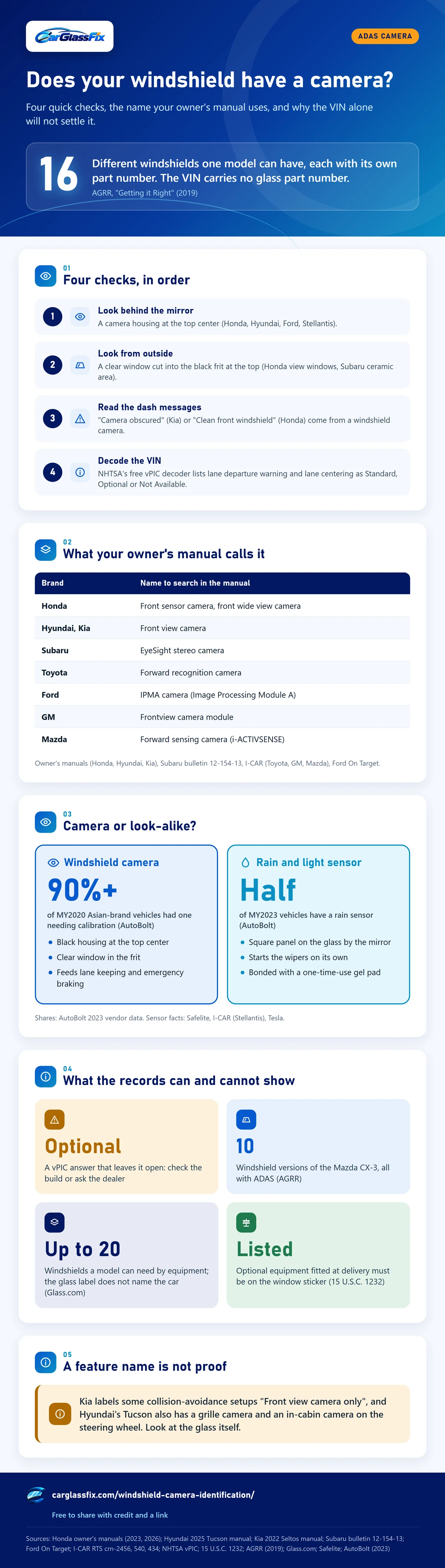
To tell if your windshield has a camera, look behind the rearview mirror for a plastic housing on a bracket bonded to the glass. From outside, look for a clear window cut into the black border at the top center. Then confirm the camera’s name in the owner’s manual or ask a dealer to check the VIN.
Where to look for a windshield camera
The forward camera sits at the top center of the windshield, behind or just above the rearview mirror. Honda’s 2026 owner’s manual says the front sensor camera “is located behind the rearview mirror.” Hyundai’s 2025 Tucson manual says the front view camera “is mounted near the top of the windshield inside your vehicle.” Stellantis describes the camera as usually being in the mirror assembly. Ford’s lane-keeping camera on the Mustang is mounted in the top center of the windshield.
Sit in the driver’s seat and look up past the mirror stalk. A camera usually shows as a dark plastic cover that runs from the headliner down to the glass. On some cars the cover is wide and obvious. On others it hides behind the mirror, so a look from the passenger seat helps. Subaru EyeSight uses a stereo camera, and Subaru’s bulletin refers to its lens openings in the plural. Then step outside and look at the same spot through the glass.
What a camera windshield looks like inside and out
A camera windshield has two visible tells: a bracket bonded to the inside of the glass and a clear opening in the black border in front of the lens. The diagram shows where each clue sits and what else shares that area.
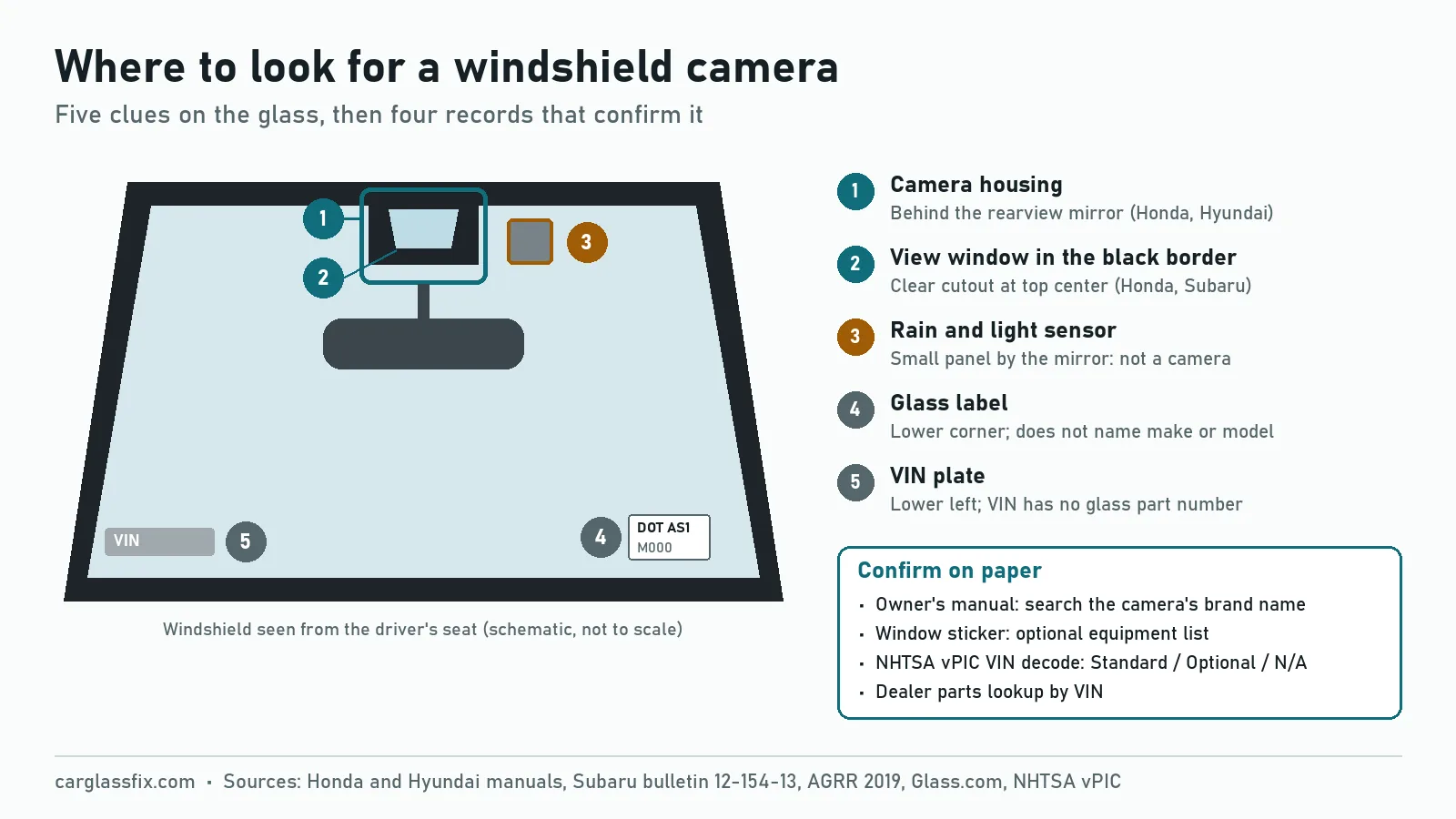
The opening in the border is the best outside check. American Honda’s job aid says camera-equipped glass has view windows at the top for the camera. Subaru’s service bulletin 12-154-13 says genuine EyeSight windshields have “a uniquely-shaped ceramic area” and low-distortion glass. Toyota warns that some aftermarket glass has a black border that blocks the camera or lacks the camera bracket.
| Clue | Where to look | What it tells you |
|---|---|---|
| Plastic housing on a bonded bracket | Inside, behind the rearview mirror | Strong sign of a forward camera |
| Clear window in the black border | Outside, top center of the glass | The glass was made for a camera |
| More than one lens opening | Mirror area | Stereo camera, such as Subaru EyeSight |
| Dash message about a dirty windshield or blocked camera | Instrument cluster | A camera is fitted and reads through the glass |
| Small square panel touching the glass | Next to the mirror | Usually a rain or light sensor, not a camera |
Camera or something else behind the mirror
Several parts share the mirror area, so check what you see against the list below before calling it a camera. Safelite describes a rain sensor as a square panel on the windshield near the mirror that reads light reflected inside the glass. Stellantis treats the rain sensor’s adhesive membrane as one-time use, and Tesla lists the Model X light and rain sensor as a one-time-use part. AutoBolt, a vendor of glass lookup data, reported rain sensors on about half of model-year 2023 vehicles. A sensor pad can sit right beside a camera, and one does not rule out the other.
Other look-alikes are easy to sort out. Mazda’s 2016 CX-5 has a front laser sensor near the mirror for low-speed braking. A toll tag or a dashcam is an add-on that the owner stuck to the glass. Honda, Hyundai and Kia all tell owners not to attach objects or accessories that block the camera’s view. Not every car camera is on the windshield. Hyundai’s Tucson manual also lists a wide-front view camera on the grille and an in-cabin camera on the steering wheel.
| Part | Usual spot | How to tell it apart | Source |
|---|---|---|---|
| Forward camera | Behind the mirror, top center | Lens looks out through a clear opening in the border | Honda, Hyundai, Stellantis |
| Rain and light sensor | Beside or behind the mirror | Small panel on the glass; automatic wipers | Safelite; Stellantis via I-CAR |
| Laser sensor | Near the mirror on some models | Named in the manual, such as Mazda Smart City Brake Support | Mazda 2016 CX-5 manual |
| Grille or surround cameras | Grille, mirrors, tailgate | Not on the glass | Hyundai 2025 Tucson manual |
| Toll tag or dashcam | Anywhere on the glass | Added by the owner, not by the factory | Owner equipment |
What your owner’s manual calls the camera
Search your owner’s manual index for the brand’s own name for the camera, because each automaker uses different words. The names below come from the automakers’ manuals, bulletins and position statements. If the manual marks the camera “if equipped” or with an asterisk, the feature depends on trim, so the manual alone does not confirm your car.
| Brand | Name in the documents | Source |
|---|---|---|
| Honda and Acura | Front sensor camera; front wide view camera | Honda owner’s manuals, 2023 and 2026 |
| Hyundai | Front view camera | 2025 Tucson owner’s manual |
| Kia | Front view camera (if equipped) | 2022 Seltos owner’s manual |
| Subaru | EyeSight stereo camera | Subaru service bulletin 12-154-13 |
| Toyota and Lexus | Forward recognition camera | Toyota guidance via I-CAR |
| Ford and Lincoln | Image Processing Module A (IPMA) camera | Ford On Target, 2021 |
| General Motors | Frontview camera module | GM guidance via I-CAR |
| Mazda | i-ACTIVSENSE forward sensing camera | Mazda guidance via I-CAR |
Feature names help, but they are not proof on their own. Kia titles one manual section “Forward Collision-Avoidance Assist (FCA) (Front view camera only)”, which tells you the same feature name can use other sensor setups. Honda’s manual lists the systems its front wide view camera feeds: Lane Keeping Assist, Road Departure Mitigation, Adaptive Cruise Control, Traffic Sign Recognition, the Collision Mitigation Braking System and Traffic Jam Assist. Dash messages are a stronger sign. Honda shows “Some driver assist systems cannot operate: Clean front windshield or poor viewing condition.” Kia shows a “Camera obscured” message.
Records that confirm it: window sticker, VIN and dealer
Paper records confirm what the glass shows, and each one has a limit. Federal law, 15 U.S.C. 1232, requires the new-car window sticker to list each item of optional equipment fitted at the factory that is not in the base vehicle. The law does not require each standard feature to be listed, so a camera that came standard may appear only in the trim description. NHTSA’s free vPIC VIN decoder has fields for lane departure warning, lane keeping assistance, lane centering, forward collision warning and automatic braking. Each field can read “Standard”, “Optional” or “Not Available”. “Optional” means the maker offered the feature, not that your car has it. NHTSA’s own definition says lane centering assistance uses “a camera-based vision system”.
Work through the records in this order:
How to confirm a windshield camera on paper
Check the glass
Look behind the mirror and for a clear window in the top border.
Read the manual
Search the index for the brand’s camera name and note any “if equipped” marks.
Find the window sticker
Look for driver assist packages in the optional equipment list or trim features.
Decode the VIN
Enter the VIN in NHTSA’s vPIC decoder and read the lane departure, lane keeping and lane centering fields.
Ask the dealer
Give the parts department the VIN and ask which windshield and camera the car was built with.
Why the camera changes which windshield fits
A camera changes the windshield part number, because the glass carries the bracket, the frit opening and a low-distortion zone in front of the lens. Ford’s On Target says automakers typically own the tooling for the camera bracket and that non-OEM brackets may not place the camera in the correct location. Nissan has the 2023 Rogue lane camera bracket replaced with the windshield as an assembly. Eastman, which makes windshield interlayers, markets a wedge interlayer for image clarity in the camera zone near the top of the glass.
The VIN alone does not name the glass. AGRR magazine reported in 2019 that the VIN “does not include the glass part number at all.” The same report said one model can have up to 16 windshields with 16 NAGS part numbers, and that the Mazda CX-3 had 10 versions, all with ADAS. Glass.com says the glass label does not identify the year, make and model. Give the shop the VIN and a photo of the mirror area from inside and outside. For the other features that change the part, see how to identify windshield type. For the glass choice itself, see OEM vs aftermarket glass for car replacement.
What to do once you know
If you find a camera, tell the glass shop before it quotes, and ask how the camera will be calibrated. Honda tells owners to have a dealer recalibrate the camera after a windshield replacement. Ford requires its IPMA camera alignment after every windshield replacement. Subaru requires the EyeSight camera to be protected during the job and calibrated afterward. The rules differ by brand, so read does my car need ADAS calibration after glass work before you book.
The camera also limits what you can stick on the glass and where a chip can be fixed. Honda says even minor repairs inside the camera’s field of vision may make the system work abnormally. Subaru prohibits repairs in the gray zones in front of the EyeSight camera. Hyundai and Kia tell owners not to tint the windshield or fit stickers or accessories on it. For film near the camera, see does windshield tint interfere with sensors. For the full job, see ADAS calibration and windshield replacement explained.
Frequently asked questions
Are there cameras in windshields?
Yes, on many newer cars a forward camera is mounted behind the windshield near the rearview mirror. Honda, Hyundai, Subaru, Toyota, Ford, GM, Mazda and Stellantis all describe a windshield camera in their manuals or service documents.
Does adaptive cruise control mean my car has a windshield camera?
Not always. Honda’s front radar sits behind the front emblem, and Ford aligns its cruise-control radar as a separate module, so check the mirror area and the manual as well.
Can I tell from the VIN if my windshield has a camera?
Partly. NHTSA’s vPIC decoder can show lane departure and lane centering as standard, optional or not available, but “optional” does not confirm your car, so ask a dealer parts department to look up the build.
Is the windshield camera recording me?
The forward camera faces the road and feeds driver assist systems, as Honda’s manual describes. Some cars have a separate driver-facing camera, such as Hyundai’s in-cabin camera on the steering wheel, and each automaker’s privacy notice explains its data use.
Who calibrates a windshield camera after replacement?
A dealer or a glass shop with the automaker’s procedure and tools does it after the new glass is fitted. See how sensors are calibrated after windshield replacement for the steps.
Sources
- Honda 2026 owner’s manual: Front Sensor Camera (checked 27 October 2026)
- Honda 2023 Civic Sedan owner’s manual: Front Wide View Camera (checked 27 October 2026)
- American Honda: Aiming Driving Support Systems job aid, version 12 (August 2025)
- Hyundai 2025 Tucson owner’s manual: Cameras (checked 27 October 2026)
- Kia 2022 Seltos owner’s manual: Forward Collision-Avoidance Assist detecting sensor (checked 27 October 2026)
- Subaru of America Service Bulletin 12-154-13: Acceptable Windshield Repair Areas (08/07/13)
- Repairer Driven News: Ford stresses importance of installing OEM glass (5 August 2024)
- Ford: On Target 2021 Vol. 2
- Ford: ADAS Job Aid (November 2021)
- I-CAR: Toyota/Lexus/Scion Glass Replacement Requirements
- I-CAR: Mazda Glass Replacement Requirements
- I-CAR: FCA/Stellantis Glass Replacement Requirements
- I-CAR: GM Glass Replacement Requirements
- Repairer Driven News: FCA position statement on camera recalibration (10 December 2019)
- Mazda 2016 CX-5 owner’s manual: i-ACTIVSENSE
- AAA: Cost of ADAS Repairs report (2023)
- AutoBolt: Auto Glass ADAS and Technology Report (2023)
- Eastman: Saflex Horizon Vision
- Safelite: Rain sensors
- NHTSA: vPIC VIN decoder and vehicle variable list (checked 27 October 2026)
- 15 U.S.C. 1232, label and entry requirements for new automobiles (checked 27 October 2026)
- 49 CFR 565.13, VIN location (checked 24 October 2026)
- AGRR magazine: Getting it Right, Tara Taffera (20 February 2019)
- Glass.com: Decoding Your Car’s Windshield

Similar Posts