How to Use Anti-Fog Spray on a Windshield, Step by Step
Senior Automotive Glass Diagnostic Specialist & Master Technician at CarGlassFix · AGSC Master Certified Auto Glass Technician, NGA Certified Installer, I-CAR Automotive Safety Specialist · 12+ Years in Automotive Glazing, Windshield Structural Bonding, ADAS Camera Calibration & Precision Chip Restoration
To use anti-fog spray on a windshield, clean and dry the inside glass first. Put a small amount of spray on a cotton or microfiber cloth, not on the glass. Wipe one section at a time, let it flash for a few minutes, then buff with a dry cloth until clear. Reapply when fog returns.
What anti-fog spray does on the inside of a windshield
Anti-fog spray leaves a thin water-loving film on the inside of the glass, so moisture spreads flat instead of forming fog. Fog is thousands of tiny droplets that scatter light, as MIT researchers Michael Rubner and Robert Cohen explained. A hydrophilic surface makes those droplets flatten and merge into a clear sheet. Rain-X describes its Anti-Fog the same way: it applies a hydrophilic coating to interior glass where condensation keeps coming back.
The spray works only on the cabin side. Fog on the outside of the glass is a different problem with a different fix. Exterior rain repellents do the opposite job, and the difference is covered in how to use car glass anti-fog hydrophobic coating.
Anti-fog spray does not replace the defroster. Federal standard FMVSS 103 requires every car to have a windshield defrosting and defogging system. A spray reduces how often you need it. To choose a product type first, see the best anti-fog for car windows.
How to apply anti-fog spray, step by step
The steps below follow the printed directions from Rain-X, Invisible Glass and Adam’s Polishes, plus AAA Club Alliance’s advice. Your product’s label always comes first, because wait times and surface limits differ between brands.
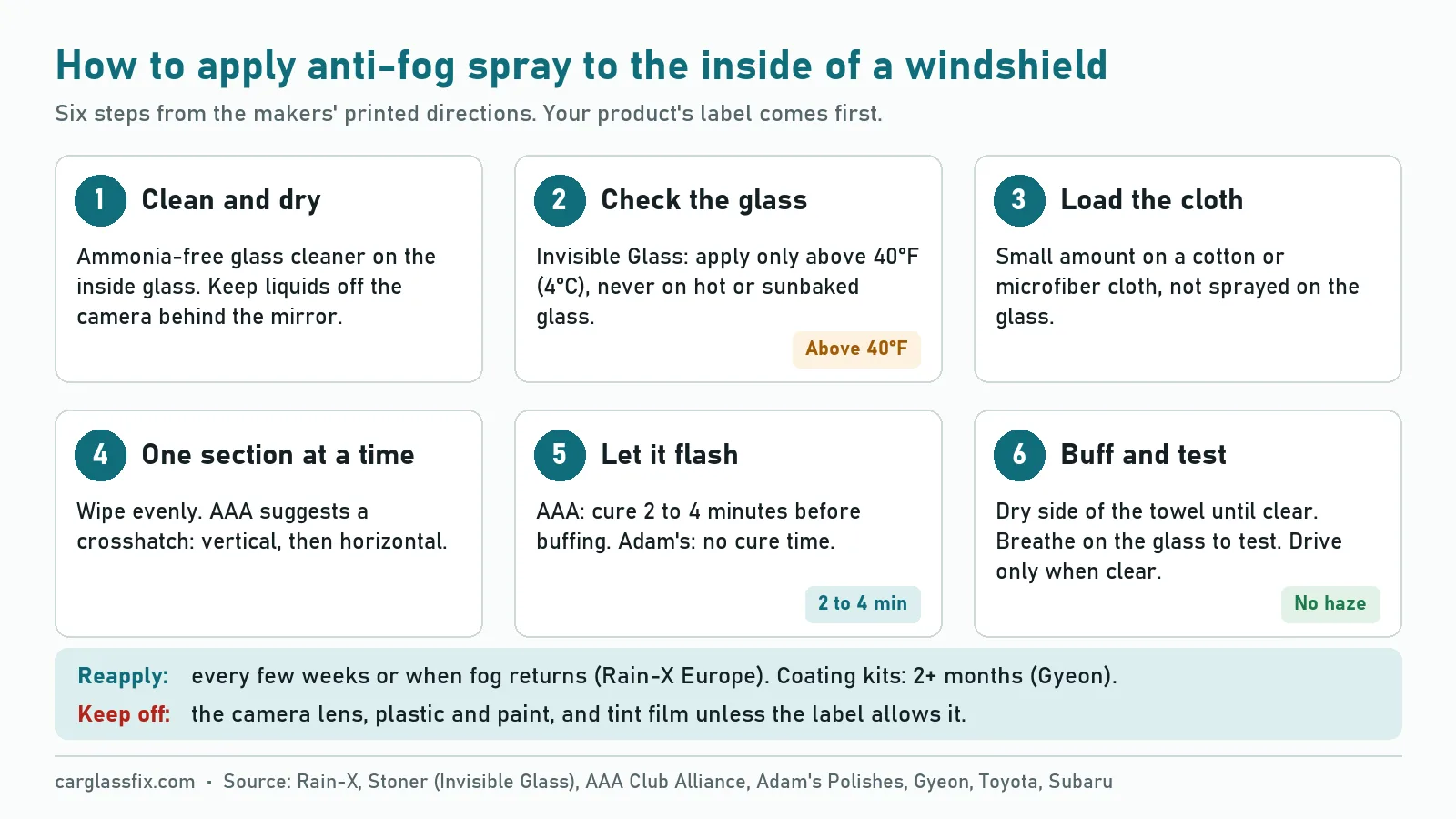
How to apply anti-fog spray to the inside of a windshield
Clean the inside glass
Use an ammonia-free glass cleaner and let the glass dry fully. Invisible Glass and Rain-X both say the product must go on clean glass.
Check the glass temperature
Invisible Glass says to apply only above 40°F (4°C) and never on a hot or sunbaked windshield. Park in shade if the glass is warm.
Load the cloth, not the glass
Put a small amount on a paper towel, 100% cotton cloth or microfiber applicator. Rain-X Europe says a little goes a long way.
Work one section at a time
Wipe evenly across each section. AAA suggests a crosshatch pattern, vertical then horizontal, so no strip is missed.
Let it flash
AAA says to let the coating cure 2 to 4 minutes. Rain-X Europe says to let it dry for a few minutes. Adam’s needs no cure time.
Buff and test
Buff with the dry side of the towel until the glass is clear. Rain-X suggests breathing on the glass to check that it stays clear.
Rain-X’s wipe directions add one safety rule: do not drive until the windshield is completely clear.
AAA Club Alliance also allows spraying straight onto the glass, but Rain-X, Invisible Glass and Adam’s all say to load the cloth or applicator. Loading the cloth keeps overspray off the dashboard, the trim and the camera housing behind the mirror.
Cure time and temperature limits by product
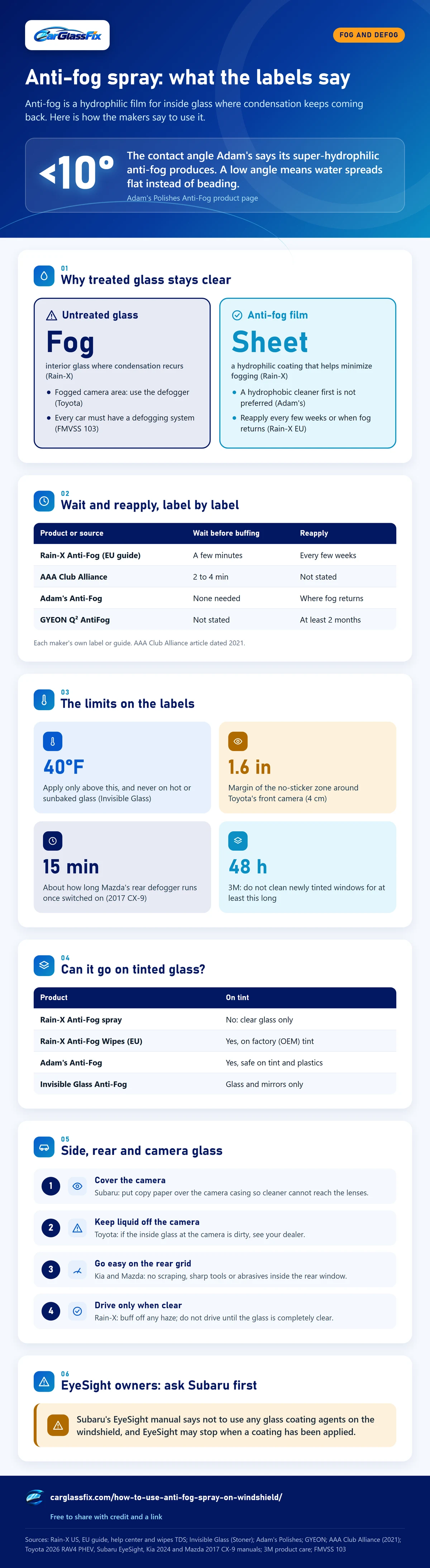
Each maker gives different wait times and limits, so read the label before you start. Only Invisible Glass publishes a minimum air temperature for a spray. Only the coating kits publish a lifespan. The table compares the published directions side by side.
| Product | How to apply | Wait before buffing | Temperature or surface limit | Reapply |
|---|---|---|---|---|
| Rain-X Interior Glass Anti-Fog (US) | Small amount on paper towel or cotton cloth, one section at a time | Not stated; Rain-X Europe says a few minutes | Not on tinted glass; not on plastic or acrylic (Rain-X Europe) | As needed; every few weeks (Rain-X Europe) |
| Invisible Glass Anti-Fog | Moderate amount on a lint-free cloth, back and forth | Not stated | Above 40°F (4°C); not on hot glass; keep off plastic and paint | No figure published |
| Adam’s Anti-Fog | Microfiber applicator, cross-hatch | No cure time | Safe on tint; touching may ruin the effect | Where fog appears |
| GYEON Q² AntiFog (coating) | Spread evenly until a light haze | Not stated | None stated | At least two months |
| CARPRO FogFight (coating) | Spray lightly, spread with suede on a block | About 10 min at 23 to 70°F; 1 to 3 min at 70 to 90°F | Do not touch, rub or clean afterwards | Over a month if untouched |
The FogFight figures come from an authorized retailer that reproduces CARPRO’s directions; the converted Fahrenheit bands are rounded from -5 to 21°C and 21 to 32°C.
Coating kits ask for more care than sprays. CARPRO’s directions say to apply FogFight to a dry surface and then leave it alone, with no touching, rubbing or cleaning after the cure. Gyeon says to spread its coating until a light haze appears, then wipe off the residue.
How often to reapply anti-fog spray
Reapply anti-fog spray when fog starts forming on treated glass again. Rain-X’s European guide puts that at every few weeks, sooner in cold or humid weather. Rain-X’s US label simply says to reapply as needed. Invisible Glass calls its product long-lasting but gives no figure.
Sprays wear off faster than coating kits. The MIT researchers noted that anti-fog sprays for car windows must be reapplied constantly to stay effective. Gyeon rates its Q² AntiFog coating for at least two months, depending on conditions. CARPRO’s copy says FogFight lasts over a month if the glass is not touched or wiped.
Touch is the main thing that shortens the effect. Adam’s warns that agitation or touch may ruin the film. Wiping fog away with a hand or sleeve removes the coating in that spot. So does a full clean with ordinary glass cleaner. After you clean the inside glass, treat it again. For a clean base coat, follow how to clean windshield without streaks before you reapply.
The camera zone, tint and the rear defroster grid
Keep anti-fog spray and cleaner away from the camera behind the rearview mirror. Toyota’s 2026 RAV4 PHEV manual says not to allow liquids to contact the front camera. Its illustration marks a shaded area of the windshield in front of the camera, measured in about 1.6 in (4 cm) steps, where nothing may be attached. If the inside glass there is dirty, Toyota tells owners to contact a dealer.
Subaru’s EyeSight manual says to cover the camera casing with dust-free paper, such as copy paper, while cleaning the windshield. The same manual says not to use glass coating agents on the windshield. Subaru owners should ask a dealer before treating the windshield. To check for a camera, see how to tell if your windshield has a camera behind it.
Tint changes the rules. Rain-X says its anti-fog spray must go on clear glass with nothing on it, such as tint. Rain-X’s European wipe data sheet says the wipes are safe on factory-tinted glass. 3M says not to clean newly tinted windows for at least 48 hours.
On the rear window, wipe gently along the heater lines. Kia and Mazda manuals warn that scraping or abrasive cleaners can damage the rear window defroster grid.
Using anti-fog on side windows, mirrors and the rear glass
The same six steps work on every inside window, not only the windshield. Rain-X labels its interior anti-fog for automotive interior glass and mirrors. Invisible Glass says to use its product on clean interior glass and mirrors only. Treat every window that fogs, because an untreated window still fogs normally.
Load the cloth again for each window so the film stays thin and even. Do the rear window last, with light pressure along the grid lines. The rear window’s own heater still does the main work on that glass, as explained in what is rear windshield defroster.
Keep the spray off plastic. Rain-X Europe says not to use its anti-fog on acrylic, plastic, motorbike helmets or motorbike windshields. Invisible Glass says to avoid plastic, painted metal and clear coated surfaces. Cover dashboard trim with a towel or spray only onto the cloth.
Common mistakes and how to fix haze
Most streaks and haze come from too much product or from dirty glass under it. Rain-X says that if haze appears from excess application, sprinkle the glass with a little water and wipe it with a dry cloth or paper towel until clear. Adam’s says to wipe with fresh sides of a microfiber towel and check the glass from several angles.
Other mistakes are easy to avoid:
- Applying on hot or sun-warmed glass, which Invisible Glass warns against.
- Using a glass cleaner with a water-repellent additive first. Adam’s says its own hydrophobic glass cleaner is not the preferred prep.
- Spraying straight at the windshield and onto the dashboard or camera.
- Touching the treated glass with bare hands.
- Driving before the haze is gone.
Spray alone will not stop heavy, constant fog. For settings that clear glass in seconds, see how to defog windshield quickly. If fog keeps returning on treated glass, a moisture source inside the car may be the cause, as covered in why is my windshield always foggy.
Frequently asked questions
Does anti-fog spray on a windshield actually work?
It reduces fog rather than stopping it completely. A MotorHome Magazine field test found Rain-X Anti-Fog did not fully stop fog over time but greatly reduced it. The car’s defroster is still needed in heavy fog.
Should I spray anti-fog directly on the windshield?
Most makers say no. Rain-X, Invisible Glass and Adam’s direct you to put the product on a cloth or applicator first, which also keeps it off the dashboard and the camera.
How long does anti-fog spray last on a car windshield?
Rain-X Europe says to reapply every few weeks, sooner in cold or humid weather. Coating kits last longer: Gyeon rates its Q² AntiFog for at least two months. Touching or cleaning the glass shortens any product’s life.
How long should anti-fog dry before driving?
AAA Club Alliance says to let it cure 2 to 4 minutes, then buff. Rain-X says not to drive until the windshield is completely clear of haze.
Can I use anti-fog spray on tinted windows?
It depends on the product. Rain-X says its spray must go on clear glass without tint, while Adam’s says its product is safe on tint. For more ways to keep glass clear, see how to prevent car glass from fogging.
Sources
- Rain-X, Interior Glass Anti-Fog directions (checked 2026-10-26)
- Rain-X Europe, How to apply Rain-X Anti-Fog: a step-by-step guide (checked 2026-10-26)
- Rain-X help center, Can Anti-Fog be applied to tinted windows?
- Rain-X help center, What is an auto antifog spray and how does it work?
- Rain-X Anti-Fog Wipes technical data sheet (Europe)
- Stoner Car Care, Invisible Glass Anti-Fog directions (checked 2026-10-26)
- Adam’s Polishes, Anti-Fog Solution
- GYEON, Q² AntiFog
- Waxit (authorized retailer), CARPRO FogFight directions
- AAA Club Alliance, The Best Ways To Defog Your Vehicle’s Windows (Oct 7, 2021)
- MIT News, anti-fog coating research (Sept 8, 2005)
- 49 CFR 571.103, FMVSS 103 Windshield defrosting and defogging systems (checked 2026-10-26)
- Toyota, 2026 RAV4 PHEV owner’s manual excerpt for driving support systems
- Subaru, EyeSight owner’s manual supplement
- Kia 2024 owner’s manual, Cleaning the interior window glass
- Mazda 2017 CX-9 owner’s manual, Rear window defogger
- 3M, window film product care instructions
- MotorHome Magazine (RV.com archive), Tested: Rain-X cleaning and treatment products

Similar Posts