Washington Window Tint Laws: 24% Limit by Window
Senior Automotive Glass Diagnostic Specialist & Master Technician at CarGlassFix · AGSC Master Certified Auto Glass Technician, NGA Certified Installer, I-CAR Automotive Safety Specialist · 12+ Years in Automotive Glazing, Windshield Structural Bonding, ADAS Camera Calibration & Precision Chip Restoration
Washington window tint laws require every window except the windshield to pass at least 24% of light, measured with the film and glass together, and to reflect no more than 35%. Trucks, SUVs and vans may go darker behind the driver. Windshield tint is limited to a transparent strip in the top 6 inches above the AS-1 line.
Washington window tint limits by window
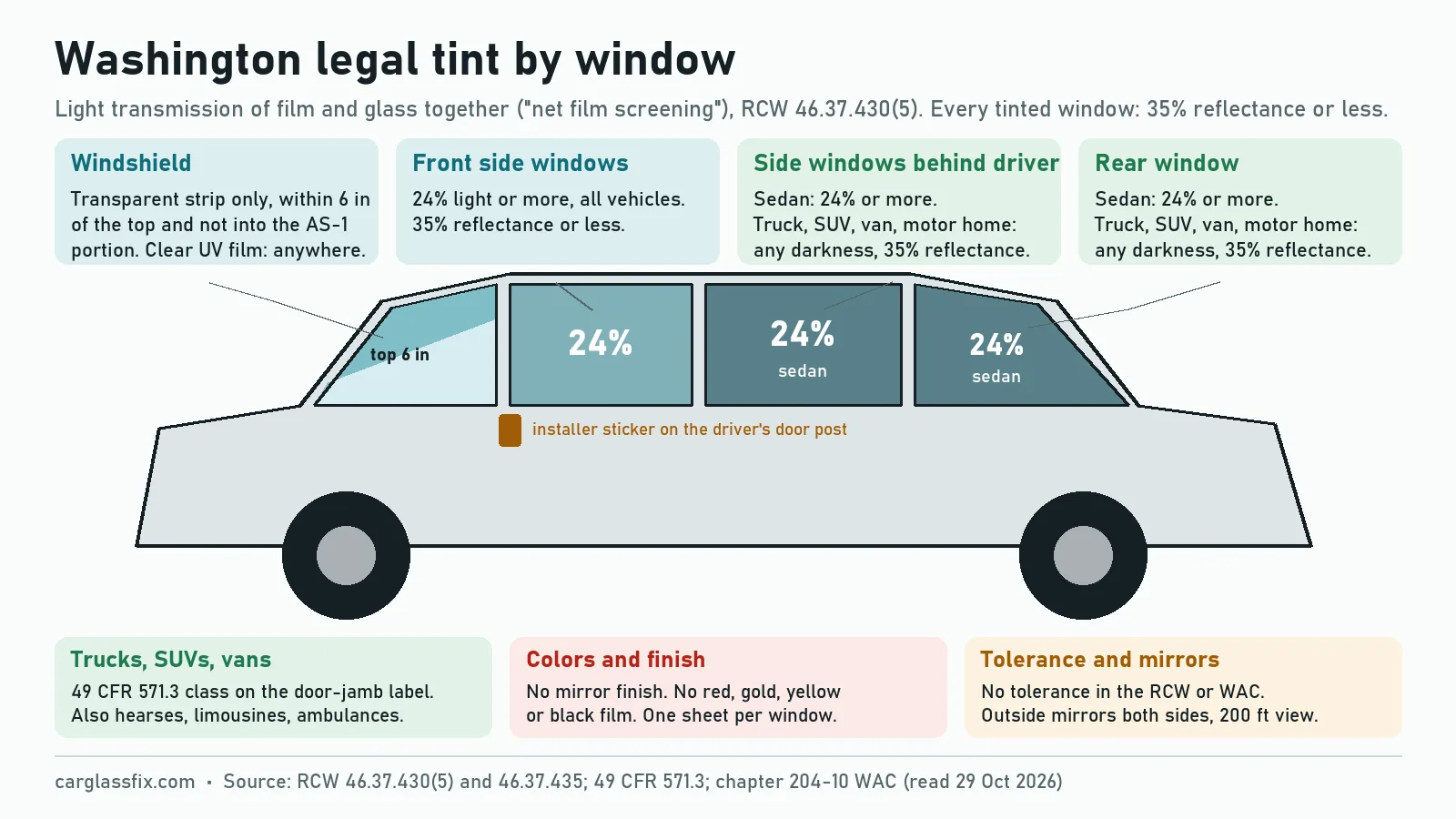
Washington sets one darkness limit, 24% light transmission, for every window except the windshield, and applies it to a sedan on all sides. The rule is RCW 46.37.430(5)(a), as rewritten by 2009 c 142. The same subsection caps reflectance at 35% and allows only “a single sheet of film” on any window. Outside mirrors on both sides are a condition of any tint. Washington does not split the limit into front side, back side and rear window figures the way most states do. The split appears only in subsection (5)(b), which lets listed vehicles go darker behind the driver. For a passenger car, 24% is the floor on the front doors, the rear doors and the back glass alike. Factory privacy glass counts toward that figure, as the next section explains.
| Window | Sedan | SUV, van, pickup (truck, motor home or MPV under 49 CFR 571.3) |
|---|---|---|
| Windshield | Transparent strip only, within 6 in of the top and not into the AS-1 portion; clear UV film allowed anywhere | Same |
| Front side windows | 24% light or more, 35% reflectance or less | Same |
| Side windows behind the driver | 24% light or more, 35% reflectance or less | Any darkness, 35% reflectance or less |
| Rear window | 24% light or more, 35% reflectance or less | Any darkness, 35% reflectance or less |
| Measured as | Film and glass together (“net film screening”) | Same |
| Tolerance | None in the statute or in chapter 204-10 WAC | Same |
| Mirrors | Outside mirrors on both sides showing 200 ft to the rear | Same |
| Colors and finish | No mirror finish; no red, gold, yellow or black film; one sheet per window | Same |
How Washington measures tint: net film screening, no tolerance
Washington measures the finished window, film and glass together, and calls that figure “net film screening”. Subsection (2)(b) defines it as the material “applied by the manufacturer during the safety glazing” plus any film added after the vehicle was built. A film sold as 24% on clear glass may read close to 24%, but the same film on factory-tinted rear glass reads far lower and fails.
The current statute has no tolerance. Until 2009, subsection (5)(a) allowed film with “a light transmission of thirty-five percent or more, plus or minus three percent”, measured against clear glass, which the statute said worked out to 24% on AS-2 side glass. The 2009 rewrite dropped the film figure and the 3% allowance and left 24% net as the only number. Chapter 204-10 WAC, the State Patrol’s equipment rules, has no tint section and adds no tolerance either. A driver who wants to check a car before a stop can follow how to measure window tint, or use a window tint meter, which reads the same net figure an officer sees. The window tint percentage chart shows how dark 24% looks next to 35% and 20%.
Windshield tint in Washington: 6 inches, the AS-1 line and clear UV film
A Washington windshield may carry a tinted strip only along the top edge, and the product must be transparent. Subsection (5)(e) sets two limits on the strip: it may not “extend into the AS-1 portion of the windshield” and may not “extend more than six inches from the top”. Both limits apply, so the strip stops at whichever line comes first. The AS-1 mark is etched near the top corners of the glass; the AS-1 line on a windshield explains where to find it and what it means.
Clear film is treated differently. The same subsection says clear film that “reduces or eliminates ultraviolet light may be applied to windshields”, with no strip limit, so a clear UV film may cover the whole windshield. Few state statutes say this in so many words; Texas, for example, allows it through a DPS rule rather than in the code. The strip itself must still be transparent, so a dark visor band fails even inside the 6 inches. Before 2009 the statute allowed the “top six-inch area” with no AS-1 wording; the 2009 rewrite added the AS-1 limit. For how other states treat windshield film, read is it illegal to have tint on a windshield.
Trucks, SUVs and vans: darker rear windows under the 35% reflectance rule
Vehicles the manufacturer identifies as a truck, motor home or multipurpose passenger vehicle may use film under 24% on “any window to the rear of the driver”. That is subsection (5)(b). Two conditions stay: reflectance of 35% or less, and outside mirrors on both sides. The front door windows keep the 24% floor. 49 CFR 571.3 defines a multipurpose passenger vehicle as one that carries 10 people or fewer and is built “on a truck chassis or with special features for occasional off-road operation”. That covers most SUVs, vans and pickups, but the class is the maker’s choice, printed on the certification label in the door jamb. A crossover certified as a passenger car gets the sedan rule.
The same subsection lists hearses, collector vehicles, limousines, passenger buses used for hire, ambulances, rescue squad vehicles and other licensed emergency medical vehicles. Before 2009 the exception covered vehicles labelled “multi-use, multipurpose, or other similar designation” and the threshold was 35%; the 2009 act tied it to the federal definition and the 24% figure. The 35% reflectance cap is why a mirror-look film fails on these windows even where darkness is unlimited. Our page on whether you can put mirror tint on a car covers reflective films in more detail.
How Washington tint law changed, and what older pages still get wrong
The limits that apply today date from 2009 c 142, which rewrote subsection (5) of RCW 46.37.430. The film rules themselves began with 1990 c 95, which also gave owners of cars tinted behind the driver before June 7, 1990 until July 1, 1993 to comply. The 2009 act replaced a 35% film standard with a 3% tolerance by the flat 24% net figure, added the “net film screening” definition, wrote the AS-1 line into the windshield rule, and tied the truck and SUV exception to 49 CFR 571.3.
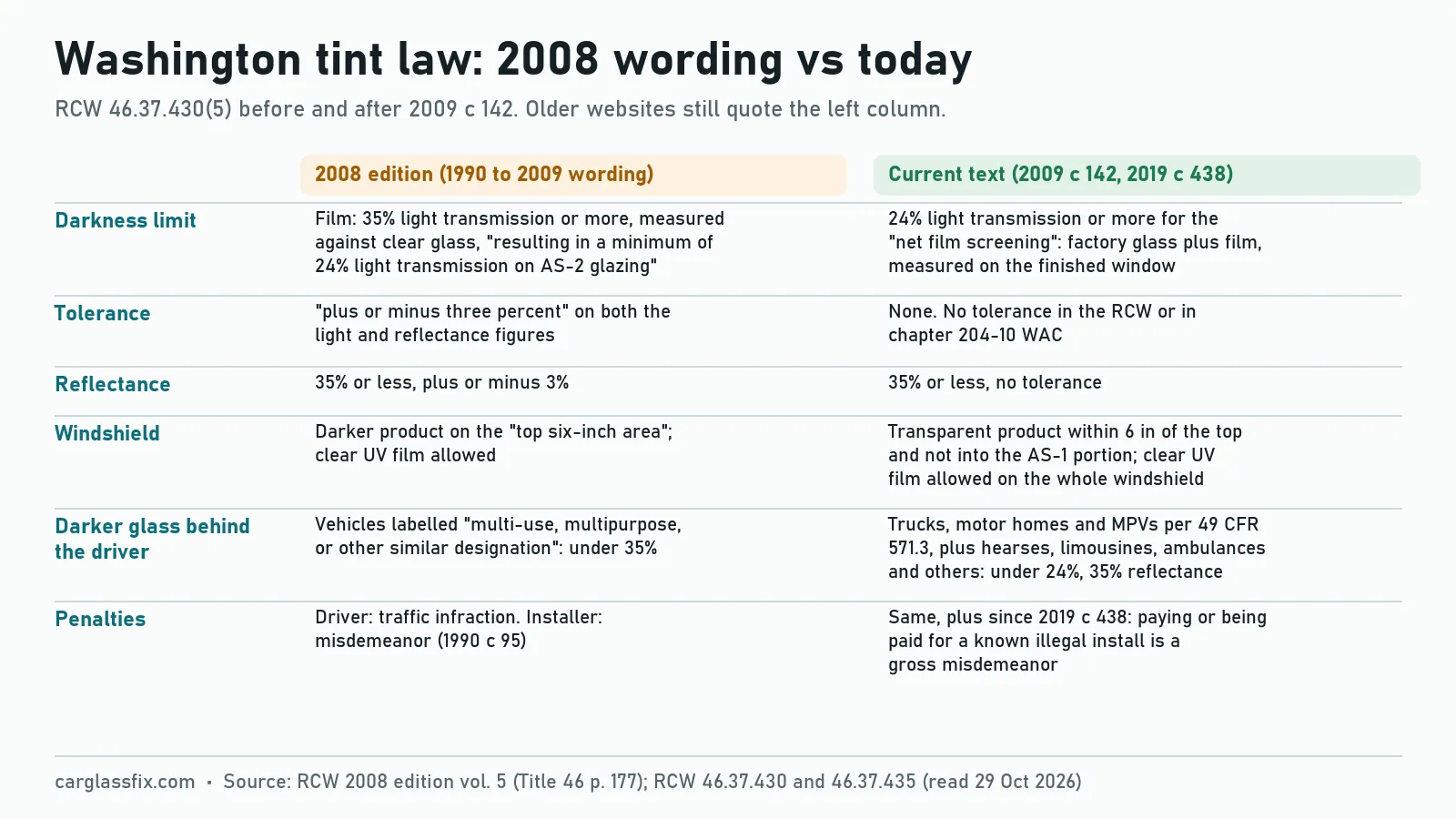
Two later changes matter. 2007 c 168 exempted the side and rear windows of law enforcement vehicles. 2019 c 438 added subsection (2) to RCW 46.37.435, which makes paying for a known illegal installation a gross misdemeanor. Older pages still carry the pre-2009 wording. One aggregator lists a “plus or minus 3%” meter tolerance for Washington; another says the law was “enacted in 2011” and puts the installer sticker on the driver’s window; the Bing AI answer says stickers are not required and that the medical exemption is filed with the Department of Licensing. None of that is in the current statute.
Washington medical exemption for window tint
Washington allows darker film for a medical need on the strength of a physician’s letter alone. Subsection (5)(d) permits “a greater degree of light reduction” on “all windows and the top six inches of windshields” of a vehicle driven by, or carrying, a person who holds “a written verification from a licensed physician” that they “must be protected from exposure to sunlight for physical or medical reasons”. The statute names no form, fee, agency, decal or lower limit, and neither the Washington State Patrol nor the Department of Licensing publishes one.
How to use the Washington medical tint exemption
See a licensed physician
Only a licensed physician’s verification counts under subsection (5)(d); the statute does not name optometrists, nurse practitioners or physician assistants.
Get the verification in writing
It must state that the driver or passenger must be protected from exposure to sunlight for physical or medical reasons.
Keep it with the person
The exemption follows the person, since it applies to a vehicle “operated by or carrying as a passenger” the person who “possesses” the letter.
Stay within the other rules
The letter lifts only the light limit; the 35% reflectance cap, the color ban, the single-sheet rule and the mirror rule are separate subsections and still apply.
The exemption reaches the windshield only in its top 6 inches, so a fully darkened windshield is not allowed even with a letter. Because the letter belongs to the person, a family member driving the car without that person aboard has no exemption at that moment. Keep the letter in the vehicle to show at a stop.
Washington tint tickets, fines and how the State Patrol checks tint
Driving with film outside the limits is a traffic infraction under RCW 46.37.430(7). RCW 46.63.110 caps the penalty at $250 per offense; the base amount comes from the Supreme Court’s penalty schedule (IRLJ 6.2), which the court may waive or reduce. Fixed fees of $5, $10 and $10 that “under no circumstances” may be waived sit on top, plus a $24 penalty the court may drop only for an indigent defendant, $49 in all. Washington has no safety inspection program, so enforcement is roadside. An Associated Press report from April 2011 said some Washington State Patrol troopers carry tint meters and all carry cards printed at the legal limit for a visual comparison.
The installer faces more than the driver. Knowingly installing illegal film, or fitting a window that already carries it, is a misdemeanor under RCW 46.37.435(1); since 2019, knowingly paying for such work is a gross misdemeanor. The installer must also fit the subsection (5)(c) sticker on the driver’s door post, next to the manufacturer’s tag, showing the business name and state tax identification number. Preview shades in the window tint simulator, and compare other states in what car window tint is legal. Rules can change; check the current RCW 46.37.430 before tinting. This article is general information, not legal advice.
Frequently asked questions
Is 20% tint legal in Washington?
A 20% reading is illegal on any window of a sedan and on the front door windows of every vehicle, because Washington requires 24% with the film and glass together. On a truck, SUV, van or motor home it is legal on the windows behind the driver if reflectance is 35% or less.
How much is a ticket for window tint in Washington?
Illegal tint is a traffic infraction. RCW 46.63.110 caps the penalty at $250 per offense and adds fixed fees of $5, $10 and $10 plus a $24 penalty; the base amount comes from the state court penalty schedule and varies with the court.
Is it illegal to have 5% tint all around in Washington?
Yes. The front door windows of every vehicle and all windows of a sedan must pass at least 24% of light. Only trucks, motor homes and multipurpose passenger vehicles may run 5% on the windows behind the driver, and only with 35% reflectance or less and both outside mirrors.
Is windshield tint legal in Washington state?
Only as a transparent strip within the top 6 inches and above the AS-1 portion, or as clear UV film anywhere on the glass. A physician’s letter extends darker film to the top 6 inches only, never the whole windshield.
What are the Washington window tint laws for trucks?
A vehicle the maker certifies as a truck, motor home or multipurpose passenger vehicle may use any darkness behind the driver under RCW 46.37.430(5)(b), with reflectance of 35% or less and both outside mirrors. The front door windows still need 24%; the window tint percentage chart shows what 24% looks like.
Sources
- RCW 46.37.430, Safety glazing, sunscreening or coloring (checked 29 October 2026)
- RCW 46.37.435, Unlawful installation of film sunscreening material, penalty (checked 29 October 2026)
- RCW 46.63.110, Monetary penalties for traffic infractions (checked 29 October 2026)
- Revised Code of Washington, 2008 edition, volume 5 (Title 46, RCW 46.37.430 as amended by 2007 c 168) and 2006 edition, volume 5, Office of the Code Reviser archive (read 29 October 2026)
- WAC 204-10-024, Windows and chapter 204-10 WAC, Equipment standards (checked 29 October 2026)
- 49 CFR 571.3, Definitions (multipurpose passenger vehicle) (checked 29 October 2026)
- Washington State Patrol: Vehicle and Equipment Requirements (checked 29 October 2026; no window tint section)
- Associated Press via The Seattle Times: New tool helps police crack down on tinted windows (17 April 2011)

Similar Posts