How to Make Homemade Windshield Washer Fluid (and Risks)
Senior Automotive Glass Diagnostic Specialist & Master Technician at CarGlassFix · AGSC Master Certified Auto Glass Technician, NGA Certified Installer, I-CAR Automotive Safety Specialist · 12+ Years in Automotive Glazing, Windshield Structural Bonding, ADAS Camera Calibration & Precision Chip Restoration
Homemade windshield washer fluid is usually water with rubbing alcohol, and sometimes vinegar or dish soap. Several automakers advise against it. Honda says vinegar can damage the washer pump, and Mazda warns soapy water can discolor paint. If you still mix your own, skip vinegar and soap, and size the alcohol to the coldest weather you expect.
Can you make your own windshield washer fluid?
You can mix your own washer fluid, but several automakers tell owners not to. Honda’s 2026 HR-V manual says to “use only commercially available windshield washer fluid”. Ford’s 2012 Focus manual asks for washer fluid that meets Ford specifications. Other makers are less strict, and some allow plain water as a short-term fill.
Automakers that ask for commercial fluid
Honda and Ford give the clearest answer, and both point owners to bought fluid. Honda adds a notice that a vinegar and water solution can damage the washer pump. Ford allows a non-methanol antifreeze fluid only if it protects without damaging paint, wiper blades or the washer system. GM’s 2024 Silverado 1500 manual asks for a fluid with sufficient protection against freezing.
Automakers that allow plain water
Kia, Mazda and Hyundai allow plain water, but only as a stopgap. Kia’s 2026 manual says plain water may be used if washer fluid is not available. Mazda’s 2026 CX-50 manual allows “only windshield washer fluid or plain water” in the reservoir. All three tell owners to use antifreeze washer fluid in cold climates. Tesla takes a stricter line on water, covered in the bacteria section below.
| Ingredient | What the manual says | Manual |
|---|---|---|
| Vinegar and water | Can damage the washer pump | Honda HR-V 2026, Honda Canada |
| Soapy water | Can cause paint discoloration or pump damage | Mazda CX-50 2026, CX-30 2025 |
| Soapy water | May cause streaking on painted surfaces | Toyota Highlander 2011 |
| Plain water | Allowed if washer fluid is not available; antifreeze fluid in cold climates | Kia 2026, Mazda 2026, Hyundai 2026 |
| Untreated water | Can cause bacterial growth in the climate control system | Tesla Model S |
| Non-methanol antifreeze fluid | Only if it does not damage paint, wiper blades or the washer system | Ford Focus 2012 |
| Engine antifreeze or coolant | Never; harms paint or visibility | GM, Honda, Mazda, Kia |
| Ammonia or household glass cleaner | Not named in any manual reviewed | None found |
How cold can a homemade alcohol mix go?
A homemade alcohol mix protects only as far as its alcohol share allows, and common home ratios hold far less alcohol than winter fluid. Handbook tables give the freezing point of each alcohol and water mix, so the protection can be estimated before the jug goes in the car.
Rubbing alcohol (isopropyl) freeze points
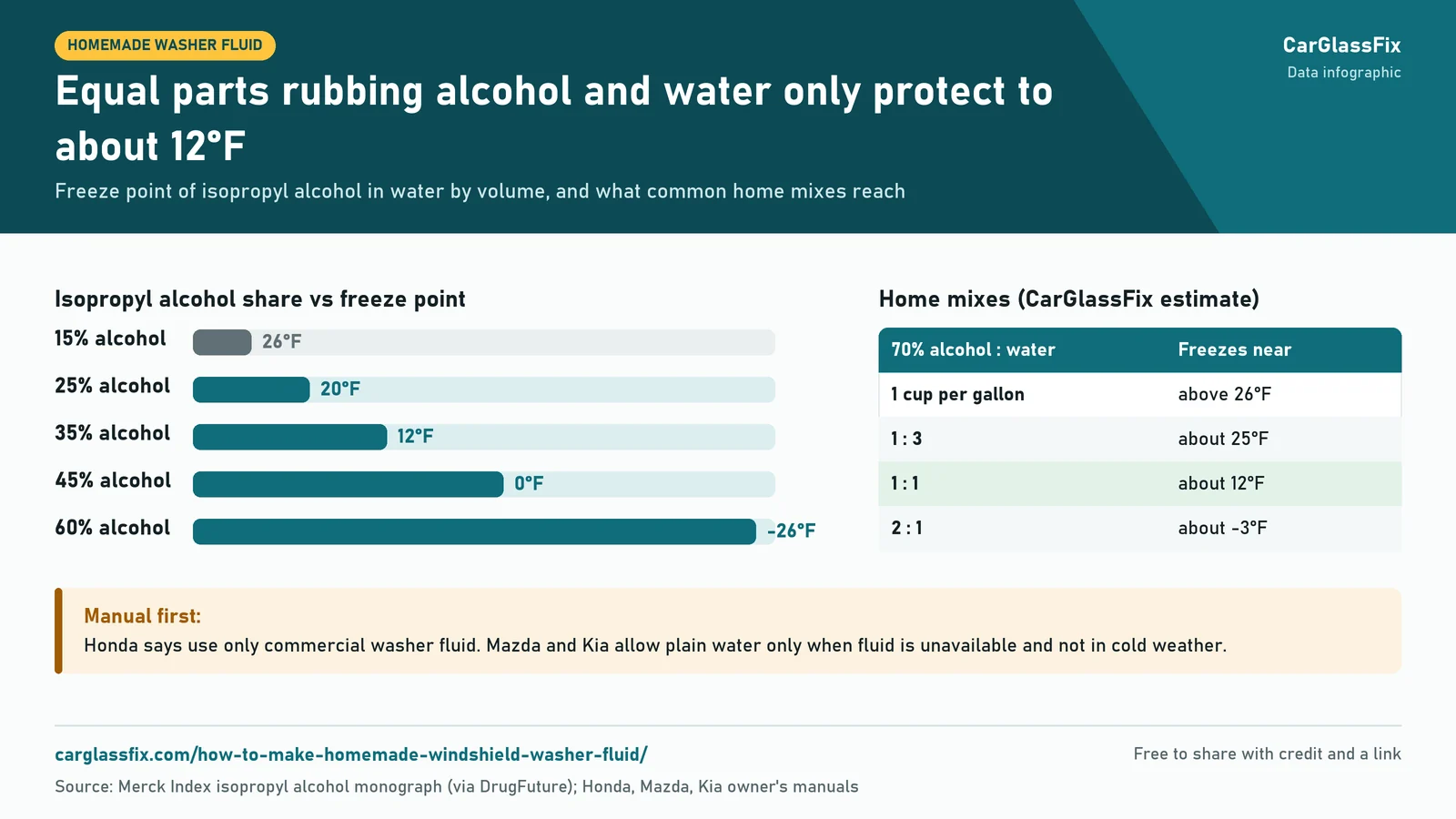
Each step up in isopropyl alcohol share lowers the freeze point. The Merck Index monograph on isopropyl alcohol lists freezing points of its mixtures with water by volume. A 15 percent mix freezes at -3.3°C, about 26°F. A 35 percent mix freezes at -11.1°C, about 12°F. A 45 percent mix freezes at -17.8°C, about 0°F. A 60 percent mix freezes at -32°C, about -26°F.
| Mix of 70% rubbing alcohol and water | Alcohol share in the jug | Estimated freeze point |
|---|---|---|
| 1 cup in a gallon of water | About 4% | Above 26°F |
| 1 part alcohol, 3 parts water | About 17.5% | About 25°F |
| Equal parts | 35% | About 12°F |
| 2 parts alcohol, 1 part water | About 47% | About -3°F |
| Equal parts of 91% alcohol and water | About 45.5% | About -1°F |
These are CarGlassFix estimates. They assume the 70 percent on the bottle is by volume, ignore the small shrink when alcohol meets water, and interpolate between table rows. The “cup per gallon” mix sits below the table’s lowest row, so it gives very little protection.
Ethanol and vinegar mixes
Ethanol mixes follow the same pattern, and vinegar barely lowers the freeze point at all. Lange’s Handbook of Chemistry lists ethanol at 20.2 percent by volume freezing at -7.5°C, about 18°F. At 40.5 percent by volume it freezes at -23.6°C, about -10°F. AAA says a vinegar pretreatment’s freezing point is “just barely lower than that of water”. Household vinegar holds at least 4 grams of acetic acid per 100 mL under FDA guidance, so it is mostly water.
The 40°F line in owner’s manuals
Several manuals ask for antifreeze fluid above the freezing point of water. Mazda calls washer fluid without anti-freeze protection dangerous below 40°F (4°C). Tesla and Ford give the same 40°F line. Freeze protection and nozzle icing are covered in how to prevent windshield washer freezing.
Why a bottle label can differ from the table
A commercial label can read colder than a plain mix, because bought fluid may hold other ingredients and use other test methods. The Super Tech -20F sheet lists 30 percent methanol, while the methanol handbook table gives about -13°F for 29.2 percent. A homemade jug has no label rating at all. What each commercial fluid type contains is covered in how to switch windshield washer fluid type.
Common homemade ingredients, one by one
Each common homemade ingredient carries a different risk for the washer system, and only some have an automaker rule. The notes below use the owner’s manuals and safety sources listed at the end of this page.
Plain, tap and distilled water
Plain water is the base of every homemade recipe, and it brings three problems. Honda tells owners to avoid prolonged use of hard water to prevent lime scale buildup. Mitsubishi’s service newsletter says tap water used to dilute fluid “may contain minerals” that collect in nozzle holes, and it recommends purified water. Mercedes-Benz found that fluid mixed with distilled water can trigger a false “washer fluid empty” warning on some Sprinter and Metris models, because the level sensor reads electrical conductivity. Its fix is standard washer fluid and water, with no distilled water.
Vinegar
Vinegar is the ingredient with the clearest automaker warning. Honda’s notice says a vinegar and water solution can damage the windshield washer pump. AAA reports that some glass professionals caution that long exposure to liquid vinegar may cause micro pitting of windshield glass. AAA also says vinegar-based pretreatments remove car wax over time. Vinegar works on mineral spots in a spray bottle, which is covered in how to make car glass cleaner at home.
Dish soap and hand soap
Dish soap is a common recipe ingredient, and two automakers warn against soapy water in the reservoir. Mazda says soapy water could cause paint discoloration or pump damage. Toyota’s 2011 Highlander manual says soapy water may cause streaking on painted surfaces. AAA says dishwashing soap removes car wax. Invisible Glass leaves soaps out of its glass cleaner because they can leave a filmy residue.
Ammonia and household glass cleaner
No owner’s manual reviewed for this guide names ammonia or household glass cleaner as a washer fluid. That silence is not approval. SC Johnson says its Windex Foaming Glass Cleaner with Ammonia-D is not recommended for painted surfaces. GUNK’s M516 washer concentrate does list an ammonia formula, but it is a made-for-purpose product with dilution ratios. Household cleaners and washer fluid are compared in car glass cleaner vs Windex.
Rubbing alcohol and other alcohols
Alcohol is the only common homemade ingredient that lowers the freeze point by a useful amount. AAA says alcohol-based de-icing solutions are not directly harmful to paint but do remove car wax. Ford allows a non-methanol fluid only if it does not damage paint, wiper blades or the washer system. Pure isopropyl alcohol has a flash point of 53°F, according to NIOSH, and a 70 percent rubbing alcohol label carries a “Flammable” warning.
Risks of homemade fluid to the pump, nozzles and paint
Homemade fluid puts the pump, the nozzles, the paint and the wiper rubber at risk, and some ingredients add a visibility or fire risk. Each risk below comes from an automaker or safety source.
Washer pump
The washer pump is the part most often named in manual warnings. Honda says vinegar can damage it, and Mazda says soapy water can. Kia warns against running the washer with an empty reservoir. A failing pump is covered in how to replace windshield washer pump.
Nozzles and lines
Nozzles clog when minerals or residue build up in their small holes. Mitsubishi traces mineral buildup in nozzle holes to tap water used for dilution. Honda links hard water to lime scale buildup. Clearing a blocked jet is covered in how to clean windshield washer nozzles.
Paint, wax and wiper blades
Paint is the next risk, because washer fluid can reach painted surfaces. Mazda and Toyota both link soapy water to paint damage or streaks. AAA says vinegar, alcohol de-icers and dish soap remove car wax. Ford names wiper blades among the parts a non-methanol fluid must not damage.
Engine antifreeze (coolant)
Engine antifreeze never belongs in the washer reservoir. GM says engine coolant can damage the washer system and paint. Honda says antifreeze can damage the vehicle’s paint. Kia warns that coolant can severely obscure visibility when sprayed on the windshield.
Fire risk when filling
Alcohol mixes are flammable, so the fill happens with the engine off. Toyota says not to add washer fluid when the engine is hot or running, because the fluid contains alcohol and may catch fire if spilled. Hyundai says washer fluid with alcohol can be flammable.
Bacteria and Legionella in homemade fluid
Water-based homemade fluid can grow bacteria in the reservoir, and peer-reviewed studies have linked it to Legionnaires’ disease. Tesla’s Model S manual warns that untreated water can cause bacterial growth in the climate control system, with odor and damage that its warranty does not cover.
What the studies found
Three study groups found the same pattern in different countries. A 2010 case-control study by the UK Health Protection Agency covered 75 cases and 67 controls in England and Wales. Driving a vehicle with wiper fluid that had no added screenwash carried an odds ratio of 47.2. The authors estimated that about 20 percent of community-acquired sporadic cases could be linked to that exposure. A 2015 Arizona State University study found that 1 liter of tap water in a washer reservoir supported Legionella growth for several months. The same study found Legionella in 84 percent of washer fluid samples from 12 school buses, and live cells in the spray. A 2022 report from Barcelona tied two cases in truck drivers to wiper fluid without screen wash.
What the researchers advise
Researchers point drivers to screenwash or alcohol-based washer fluid. The 2010 authors called a simple recommendation to use screenwash a way to reduce transmission. A 2024 paper by NIOSH and CDC authors suggested genuine windshield cleaner with bactericidal properties, such as isopropanol or methanol, to reduce the risk. A 2026 survey of 62 reservoirs in Portugal found no Legionella but did find other bacteria living in the fluid. No study reviewed for this guide tested a homemade recipe.
A lower-risk way to mix your own fluid
The lowest-risk homemade mix is clean water with enough rubbing alcohol for your coldest weather, and nothing else. The steps below follow the manual rules and safety sources on this page. They do not override an owner’s manual that asks for commercial fluid only. GM asks for a fluid with sufficient protection against freezing, so the alcohol share has to match the coldest morning you expect. Below about 0°F, the handbook table calls for more 70% rubbing alcohol than water in the jug.
How to make homemade windshield washer fluid with lower risk
Check the owner’s manual
Look for the washer fluid notice. If it asks for commercial fluid only, as Honda does, buy washer fluid instead.
Leave out vinegar, soap and coolant
Honda, Mazda, Toyota and GM warn against these in the reservoir.
Start with clean, soft water
Mitsubishi recommends purified water over mineral-rich tap water. Mercedes-Benz advises against distilled water on vans whose level sensor reads conductivity.
Size the alcohol to the cold
Use the freeze table above. Equal parts 70% rubbing alcohol and water reach about 12°F (CarGlassFix estimate), so colder regions need commercial winter fluid.
Mix in a labeled jug
Poison Control advises copying the label onto any transfer container and adding the poison center number. Never use a food or drink container.
Fill with the engine off and cool
Toyota warns that alcohol in washer fluid may catch fire if spilled on a hot engine.
Spray and check the glass
Watch for streaks, smears or a weak spray, and switch to bought fluid if they appear.
Refill steps for each reservoir type are covered in how to refill windshield washer reservoir. Concentrates and tablets have their own dilution rules in how to use car wiper detergent.
Homemade vs commercial washer fluid
Commercial washer fluid has a printed freeze rating and a published ingredient list, and a homemade mix has neither. That gap is why the stricter manuals ask for bought fluid.
| Point | Homemade mix | Commercial washer fluid |
|---|---|---|
| Freeze rating | None; estimate from a handbook table | Printed on the label |
| Ingredients | Whatever went into the jug | Hazardous ingredients listed on the safety data sheet |
| Manual approval | Honda and Ford ask for commercial or spec fluid | Meets the manual’s request |
| Bacteria | Water-only mixes linked to Legionella in studies | Alcohol content suggested by NIOSH and CDC authors |
| Paint and pump | Vinegar and soap carry manual warnings | Made for washer systems |
| Labeling | Must be added by hand | Comes on the container |
Storing and labeling a homemade jug
A homemade jug needs its own label, because nothing on it tells others what is inside. Poison Control says to keep cleaning products in original containers when possible. For a transfer, it says to place a copy of the label on the new container with the poison center number, 1-800-222-1222. UF/IFAS Extension adds that cleaners should never go in food containers and should be stored out of children’s reach.
Never mix with bleach
Bleach must never meet homemade washer ingredients. Poison Control says bleach and ammonia make chloramine gas. It says bleach mixed with an acid, such as vinegar, makes chlorine gas. Poison Control says chlorine gas causes burning of the eyes, nose and throat.

Frequently asked questions
Can I just use water as windshield washer fluid?
Kia, Mazda and Hyundai allow plain water only when washer fluid is not available, and call for antifreeze fluid in cold climates. Tesla warns that untreated water can grow bacteria, and studies have linked water-only reservoirs to Legionella.
Is vinegar safe in a windshield washer reservoir?
Honda says a vinegar and water solution can damage the windshield washer pump. AAA adds that vinegar barely lowers the freezing point of water.
Can I put dish soap in my washer fluid?
Mazda warns that soapy water in the reservoir could cause paint discoloration or pump damage, and Toyota warns of streaks on painted surfaces. AAA says dish soap also removes car wax.
How much rubbing alcohol keeps homemade washer fluid from freezing?
Based on the Merck Index table, equal parts 70% rubbing alcohol and water would freeze at about 12°F, and 2 parts alcohol to 1 part water at about -3°F (CarGlassFix estimates). A cup of rubbing alcohol per gallon of water gives very little protection.
Can I use Windex as windshield washer fluid?
No owner’s manual reviewed for this guide approves household glass cleaner in the reservoir, and SC Johnson says its ammonia foaming cleaner is not recommended for painted surfaces. See car glass cleaner vs Windex for the full comparison.
Sources
- Honda, 2026 HR-V Owner’s Manual: Refilling Window Washer Fluid
- Honda Canada, Owner’s Manual: Window Washer Fluid
- Mazda, 2026 CX-50 Owner’s Manual: Replenishing Windshield Washer Fluid
- Mazda, 2025 CX-30 Owner’s Manual: Replenishing Windshield Washer Fluid
- Toyota, 2011 Highlander Owner’s Manual: Washer fluid (mirror on ManualsDir)
- Ford, 2012 Focus Owner’s Manual: Windshield washer fluid (mirror on ManualsDir)
- Tesla, Model S Owner’s Manual: Windshield Wiper Blades, Jets and Fluid
- GM, 2024 Chevrolet Silverado 1500 Owner Manual
- Kia, 2026 Owner’s Manual (MV1A): Checking the washer fluid level
- Kia, 2025 Owner’s Manual (SV1): Washer warnings
- Hyundai, 2026 Owner’s Manual (LX3): Washer Fluid
- Mitsubishi Motors North America, Tech Talk vol. 271 (2022, via NHTSA)
- Mercedes-Benz, LI82.35-N-078930: washer fluid empty warning with distilled water (2025, via NHTSA)
- Merck Index monograph: Isopropyl Alcohol, freezing points of mixtures with water (reproduced by DrugFuture, checked 2026-11-06)
- Ethanol data page: properties of aqueous ethanol solutions, from Lange’s Handbook of Chemistry (10th ed.) (checked 2026-11-06)
- Methanol data page: aqueous methanol freezing points, from Lange’s Handbook (10th ed.) and CRC Handbook (44th ed.) (checked 2026-11-04)
- Fox Packaging, Super Tech -20F Windshield Washer Fluid safety data sheet (2005)
- AAA, How to De-Ice Your Car’s Windshield
- FDA, CPG Sec. 525.825 Vinegar, Definitions
- CDC NIOSH Pocket Guide to Chemical Hazards: Isopropyl alcohol
- DailyMed, 70% Isopropyl Rubbing Alcohol label
- Wallensten A. et al., Windscreen wiper fluid without added screenwash in motor vehicles: a newly identified risk factor for Legionnaires’ disease, Eur J Epidemiol (2010)
- Schwake D.O. et al., Automobile windshield washer fluid: a potential source of transmission for Legionella, Sci Total Environ (2015)
- Politi J. et al., Vehicle windshield wiper fluid as potential source of sporadic Legionnaires’ disease in commercial truck drivers, Emerg Infect Dis (2022)
- Harduar Morano L. et al., Legionnaires’ disease in transportation, construction and other occupations, Occup Environ Med (2024)
- Bento J.T. et al., Microbial diversity in vehicle windshield washer reservoirs, Microorganisms (2026)
- SC Johnson, Windex Foaming Glass Cleaner with Ammonia-D product text (distributor copy)
- GUNK, Windshield Washer Solvent with Anti-Freeze M516 product information sheet (2013)
- Invisible Glass, Auto Glass Cleaner
- Poison Control, Chlorine gas: what happens if you mix bleach and other cleaners
- Poison Control, Why container transfers are dangerous
- UF/IFAS Extension, FCS3319 Homemade Household Cleaners

Similar Posts