How to Replace a Windshield Washer Pump: Tests and Steps
Senior Automotive Glass Diagnostic Specialist & Master Technician at CarGlassFix · AGSC Master Certified Auto Glass Technician, NGA Certified Installer, I-CAR Automotive Safety Specialist · 12+ Years in Automotive Glazing, Windshield Structural Bonding, ADAS Camera Calibration & Precision Chip Restoration
To replace a windshield washer pump, first confirm the pump is bad with the fluid level, the fuse and a voltage test at its connector. Then reach the reservoir from the top, through the wheel-well liner or by removing the reservoir, unplug the pump, release its hose, pull it from its seal and fit the new one.
What a windshield washer pump does and when it needs replacing
A windshield washer pump is a small electric motor that pushes fluid from the reservoir through the hoses to the spray nozzles. It usually sits low on the reservoir, sealed into it with a rubber grommet. Federal Motor Vehicle Safety Standard No. 104 requires every passenger car, multipurpose passenger vehicle, truck and bus to be built with a windshield washing system.
A pump needs replacing when it gets power and ground but does not run, or when it runs and moves no fluid with a clear inlet and clear lines. A silent washer is not proof of a dead pump. The fuse, the relay, the switch, a body control module or an empty reservoir can stop it too.
Kia’s 2026 Sorento owner’s manual tells drivers to check the fluid level first when the washer does not work. The same manual says not to run the washer with an empty reservoir, to prevent possible damage to the pump. Honda’s owner information adds that a vinegar and water mix can damage the washer pump. If the fluid is simply low, start with how to refill windshield washer fluid.
Where the pump sits: three access routes by vehicle
The pump is reached from the top of the engine bay, through the front wheel-well liner or by taking the whole reservoir out, depending on the vehicle. The route decides most of the work, so read the procedure for your car before you buy parts. Service information shows all three routes.
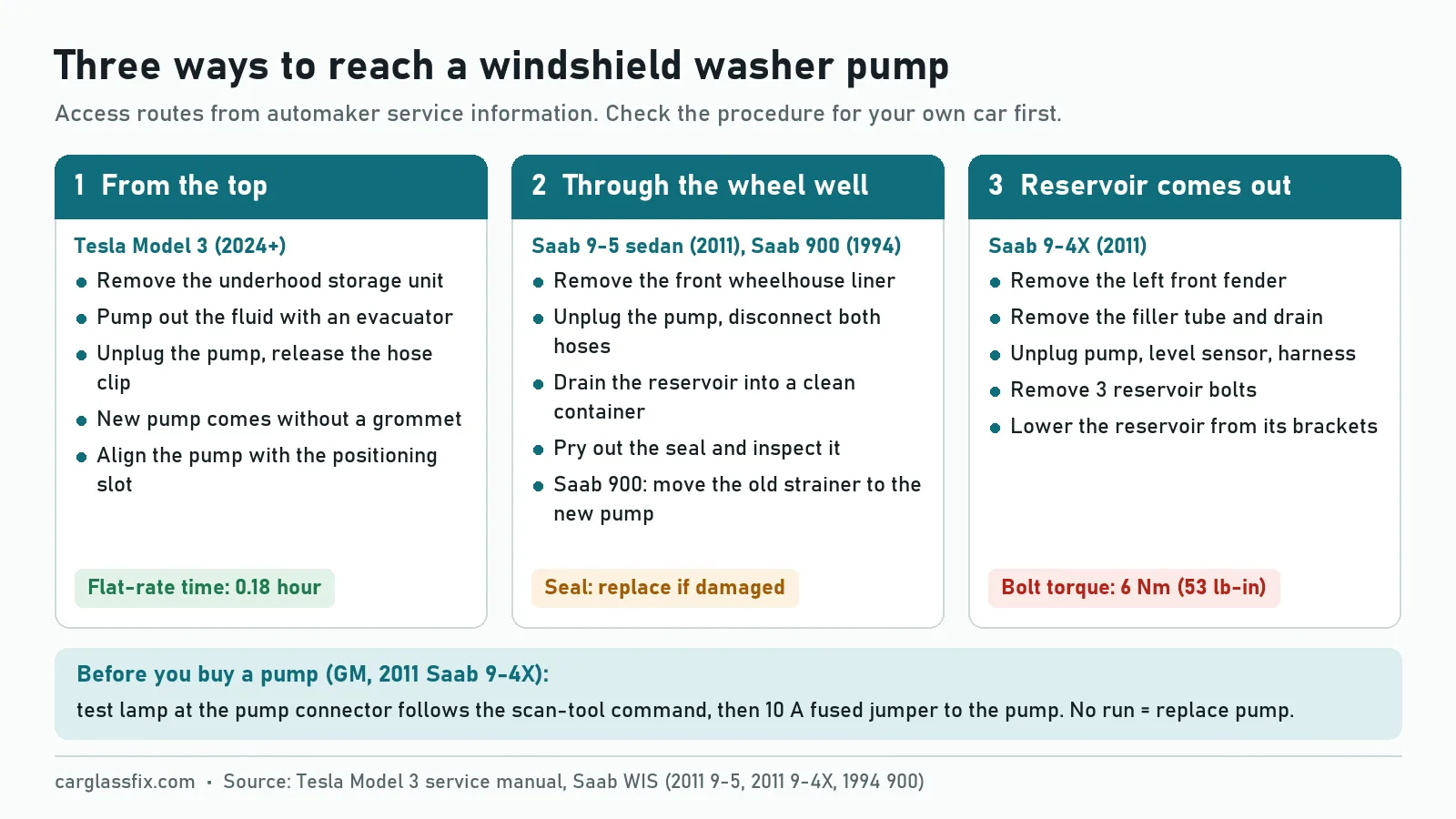
| Access route | Example | What comes off first | Detail from the procedure |
|---|---|---|---|
| From the top | Tesla Model 3 (2024+ manual) | Underhood storage unit | Fluid is pumped out with an air-operated evacuator; flat-rate time 0.18 hour |
| Through the wheel well | 2011 Saab 9-5 sedan | Front wheelhouse front liner | Drain the reservoir; pry the seal out with a small flat-bladed tool |
| Through the wheel well | 1994 Saab 900 | Front left wing liner, car raised | Ease the pump up out of the reservoir |
| Reservoir removal | 2011 Saab 9-4X (GM-built) | Left front fender and filler tube | Three reservoir bolts, tightened to 6 Nm (53 lb-in) |
Tesla’s flat-rate time is a technician labor figure for one model, not a promise for a home job. A route that needs the fender off is a bigger job than the pump itself, and the wheel-well route usually means raising the car safely first.
How to prove the pump is bad before you replace it
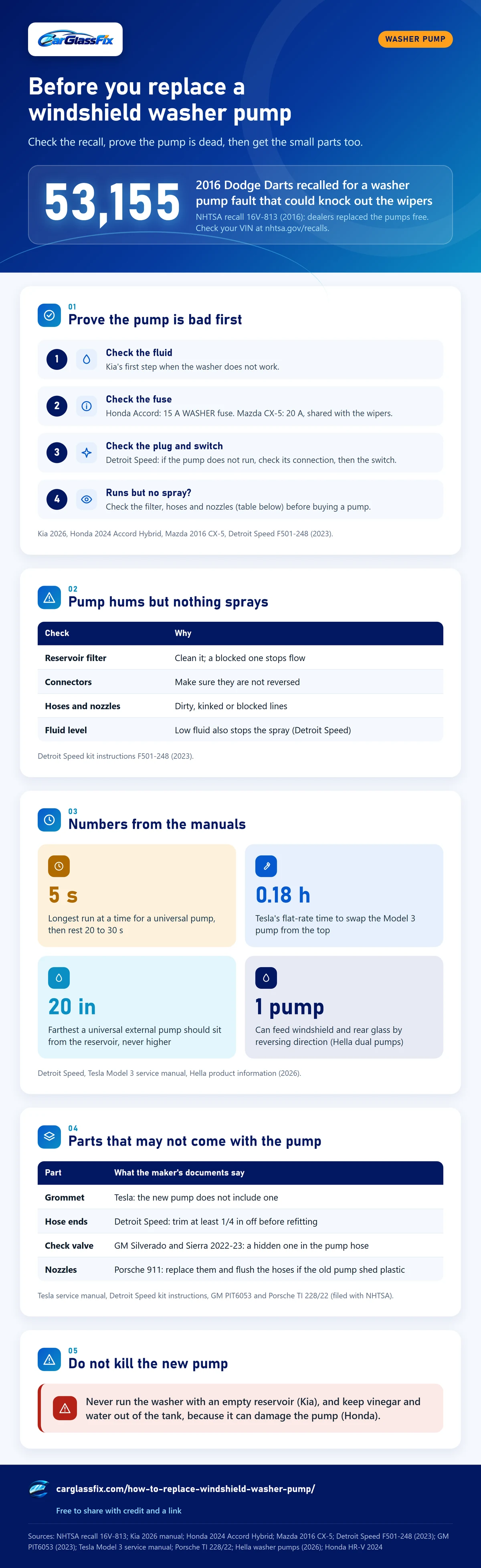
Prove the pump is bad by checking, in order, the fluid, the fuse, the power at the pump connector and then the pump on a fused jumper. GM’s diagnostic for the 2011 Saab 9-4X follows that order and ends with “test or replace” the pump only when every circuit tests normal. The full circuit, pin numbers and polarity are covered in how to wire a windshield washer pump.
| Check | What passes | Source |
|---|---|---|
| Fluid level | Fluid above the minimum mark | Kia owner’s manual; GM 9-4X diagnostic |
| Fuse | Intact fuse of the rated amperage, such as the 15 A WASHER fuse on the 2024 Honda Accord Hybrid or the 20 A WIPER fuse the 2016 Mazda CX-5 shares with the washer | Honda and Mazda owner’s manuals |
| Switch and relay | Scan tool shows the washer switch change between INACTIVE and ACTIVE, and the washer follows a relay ON and OFF command | GM 9-4X diagnostic |
| Power at the pump | With the pump unplugged, a test lamp on the control terminal turns on and off with the relay command | GM 9-4X diagnostic |
| Pump itself | The pump runs on a 10 A fused jumper to 12 volts with its ground terminal grounded; if not, replace it | GM 9-4X diagnostic |
A pump that hums but sprays nothing points elsewhere first. Detroit Speed lists a low reservoir, a dirty reservoir filter, reversed connectors, debris in the nozzles or hose, and kinked lines. Replace a blown fuse only with one of the same rating, as Honda’s manuals require. For blocked jets, see how to clean windshield washer nozzles.
How to replace a windshield washer pump step by step
Replacing the pump means draining the reservoir, unplugging and unhooking the old pump, transferring or renewing its seal and strainer, and seating the new pump in the same position. The steps below combine Tesla’s Model 3 procedure with Saab’s 9-5 and 900 procedures. Your own car’s service information comes first wherever it differs.
How to replace a windshield washer pump
Reach the pump
Remove the part your procedure names first: the underhood storage unit on a Tesla Model 3, the front wheelhouse liner on a 2011 Saab 9-5 sedan, or the fender and reservoir on a 2011 Saab 9-4X.
Drain the reservoir
Pump or drain the fluid into a clean container. Tesla uses an air-operated fluid evacuator through the filler; Saab drains the container before the pump comes out.
Unplug the pump
Disconnect the pump’s electrical connector. Detroit Speed starts its pump installation by disconnecting the negative battery lead.
Release the hoses
Release the clip or disconnect the hoses at the pump. The 2011 Saab 9-5 pump has two hoses.
Remove the pump
Pull or pry the pump out of the reservoir. Saab uses a small flat-bladed tool for the seal and the pump.
Inspect the seal and strainer
Inspect the grommet and replace it if it is damaged. On the 1994 Saab 900, move the strainer from the old pump to the new one.
Fit the new pump
Seat the new pump fully in the grommet. Tesla says to align the pump with the positioning slot in the reservoir.
Reconnect and refill
Fasten the hose clip, plug in the connector, refit any panels, fill the reservoir and check that the washers and wipers work.
Tesla’s Model 3 manual lists a separate grommet procedure, because the new pump arrives without one. Note which hose goes to which outlet before you pull them off. A photo of the connector and hose routing helps on pumps with two outlets. Compare the new pump with the old one before fitting it, since the outlets, the connector and the positioning tab must match.
Seals, strainers and check valves that come with the job
The pump is only one of several small parts that decide whether the new pump seals and sprays. Tesla notes that its new washer pump “does not come with a new grommet”. Saab’s 2011 9-5 procedure inspects the pump seal and replaces it only if it is damaged. Both makers treat the seal as its own part.
The inlet strainer matters too. Saab’s 1994 900 procedure moves the strainer from the old pump to the new one, so a replacement pump may be sold without it. A clogged reservoir filter can starve a new pump, which is why Detroit Speed lists it in its no-flow checks. Filter service has its own guide on how to replace a windshield washer filter.
Some systems hide a check valve in the hose. GM’s PIT6053 bulletin for the 2022 and 2023 Silverado and Sierra 1500 says a one-way check valve is built into the hose that connects to the washer pump, and it is not shown in the service information or parts catalog. Hella’s dual-outlet pumps reverse direction to feed the rear window and carry their own non-return valve. On those, match the outlet routing exactly.
After the swap: prime, flush and test
After the new pump is in, fill the reservoir, prime the pump in short bursts and check the spray and the seal for leaks. Detroit Speed primes its kit pump by pressing the washer switch until fluid appears. It also says never to run that pump for more than five seconds at a time, with 20 to 30 seconds between runs, to prevent overheating.
A failed pump can leave debris in the lines. Porsche’s Technical Information 228/22 covers 911 (992) cars built from January 1 to September 14, 2022, where contact between the pump impeller and housing shed plastic particles that blocked the nozzles. Porsche’s fix replaces the pump and the nozzles and flushes the hoses. Technicians loosen the hoses at the nozzles and run the washer several times into a container.
Finish by watching the spray land on the glass with the wipers running. Kia’s manual adds a winter rule: use washer fluid with antifreeze in cold weather to prevent damage to the wipers and washer system. For a full check of hoses and spray, use how to test a windshield washer system. Cold-weather advice is in how to keep windshield washer fluid from freezing.
Recalls, bulletins and when a shop makes sense
Check for a recall before you pay for a pump, because some washer pump failures are fixed free by the automaker. NHTSA recall 16V-813 covers 53,155 Dodge Dart cars of the 2016 model year built from April 13, 2015 to June 7, 2016. Chrysler reported that voltage spikes from a problem inside the washer pump could make the wiper circuit fail. Dealers replace the washer pumps free under Chrysler recall S83.
Owners can search their VIN on NHTSA’s recall site. Service bulletins such as Porsche’s 228/22 do not always mean a free repair, so ask the dealer how a bulletin applies to your car.
A shop or dealer makes sense when the route needs a fender or bumper removed, or when the washer is run by a body control module that needs a scan tool to test. A shop also makes sense when the wipers have stopped too. In that case, start with how to fix windshield wipers, since the same fault can sit in a shared fuse or module.
Frequently asked questions
Is it hard to replace a windshield washer pump?
The pump itself unplugs, unclips and pulls out of a rubber grommet. The access route sets the difficulty: Tesla reaches the Model 3 pump from the top, while the 2011 Saab 9-4X reservoir comes out only after the left front fender is removed.
Do I have to remove the washer reservoir to replace the pump?
Not always. Tesla’s Model 3 and Saab’s 2011 9-5 procedures remove the pump with the reservoir in place, after draining it, while the 2011 Saab 9-4X procedure takes the reservoir out.
Does a new washer pump come with a new grommet?
Not necessarily. Tesla states that its new Model 3 washer pump does not come with a new grommet, and Saab inspects the old seal and replaces it only if it is damaged.
Why does my new washer pump hum but not spray?
Detroit Speed lists a low reservoir, a dirty reservoir filter, reversed connectors, debris in the nozzles or hose and kinked lines as the checks when a pump runs with no flow. Weak but working spray is covered in how to increase windshield washer pressure.
Is a working windshield washer required by law?
FMVSS No. 104 requires new passenger cars, multipurpose passenger vehicles, trucks and buses to be built with a windshield washing system. Rules for keeping it working on a car in use are set by each state, so check your state’s inspection rules.
Sources
- 49 CFR 571.104, FMVSS No. 104 Windshield wiping and washing systems (eCFR via LII), checked 29 October 2026
- NHTSA recall 16V-813, 2016 Dodge Dart windshield washer pump, checked 29 October 2026
- NHTSA recall lookup by VIN
- Tesla Model 3 service manual: Pump – Windshield Washer (Remove and Replace)
- Tesla Model 3 service manual: Grommet – Pump – Windshield Washer
- Saab WIS: Windshield Washer Pump Replacement (Sedan), 2011 9-5
- Saab WIS: Replacement of washer pump, 1994 900
- Saab WIS: Windshield Washer Solvent Container Replacement, 2011 9-4X
- Saab WIS: Washer Malfunction, 2011 9-4X
- Kia owner’s manual (2026, US): Windshield washer operation
- Honda 2024 Accord Hybrid owner’s manual: fuses
- Honda owner information: window washer fluid notice
- Mazda USA 2016 CX-5 owner’s manual: fuse panel
- Detroit Speed Windshield Washer Pump Kit 121102 instructions (F501-248, Rev 02/07/23)
- Porsche Technical Information 228/22, 911 (992) washer pump and nozzles (Nov 9, 2022)
- GM PIT6053, washer hose check valve, 2022-23 Silverado and Sierra 1500 (Aug 25, 2023)
- Hella: Washer pumps and water tanks, product information

Similar Posts