How to Stop Windshield Glare: Causes and Fixes
Senior Automotive Glass Diagnostic Specialist & Master Technician at CarGlassFix · AGSC Master Certified Auto Glass Technician, NGA Certified Installer, I-CAR Automotive Safety Specialist · 12+ Years in Automotive Glazing, Windshield Structural Bonding, ADAS Camera Calibration & Precision Chip Restoration
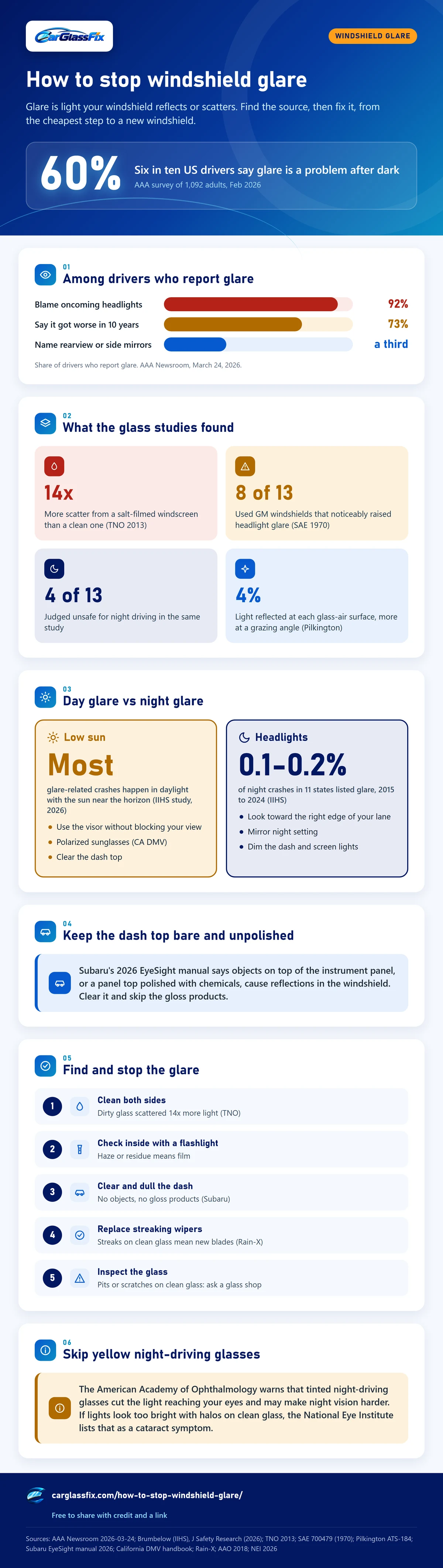
To stop windshield glare, first find its cause. Clean the inside film and both glass surfaces, replace streaking wiper blades, keep shiny objects and gloss off the dashboard, and dim the dash lights at night. Look toward the right edge of your lane when headlights approach, use the mirror’s night setting, and use the visor against a low sun.
What causes windshield glare?
Windshield glare comes from two things: light that the glass reflects into your eyes, and light that dirt, film or damage scatters across your view. Researchers call the washed-out haze this creates veiling glare, because it lays a bright veil over the road and lowers contrast. UMTRI lab tests found that glare and scatter hurt the detection of low-contrast objects most.
Reflection and scatter have different sources. Reflection comes from the glass itself and from bright things in front of it, such as a light dashboard or papers on the dash. Scatter comes from what sits on or in the glass: the oily film inside, road grime outside, wiper streaks, scratches and pits. The light source then decides when you notice it. A low sun causes most daytime glare. Oncoming and following headlights cause most night glare.
The fix depends on which cause you have, so the table below matches each symptom to its likely source.
| What you see | Likely cause | First fix |
|---|---|---|
| Hazy smear that lights up when the sun or headlights hit it | Film on the inside of the glass | Clean the inside with a microfiber cloth and glass cleaner |
| A pale copy of the dashboard on the glass on sunny days | Dashboard reflection | Clear the dash top and skip gloss products |
| Arcs or stripes in the wiper path | Worn blades or wiper scratches | Clean the glass, then replace streaking blades |
| Starbursts that stay after cleaning | Pitting or scratches in the glass | Inspect, then consider repair or replacement |
| Dazzle from cars ahead or behind | Headlights | Look to the right edge of your lane; mirror night setting |
| Lights look too bright with halos on clean glass | Your eyes | Eye exam |
How a windshield reflects and scatters light
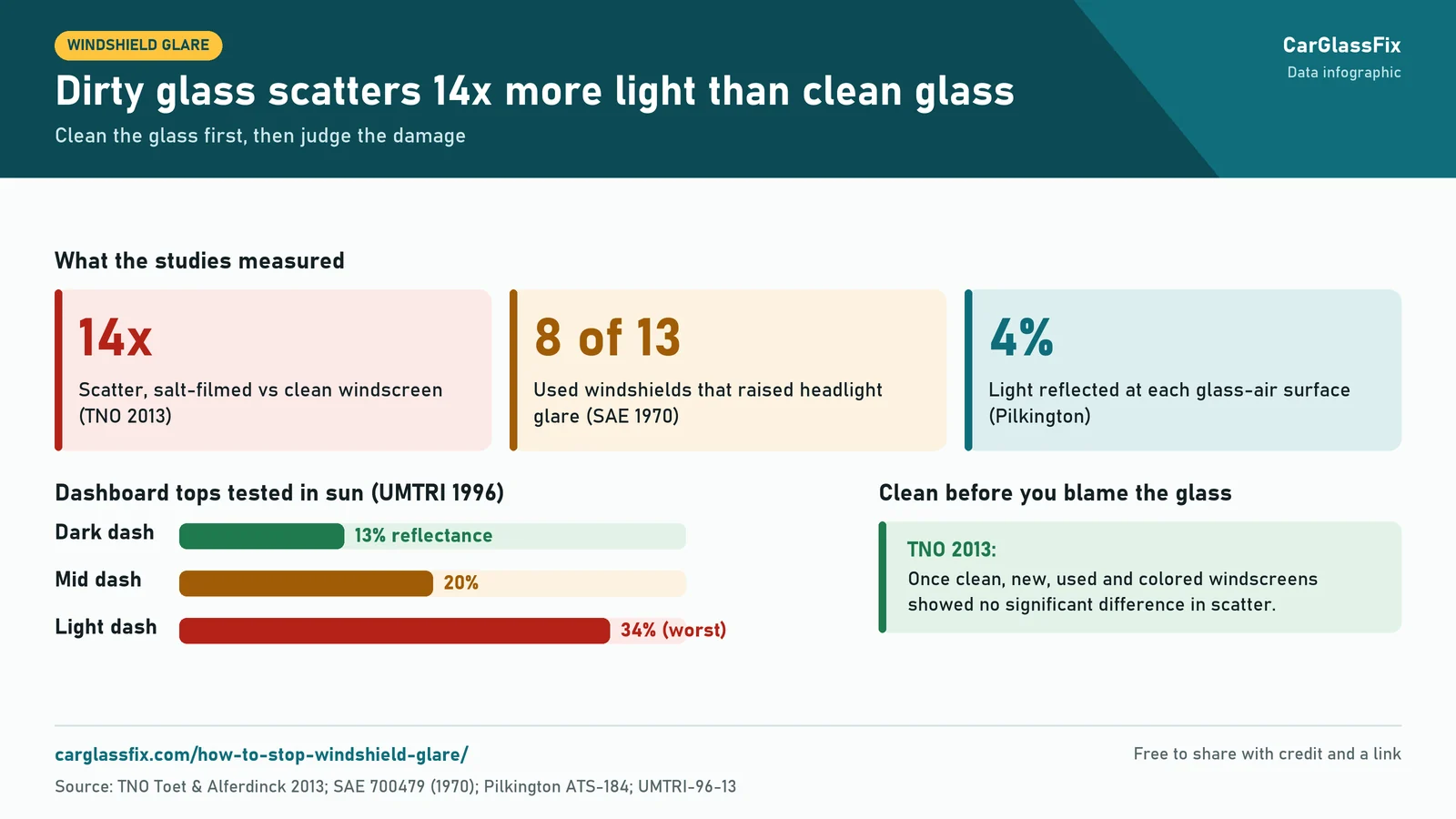
A clean windshield still reflects some light, but a dirty one scatters far more, so cleaning is the first test before you blame the glass.
Reflection from the glass
Every surface where glass meets air reflects about 4% of light, and more at a grazing angle, according to a technical bulletin from glass maker Pilkington. A windshield is laminated: NHTSA describes it as a sheet of plastic bonded between two sheets of glass. Pilkington notes that the two inner faces touching the interlayer show no visible reflection, so only the outer and inner air-facing surfaces reflect. A raked windshield meets your line of sight at a shallow angle, which is where reflection grows.
Scatter from dirt, film and wear
Scatter does more harm than reflection or tint at night. A University of Michigan Transportation Research Institute (UMTRI) lab study from 1992 tested 30 drivers behind clean and dirty windshields. Light scatter from dirty windshields raised low-contrast thresholds “to unmeasurable levels.” The authors judged the effects of tint and rake small next to scatter from dirt and wear. A 2013 TNO study found the scatter from a windscreen with a dried salt film was 14 times larger than from a clean one. The same study found no significant difference between new and used windscreens once both were clean.
That result has a practical meaning. Most glare that looks like damage starts as a film. Clean both surfaces, check again at night, and only then judge the glass.
Film on the inside of the windshield
The film on the inside of a windshield is a common glare source, because it scatters light from every lamp and low sun that reaches it.
Much of it comes from the car itself. A Thermo Fisher application note explains that high interior temperatures make plastics, textiles and other cabin materials outgas organic compounds. Those compounds condense on the cooler windshield as a film that can limit and refract the light passing through. Skin oil adds to it. AAA Club Alliance warns that the oil from your hands leaves smears on the inside glass, and that night driving can reveal streaks that were invisible in daylight. The American Academy of Ophthalmology (AAO) calls the inside of the windshield easily smudged.
A quick check tells you whether film is the problem. Tesla’s service manual has technicians inspect the inside glass with an LED flashlight for haze, stains or residue. The same check works at home: shine an LED flashlight on the inside glass and look for haze or residue.
AAA’s fix is a microfiber cloth and glass cleaner on the inside of the glass. The full method, including the two-towel technique and the cleaning step for cutting glare, is in our guide on how to clean windshield without streaks. Film that keeps coming back is covered in how do you get rid of haze on the inside of a windshield.
Dashboard reflection on the windshield
Dashboard reflection is the pale image of the dash top that the windshield bounces into your eyes, and it is worst on sunny days with a light or shiny dashboard.
What the research shows
The brightness of the dash top and the slope of the glass both matter. A 1996 UMTRI field study tested drivers in sunlight behind windshields raked at 45, 60 and 70 degrees, over dashboard tops that reflected 13%, 20% and 34% of light. Visual performance fell as the rake angle grew, especially above 60 degrees. Performance was worst when a steep rake met a bright dashboard. Both age groups rated visibility lowest at 70 degrees with the 34% dashboard. The 8 older drivers, with a mean age of 72, lost more than the 8 younger drivers and tended to overestimate how well they could see.
How to reduce it
Keep the dash top dark, dull and empty. Subaru’s 2026 EyeSight manual tells owners not to place any objects on top of the instrument panel, because of reflections in the windshield. The same manual warns that polishing the panel top with chemicals or other substances can cause those reflections. A matte, low-reflectance dash top reflects less light, which matches the UMTRI finding that the 13% dashboard performed better than the 34% one.
At night the source changes. AAA Club Alliance says the glow from the instrument panel and infotainment screen can cause reflections on the windshield that make it harder for your eyes to adjust. AAA’s fix is the dimmer switch.
Scratches, pitting and worn wipers
Scratches, pits and worn wiper blades cause glare that stays after the glass is clean, and they are the next suspects once film is ruled out.
Worn wiper blades
Worn blades leave streaks, and streaks scatter light the way film does. The AAO lists wipers in good condition among its night-vision basics. Rain-X says that if wiper blades streak on a clean windshield, it is time to change them. Trico, a blade maker, gives six months as a general replacement rule and lists streaks, squeaking and chatter as warning signs. The checks are in how to check windshield wipers for wear, and the swap itself is in how to replace windshield wiper blades. Subaru tells EyeSight owners to fit only genuine Subaru blades, because other blades can affect the camera’s view.
Scratches and pitting
Damage in the glass scatters light permanently. In a 1970 SAE study, Merrill J. Allen examined 13 used GM windshields. He judged 8 of them to noticeably increase headlight glare, enough to consider replacement, and 4 unsafe for night driving. Wiper damage grew with mileage, and small high-velocity particles caused the pitting. Light scratches can sometimes be polished, as covered in how to remove scratches from car windshield at home. Dense pitting that causes glare at night is usually a replacement case, as explained in how to repair a pitted windshield. GEICO notes that policies typically do not cover small pits, scratches or hazing that develop over time.
Night glare from oncoming headlights
Night glare from oncoming headlights cannot be switched off, so the fixes limit how much of it reaches your eyes.
How common it is
Headlight glare is the most reported glare problem. In a AAA survey of 1,092 US adults in February 2026, six in ten drivers said glare is a problem after dark. Of those, 73% said it had grown worse over the past decade, 92% blamed oncoming headlights and about a third named their mirrors. Drivers with prescription glasses reported glare more often (70%) than drivers without (56%). Police data shows a different side. A 2026 study by Matthew Brumbelow of IIHS found glare in only 0.1 to 0.2% of nighttime crashes in 11 states from 2015 to 2024. Night glare crashes were linked more often to older drivers, older vehicles and undivided low-speed roads.
What to do when headlights approach
The California DMV handbook says not to look directly into oncoming headlights and to look toward the right edge of your lane. It also says not to answer another driver’s high beams with your own. AAA adds that you should avoid looking directly at oncoming lights.
For lights behind you, use the mirror’s night setting. Kia’s manual tells drivers to pull the day/night lever toward them to reduce glare from headlights behind, and warns that the night position costs some rearview clarity.
Your own headlights and glasses
Your own lamps affect what you see and what other drivers see. AAA recommends clean, working headlights of the original equipment design and a professional aim check. AAA Club Alliance warns that headlights can sit uneven or pointed too low. IIHS tests headlights as received from the dealer, without aiming them, because few owners adjust aim. Low-beam glare for oncoming drivers costs a vehicle points in those ratings. In February 2022, NHTSA amended FMVSS 108 to allow adaptive driving beam headlamps, which give more light than a low beam without more glare. The rule does not require automakers to fit them.
Skip yellow night-driving glasses. The AAO warns that tinted night-driving glasses reduce the light reaching the eye and may make night vision harder. Keep your regular glasses clean instead.
Sun glare at sunrise and sunset
Sun glare is worst when the sun sits low ahead of you, and the visor, clean glass and polarized sunglasses are the main defenses.
In police crash data, a low sun shows up more often than headlights. Brumbelow’s 2026 study found that most glare-related crashes happened in daylight, when the sun was close to the horizon. The California DMV handbook lists the steps for sun glare: keep the inside and outside of the windshield clean, make sure the visor works and nothing blocks it, wear polarized sunglasses, and leave extra space around other vehicles. Kia’s manual adds a limit: do not block your view with the visor.
Polarized lenses have one catch. Kia’s manual says a head-up display image may be invisible to a driver wearing polarized sunglasses. Kia also tells owners not to apply tint or other coatings to a windshield with a head-up display. Tint strips and films for glare are compared in pros and cons of windshield tint, including the limits that apply to the glass.
The steps below put the checks in order, from the cheapest fix to the one that costs a windshield.
How to find and stop windshield glare
Clean both sides
Clean the inside and outside glass, since a TNO test found a dirty windscreen scatters 14 times more light than a clean one.
Check the inside at night
Shine an LED flashlight on the inside glass and look for haze or residue.
Clear the dashboard
Remove papers and objects from the dash top and skip gloss products on it.
Dim the cabin
Turn down the instrument and screen lights with the dimmer switch.
Test the wipers
Run the blades on clean, wet glass and replace them if they streak.
Fix your aim and gaze
Have your headlights checked and aimed, use the mirror night setting, and look toward the right edge of your lane.
Inspect the glass
If glare stays on clean glass, look for pits and scratches and ask a glass shop about repair or replacement.
When glare points to your eyes
If lights look too bright on clean glass, the cause may be your eyes, and an eye exam is the next step.
The National Eye Institute lists cataract symptoms that match glare complaints: lamps, sunlight or headlights seem too bright, halos appear around lights, and night vision gets worse. The AAO links changing night vision to cataracts, glaucoma and dry eye. It advises an ophthalmologist visit when night vision changes and regular eye exams starting at age 40. The UMTRI studies found older drivers lost more visibility to glare and dirty glass than younger drivers. A driver who has trouble on clean glass at night should see an eye doctor before buying a new windshield or more products.
Frequently asked questions
How can I reduce windshield glare at night?
Clean the inside of the glass, dim the dash and screen lights, replace streaking wipers and use the mirror’s night setting. When headlights approach, look toward the right edge of your lane, as the California DMV handbook advises.
What causes glare on a windshield?
Glare comes from light the glass reflects and light that film, dirt, streaks, scratches or pits scatter. A low sun causes most daytime glare and headlights cause most night glare.
Is there an anti-glare spray for windshields?
No maker evidence we found shows that a spray cuts glare by itself. Cleaning off the film that scatters light does, and the method is in how to clean windshield without streaks.
Do night-driving glasses help with glare?
No. The American Academy of Ophthalmology warns that tinted night-driving glasses reduce the light reaching your eyes and may make night vision harder.
Should I replace a windshield that causes glare?
Clean it first, because used and new windscreens scattered about the same light when clean in a TNO test. If glare stays on clean glass because of dense pits or scratches, ask a glass shop about replacement.
Sources
- AAA Newsroom: New AAA Survey: Six in Ten Drivers Struggle with Headlight Glare (Mar 24, 2026)
- AAA Club Alliance: Driving at Night: Learn the Do’s and Don’ts (Nov 11, 2024)
- Brumbelow, Headlight glare in police-reported crash data, Journal of Safety Research 98 (Sep 2026), TRID record
- IIHS: Headlight test protocol (checked 2026-11-04)
- NHTSA: FMVSS 108 adaptive driving beam final rule, 87 FR 9916 (Feb 22, 2022; checked 2026-11-04)
- NHTSA: Nighttime Glare and Driving Performance: Research Findings, DOT HS 811 043 (Sep 2008), TRID record
- NHTSA: Federal Register 54 FR 41636 (Oct 11, 1989)
- California DMV: Driver Handbook, Section 8 Safe Driving (checked 2026-11-04)
- UMTRI-96-13: Daytime Veiling Glare and Driver Visual Performance: Influence of Windshield Rake Angle and Dashboard Reflectance (1996), TRID record
- UMTRI-92-37: Effects of Light Transmittance and Scatter by Windshields on Nighttime Visual Performance (1992), TRID record
- TNO, Toet and Alferdinck: Effects of high power illuminators on vision through windscreens (2013)
- SAE 700479, Merrill J. Allen: Automobile Windshields, Surface Deterioration (1970)
- Pilkington North America: ATS-184 OptiView design details (2013-01-04)
- Thermo Fisher: Understanding a Fog Testing System (application note, 2011)
- Subaru: 2026 EyeSight owner’s manual supplement MSA5M2026A
- Kia owner’s manual: Day/night rearview mirror
- Kia owner’s manual: Head-Up Display
- Kia 2026 Tasman owner’s manual: General precautions
- Tesla Model Y Service Manual: Clean Forward Camera View
- Rain-X: Wiper blade information and maintenance
- Trico: Four signs you should replace your wiper blades
- American Academy of Ophthalmology: Night Driving Glasses May Hurt, Not Help (Jan 30, 2018)
- National Eye Institute: Cataracts (updated Aug 19, 2026)
- GEICO: Does car insurance cover windshield damage? (Oct 12, 2026)

Similar Posts