How to Repair a Pitted Windshield: Fill, Polish or Replace
Senior Automotive Glass Diagnostic Specialist & Master Technician at CarGlassFix · AGSC Master Certified Auto Glass Technician, NGA Certified Installer, I-CAR Automotive Safety Specialist · 12+ Years in Automotive Glazing, Windshield Structural Bonding, ADAS Camera Calibration & Precision Chip Restoration
A pitted windshield is repaired in one of three ways. A single surface pit is filled with a thick pit resin, cured under a film tab and scraped flush. Light, scattered wear can be reduced with a cerium oxide glass polish. Dense sand pitting that causes glare or blocks the driver’s view usually means replacing the windshield.
What windshield pitting is
Windshield pitting is a pattern of tiny craters on the outer surface of the glass. An SAE study of used windshields traced pitting to small particles striking the glass at high speed. Sand, grit and gravel thrown by other vehicles are the usual source. A windshield is laminated glass. NHTSA describes it as a sheet of plastic bonded between two sheets of glass. Pits sit in the outer glass layer and do not reach the plastic. The repair standard for laminated glass, ROLAGS 002-2022, lists the surface pit as its own repairable damage type, separate from bullseyes, star breaks and cracks. Pitting builds up gradually, and GEICO describes small pits as damage that develops over time. A single pit may be invisible in daylight. Many small pits together scatter light, and that shows up as glare from headlights and low sun. For the other damage types, see the difference between a windshield crack and a chip.
Fill, polish or replace: which fix fits your pits
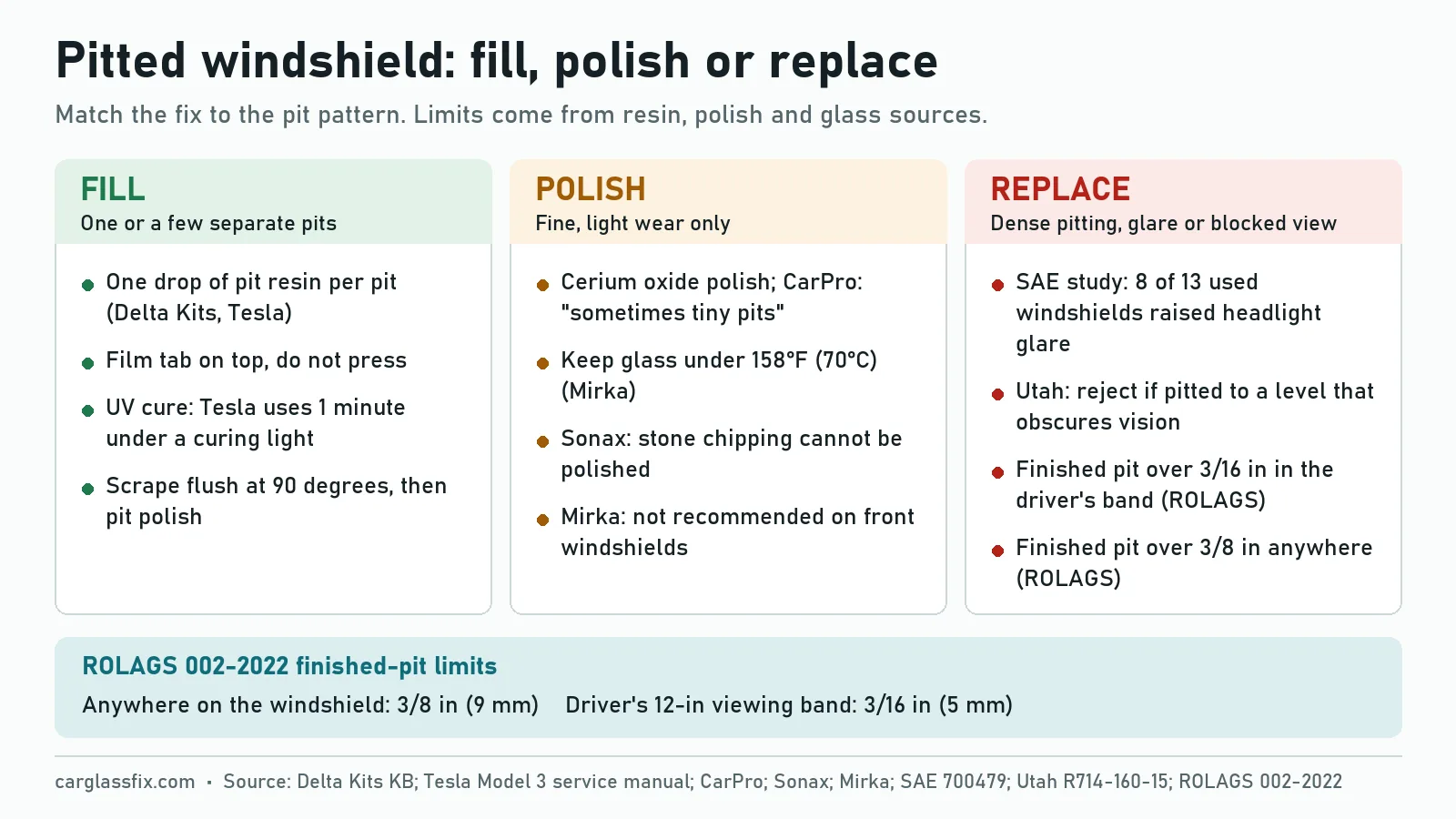
The right fix depends on how many pits there are and where they sit. A few separate pits can be filled one by one with resin. A fine, even wear pattern can sometimes be reduced with polish. A dense field of pits in front of the driver is a replacement job.
Look at the glass from the driver’s seat at night or against low sun before you choose. A pit you can see only up close is cosmetic. Pits that light up as a haze across your view affect safety. Clean the glass first. A 2013 TNO study found that a dried salt film raised light scatter 14 times compared with clean glass. The same study found no significant difference between clean used and clean new windshields.
| What you see | Fix | What the sources say |
|---|---|---|
| One or a few separate pits | Fill with pit resin | Delta Kits and the Tesla Model 3 service manual both fill a pit with one drop of pit resin under a curing tab |
| Fine, light wear across the wiper area | Polish with cerium oxide | CarPro says its CeriGlass on a rotary removes “sometimes tiny pits” |
| Stone chipping or deep pits | Fill or replace, not polish | Sonax: “Windows with stone chipping cannot be polished” |
| Dense pitting that causes glare or blocks the view | Replace | Utah rejects glass “pitted to a level that obscures vision” |
How to fill a single pit with pit resin
A single pit is filled with a thick pit resin, cured under a film tab and scraped level with the glass. Delta Kits, a maker of professional repair resins, explains that pit resin is not just a thicker fill resin. It cures to a very hard, smooth surface that resists weather, wiper abrasion and chemicals. Its higher viscosity keeps it in place on sloped glass. Injection resin is the opposite. It is made to flex with the glass, and it fills breaks under the surface. The steps below follow Delta Kits’ knowledge base and the pit filler procedure in the Tesla Model 3 service manual. Read your own kit’s directions first, because cure times differ by product. Permatex warns that its kit “may not completely remove blemish or permanently fill the pit.” The ROLAGS standard also expects a small visible blemish after any repair.
How to fill a windshield pit with resin
Clean and strip the glass
Wash the area and remove wax or water repellent. Delta Kits says these treatments make pit resin lift off with the curing film.
Prime the pit (optional)
Coat the pit with a thin injection resin so it wicks into fine scratches. Delta Kits says this is not required but improves the finished look.
Add one drop of pit resin
Place one drop of pit resin on the pit, as Delta Kits and Tesla both describe.
Lay the curing tab
Lay a clean film tab over the drop with no air under it, and do not press it. Pressing pushes the resin out of the pit.
Cure with UV light
Cure under UV light or direct sun. Tesla’s procedure uses a curing light for 1 minute over the tab.
Scrape flush
Remove the tab and scrape with a new razor blade held flat at 90 degrees. Do not hit the pit with the blade edge.
Polish the spot
Rub one or two drops of pit polish with a cork or paper towel until the resin almost disappears.
If you can still feel the pit after the repair, Delta Kits names three causes: pressure on the tab, no pit resin, or a blade edge that cut into the fill. For cleanup after a kit, see how to clean a windshield after resin repair.
Can you polish out windshield pitting
Polishing can reduce very light, shallow pitting, but it cannot remove deep pits or stone chips. Polishing levels the glass by removing material from the surface around each pit. Delta Kits warns that removing damage that is too deep may result in distortion. The USGS calls cerium oxide uniquely suited as a polishing agent for glass. CarPro and Sonax both name cerium oxide in their glass polishes. CarPro says its CeriGlass on a rotary polisher removes swirls, light scratches “and sometimes tiny pits”. Sonax says glass with stone chipping cannot be polished and asks for at least 30 minutes per windshield. Heat is the main risk. Mirka, an abrasives maker, sets a limit of 158°F (70°C) and does not recommend its glass process on front windshields because of optical refraction. Tesla’s scratch procedure keeps laminated glass between 115°F and 150°F. Delta Kits does not recommend polishing out a scratch you can feel with a fingernail. For products and technique, see what you can use to polish your windshield.
When pitting means replacement (glare at night)
A pitted windshield needs replacing when the pits scatter enough light to blur your view, or when a repair would leave too large a mark in front of the driver. Glare is the usual sign. In SAE study 700479, 8 of 13 used windshields were judged to noticeably increase headlight glare, and 4 were judged unsafe for night driving. ROLAGS sets size limits for a finished pit. A finished pit may be up to 3/8 inch (9 mm). Inside the driver’s primary viewing area, a 12-inch band centered on the driver, the limit is 3/16 inch (5 mm). State inspection rules also matter. Utah’s passenger-vehicle rule rejects glass “pitted to a level that obscures vision”, and its heavy-vehicle rule rejects “sandpits” that interfere with the driver’s vision. Virginia rejects any distortion that interferes with a driver’s vision. Compare your options in windshield repair vs. replacement, and see how to stop windshield glare for glare from other causes.
Does insurance pay for a pitted windshield
Insurance usually does not pay for pitting that builds up over time, because insurers treat it as wear and tear. GEICO states that policies typically don’t cover “small pits, scratches, or hazing that develop over time.” Glass damage from a single event, such as a rock strike, is a different case. That damage is usually claimed under comprehensive coverage, and the policy terms decide what is paid. Delta Kits notes that there is no technical limit on how many repairs a windshield can have. It adds that insurers may set their own payment limits. If pitting is bad enough to fail inspection, ask your insurer how it classifies the damage before you book a replacement. Ask the glass shop to put the reason for replacement in writing. For claim rules by state and policy type, see does insurance cover windshield replacement.
How to prevent windshield pitting
You prevent pitting by keeping grit off the glass and by not dragging grit across it. Pitting comes from small particles that hit the glass at speed, so staying back from trucks and gravel loads cuts your exposure. Federal rule 49 CFR 393.100 requires trucks and trailers to secure cargo against “leaking, spilling, blowing or falling” from the vehicle. Wipers are the second source. The SAE study found that wiper damage increased with mileage. Trico, a wiper maker, says never run your wipers without fluid on the windshield. Replace worn blades before they drag grit, as explained in how to replace windshield wiper blades. The SAE study also found ice-scraper damage, so clear loose grit before you scrape. A clear protection film is a third option. Madico says its ClearPlex film reduces rock chips, pitting and bullseyes, and that the film should be replaced from time to time. See how to use windshield crack prevention film. Rain-X advises repairing chips as soon as possible, before dirt or water gets in.

Frequently asked questions
Can a pitted windshield be restored?
A few separate pits can be filled with pit resin, and light wear can sometimes be reduced with a cerium oxide polish. Deep or dense pitting cannot be restored. Sonax says glass with stone chipping cannot be polished.
Why is my windshield so pitted?
Pitting comes from small particles such as sand and grit striking the glass at speed, and it builds up with mileage. Worn or dry wipers dragging grit across the glass add wear, according to the SAE study of used windshields.
Will insurance cover a badly pitted windshield?
Usually not. GEICO says policies typically don’t cover small pits, scratches or hazing that develop over time. Check your own policy, see does insurance cover windshield replacement.
What is windshield pit filler?
Pit filler, or pit resin, is a thick resin made to fill surface pits. Delta Kits formulates it for a very hard, smooth cured surface that resists weather and wiper abrasion.
Can a pitted windshield fail inspection?
Yes, in some states. Utah rejects a windshield pitted to a level that obscures vision, and Virginia rejects distortion that interferes with the driver’s vision. Rules vary by state, so check your state’s inspection rules.
Sources
- SAE 700479, Merrill J. Allen, Automobile Windshields, Surface Deterioration (1970)
- NHTSA, 54 FR 41636 (1989), windshield construction
- ANSI/AGSC/NWRD ROLAGS 002-2022, Repair of Laminated Automotive Glass Standard (checked 2026-10-24)
- Delta Kits, Why do I have to use a pit resin?
- Delta Kits, Use pit resin to smooth small nicks in windshield glass
- Delta Kits, Why can I still feel the pit after repairing the break?
- Delta Kits, Why does the pit resin come off the windshield?
- Delta Kits, How is pit polish used for the final finish?
- Delta Kits, How long does it take to remove a scratch from a windshield?
- Delta Kits, How many repairs can a windshield have?
- Tesla Model 3 Service Manual, Windshield and Roof Glass Chip Repair
- Tesla Model 3 Service Manual, Windshield Scratch Repair
- Permatex Windshield Repair Kit 09103
- USGS Fact Sheet 087-02, Rare Earth Elements
- CARPRO CeriGlass
- SONAX PROFILINE Glass Polish
- Mirka, Glass sanding and polishing
- Toet and Alferdinck, TNO, Proc. SPIE 8898 (2013)
- Utah Admin. Code R714-160-15, Vehicle Windows (checked 2026-10-25)
- Utah Admin. Code R714-162-18, Windows and Glazing (checked 2026-10-25)
- Virginia 19VAC30-70-210 (checked 2026-10-23)
- GEICO, Does car insurance cover windshield damage?
- 49 CFR 393.100, cargo securement (checked 2026-10-25)
- Trico, How to Replace Your Windshield Wipers
- Madico, ClearPlex windshield protection film
- Rain-X Windshield Repair Kit

Similar Posts