How to Prevent Windshield Cracks and Rock Chips
Senior Automotive Glass Diagnostic Specialist & Master Technician at CarGlassFix · AGSC Master Certified Auto Glass Technician, NGA Certified Installer, I-CAR Automotive Safety Specialist · 12+ Years in Automotive Glazing, Windshield Structural Bonding, ADAS Camera Calibration & Precision Chip Restoration
To prevent windshield cracks, stop the impact first and then stop a chip from spreading. Keep at least three seconds behind other vehicles, with more space on gravel. Repair any chip quickly, keep hot water and blasting air off cold glass, never run wipers dry, and avoid automated car washes until a chip is fixed.
How do you prevent windshield cracks?
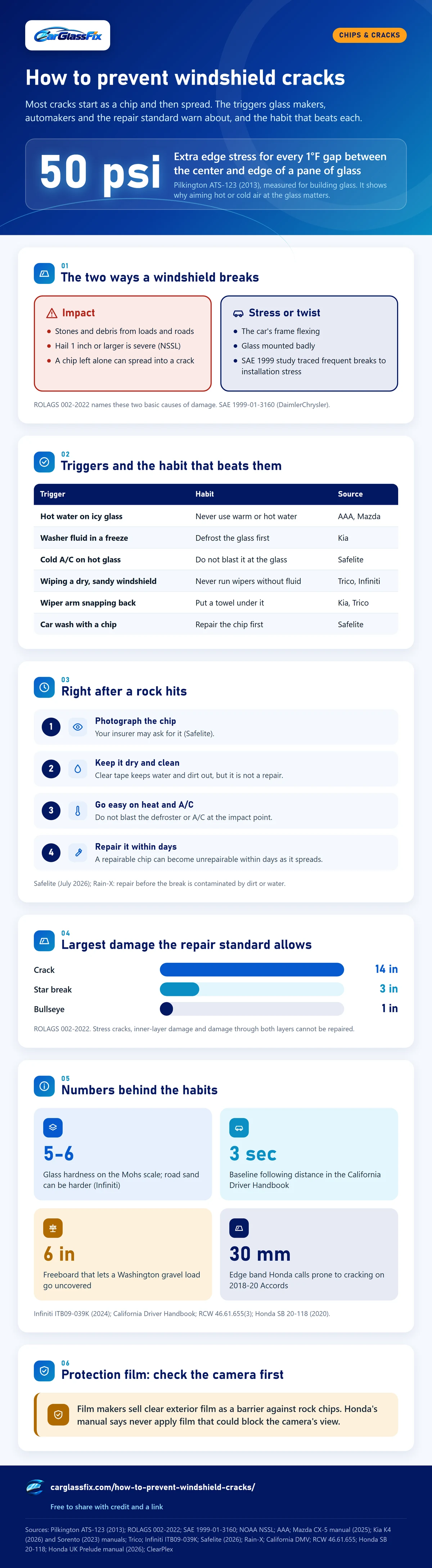
You prevent windshield cracks by avoiding the impacts that start them and by removing the stresses that make a chip grow. The ROLAGS 002-2022 repair standard names two basic causes of damage. The first is impact. The second is “stress or twist”, which ROLAGS describes as flexing within the vehicle frame or improper mounting. Nissan’s dealer bulletin on windshield cracking says Nissan typically finds no stress cracks after its pre-delivery inspection. Infiniti’s version of the bulletin says a crack that never reaches an edge is always caused by an impact. For most drivers, prevention therefore starts on the road and continues with fast chip repair. The table lists each documented trigger and the habit that answers it. The causes of windshield cracks have their own guide with the stress crack tests.
| Trigger | What to do | Source |
|---|---|---|
| Stones and gravel from vehicles ahead | Keep at least three seconds behind; add space on gravel and behind open loads | California DMV handbook; RCW 46.61.655 |
| An unrepaired chip | Have it repaired before dirt or water gets in | ROLAGS 002-2022; Rain-X |
| Hot water on ice | Never use warm or hot water to clear ice | AAA; Mazda owner’s manual |
| Washer fluid on frozen glass | Warm the glass with the defroster first | Kia owner’s manual |
| Sand under the wipers | Never wipe a dry windshield | Infiniti bulletin; Trico |
| Vibration and potholes | Slow down for rough roads when a chip is present | Infiniti bulletin |
| Body flex and mounting stress | Use an installer who follows the AGRSS standard | ROLAGS; AGRSS 005-2022 |
How to avoid rock chips on the highway
The best way to avoid rock chips is to leave more room behind the vehicle in front, especially on gravel and behind trucks with open loads. The California Driver Handbook tells drivers to use the three-second rule for a safe following distance. It also says to leave extra space behind motorcyclists on gravel.
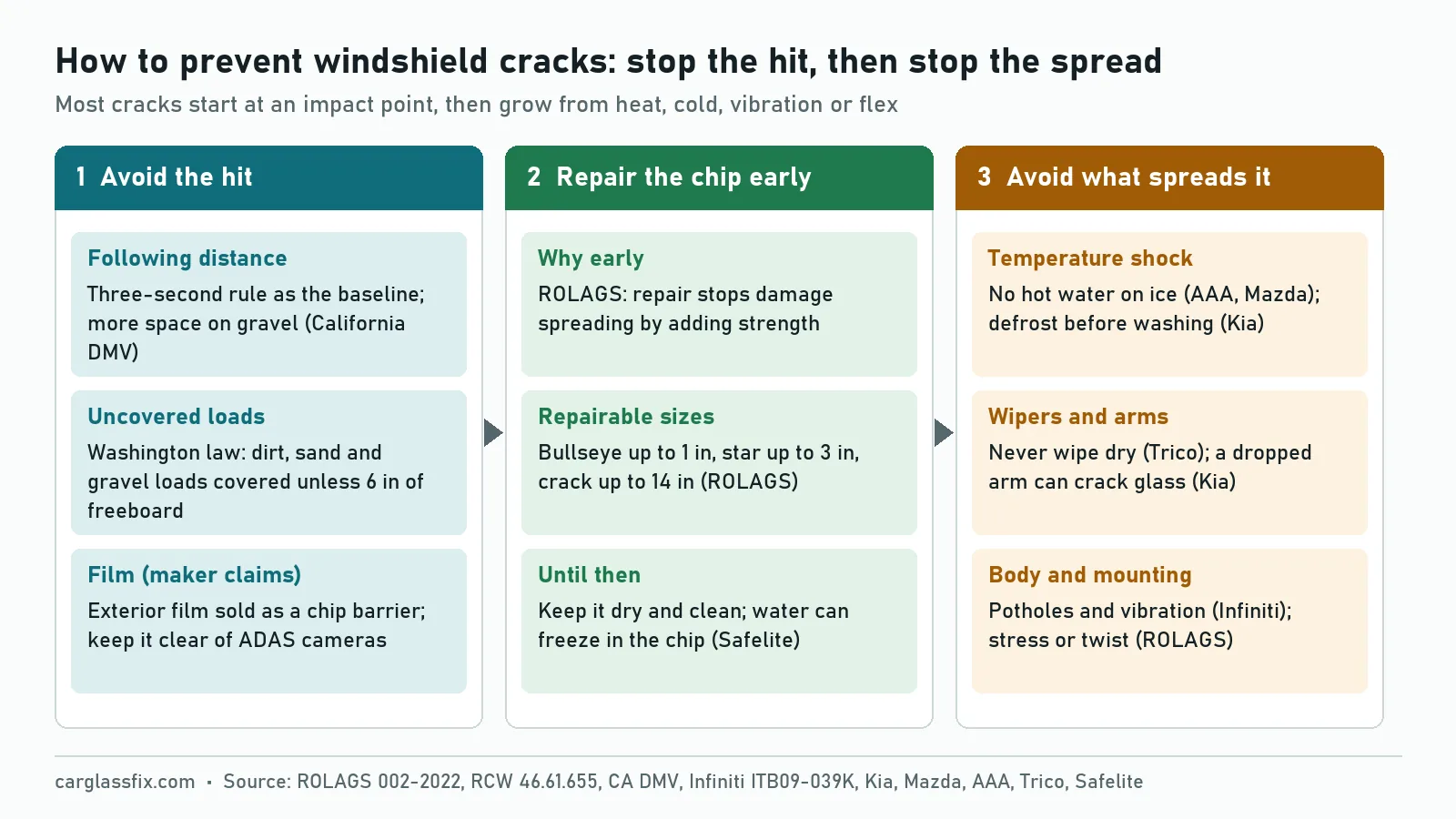
No law or study sets a distance that guarantees no chips. Three seconds is a baseline, so add more room on fresh gravel, in work zones and behind dump trucks or landscaping trailers. Washington’s RCW 46.61.655 bars driving any vehicle whose load can drop, sift or leak onto the road. It requires dirt, sand and gravel loads on paved highways to be covered unless 6 inches of freeboard is kept in the bed. Federal rule 49 CFR 393.100 requires commercial trucks to secure cargo so it cannot leak, spill, blow or fall off. A truck that is shedding gravel is a reason to drop back or change lanes when it is safe. Hail is a separate risk, and the guide on how to protect a car windshield covers hail covers and parking.
Repair chips early so they do not become cracks
A chip repaired early is the most reliable way to stop it from turning into a crack. ROLAGS 002-2022 says a professional repair can stop the damage from spreading by adding strength to the damaged area. Rain-X tells kit users to repair damage as soon as possible, before dirt or water contaminates the break. Safelite’s guide on rock hits, dated July 23, 2026, says a chip that is repairable right after the impact can become unrepairable within days. Temperature changes, road vibration and moisture are the reasons it gives. Subaru’s 2025 service bulletin describes a covered crack type that it presumes was caused by continuous stress starting from a small chip. Size limits decide whether a chip can still be repaired, and how big a windshield crack can be repaired lists them by damage type. Safelite also notes that many comprehensive policies cover chip repair with no deductible. Check your own policy, or read does insurance cover windshield replacement.
These steps come from Safelite’s rock-hit guide and the ROLAGS standard.
What to do in the first hours after a rock chip
Check it when safe
Pull over or park when it is safe, then look at the size and location of the chip and whether any line already runs from it.
Photograph the damage
Take photos from several angles right away, since your insurer will want evidence of the damage.
Keep it dry and clean
Cover the chip with clear tape to keep out water and grit; water in a chip can freeze and expand the damage.
Keep air off the impact point
Do not blast the defroster or air conditioning at the chip, because rapid temperature change can crack it further.
Book a repair
Have a trained technician fill it with resin while it is still small and clean, before temperature changes or vibration spread it.
Avoid temperature shock from defrosters, hot water and A/C
Temperature shock means one part of the glass heats or cools much faster than the rest, and it is a main reason chips grow. Infiniti’s bulletin lists thermal stress caused by temperature fluctuation as a cause of cracks spreading from an impact point. Pilkington’s thermal stress bulletin for building glass gives the scale. About 50 psi of edge tension builds for each 1 F difference between the center and the edge of a pane. Pilkington adds that air from vents blowing hot or cold air directly at glass can cause excessive edge stress. AAA warns that hot water on ice can crack glass by thermal shock. Mazda’s CX-5 manual says never to use warm or hot water to remove snow or ice. Kia’s K4 manual says to warm the windshield with the defroster before using the washer in freezing weather. In summer, Safelite names cold A/C aimed at a hot windshield and cold water on hot glass as triggers. With a chip, start the defroster low and raise it gradually. More detail sits in can cold weather cause a windshield crack.
Car washes, wipers and scrapers
A car wash, dry wiping and a falling wiper arm can all turn a small flaw into a crack. Safelite’s car wash guide, dated July 23, 2026, says automated washes combine high-pressure water, hot water or steam followed by a cold rinse, and brushes that can flex damaged glass. Its advice is to repair the damage before using an automated wash. Infiniti’s bulletin says glass rates 5 to 6 on the Mohs hardness scale, and sand can be harder. It names sand under wipers, especially when wiping a dry windshield, as a source of scratches. A small scratch can then lead to a crack from thermal conditions, vibration or wind pressure. Trico’s rule is to never run wipers without fluid on the windshield. Kia’s Sorento manual warns that a wiper arm falling against the glass may chip or crack the windshield. Trico suggests a towel on the glass while blades are changed. AAA also says never to use a metal scraper on ice. Worn blades that drag grit are easier to spot with the steps in how to check windshield wipers for wear.
Reduce body flex and mounting stress
Mounting stress comes from how the windshield sits in its frame, and it can crack glass without any new impact. ROLAGS lists flexing within the vehicle frame and improper mounting as the second basic cause of windshield damage. A 1999 SAE paper by DaimlerChrysler engineers studied an early development vehicle with unusually frequent windshield breakage. The authors found that manufacturing stresses were low, while installation stresses were high enough to explain the failures. Subaru’s 2025 bulletin describes continual stress from body structure movements, such as twist and shock, acting on small external damage. Honda’s bulletin for 2018 to 2020 Accords says the area up to 30 mm (1.2 in) from the outer edge of that windshield is susceptible to cracking. Viracon, a building glass maker, says edge damage before or during installation dramatically reduces glass resistance to thermal stress. For a replacement, ask whether the shop follows ANSI/AGSC/AGRSS 005-2022, the auto glass replacement safety standard. The checklist of signs of a poor car glass replacement job helps after the install. Infiniti also lists vibration from potholes as a crack spreader, and Safelite says to close doors gently when the glass is damaged.
Does windshield protection film prevent chips?
Windshield protection film is sold to reduce chips, but the protection figures come from the film makers, not from an independent standard. Madico describes its ClearPlex film as a clear 4-mil PET film installed on the outside of the windshield as a physical barrier against rock chips and road debris. ExoShield says its film “increases the impact protection by 6X”, and its FAQ does not publish the test. ExoShield also states that its film is not bulletproof. Automakers are more cautious about anything placed in front of a driver assistance camera. Honda’s UK manual for the 2026 Prelude says never to apply a film to the windscreen that could obstruct the camera’s field of vision. ClearPlex’s care sheet still tells owners to never run wipers dry and to replace damaged blades. Film therefore adds a layer, but the road habits above still apply. Legality, camera zones and installation steps are covered in how to use windshield crack prevention film.
Frequently asked questions
What can I put on my windshield to prevent chips?
Clear exterior protection film is the product sold for chip protection, and the impact claims come from its makers. Check your owner’s manual first, since automakers such as Honda say no film should block the camera’s view.
Can a car wash crack a windshield?
A car wash can spread an existing chip or crack. Safelite lists high-pressure water, hot water followed by a cold rinse, and brushes that flex the glass as the risks, and advises repairing the damage first.
Will clear nail polish keep a chip from cracking?
No glass maker or repair standard recommends nail polish as a chip repair. ROLAGS describes resin injected into the break and cured as the repair method, so book a resin repair instead.
Can you stop a crack once it has started?
A crack that has already formed needs holding steps and a resin repair or replacement. The guide on how to stop a windshield crack from spreading covers tape, kit limits and when ROLAGS says replace.
Can cold weather alone crack a healthy windshield?
Safelite says existing damage is where cold-weather tension releases, so a chip is the weak point. Safelite names high heat aimed at a cold windshield, wipers on ice and slammed doors as habits that make cracks worse.
Sources
- ANSI/AGSC/NWRD/ROLAGS 002-2022, Repair of Laminated Automotive Glass Standard, introduction and clauses 6 and 7 (checked 29 October 2026)
- ANSI/AGSC/AGRSS 005-2022, Automotive Glass Replacement Safety Standard (checked 28 October 2026)
- Washington RCW 46.61.655, Dropping load, other materials, covering (checked 29 October 2026)
- 49 CFR 393.100, cargo securement (FMCSA) (checked 25 October 2026)
- California DMV, California Driver Handbook: Safe Driving
- Infiniti Technical Bulletin ITB09-039K, Windshield Cracking (via NHTSA)
- Subaru Service Bulletin 12-257-25R (via NHTSA)
- American Honda Service Bulletin 20-118 (via NHTSA)
- Trate, Griffin and Zickel, SAE Technical Paper 1999-01-3160
- Pilkington North America, ATS-123 Thermal Stress
- Viracon, VTT-011 Thermal Stress Breakage
- AAA, How to deice your car’s windshield
- Mazda 2025 CX-5 owner’s manual, Winter Driving
- Kia 2026 K4 owner’s manual, windshield defrosting and Kia 2023 Sorento Plug-in Hybrid owner’s manual, wiper blades
- Trico, How to Replace Your Windshield Wipers
- Rain-X Windshield Repair Kit product page
- Safelite, What to Do When a Rock Hits Your Windshield (July 23, 2026)
- Safelite, Can You Go Through a Car Wash with a Cracked Windshield? (July 23, 2026)
- Safelite, Does Cold Weather Make Windshield Cracks Worse? and Why Do Windshields Crack in the Heat?
- Safelite, How to Stop a Windshield Crack from Spreading (July 1, 2026)
- ClearPlex (Madico) FAQ and ClearPlex Film Care sheet
- ExoShield FAQ
- Honda UK, 2026 Prelude owner’s manual, front wide view camera

Similar Posts