Bathroom Mirror Size Calculator: Never Guess Again
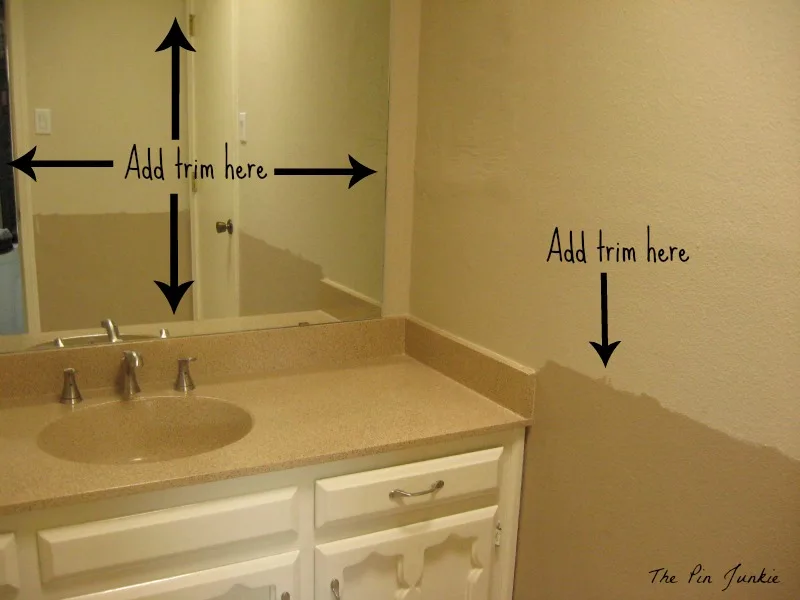
Picking the wrong bathroom mirror size is one of those small mistakes that makes a room feel off every single day. A bathroom mirror size calculator helps you avoid that regret by giving you exact dimensions based on your specific vanity, ceiling height, and who's using the mirror. Getting it right isn't complicated, but it does require a few careful measurements.
The National Kitchen and Bath Association (NKBA) recommends the mirror width should be within a few inches of the vanity width. Standard bathroom vanities sit at 34 to 36 inches tall, with 8-foot ceilings being the norm in most U.S. homes. The problem is that rules of thumb don't account for your specific situation, which is exactly where a proper sizing workflow comes in.
Quick Answer
A bathroom mirror size calculator gives you exact dimensions based on your vanity width. It also considers your ceiling height and user eye level. The result is a mirror that fits your space perfectly.
No guesswork, no returns.
Why Getting the Right Mirror Size is Trickier Than You Think
Most people assume you just pick a mirror that looks about right. That approach works sometimes, but it fails more often than you'd expect. A mirror that's too wide overhangs the vanity and looks clumsy.
One that's too tall can hit a light fixture or the ceiling.
The real problem is that every bathroom has different constraints. You might have a double vanity with a light bar in the middle. Or a pedestal sink with no countertop at all.
A single rule like "mirror should be 2 inches narrower than the vanity" doesn't handle those situations.
You also have to account for the person using the mirror. A mirror that works for someone who is 5 feet 2 inches might be useless for someone who is 6 feet tall. The height placement matters just as much as the width.
That's why a static sizing chart isn't enough. You need a decision tree that walks through each variable in order. That way, you get a result tailored to your actual bathroom, not a generic average.
The 4 Key Variables That Change the Answer
Vanity Width
The vanity width is your starting point. It sets the maximum mirror width you can use. Measure the total width of your vanity from left edge to right edge.
For a double vanity, measure the full width, not each sink separately.
The mirror should be narrower than the vanity by 2 to 4 inches. That leaves room for light fixtures, sconces, or just a visual breathing room. If your vanity is 60 inches wide, your mirror should be 56 to 58 inches wide.
Ceiling Height
Standard ceilings in U.S. homes are 8 feet (96 inches). Older homes might have 7-foot ceilings. Newer homes sometimes go to 9 or 10 feet.
Your ceiling height determines how tall the mirror can be.
You need to leave 6 to 12 inches between the top of the mirror and the ceiling. If you don't, the mirror will feel cramped and the room will look smaller.
User Eye Level
The average adult eye level is about 60 to 65 inches from the floor. But that's just an average. If you're tall, your eye level is higher.
If you're short, it's lower.
The mirror should be centered on the eye level of the person who uses it most. If multiple people use the bathroom, aim for the middle of the range. You can also split the difference with a vertically adjustable mirror.
Lighting and Fixture Placement
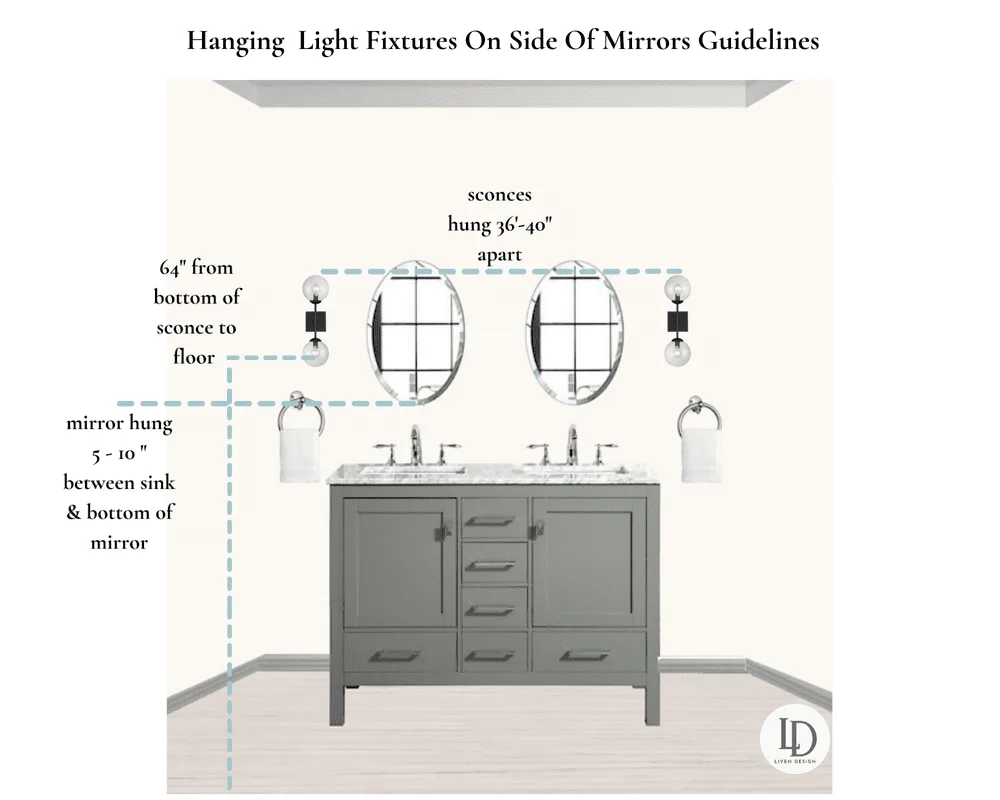
Light fixtures, sconces, outlets, and switches all affect where the mirror can go. A mirror that overlaps a light bar or an outlet is a problem. Measure the positions of these fixtures before you decide on a mirror size.
You'll also need to account for the backsplash height. If you have a tile backsplash, the mirror should sit above it, not overlap it.
Your Step-by-Step Decision Tree: How to Calculate the Perfect Size
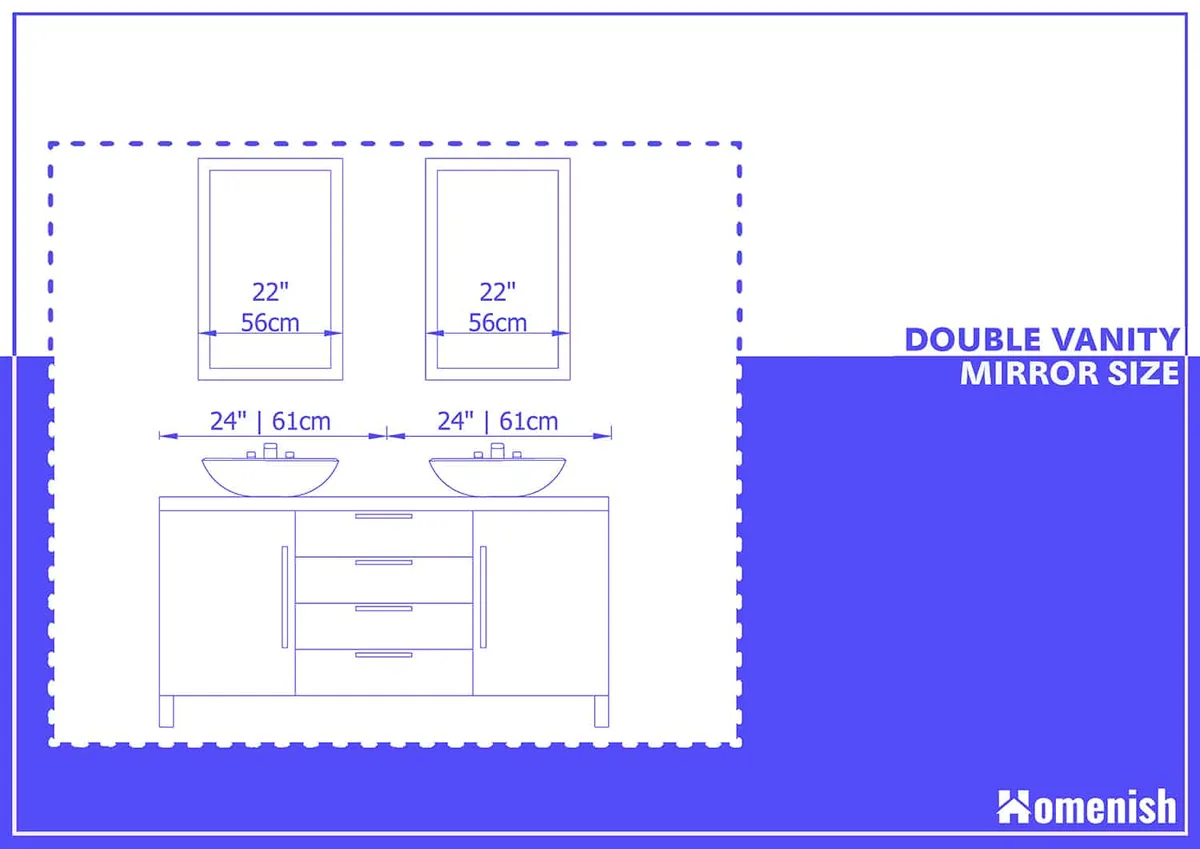
Here is the exact process. Follow these steps in order, and you will get the right mirror size for your bathroom.
Step 1: Measure Your Vanity Width
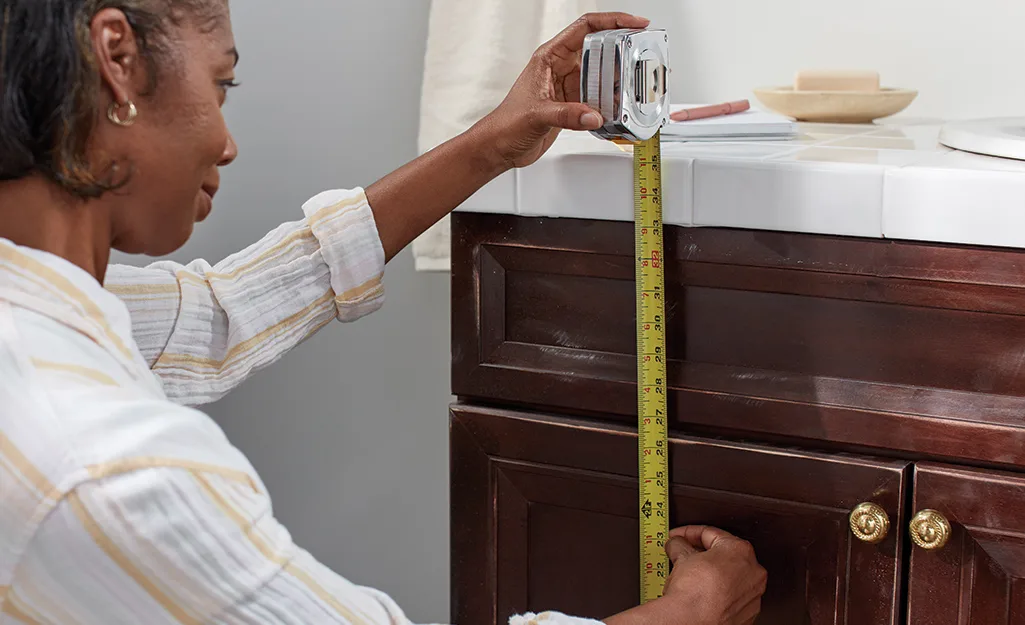
Use a tape measure to get the exact width. Write it down. For a double vanity, measure the full width.
Do not measure each sink separately.
Step 2: Subtract the Overhang Margin
Subtract 2 to 4 inches from the vanity width. That gives you the maximum mirror width. For a 48-inch vanity, your mirror should be 44 to 46 inches wide.
Step 3: Check for Obstacles
Look at the wall above the vanity. Are there light fixtures, sconces, outlets, or switches? Mark their positions.
If a fixture is in the way, you may need to go narrower than the calculation.
Step 4: Determine the Mirror Height
Measure from the countertop to the ceiling. Subtract 6 to 12 inches for the top gap. Then subtract 5 to 10 inches for the bottom gap.
The result is the maximum mirror height.
For example, if your countertop is 36 inches from the floor and your ceiling is 96 inches, you have 60 inches of wall space. Subtract 10 inches for the top gap and 8 inches for the bottom gap. That gives you a maximum mirror height of 42 inches.
Step 5: Center the Mirror on Eye Level
The mirror should be centered at about 60 inches from the floor. If the mirror is 42 inches tall, its center is at 21 inches from the bottom. So the bottom of the mirror should be about 39 inches from the floor.
That leaves 8 inches above the countertop, which is within the recommended range.
Step 6: Decide Between Single or Double Mirror
For a double vanity, you have two options. A single large mirror that spans the full width gives a clean, modern look. Two separate mirrors, one over each sink, can feel more traditional and allow for independent placement.
The decision tree splits here. If you want a single mirror, use the full vanity width minus the margin. If you want two mirrors, divide the vanity width by two, then subtract 2 to 4 inches for each mirror.
Leave a gap of 2 to 4 inches between the two mirrors.
Step 7: Compare With Stock Sizes
Most mirrors come in standard sizes. Common widths are 24, 30, 36, 40, 48, and 60 inches. Common heights are 24, 30, 36, 40, and 48 inches.
Compare your calculated dimensions with these stock sizes.
If your calculation gives you 44 inches wide and 42 inches tall, look for a 40-inch or 48-inch wide mirror. The 40-inch width is closer and will still look proportional. If no stock size works, you will need a custom mirror.
Real Bathroom Scenarios: The Decision Tree in Action
Let's walk through three common situations. Each one uses the same decision tree but produces a different result.
Scenario 1: Standard Single Vanity, 8-Foot Ceiling
You have a 36-inch wide vanity with a 36-inch countertop height. The ceiling is 96 inches. Your eye level is about 62 inches.
Vanity width: 36 inches. Subtract 3 inches for the margin. Maximum mirror width: 33 inches.
The closest stock size is 30 inches.
Wall space above countertop: 60 inches. Subtract 10 inches for the top gap and 8 inches for the bottom gap. Maximum mirror height: 42 inches.
The closest stock size is 36 inches.
The result: a 30 by 36 inch mirror. Center it at 62 inches from the floor. The bottom sits at about 44 inches, which is 8 inches above the countertop.
Scenario 2: Double Vanity, 9-Foot Ceiling
You have a 72-inch wide double vanity. The countertop is 36 inches high. The ceiling is 108 inches.
You want two separate mirrors.
Divide the vanity width by two: 36 inches per side. Subtract 3 inches for the margin and 2 inches for the gap between mirrors. Each mirror should be about 31 inches wide.
The closest stock size is 30 inches.
Wall space above countertop: 72 inches. Subtract 12 inches for the top gap and 10 inches for the bottom gap. Maximum mirror height: 50 inches.
The closest stock size is 48 inches.
The result: two 30 by 48 inch mirrors. Each one is centered over its sink. The bottom sits at 46 inches from the floor, which is 10 inches above the countertop.
Scenario 3: Pedestal Sink, 7-Foot Ceiling
You have a pedestal sink with no vanity. The sink is 24 inches wide. The ceiling is 84 inches.
Your eye level is 60 inches.
The mirror width should be close to the sink width. A 24-inch wide mirror works well.
Wall space above the sink: 84 inches minus the sink height. If the sink is 30 inches tall, you have 54 inches of wall space. Subtract 6 inches for the top gap and 10 inches for the bottom gap.
Maximum mirror height: 38 inches. The closest stock size is 36 inches.
The result: a 24 by 36 inch mirror. Center it at 60 inches from the floor. The bottom sits at 42 inches, which is 12 inches above the sink.
Common Mistakes That Lead to a Bad Fit
Ignoring the Ceiling Height
This is the most common mistake. People measure the vanity width and forget to check the ceiling. A mirror that looks right in the store might be too tall for your wall.
Always measure from the countertop to the ceiling before you buy.
Centering the Mirror on the Wall Instead of the Sink
The mirror should be centered on the sink, not the wall. If the vanity is off-center, the mirror should be off-center too. A mirror that is centered on the wall but not on the sink looks wrong.
Forgetting About Light Fixtures and Outlets
You might find the perfect mirror size, only to realize it covers a light switch or an outlet. Measure the position of every fixture before you order. If you have to move an outlet, that adds cost and time to the project.
Choosing a Mirror That Is Too Wide
A mirror that extends beyond the vanity looks clumsy. It also collects water and toothpaste splatters on the wall. Keep the mirror width within the vanity width by at least 2 inches.
Not Accounting for Multiple Users
If two people use the bathroom, the mirror should work for both. If one person is 5 feet 2 inches and the other is 6 feet tall, a single fixed mirror will not work for both. Consider a vertically adjustable mirror or two separate mirrors at different heights.
Buying a Stock Size Without Checking the Exact Dimensions
Stock mirrors are listed by nominal size, but the actual dimensions can vary by an inch or two. Always check the exact dimensions on the product page. A 30 by 36 inch mirror might actually be 29.5 by 35.5 inches.
That half-inch difference can matter.
What to Do With Your Measurements: Stock vs Custom
Once you have your ideal dimensions, the next decision is straightforward. You need to find a mirror that matches those numbers as closely as possible. That means choosing between a stock mirror and a custom one.
Stock mirrors are pre-manufactured in standard sizes. They are significantly cheaper and available immediately. Most home improvement stores carry common sizes like 24×36, 30×40, and 36×48 inches.
If your calculated dimensions land within an inch or two of a stock size, that is almost always the right choice.
Custom mirrors are cut to your exact specifications. They cost more and take longer to arrive. But they are the only option when your bathroom has unusual dimensions or when you need a specific shape.
A round mirror over a pedestal sink, for example, is almost always a custom order.
Here is a quick comparison of the two options.
| Factor | Stock Mirror | Custom Mirror |
|---|---|---|
| Cost | $50 to $200 | $200 to $600+ |
| Lead time | Same day | 1 to 3 weeks |
| Size options | Limited to standard sizes | Any size you need |
| Shape options | Rectangular, some round | Any shape |
| Returns | Easy, usually accepted | Usually no returns |
When to Go Stock
Choose a stock mirror if your calculated dimensions fall within 2 inches of a standard size. The slight difference in width or height will not be noticeable. The savings in cost and time are worth it.
Stock mirrors are also easier to install. They come with pre-drilled holes or mounting clips. You can pick one up at the store and have it mounted in an hour.
When to Go Custom
Choose a custom mirror if your bathroom has non-standard dimensions. A 7-foot ceiling, for example, might require a mirror height that is not available in stock sizes. Custom is also the right choice for double vanities where you want exact symmetry.
Custom mirrors require a wait time. Order them early in your renovation process. Most glass shops can cut a mirror to size within a week.
The price is higher, but the fit is perfect.
The Compromise: Trim a Stock Mirror
Some glass shops will trim a stock mirror down to a smaller size. This costs less than a full custom order. You pay for the cutting service, which is usually $20 to $50.
Ask your local glass shop if they offer this service.
Frequently Asked Questions
What is the standard bathroom mirror size for a single vanity?
The most common size is 30 by 36 inches. This fits a 36-inch wide vanity with an 8-foot ceiling. It also works well for most users' eye level.
Always measure your own vanity before buying.
How much smaller should a mirror be than the vanity?
The mirror should be 2 to 4 inches narrower than the vanity. This leaves room for light fixtures and creates a visual margin. A mirror that is exactly the same width as the vanity looks cramped.
Can I use a mirror that is wider than the vanity?
You can, but it usually looks wrong. The mirror will extend past the edges of the vanity. Water and toothpaste splatters will hit the wall instead of the mirror.
Stick to the 2 to 4 inch margin.
How high should a bathroom mirror be above the sink?
The bottom of the mirror should sit 5 to 10 inches above the countertop. For a pedestal sink, measure from the top of the sink basin. This keeps the mirror usable for most people.
What if the mirror is too tall for my wall space?
You can reduce the mirror height by choosing a smaller stock size. Or you can lower the installation height slightly. Just make sure the bottom of the mirror stays at least 5 inches above the countertop.
Should I get a frameless or framed mirror?
Frameless mirrors are easier to clean and look more modern. Framed mirrors add a decorative element and can hide rough edges. Choose based on your bathroom style.
Both work well with the sizing guidelines.

Similar Posts