Why your contact prescription differs from glasses
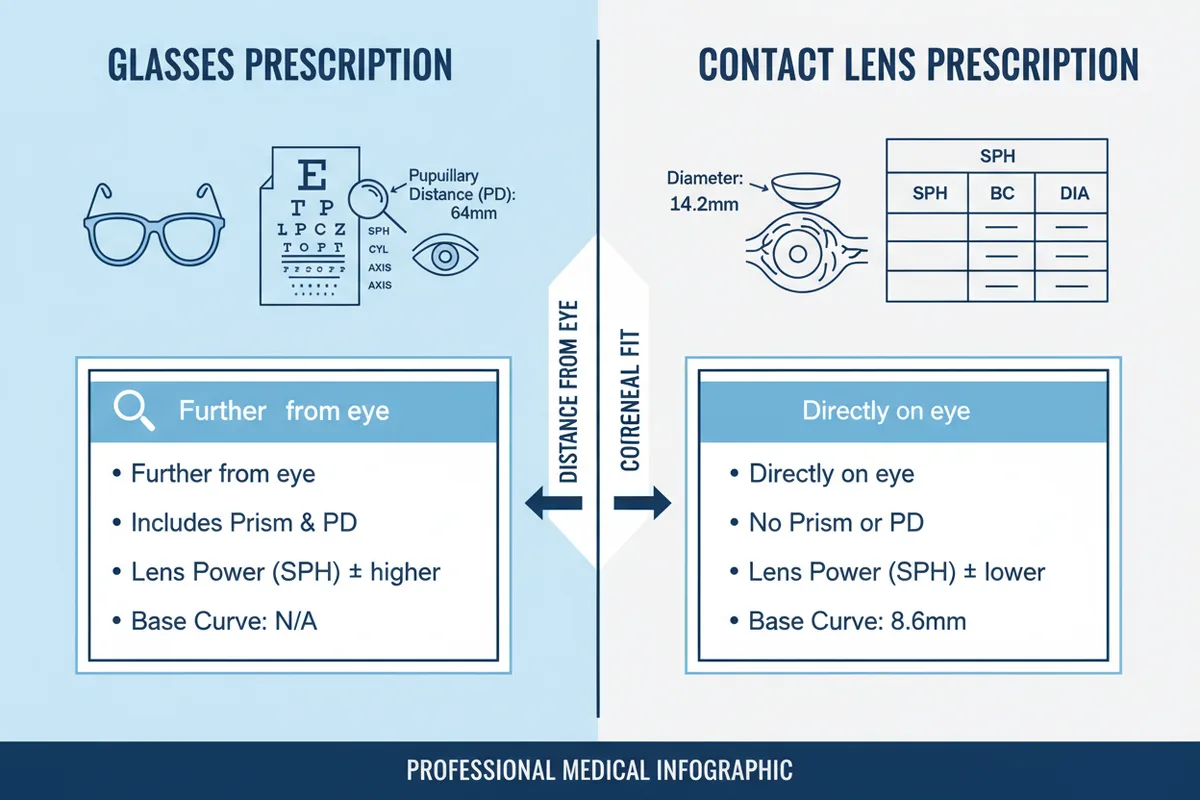
So, are contact prescriptions the same as glasses? The answer is a firm no. They are not interchangeable.
Using your glasses prescription to order contact lenses can damage your eyes.
The FDA classifies contact lenses as medical devices. A glasses prescription only measures the power you need. A contact lens prescription must account for the shape and health of your eye.
Let's break down why your glasses prescription won't work for contacts.
Quick Answer
No, contact prescriptions are not the same as glasses prescriptions. They measure different things. Glasses prescriptions only include lens power.
Contact lens prescriptions include base curve, diameter, and brand. Using a glasses prescription for contacts can damage your eyes. Always get a separate contact lens exam.
Why It's Dangerous to Assume Your Glasses Prescription Works for Contacts
Your eyes are not a one-size-fits-all system. The distance between a glasses lens and your eye matters. That gap is called vertex distance.
A glasses lens sits about 12 millimeters from your cornea. A contact lens rests directly on your eye. This single change can alter the required power.
For prescriptions above ±4.00 diopters, the difference becomes significant. If you ignore this, you risk overcorrection or undercorrection. Your vision will be blurry.
You might get headaches or eye strain. But the real danger goes deeper.
The wrong power is only half the problem. A contact lens must fit your cornea correctly. The base curve and diameter are unique to your eye shape.
A lens that is too flat can slide around. A lens that is too steep can cause suction. Both scenarios can lead to corneal abrasions.
The FDA warns that an ill-fitting lens can restrict oxygen flow to your cornea. This can cause corneal hypoxia.
Many people assume the numbers are the same. They are not. The contact lens prescription is a separate document.
It is a legal requirement in the United States under the FTC Contact Lens Rule. You cannot use your glasses prescription to buy contacts. Any retailer that sells you contacts without a valid contact lens prescription is breaking the law.
| Risk | Glasses Prescription | Contact Lens Prescription |
|---|---|---|
| Power accuracy | Correct for 12mm distance | Correct for 0mm distance |
| Fit | Not measured | Base curve and diameter |
| Legal use | For glasses only | For contacts only |
| Safety | Low risk if wrong | High risk if wrong |
The bottom line is simple. Your glasses prescription is not a substitute. Do not use it.
Your eyes are worth the extra step.
The Key Differences Between a Glasses Prescription and a Contact Lens Prescription
A glasses prescription typically lists sphere, cylinder, axis, and sometimes prism. These numbers tell an optician how to grind your lenses. The lens sits in a frame.
The distance from your eye is fixed by the frame.
A contact lens prescription includes all of those numbers plus a few more. The base curve (BC) is the curve of the inner surface of the lens. It must match the curve of your cornea.
The diameter (DIA) is the width of the lens. It must cover your cornea without being too large. The brand and material are also listed.
Not all lenses are made the same. Some materials allow more oxygen to pass through. Some are better for dry eyes.
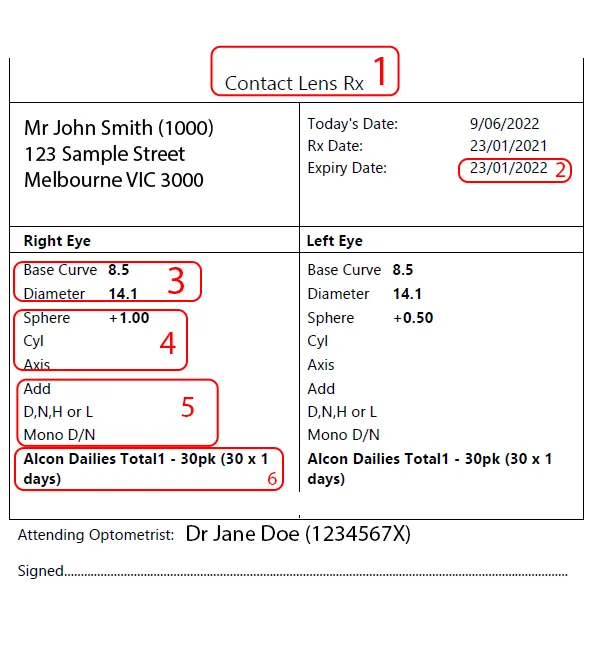
Here is a breakdown of the main differences.
| Parameter | Glasses Prescription | Contact Lens Prescription |
|---|---|---|
| Sphere (SPH) | Measured for 12mm distance | Adjusted for zero distance |
| Cylinder (CYL) | Standard measure | Adjusted for lens rotation |
| Axis | Standard measure | Adjusted for lens rotation |
| Base Curve (BC) | Not included | Required for fit |
| Diameter (DIA) | Not included | Required for fit |
| Brand | Not included | Required for specific lens |
| Expiration | 1–2 years | 1–2 years (separate exam) |
The sphere power looks similar. But for high prescriptions, your optometrist will adjust the number. This is called a vertex distance conversion.
The cylinder and axis are also adjusted. A contact lens sits on a curved surface. It can rotate slightly.
The prescription must account for that.
The brand is also critical. Your optometrist will prescribe a specific brand of lens. The material and design affect the fit.
You cannot switch brands without a new prescription. The base curve and diameter are tied to the brand. Using a different brand with the same power can cause discomfort or injury.
What Happens During a Contact Lens Fitting and Exam
You cannot just walk into an optometrist and ask for contact lenses. The process is detailed. It requires a separate appointment.
The exam is different from a standard eye exam.
First, your optometrist will perform a refraction. This is the same test you get for glasses. You look through a machine and say which lens is clearer.
This gives your basic power numbers. But the exam does not stop there.
Next, your optometrist will measure your cornea. They use a device called a keratometer. This measures the curve of your cornea.
Some offices use a corneal topographer. This creates a map of your cornea. It is more detailed.
Both tests give the base curve and diameter numbers.
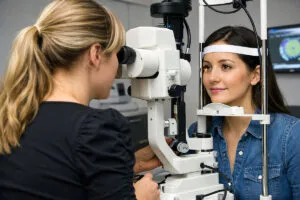
Then comes the trial. Your optometrist will place a set of trial lenses on your eyes. You will wear them for a few minutes.
The optometrist will check the fit. They will look at the lens under a slit lamp. This is a microscope that checks the lens position and movement.
They will also check your tear film. Dry eyes can affect lens comfort.
After the trial, the optometrist will perform an over-refraction. This means they check your vision while you are wearing the trial lenses. This ensures the power is correct.
If the fit or power is off, they will try a different lens. This process can take several visits.
You will also receive training. The optometrist or an assistant will teach you how to insert and remove the lenses. They will show you how to clean and store them.
You will practice in the office. This is a legal requirement in many places. The FDA recommends that all first-time wearers receive this training.
Finally, you will have a follow-up appointment. This is usually one to two weeks after you start wearing the lenses. The optometrist will check your eyes again.
They will make sure the lenses are not causing any damage. If everything looks good, you will receive your final prescription. This prescription is valid for one to two years.
Common Mistakes and Safety Risks You Need to Know
The most common mistake is using a glasses prescription to order contacts. We have covered why this is dangerous. But there are other mistakes that are just as risky.
Sleeping in contact lenses is a major problem. Some lenses are approved for overnight wear. Most are not.
The FDA warns that sleeping in lenses that are not approved can cause corneal ulcers. This is a serious infection. It can lead to vision loss.
Always check the label. If your lenses are daily wear, remove them before sleep.
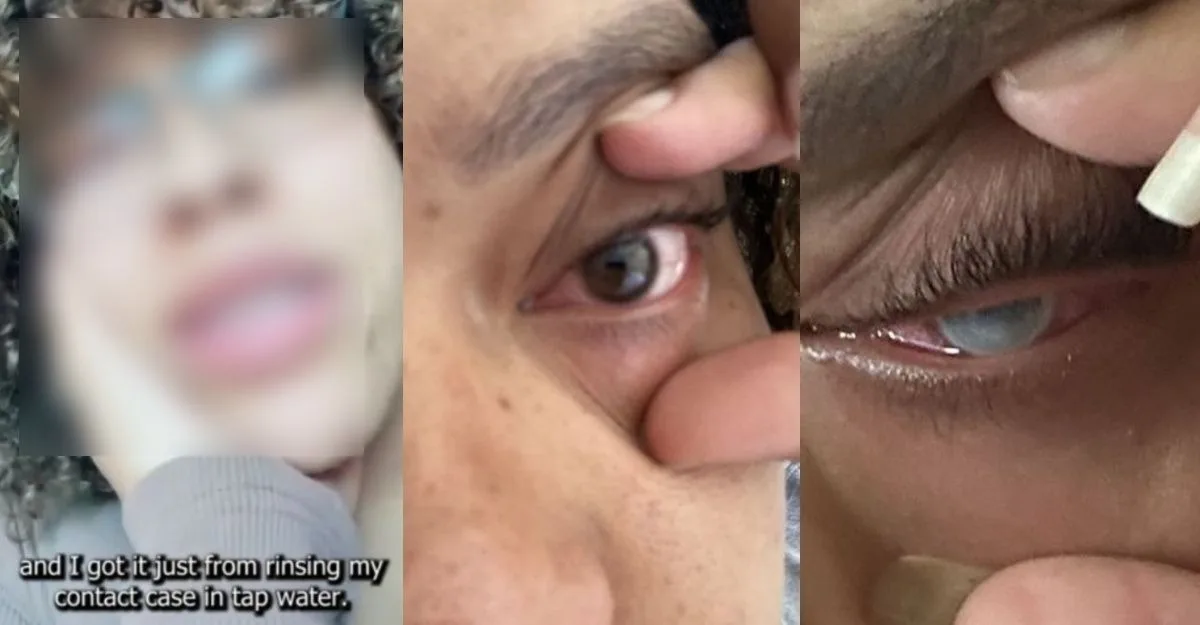
Another mistake is using tap water to clean lenses. Tap water contains a microorganism called Acanthamoeba. This can cause a severe eye infection.
The infection is difficult to treat. It can cause permanent damage. Always use the recommended contact lens solution.
Never use water, saliva, or homemade saline.
Sharing contact lenses is also dangerous. Your prescription is unique to your eyes. Someone else's lenses will not fit your eyes.
They can also carry bacteria. Sharing lenses can spread infections. Never share your lenses with anyone.
Over-wearing lenses is another risk. Lenses have a replacement schedule. Daily lenses are for one day only.
Monthly lenses are for one month. Wearing them past the recommended time can cause deposits to build up. This can lead to discomfort and infection.
It can also reduce oxygen flow to your cornea.
Here are the most common mistakes to avoid.
- Using a glasses prescription for contacts
- Sleeping in lenses not approved for overnight wear
- Cleaning lenses with tap water or saliva
- Sharing lenses with others
- Wearing lenses past the replacement date
- Not replacing the lens case every three months
- Swimming or showering with lenses in
The FTC Contact Lens Rule requires that your optometrist give you a copy of your prescription. You have the right to shop around. But you also have the responsibility to use the correct prescription.
Ignoring these rules puts your vision at risk.
How to Keep Your Eyes Healthy While Wearing Contacts
Your eyes are delicate. Contact lenses are a foreign object. Keeping them healthy requires a routine.
It is not difficult. But it is essential.
Start with hygiene. Always wash your hands before touching your lenses. Use soap and water.
Dry your hands with a lint-free towel. This prevents dirt and bacteria from getting on your lenses.
Use the correct solution. Multi-purpose solutions work for most people. Some people need peroxide-based solutions.
Peroxide solutions require a special case. They must neutralize for a set amount of time. Never use a peroxide solution directly on your eyes.
It will burn. Always follow the instructions on the bottle.
Replace your lens case every three months. Bacteria can build up in the case. Rinse the case with fresh solution after each use.
Never top off old solution. Use fresh solution each time you store your lenses.
Follow the replacement schedule. This is non-negotiable. Daily lenses are for one day.
Throw them away at night. Bi-weekly lenses are for two weeks. Monthly lenses are for one month.
Mark your calendar. Set a reminder. Your eyes will thank you.
Always have a backup pair of glasses. If your eyes get irritated, you need to remove your lenses. Do not wear them again until the irritation is gone.
A backup pair of glasses is essential. Do not wear lenses if your eyes are red, painful, or sensitive to light. Those are signs of an infection.
Here is a simple maintenance schedule.
| Task | Frequency |
|---|---|
| Wash hands before handling | Every time |
| Clean and rinse lenses | After each wear |
| Replace solution in case | Daily |
| Replace lens case | Every 3 months |
| Replace lenses | Per schedule (daily, bi-weekly, monthly) |
| Eye exam and fitting | Every 1–2 years |
If you experience dryness, use rewetting drops. Only use drops that are safe for contact lenses. Regular eye drops can damage the lenses.
Your optometrist can recommend a brand.
Finally, know when to see a doctor. If you have persistent redness, pain, or blurred vision, remove your lenses immediately. Call your optometrist.
Do not wait. Early treatment is key. Corneal infections can worsen quickly.
Frequently Asked Questions
Can I use my glasses prescription to buy contact lenses online?
No. This is illegal in the United States under the FTC Contact Lens Rule. Online retailers require a valid contact lens prescription.
They will reject your glasses prescription. Using the wrong prescription can damage your eyes.
Do I need a separate exam for contact lenses?
Yes. A contact lens exam is different from a standard eye exam. It includes a corneal measurement, a trial fitting, and training.
Most states require a separate exam. Your glasses prescription alone does not qualify you for contacts.
Why is the contact lens prescription different from my glasses prescription?
The two prescriptions measure different things. Glasses sit about 12 millimeters from your eye. Contact lenses sit directly on your cornea.
The power must be adjusted for this distance. The base curve and diameter are also unique to your eye shape.
How long is a contact lens prescription valid?
A contact lens prescription is typically valid for one to two years. It depends on your state's regulations. Some states require an annual exam.
Others allow two years. Always check the expiration date before ordering new lenses.
Can I switch brands with the same contact lens prescription?
No. Your prescription is tied to a specific brand. Each brand has a unique base curve, diameter, and material.
Switching brands without a new fitting can cause discomfort or injury. Your optometrist must approve any brand change.
What happens if I wear the wrong contact lens prescription?
You risk blurred vision, eye strain, and headaches. An ill-fitting lens can cause corneal abrasions or infections. The wrong power can lead to overcorrection or undercorrection.
In severe cases, you can develop corneal ulcers or vision loss.
The Bottom Line: Always Get a Separate Exam for Contacts
The answer is clear. Contact prescriptions are not the same as glasses prescriptions. They are different documents for different medical devices.
Your glasses prescription only tells you the lens power you need. A contact lens prescription tells you the power, the fit, and the brand.
The risks of skipping a contact lens exam are serious. You can damage your cornea. You can develop infections.
You can lose vision. The extra time and cost of a fitting is small compared to the cost of treating an eye injury.
As of 2026, the FDA and the FTC both require a separate contact lens prescription. This is not a suggestion. It is the law.
Your eye doctor is required to give you a copy of your prescription after the fitting. You have the right to shop around for the best price on lenses. But you must use the correct prescription.
If you are thinking about switching from glasses to contacts, start with an exam. If you already wear contacts, keep your exam schedule. Your eyes change over time.
Your prescription needs to change with them.
Wear your contacts safely. Follow the care instructions. Replace your lenses on schedule.
And always keep a backup pair of glasses. Your vision is worth the effort.

Similar Posts