What Size Windshield Crack Can Be Repaired?
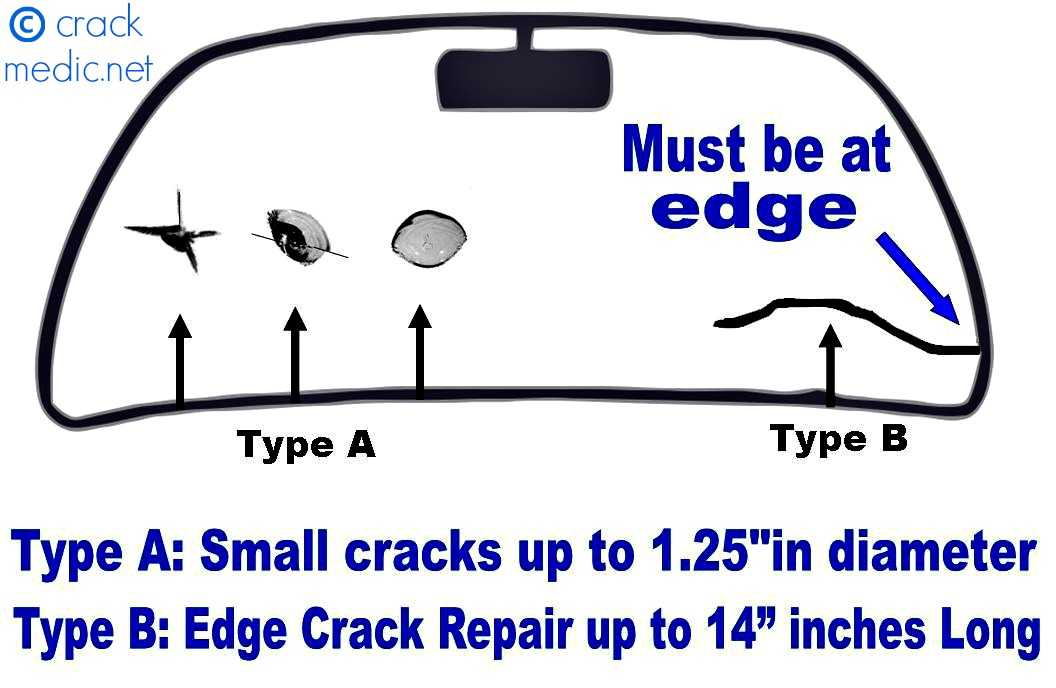
Quick answer: Under the auto glass industry's own repair standard, ROLAGS, cracks up to about 14 inches long can be repairable, along with star breaks up to roughly 3 inches and bullseye chips up to about 1 inch. Most shops draw the line well below that, commonly around 6 inches. Both numbers are real, and the gap between them is not a contradiction: the standard describes what is technically repairable, while a shop's limit reflects its own equipment, training, and appetite for a repair that might not hold. Size is also not the deciding factor on its own. A short crack at the edge of the glass or directly in front of the driver is often a replacement, while a longer one in a harmless spot may not be.
If you have been quoted a replacement for a crack you thought was small, or told a long crack is fine when another shop said otherwise, this page explains why both answers can be honest.
Why you keep seeing different numbers
Search this question and you will get 3 inches, 6 inches, "the length of a dollar bill," and 14 inches, often stated as though each were the rule. Three different things are being quoted, and they are not interchangeable.
The industry standard. ROLAGS, the Repair of Laminated Automotive Glass Standard published through the Auto Glass Safety Council, is the closest thing to an authoritative answer. As reported by sources citing the standard, it treats cracks up to around 14 inches as within repairable range.
Shop policy. Many shops cap repairs around 6 inches. That is not them ignoring the standard. Long-crack repair needs specific equipment and technique, the outcome is less predictable, and a repair that fails later becomes the shop's problem. A 6-inch limit is a defensible business decision, not a safety rule.
Rules of thumb. "Smaller than a dollar bill" and "smaller than a quarter" are shorthand meant to be usable without a tape measure. They are approximations of the chip and short-crack cases, and they get repeated as if they were the standard itself.
So when two shops disagree, they are often both telling you the truth about what they will do.
What actually decides repairability
Length is one input among several, and it is frequently not the one that settles it.
| Factor | Repair more likely | Replacement more likely |
|---|---|---|
| Crack length | Shorter, and within the shop's stated limit | Beyond the shop's limit, or approaching the standard's outer range |
| Location on the glass | Away from the edges | Reaching or starting near the edge |
| Driver's view | Outside the primary viewing area | Inside the area swept in front of the driver |
| Depth | Damage in the outer glass layer | Damage penetrating through to the inner layer |
| Contamination | Fresh, clean, dry | Dirt, water or a failed prior repair inside the break |
| Spreading | Stable | Actively lengthening |
| Count | A single break | Multiple breaks, or a crack crossing others |
Two of these override length outright.
Edge damage. A crack that reaches the edge of the windshield sits where the glass is bonded to the body and where stress concentrates. Sources citing ROLAGS list cracks extending to the edge, and edge damage that compromises the structural bond to the frame, as non-repairable. A 3-inch edge crack can be a replacement while a 10-inch crack across the passenger side is not.
The driver's critical viewing area. Damage directly in the driver's line of sight is treated as non-repairable, because even a good repair leaves some optical distortion. A repair that is invisible from the passenger seat can still be unacceptable in front of the steering wheel.
Chips are measured differently from cracks
A chip and a crack are not the same damage and do not share a threshold.
- Bullseye, a circular break with visible rings: repairable up to roughly 1 inch across, as reported from the standard.
- Star break, short legs radiating from an impact point: repairable up to roughly 3 inches.
- Combination break, a bullseye with legs coming off it: judged on its overall size and how far the legs run.
- Surface pit, a shallow nick that has not penetrated: usually cosmetic, though very small pits may fall below the size the standard treats as repairable damage at all.
This is why "smaller than a quarter" persists as advice for chips. It is a rough stand-in for the bullseye case, and it does not transfer to cracks.
Why the same crack gets two different answers
Beyond shop policy, a few things genuinely change the assessment.
The repair system in use. Long-crack repair is a distinct capability. A shop without that equipment is not being cautious when it declines a 10-inch crack, it simply cannot do that repair well.
Vehicle technology. If your windshield carries a forward-facing camera for driver assistance systems, replacement pulls in a recalibration step, which changes the cost comparison. Our guide to ADAS calibration and windshield replacement covers what that adds.
Age and condition of the break. A crack that has been open for weeks has collected dirt and moisture. Resin bonds to clean glass, so the same crack is more repairable on day one than a month later.
Inspection rules where you live. Whether damaged glass passes inspection varies by jurisdiction, and a shop may recommend replacement for a crack that is technically repairable but will not pass where you are.
What to do with the crack you actually have
- Measure it honestly against something known, such as a credit card's long edge at roughly 3.4 inches, rather than estimating.
- Check the ends. Does either end reach the black border or the edge of the glass? If so, expect a replacement recommendation.
- Sit in the driver's seat and look at where it falls. In your normal sightline, expect replacement.
- Keep it clean and dry and get it looked at sooner rather than later. Waiting reduces your options.
- If a shop declines, ask why. "Over our limit" and "unsafe to repair" are different answers. The first is worth a second opinion; the second usually is not.
The honest part
Repair is cheaper than replacement, and there is a real temptation to shop for the answer you want. That works up to a point. A shop with long-crack capability may genuinely fix something another shop turned away, and getting a second opinion on a policy limit is reasonable.
What does not work is shopping past a structural objection. If the crack reaches the edge or sits in your sightline, the shop declining it is not being conservative for the sake of a bigger invoice, and finding someone willing to fill it anyway leaves you with a windshield that looks repaired and is not. The windshield contributes to the structure of the roof and to how the passenger airbag deploys, so this is not the part of the car to win an argument about.
The other honest point: a repaired crack does not disappear. A good repair stops it spreading and makes it much less noticeable. If you are expecting the glass to look untouched, you are going to be disappointed by a technically successful repair.
Frequently asked questions
Is there a legal maximum crack size?
Rules on damaged glass vary by jurisdiction, and many are written around obstruction of the driver's view rather than a specific measurement. Check the rule where your vehicle is registered rather than assuming a national standard exists.
My crack is 8 inches. One shop said yes and another said no. Who is right?
Both can be. Eight inches sits above the common 6-inch shop limit but within the range the industry standard treats as repairable, so the difference is usually whether that shop does long-crack repair at all.
Does a repaired crack ever spread later?
It can, particularly if the glass takes another impact or a sharp temperature change. A proper repair substantially reduces the risk but does not restore the glass to undamaged strength.
Will the crack keep growing if I leave it?
Often, yes. Temperature swings, rough roads and door slams all flex the glass. A crack that is repairable today may not be in a month, which is the practical argument for acting quickly.
Does insurance cover the repair?
Comprehensive policies frequently cover glass repair, sometimes with the deductible waived because repairing is cheaper than replacing. Coverage varies, so confirm with your own insurer rather than assuming.

Similar Posts





2 comments
Comments are closed.




[…] you’re wondering whether your windshield crack can be repaired twice, the answer isn’t one-size-fits-all. It largely depends on the type and extent of the […]
[…] you’re wondering whether windshield crack repair kits really work, the answer is: they can be surprisingly effective for minor damage, but they […]