Can Cold Weather Crack a Rear Windshield?
Senior Automotive Glass Diagnostic Specialist & Master Technician at CarGlassFix · AGSC Master Certified Auto Glass Technician, NGA Certified Installer, I-CAR Automotive Safety Specialist · 12+ Years in Automotive Glazing, Windshield Structural Bonding, ADAS Camera Calibration & Precision Chip Restoration
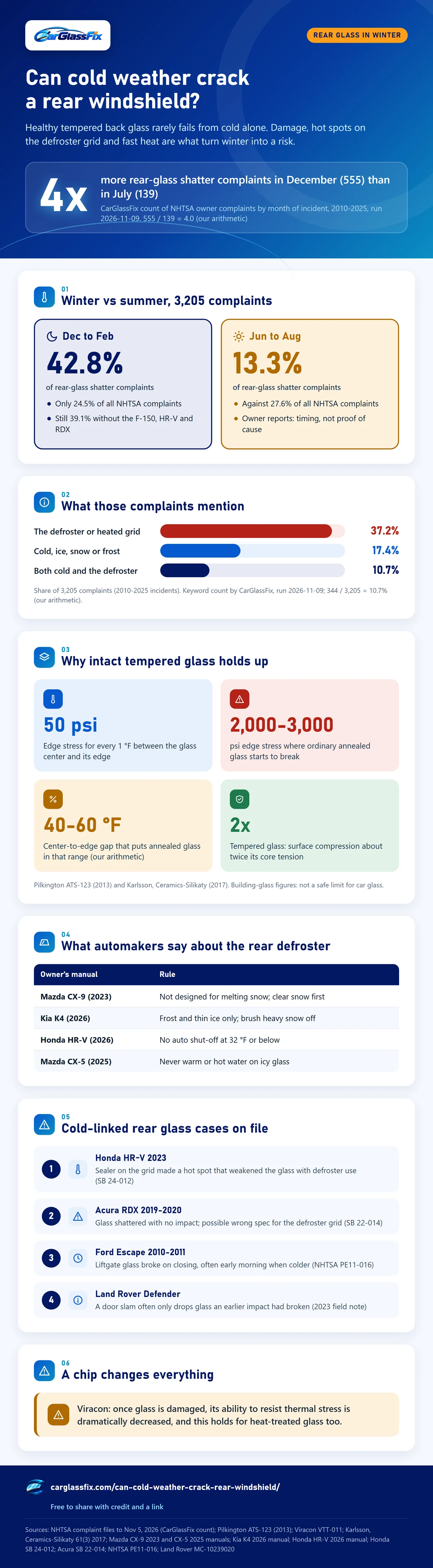
Cold weather alone rarely cracks an intact rear windshield, because most rear windows are tempered glass built to resist thermal stress. Cold becomes a trigger when the glass has a chip or edge damage, when hot water or fast heat hits frozen glass, or when a defroster grid has a hot spot. NHTSA rear-glass shatter complaints peak in winter.
How cold affects tempered rear glass
Cold alone seldom breaks an undamaged rear windshield, because the glass is usually tempered, and glass makers use tempering to prevent thermal stress breakage. AAA’s 2019 glazing list shows laminated back glass on only a few models. Safelite also describes side and rear windows as tempered glass that breaks into fragments.
Thermal stress comes from uneven temperature, not from cold itself. Pilkington’s bulletin ATS-123 says a temperature difference across a pane puts the edge in tension of about 50 psi for every 1 °F. It adds that breakage becomes likely once edge tension passes 2,000 to 3,000 psi. By that rule, ordinary annealed glass reaches the danger zone at roughly a 40 to 60 °F difference. These are building-glass figures, used here only to show the scale.
Tempered glass has a surface held in compression, as a 2017 review by researcher Stefan Karlsson explains. Pilkington lists fully tempered glass as a way to prevent thermal stress breakage. Karlsson writes that strengthened glass normally withstands thermal shock “unless seriously scratched”. Front windshields are laminated and behave differently, which is covered in can cold weather cause a windshield crack. The full glass comparison is in laminated vs tempered glass.
When rear glass breaks: what NHTSA complaints show
Owner complaints about shattered rear glass cluster in the coldest months. CarGlassFix counted 3,205 NHTSA complaints from 2010 to 2025 that describe a rear window shattering, exploding or blowing out, sorted by the month of the incident.
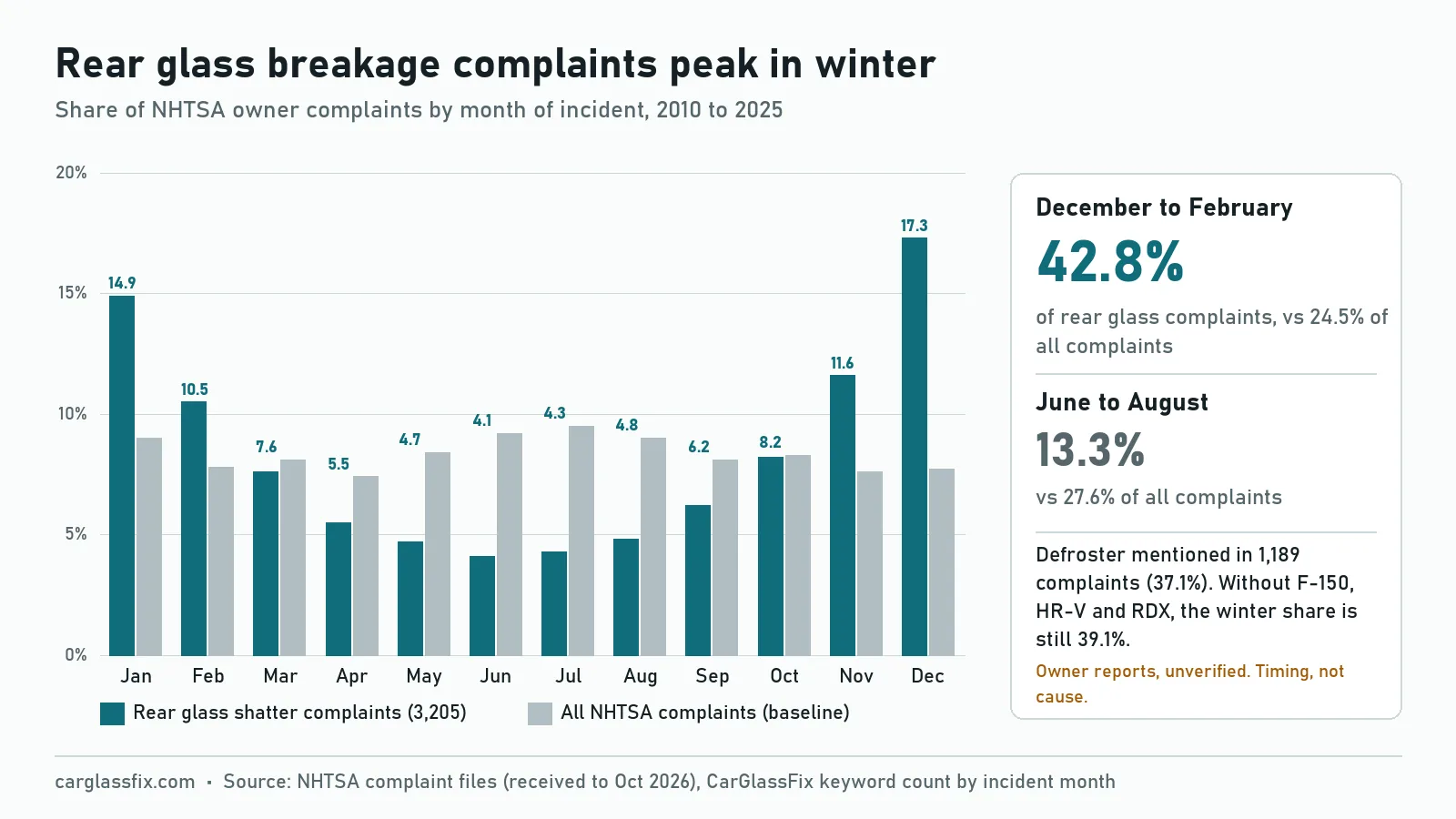
December alone had 555 rear-glass complaints, against 138 in July. The defroster was mentioned in 1,189 of the 3,205 complaints. Three models supplied many reports: the Ford F-150, the 2023 Honda HR-V and the Acura RDX. Without them, the December to February share is still 39.1%.
| Season of incident | Rear glass complaints | Share | Share of all NHTSA complaints |
|---|---|---|---|
| December to February | 1,371 | 42.8% | 24.5% |
| March to May | 571 | 17.8% | 23.9% |
| June to August | 426 | 13.3% | 27.6% |
| September to November | 837 | 26.1% | 24.0% |
The data shows timing, not cause. Complaints are unverified, and some F-150 reports describe rear door glass. The causes behind these breaks are covered in what causes a rear windshield to shatter.
Thermal shock: hot water and fast heat
Thermal shock is the fastest way cold weather turns into broken glass, and hot water on frozen glass is the classic trigger. Mazda’s winter driving instructions say never to use warm or hot water on snow or ice on windows and mirrors, because the glass could crack. AAA calls hot water a “no-no” for deicing and warns against torches and tapping ice with a hammer.
The stress comes from one area changing temperature much faster than the rest. Pilkington’s bulletin ATS-161 warns that excessive temperature differences must be avoided, “especially in winter”, or thermal stress can cause breakage. Its ATS-123 bulletin names HVAC vents that blow hot or cold air directly at glass as one source of edge stress.
A rear window takes heat from two sides on a cold morning. The defroster grid warms the inside surface, while the outside stays near the air temperature. Tempered glass usually copes with this, as long as its surface and edges are intact. A cracked or chipped pane does not get that margin. For safe ways to clear ice, see how to make car windows defrost.
Existing chips and edge damage
Existing damage is what lets cold weather finish off a rear window. Viracon’s technical note on thermal breakage says damaged glass has a “dramatically decreased” ability to resist thermal stress. It states that this applies to heat-treated glass as well as annealed glass.
The edge is the weak point. Pilkington’s ATS-123 says actual edge strength depends on cut quality and on the edge staying free of damage from tools and hard surfaces. Karlsson’s review adds that strengthened glass should be mounted with protected edges and without contact with hard or sharp materials.
Tempered glass also hides old damage. A Land Rover field note for the 2020-2023 Defender says impact-broken tempered glass may stay in place until something disturbs it. The note says broken tailgate glass is “almost always” impact damage. It tells technicians to look for stress lines running away from one impact point.
For a driver, the practical rule is simple. A rear window with a chip, a scratch that catches a fingernail or a nick near the edge carries more risk on cold days. Have it checked before winter, and avoid fast heat on that glass.
Using the rear defroster in freezing weather
The rear defroster is designed for frost, fog and thin ice, and automakers ask drivers to clear snow first. The grid is a printed conductor on the inside of the glass, as described in what a rear windshield defroster is. Manuals give different timers and warnings.
| Automaker document | What it says about cold or snow | Timer |
|---|---|---|
| Mazda CX-9 (2023) manual | “Not designed for melting snow”; remove accumulated snow before use | About 15 minutes; a setting keeps it on in low temperatures |
| Kia K4 (2026) manual | Removes frost, fog and thin ice; brush heavy snow off first | About 20 minutes |
| Honda HR-V (2026) manual | Uses a lot of power; avoid long use at idle | 10 to 30 minutes; no automatic shutoff at 32 °F (0 °C) or below |
| Mazda and Kia manuals | No sharp tools or abrasive cleaners on the inside glass | n/a |
A healthy grid is not a known cold-weather hazard. A faulty one can be. Honda said in January 2024 that rear glass breaking on some 2023 HR-V models was associated with defroster use. Sealer touching the heating elements caused a hot spot that weakened the glass over time. Acura bulletin 22-014 names an incorrect grid specification as a possible cause on the 2019-2020 RDX. A grid with dead lines is a separate repair issue, covered in why a rear windshield heater stops working.
Frozen hatches, door slams and cold mornings
Cold mornings add mechanical stress, because frozen hatches and door slams load glass that may already be weak. NHTSA investigation PE11-016 looked at 2010 and early 2011 Ford Escape and Mercury Mariner liftgate glass. The glass broke while the liftgate was opened or, more often, closed, with the vehicle parked.
The NHTSA summary says failures often happened in early morning hours, when temperatures may be lower. Ford linked them to thermal expansion and contraction in the adhesive that mounted the rear wiper motor to the glass. Ford switched to a nut and bolt mount in October 2010. NHTSA closed the case without a defect finding.
A slammed door can also make an old break visible. Land Rover’s field note explains that closing a door raises cabin air pressure. That pressure can push out tempered glass that an earlier impact had already shattered. The owner then sees the break at that moment and blames the door.
On icy days, free a frozen hatch gently instead of forcing it. Close doors and the hatch without slamming them while the glass is cold.
How to protect rear glass in winter
Protecting rear glass in winter comes down to keeping it undamaged and warming it gently. These steps follow automaker manuals, AAA and the glass makers’ thermal stress guidance. They apply to tempered rear windows with a defroster grid, which is the setup on most cars.
Protect a rear windshield in cold weather
Inspect before winter
Look for chips, scratches and edge nicks, and have damaged rear glass checked by a glass shop.
Brush snow off first
Clear heavy snow from the rear glass before you switch on the defroster, as Mazda and Kia instruct.
Use the defroster for frost and thin ice
Let the grid melt light ice and turn it off once the glass is clear.
Skip hot water
Never pour warm or hot water on frozen glass, and use a plastic scraper on the outside only.
Warm the cabin gradually
Avoid aiming hot air straight at very cold glass, since uneven heat creates edge stress.
Close the hatch gently
Free a frozen hatch with care and avoid slamming doors while the glass is cold.
Watch the grid
Report cracks that start near the grid connections, especially on models with a bulletin.
A pane that already has a chip deserves extra care, because damage removes much of tempered glass’s margin against thermal stress. Plan the inspection before the first hard frost, not after it. If the rear glass does break, ask the dealer about service bulletins for your model before paying, since Honda’s 24-012 offers reimbursement to eligible HR-V owners who already paid. Parking under cover reduces frost and ice in the first place. Methods are in how to protect a windshield from frost.
Frequently asked questions
Can cold weather crack a rear windshield while driving?
Breaks while driving do appear in NHTSA complaints, but an intact tempered rear window rarely fails from cold alone. Existing damage, a defroster hot spot or an impact from road debris is the usual trigger.
Can a back windshield break on its own?
Tempered rear glass can break with no new impact when stored stress meets a weak spot, such as an old chip or a defroster hot spot. Honda and Acura bulletins describe rear glass breaking with no external impact on the 2023 HR-V and the 2019-2020 RDX.
Can I pour warm water on a frozen rear window?
No. Mazda’s manual says never to use warm or hot water on frozen windows because the glass could crack, and AAA gives the same warning.
Is it safe to use the rear defroster when it is freezing?
Yes, automakers design it for frost, fog and thin ice, but Mazda and Kia say to remove heavy snow before switching it on. Honda notes that its HR-V defogger does not switch off automatically at 32 °F (0 °C) or below.
Can a cracked rear windshield be repaired?
Most rear windows are tempered glass, which breaks into fragments and is replaced rather than repaired, as Safelite explains. The options are covered in how to fix a cracked rear windshield.
Sources
- Pilkington North America, Technical Bulletin ATS-123, Thermal Stress (2013-01-14) (checked 2026-10-26)
- Pilkington North America, Technical Bulletin ATS-161 (2013-01-14) (checked 2026-10-26)
- Viracon Tech Talk VTT-011, Thermal Stress Breakage (checked 2026-10-26)
- Karlsson S., Spontaneous fracture in thermally strengthened glass, Ceramics-Silikaty 61(3) 188-201 (2017)
- AAA, Laminated non-windshield OEM glazing list (July 2019)
- Safelite, Windshield repair or replacement
- AAA, How to deice your car’s windshield
- Mazda 2025 CX-5 owner’s manual, Winter Driving (checked 2026-10-26)
- Mazda 2023 CX-9 owner’s manual, Rear Window Defogger (checked 2026-10-26)
- Kia K4 2026 owner’s manual, Rear window defroster (checked 2026-10-26)
- Honda HR-V 2026 owner’s manual, Rear Defogger/Heated Door Mirror Button (checked 2026-10-26)
- American Honda dealer message and media statement on 2023 HR-V rear glass (Jan 5, 2024), via NHTSA
- Honda Service Bulletin 24-012, 2023 HR-V Rear Window Inspection (July 17, 2024), via NHTSA
- Acura Service Bulletin 22-014, Rear Windshield Glass Shattering (Oct 28, 2022), via NHTSA
- Land Rover field communication, 2020-2023 Defender rear tailgate glass (June 2023), via NHTSA
- NHTSA datasets: complaint flat files (received to Oct 22, 2026) and investigation PE11-016 (downloaded 2026-10-24)

Similar Posts